Tunisia Pulses Market Size, Share & Growth Rate
The Tunisia Pulses Market was estimated at USD 305 Million in 2025 and is projected to reach USD 424 Million by 2032, growing at a CAGR of 4.8% from 2026 to 2032. This growth trajectory is largely attributed to the increasing consumption of key legumes such as lentils, chickpeas, and beans, which are staples in the traditional Tunisian diet. Coupled with rising health consciousness and governmental support for sustainable agricultural practices, the market is set to experience robust expansion over the coming years.
Tunisia Pulses Market Year-wise Growth Rate and Key Drivers
This graph highlights how the Tunisia Pulses Market has steadily grown over the years, supported by major growth factors.
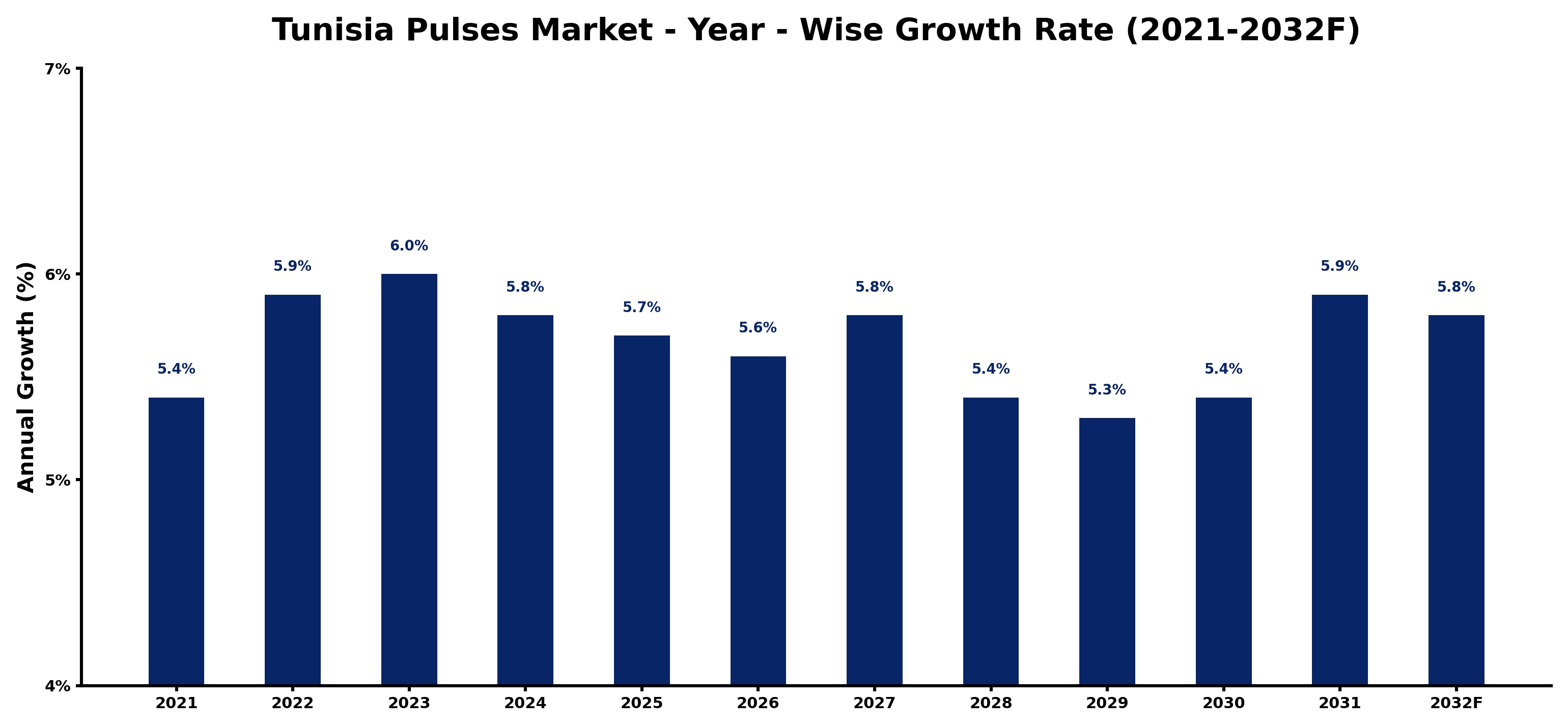
The table below presents the year‑wise growth rates along with the key drivers influencing the market
| Year | Growth Rate | Major Drivers |
| 2021 | 5.4% | Consumer demand for healthy options |
| 2022 | 5.9% | Increased agricultural investment initiatives |
| 2023 | 6.0% | Rising popularity of plant-based diets |
| 2024 | 5.8% | Export opportunities expanded significantly |
| 2025 | 5.7% | Innovative packaging attracted consumers |
| 2026 | 5.6% | Sustainable farming practices gained traction |
| 2027 | 5.8% | Nutritional awareness among consumers grew |
| 2028 | 5.4% | Local sourcing became more popular |
| 2029 | 5.3% | Culinary trends embraced diverse flavors |
| 2030 | 5.4% | E-commerce platforms enhanced accessibility |
| 2031 | 5.9% | Cultural festivals promoted local pulses |
| 2032 | 5.8% | Food security initiatives supported growth |
Note - Market size estimations and growth projections presented in this report are based on 6Wresearch’s advanced forecasting approach, validated with industry datasets as of June 2026.
Tunisia Pulses Market Synopsis
In recent years, the Tunisia Pulses Market has gained significant momentum, fueled by a growing awareness of the nutritional benefits of pulses. However, despite this positive outlook, the sector faces considerable hurdles that could hinder its potential. Sustainable growth is contingent on addressing agricultural infrastructure limitations and cultivating broader consumer acceptance.
Looking ahead, the market is positioned to align with global dietary shifts toward plant-based nutrition, further enhancing demand for pulses. The combination of governmental initiatives aimed at promoting food security and improving cultivation efficiency will likely be crucial in paving the way for a thriving pulses sector in Tunisia.
Tunisia Pulses Market Key Takeaways
- Growing health consciousness among consumers is increasing the demand for nutritious pulses.
- The government's supportive policies for sustainable agriculture are enhancing production capabilities.
- Challenges in agricultural infrastructure are a primary concern impacting yield and quality.
- An expanding vegetarian and vegan demographic is further driving pulses consumption.
- Increased awareness of pulses as a sustainable food source is essential for market growth.
Evaluation of Restraints in Tunisia Pulses Market
The Tunisia Pulses Market is currently hindered by several key restraints. Limited agricultural infrastructure and outdated farming techniques affect both crop yields and quality, presenting significant barriers to advancement. Additionally, competition from staple crops such as cereals and grains can divert consumer attention away from pulses. Unpredictable weather patterns also pose a serious threat to production consistency. A concerted effort is needed to elevate the profile of pulses as an essential and versatile food source among consumers.
Tunisia Pulses Market Trends
Current trends within the Tunisia Pulses Market indicate a rise in processed and value-added pulse products, catering to health-conscious consumers seeking convenience. Moreover, social media and digital marketing campaigns are playing a vital role in promoting the nutritional benefits of pulses. There's also a growing inclination towards organic pulses, driven by increasing demand for clean-label products. Technological advancements in agricultural practices are expected to enhance crop yields and sustainability, further shaping market dynamics.
Tunisia Pulses Market Opportunities
The Tunisia Pulses Market presents several lucrative opportunities for growth and investment. The burgeoning demand for plant-based protein alternatives opens avenues for innovative product development and marketing strategies. Expanding export potential, particularly to regional markets, could provide a significant boost to domestic producers. Additionally, collaboration with local farmers to enhance sustainable practices could improve overall production efficiency and quality, driving further demand.
Government Initiatives in the Tunisia Pulses Market
The Tunisian government is actively working to promote the pulses market through various agricultural policies and initiatives. By enhancing production efficiency, supporting sustainable farming practices, and diversifying crop choices, the government aims to bolster food security. Investment in modern agricultural infrastructure remains a priority, with a focus on improving irrigation systems and providing resources to farmers, which will ultimately support the growth of the pulses market.
Future Insights of the Tunisia Pulses Market
From 2026 to 2032, the Tunisia Pulses Market is expected to evolve substantially. As consumer preferences shift towards healthier, plant-based diets, pulses will likely become increasingly central to the Tunisian culinary landscape. Government initiatives will play a pivotal role in overcoming existing agricultural challenges, enabling producers to meet growing demand. With enhanced marketing and educational campaigns, pulses will not only solidify their place in the diet but also contribute positively to the agricultural economy.
Tunisia Pulses Market Latest Developments (May 2025 - June 2026)
Recent developments in the Tunisia Pulses Market indicate a steady focus on enhancing agricultural practices and infrastructure. The government has ramped up efforts to provide financial support and training to local farmers, aiming to improve crop quality and yields. There are ongoing discussions regarding potential partnerships with international organizations to foster sustainability within the sector, reflecting a commitment to elevating the profile of pulses as a key food source.
Tunisia Pulses Market - Key Attractiveness of the Report
- 10 Years of Market Numbers
- Historical Data Starting from 2022 to 2025
- Base Year: 2025
- Forecast Data until 2032
- Key Performance Indicators Impacting the Market
- Major Upcoming Developments and Projects
Key Highlights of the Report:
- Tunisia Pulses Market Outlook
- Market Size of Tunisia Pulses Market, 2025
- Forecast of Tunisia Pulses Market, 2032
- Historical Data and Forecast of Tunisia Pulses Revenues & Volume for the Period 2022-2032F
- Tunisia Pulses Market Trend Evolution
- Tunisia Pulses Market Drivers and Challenges
- Tunisia Pulses Price Trends
- Tunisia Pulses Porter's Five Forces
- Tunisia Pulses Industry Life Cycle
- Historical Data and Forecast of Tunisia Pulses Market Revenues & Volume By Type for the Period 2022-2032F
- Historical Data and Forecast of Tunisia Pulses Market Revenues & Volume By Chick Peas for the Period 2022-2032F
- Historical Data and Forecast of Tunisia Pulses Market Revenues & Volume By Kaspa Peas for the Period 2022-2032F
- Historical Data and Forecast of Tunisia Pulses Market Revenues & Volume By Lentils for the Period 2022-2032F
- Historical Data and Forecast of Tunisia Pulses Market Revenues & Volume By Pigeon Peas for the Period 2022-2032F
- Historical Data and Forecast of Tunisia Pulses Market Revenues & Volume By Fava Beans for the Period 2022-2032F
- Historical Data and Forecast of Tunisia Pulses Market Revenues & Volume By Black Gram for the Period 2022-2032F
- Historical Data and Forecast of Tunisia Pulses Market Revenues & Volume By Mung Beans for the Period 2022-2032F
- Historical Data and Forecast of Tunisia Chick Peas Pulses Market Revenues & Volume By Others for the Period 2022-2032F
- Historical Data and Forecast of Tunisia Pulses Market Revenues & Volume By End-use for the Period 2022-2032F
- Historical Data and Forecast of Tunisia Pulses Market Revenues & Volume By Home Use for the Period 2022-2032F
- Historical Data and Forecast of Tunisia Pulses Market Revenues & Volume By Snack Food Industry for the Period 2022-2032F
- Historical Data and Forecast of Tunisia Pulses Market Revenues & Volume By Flour Industry for the Period 2022-2032F
- Historical Data and Forecast of Tunisia Pulses Market Revenues & Volume By Others for the Period 2022-2032F
- Tunisia Pulses Import Export Trade Statistics
- Market Opportunity Assessment By Type
- Market Opportunity Assessment By End-use
- Tunisia Pulses Top Companies Market Share
- Tunisia Pulses Competitive Benchmarking By Technical and Operational Parameters
- Tunisia Pulses Company Profiles
- Tunisia Pulses Key Strategic Recommendations






































