Tunisia Refined Petroleum Products Market Size, Share & Growth Rate
The Tunisia Refined Petroleum Products Market was estimated at USD 337 Million in 2025 and is projected to reach USD 457 Million by 2032, growing at a CAGR of 4.4% from 2026 to 2032. This anticipated growth is driven by increasing industrialization and urbanization, alongside a rising demand for transportation and energy across the country. As infrastructure projects ramp up and consumer preferences evolve, the market is poised for steady advancement in the coming years.
Tunisia Refined Petroleum Products Market Year-wise Growth Rate and Key Drivers
This graph highlights how the Tunisia Refined Petroleum Products Market has steadily grown over the years, supported by major growth factors.
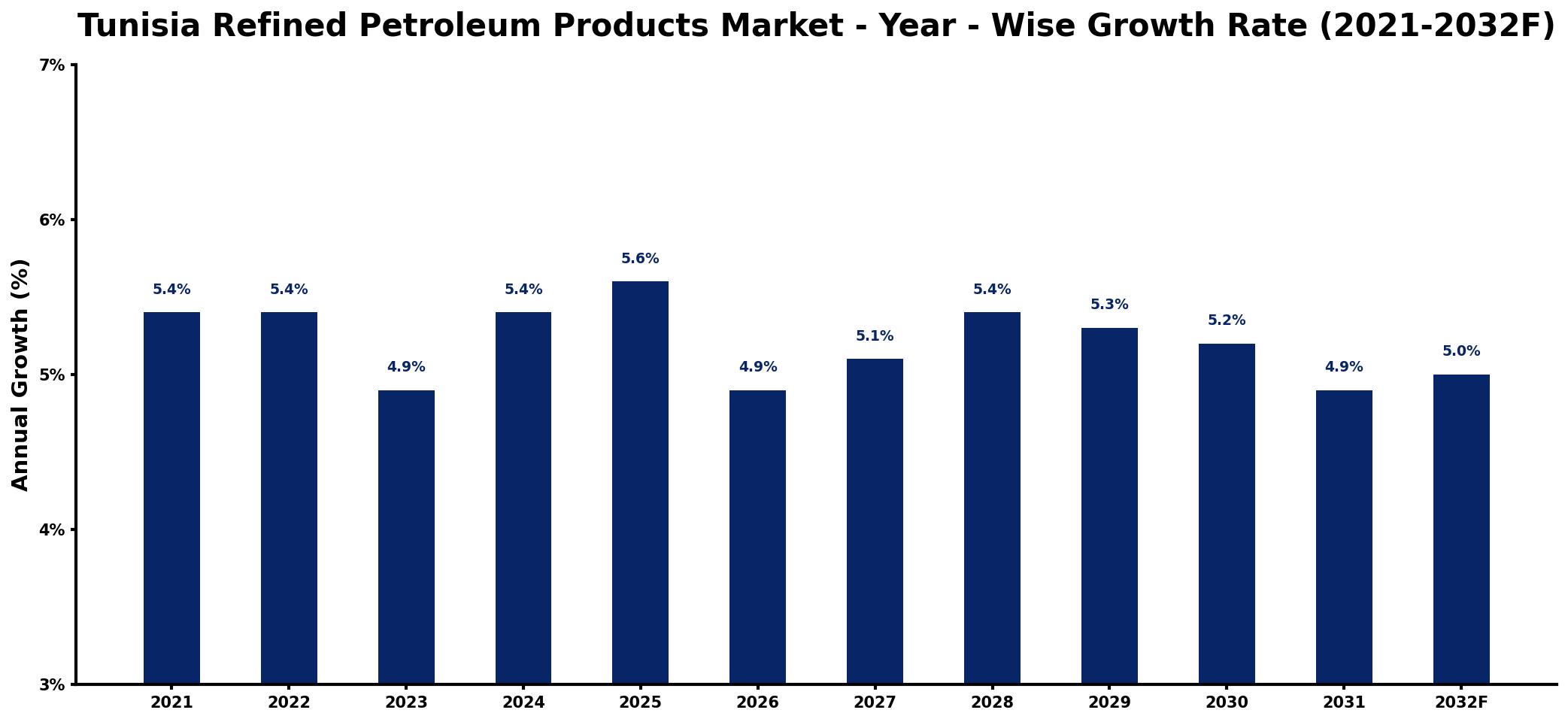
The table below presents the year‑wise growth rates along with the key drivers influencing the market
| Year | Growth Rate | Major Drivers |
| 2021 | 5.4% | Rising transportation sector demand |
| 2022 | 5.4% | Increased industrial activity growth |
| 2023 | 4.9% | Expansion of renewable energy investments |
| 2024 | 5.4% | Boost in domestic consumption levels |
| 2025 | 5.6% | Growing tourism sector recovery |
| 2026 | 4.9% | Emergence of new market players |
| 2027 | 5.1% | Strengthening international trade relations |
| 2028 | 5.4% | Advancements in logistics infrastructure |
| 2029 | 5.3% | Higher urbanization driving consumption |
| 2030 | 5.2% | Technological innovations enhancing efficiency |
| 2031 | 4.9% | Increased government energy initiatives |
| 2032 | 5.0% | Sustained growth in export markets |
Note: Market size estimations and growth projections presented in this report are based on 6Wresearch's proprietary forecasting methodology, utilizing the latest available industry data, government publications, and primary research inputs.
Tunisia Refined Petroleum Products Market Synopsis
The ongoing urbanization in Tunisia stands as the strongest force shaping the refined petroleum products market today. With an expanding population and increased transportation needs, the demand for essential products such as gasoline and diesel is rapidly growing, compelling local players to enhance their supply capabilities.
Simultaneously, global oil prices and geopolitical factors heavily influence the market dynamics. As Tunisia continues to rely on imports to satisfy domestic demand, the governments role in regulating prices and distribution becomes increasingly vital for maintaining market stability and ensuring consistent supply.
Tunisia Refined Petroleum Products Market Key Takeaways
- The market is set to grow, reaching USD 457 Million by 2032.
- Urbanization and industrialization are key demand drivers.
- The government plays a significant role in market regulation and stability.
- Investment in infrastructure is critical to enhance supply chain efficiency.
- There is a growing shift towards cleaner, low-sulfur fuels.
Evaluation of Restraints in Tunisia Refined Petroleum Products Market
Despite its growth potential, the Tunisia Refined Petroleum Products Market faces notable restraints. The volatility of global oil prices can directly impact local fuel costs, creating uncertainty for consumers and businesses alike. Additionally, competition from subsidized neighboring countries often leads to price disparities that affect market equilibrium. Inadequate infrastructure for storage and distribution further complicates the landscape, limiting the ability to efficiently meet domestic demand. Moreover, regulatory hurdles may deter new entrants, while reliance on imports introduces risks of supply chain disruptions and currency fluctuations, all of which need to be strategically navigated by stakeholders.
Tunisia Refined Petroleum Products Market Trends
The market is experiencing a shift towards more environmentally friendly fuels, with increasing demand for low-sulfur options. This trend is coupled with an emphasis on energy efficiency, prompting the adoption of advanced refining technologies to minimize emissions. Investments in infrastructure and storage facilities are on the rise, aiming to improve supply chain efficiency and ensure a reliable distribution of refined products across Tunisia. As consumer awareness regarding environmental issues grows, these trends are steering the market toward a more sustainable and efficient future.
Tunisia Refined Petroleum Products Market Opportunities
Investment opportunities in the Tunisia Refined Petroleum Products Market are abundant. The need for enhanced storage and distribution infrastructure presents a clear pathway for investors looking to improve supply chain efficiency. Furthermore, upgrading existing refineries or establishing new ones can help diminish reliance on imports and meet growing domestic needs. In addition, developing alternative energy sources, such as renewable fuels and natural gas, could diversify the energy portfolio and lessen environmental impacts, thus creating a more resilient market.
Government Initiatives in the Tunisia Refined Petroleum Products Market
The Tunisian government has implemented several important policies to support the refined petroleum products market. These initiatives include regulating fuel prices to stabilize the market and promote renewable energy sources to reduce dependence on imports. Efforts to enhance energy efficiency and lower carbon emissions align with global environmental objectives. Additionally, transparency and competition within the market are being fostered, aimed at creating a more efficient energy sector for Tunisia.
Future Insights of the Tunisia Refined Petroleum Products Market
Looking ahead to 2026-2032, the Tunisia Refined Petroleum Products Market is projected to grow steadily due to continued industrialization and urbanization. The increasing transportation and manufacturing sectors will drive demand for refined products, while government initiatives to support renewable energy adoption may lead to shifts in consumer preferences. Strategic partnerships for technology transfer and infrastructure investment are expected to boost market growth. However, stakeholders must remain vigilant in adapting to fluctuating global oil prices and navigating regulatory uncertainties as they seek to maintain competitiveness.
Tunisia Refined Petroleum Products Market Latest Developments (2025 - 2026)
Recent developments in the Tunisia Refined Petroleum Products Market reflect a focused approach toward sustainability and efficiency. Companies are increasingly investing in technologies that promote cleaner fuels and reduce emissions. Infrastructure projects have been initiated to enhance storage and distribution capabilities across the country. Furthermore, collaborations with international partners are being explored to facilitate the transfer of advanced refining technologies, ensuring that the market can adapt to evolving energy demands and environmental standards.
Tunisia Refined Petroleum Products Market - Key Attractiveness of the Report
- 10 Years of Market Numbers
- Historical Data Starting from 2022 to 2025
- Base Year: 2025
- Forecast Data until 2032
- Key Performance Indicators Impacting the Market
- Major Upcoming Developments and Projects
Key Highlights of the Report:
- Tunisia Refined Petroleum Products Market Outlook
- Market Size of Tunisia Refined Petroleum Products Market, 2025
- Forecast of Tunisia Refined Petroleum Products Market, 2032
- Historical Data and Forecast of Tunisia Refined Petroleum Products Revenues & Volume for the Period 2022-2032F
- Tunisia Refined Petroleum Products Market Trend Evolution
- Tunisia Refined Petroleum Products Market Drivers and Challenges
- Tunisia Refined Petroleum Products Price Trends
- Tunisia Refined Petroleum Products Porter's Five Forces
- Tunisia Refined Petroleum Products Industry Life Cycle
- Historical Data and Forecast of Tunisia Refined Petroleum Products Market Revenues & Volume By Product Type for the Period 2022-2032F
- Historical Data and Forecast of Tunisia Refined Petroleum Products Market Revenues & Volume By Diesel for the Period 2022-2032F
- Historical Data and Forecast of Tunisia Refined Petroleum Products Market Revenues & Volume By Gasoline for the Period 2022-2032F
- Historical Data and Forecast of Tunisia Refined Petroleum Products Market Revenues & Volume By Fuel Oils for the Period 2022-2032F
- Historical Data and Forecast of Tunisia Refined Petroleum Products Market Revenues & Volume By Kerosene for the Period 2022-2032F
- Historical Data and Forecast of Tunisia Refined Petroleum Products Market Revenues & Volume By Others for the Period 2022-2032F
- Historical Data and Forecast of Tunisia Refined Petroleum Products Market Revenues & Volume By Application for the Period 2022-2032F
- Historical Data and Forecast of Tunisia Refined Petroleum Products Market Revenues & Volume By Fuel for the Period 2022-2032F
- Historical Data and Forecast of Tunisia Refined Petroleum Products Market Revenues & Volume By Chemical for the Period 2022-2032F
- Historical Data and Forecast of Tunisia Refined Petroleum Products Market Revenues & Volume By Others for the Period 2022-2032F
- Historical Data and Forecast of Tunisia Refined Petroleum Products Market Revenues & Volume By Fraction for the Period 2022-2032F
- Historical Data and Forecast of Tunisia Refined Petroleum Products Market Revenues & Volume By Light Distillates for the Period 2022-2032F
- Historical Data and Forecast of Tunisia Refined Petroleum Products Market Revenues & Volume By Middle Distillates for the Period 2022-2032F
- Historical Data and Forecast of Tunisia Refined Petroleum Products Market Revenues & Volume By Heavy Oils for the Period 2022-2032F
- Tunisia Refined Petroleum Products Import Export Trade Statistics
- Market Opportunity Assessment By Product Type
- Market Opportunity Assessment By Application
- Market Opportunity Assessment By Fraction
- Tunisia Refined Petroleum Products Top Companies Market Share
- Tunisia Refined Petroleum Products Competitive Benchmarking By Technical and Operational Parameters
- Tunisia Refined Petroleum Products Company Profiles
- Tunisia Refined Petroleum Products Key Strategic Recommendations






































