Tunisia Renewable Chemicals Market Size, Share & Growth Rate
The Tunisia Renewable Chemicals Market was estimated at USD 561 Million in 2025 and is projected to reach USD 810 Million by 2032, growing at a CAGR of 5.4% from 2026 to 2032. This robust growth trajectory is primarily driven by the government's unwavering commitment to sustainable development and the increasing demand for environmentally-friendly products across various sectors. Furthermore, technological advancements in production processes and rising awareness among consumers regarding eco-friendly alternatives are expected to further boost market dynamics.
Tunisia Renewable Chemicals Market Year-wise Growth Rate and Key Drivers
This graph highlights how the Tunisia Renewable Chemicals Market has steadily grown over the years, supported by major growth factors.
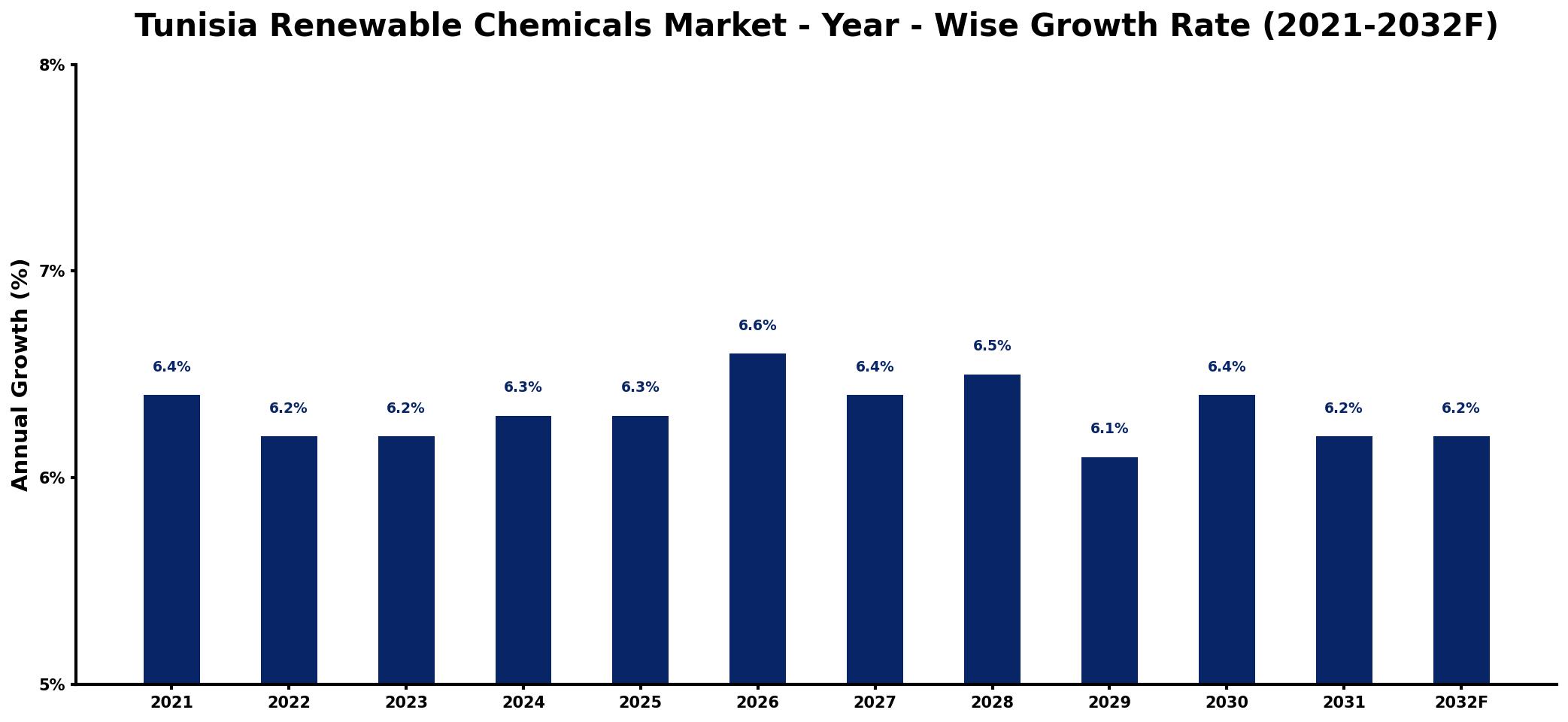
The table below presents the year‑wise growth rates along with the key drivers influencing the market
| Year | Growth Rate | Major Drivers |
| 2021 | 6.4% | Rising investments in green technologies |
| 2022 | 6.2% | Increased consumer demand for sustainability |
| 2023 | 6.2% | Expansion of bio-based material applications |
| 2024 | 6.3% | Growing government support for innovation |
| 2025 | 6.3% | Emerging collaborations in research sectors |
| 2026 | 6.6% | Advancements in production efficiency technologies |
| 2027 | 6.4% | Strengthening of local supply chains |
| 2028 | 6.5% | Growing interest in eco-friendly alternatives |
| 2029 | 6.1% | Diversification of product offerings available |
| 2030 | 6.4% | Strengthened international trade agreements |
| 2031 | 6.2% | improved processing technologies adoption |
| 2032 | 6.2% | growing emerging market penetration |
Note: Market size estimations and growth projections presented in this report are based on 6Wresearch's proprietary forecasting methodology, utilizing the latest available industry data, government publications, and primary research inputs.
Tunisia Renewable Chemicals Market Synopsis
In recent years, Tunisia has seen a notable shift toward renewable chemicals as part of its broader environmental initiatives. This sector is gaining traction due to increasing consumer demand for sustainable solutions in industries such as textiles, agriculture, and packaging.
Moreover, government incentives and policies aimed at fostering innovation in green technologies are catalyzing investments in this market. As the nation continues to embrace sustainable practices, renewable chemicals are poised to play a pivotal role in Tunisia's economic landscape.
Tunisia Renewable Chemicals Market Key Takeaways
- The market is projected to grow from USD 561 Million in 2025 to USD 810 Million by 2032.
- Government policies and initiatives are significantly promoting the adoption of renewable chemicals.
- Technological advancements are enhancing production efficiencies, which further support market growth.
- There is an increasing awareness and demand for eco-friendly products among consumers.
- Investment in research and development remains critical for overcoming production cost challenges.
Evaluation of Restraints in Tunisia Renewable Chemicals Market
Despite its promising trajectory, the Tunisia Renewable Chemicals Market is hampered by several significant constraints. High production costs relative to conventional chemicals remain a primary barrier to entry and widespread adoption. This financial hurdle can deter potential manufacturers and limit innovation. Additionally, the availability of raw materials is often tied to agricultural outputs, creating vulnerability in supply chains. Lastly, substantial investments in research and development are necessary to optimize production efficiency and scalability, without which, the growth potential may be stifled.
Tunisia Renewable Chemicals Market Trends
Current trends in the Tunisia Renewable Chemicals Market reveal a growing focus on bio-based feedstocks and innovations in production methodologies. As industries seek to align with global sustainability standards, the demand for renewable chemicals is witnessing upward momentum. Furthermore, collaborations between public and private sectors are on the rise, aimed at enhancing technological capabilities and driving product development.
The integration of digital technologies in manufacturing processes is another trend gaining traction, allowing for more streamlined production and improved environmental performance. As awareness of climate change impacts grows, consumer preference is shifting towards products that prioritize sustainability, further propelling market demand.
Tunisia Renewable Chemicals Market Opportunities
The Tunisia Renewable Chemicals Market presents a wealth of opportunities for investment and growth. With the government actively promoting sustainable practices, there are significant avenues for companies specializing in renewable chemical production. The agricultural sector, in particular, stands out as a key area for leveraging biomass and agricultural residues to produce renewable chemicals. Additionally, increased demand from industries such as packaging and textiles offers a fertile ground for innovation and market entry.
Government Initiatives in the Tunisia Renewable Chemicals Market
The Tunisian government is actively shaping the renewable chemicals landscape through various initiatives and policies. These include incentives for bio-based product development and subsidies aimed at renewable energy projects. The focus on reducing carbon emissions is coupled with efforts to create a favorable regulatory environment that encourages both domestic and foreign investments in the sector. Such measures underscore the commitment to sustainable economic growth while enhancing environmental protection.
Future Insights of the Tunisia Renewable Chemicals Market
Looking ahead to 2026-2032, the Tunisia Renewable Chemicals Market is expected to continue on its growth trajectory, propelled by ongoing governmental support and increasing consumer demand for sustainable products. Innovations in production technologies will likely drive down costs and enhance efficiency, making renewable chemicals more competitive against traditional options. With the focus on achieving environmental goals, this market is well-positioned for expansion, promising a dynamic future for stakeholders involved.
Tunisia Renewable Chemicals Market Latest Developments (2025 - 2026)
In the recent months, the Tunisia Renewable Chemicals Market has witnessed a surge in public-private collaborations aimed at boosting R&D efforts. Various pilot projects focusing on the conversion of agricultural waste into bio-based chemicals have gained momentum. Furthermore, international stakeholders are increasingly showing interest in Tunisia's renewable chemical sector, indicating a potential influx of foreign investment aimed at enhancing local capabilities. These developments are indicative of a robust and evolving market landscape, laying the groundwork for future advancements.
Tunisia Renewable Chemicals Market - Key Attractiveness of the Report
- 10 Years of Market Numbers
- Historical Data Starting from 2022 to 2025
- Base Year: 2025
- Forecast Data until 2032
- Key Performance Indicators Impacting the Market
- Major Upcoming Developments and Projects
Key Highlights of the Report:
- Tunisia Renewable Chemicals Market Outlook
- Market Size of Tunisia Renewable Chemicals Market, 2025
- Forecast of Tunisia Renewable Chemicals Market, 2032
- Historical Data and Forecast of Tunisia Renewable Chemicals Revenues & Volume for the Period 2022-2032F
- Tunisia Renewable Chemicals Market Trend Evolution
- Tunisia Renewable Chemicals Market Drivers and Challenges
- Tunisia Renewable Chemicals Price Trends
- Tunisia Renewable Chemicals Porter's Five Forces
- Tunisia Renewable Chemicals Industry Life Cycle
- Historical Data and Forecast of Tunisia Renewable Chemicals Market Revenues & Volume By Product Type for the Period 2022-2032F
- Historical Data and Forecast of Tunisia Renewable Chemicals Market Revenues & Volume By Alcohols for the Period 2022-2032F
- Historical Data and Forecast of Tunisia Renewable Chemicals Market Revenues & Volume By Organic Acids for the Period 2022-2032F
- Historical Data and Forecast of Tunisia Renewable Chemicals Market Revenues & Volume By Ketones for the Period 2022-2032F
- Historical Data and Forecast of Tunisia Renewable Chemicals Market Revenues & Volume By Platform Chemicals for the Period 2022-2032F
- Historical Data and Forecast of Tunisia Renewable Chemicals Market Revenues & Volume By Biopolymers for the Period 2022-2032F
- Historical Data and Forecast of Tunisia Renewable Chemicals Market Revenues & Volume By Others for the Period 2022-2032F
- Historical Data and Forecast of Tunisia Renewable Chemicals Market Revenues & Volume By Applications for the Period 2022-2032F
- Historical Data and Forecast of Tunisia Renewable Chemicals Market Revenues & Volume By Transportation for the Period 2022-2032F
- Historical Data and Forecast of Tunisia Renewable Chemicals Market Revenues & Volume By Textiles for the Period 2022-2032F
- Historical Data and Forecast of Tunisia Renewable Chemicals Market Revenues & Volume By Food safety for the Period 2022-2032F
- Historical Data and Forecast of Tunisia Renewable Chemicals Market Revenues & Volume By Environment for the Period 2022-2032F
- Historical Data and Forecast of Tunisia Renewable Chemicals Market Revenues & Volume By Communication for the Period 2022-2032F
- Historical Data and Forecast of Tunisia Renewable Chemicals Market Revenues & Volume By Housing for the Period 2022-2032F
- Historical Data and Forecast of Tunisia Renewable Chemicals Market Revenues & Volume By Recreation for the Period 2022-2032F
- Historical Data and Forecast of Tunisia Renewable Chemicals Market Revenues & Volume By Other Applications for the Period 2022-2032F
- Tunisia Renewable Chemicals Import Export Trade Statistics
- Market Opportunity Assessment By Product Type
- Market Opportunity Assessment By Applications
- Tunisia Renewable Chemicals Top Companies Market Share
- Tunisia Renewable Chemicals Competitive Benchmarking By Technical and Operational Parameters
- Tunisia Renewable Chemicals Company Profiles
- Tunisia Renewable Chemicals Key Strategic Recommendations






































