Tunisia Sail Canvas Market Size, Share & Growth Rate
The Tunisia Sail Canvas Market was estimated at USD 1007 Million in 2025 and is projected to reach USD 1863 Million by 2032, growing at a CAGR of 9.2% from 2026 to 2032. This impressive trajectory is primarily driven by the increasing popularity of recreational sailing, a direct result of Tunisia's stunning Mediterranean coastline attracting tourists and enthusiasts alike. Additionally, advancements in sail-making technology are enhancing the quality and performance of sail canvas, further stimulating demand.
Tunisia Sail Canvas Market Year-wise Growth Rate and Key Drivers
This graph highlights how the Tunisia Sail Canvas Market has steadily grown over the years, supported by major growth factors.
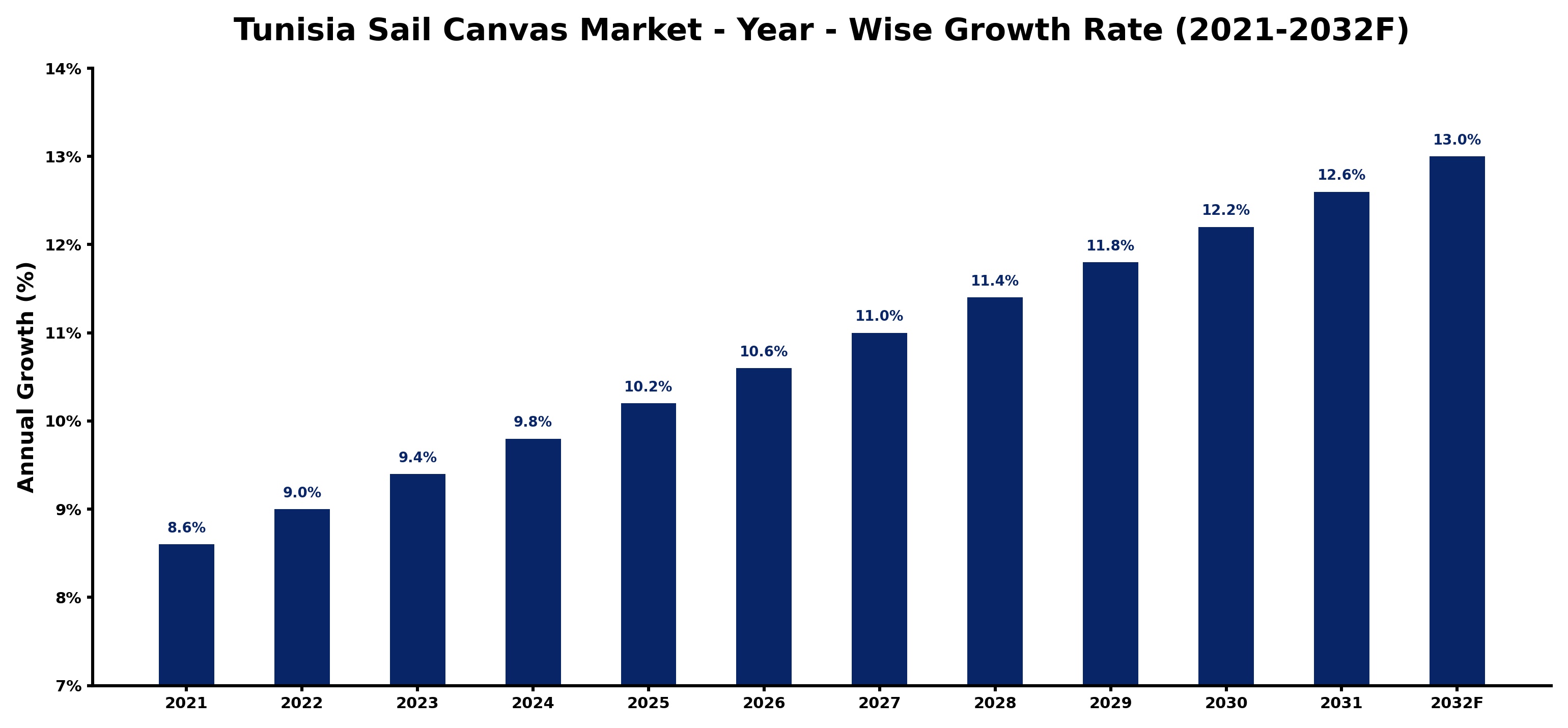
The table below presents the year‑wise growth rates along with the key drivers influencing the market
| Year | Growth Rate | Major Drivers |
| 2021 | 8.6% | New production technologies boosted local sail canvas manufacturing efficiency |
| 2022 | 9.0% | Digital weaving technology adoption boosted Tunisian sail fabric production efficiency |
| 2023 | 9.4% | Local manufacturers invest in advanced textile machinery for efficiency |
| 2024 | 9.8% | Domestic textile manufacturers invest in advanced sail fabric production technologies |
| 2025 | 10.2% | Local boat manufacturers enhance production capacities for export growth |
| 2026 | 10.6% | New manufacturing lines enhance capacity for specialized sail fabrics |
| 2027 | 11.0% | Regional boat manufacturing demand spurred sail canvas production investments |
| 2028 | 11.4% | Domestic sail manufacturers expand capacity to meet export demand |
| 2029 | 11.8% | Automation technology adoption streamlined sail canvas manufacturing processes |
| 2030 | 12.2% | Textile machinery upgrades enhanced production capacity for sail canvas |
| 2031 | 12.6% | Manufacturing investments in textile technology boost sail canvas production |
| 2032 | 13.0% | Improved local supply chains boosted Tunisia's sail canvas production capacity |
Note - Market size estimations and growth projections presented in this report are based on 6Wresearch's advanced forecasting approach, validated with industry datasets as of June 2026.
Tunisia Sail Canvas Market Synopsis
The current landscape of the Tunisia Sail Canvas Market reflects a vibrant interplay between tradition and innovation. The country's rich maritime heritage not only fuels local craftsmanship but also spurs interest in high-quality sail fabrics that can withstand the demands of both professional and leisure sailors.
As tourism continues to flourish, particularly along the Mediterranean coast, so does the need for durable and reliable sail canvas. Local manufacturers are increasingly collaborating with international brands to enhance their offerings, thus contributing to a robust competitive market environment.
Tunisia Sail Canvas Market Key Takeaways
- The market is significantly influenced by the growing interest in recreational boating along Tunisia's Mediterranean coast.
- Technological advancements in sail-making materials are creating opportunities for higher-quality and longer-lasting sail canvas.
- Government policies aimed at promoting sustainable practices are shaping manufacturing approaches in the market.
- Local expertise remains a challenge, prompting a reliance on imported raw materials for high-performance canvas production.
- Seasonal demand fluctuations necessitate adaptive strategies among market players to maintain consistent supply and revenue.
Evaluation of Restraints in Tunisia Sail Canvas Market
Several restraints are currently impacting the Tunisia Sail Canvas Market. The availability of high-quality raw materials is a prominent issue; sourcing durable components is vital for ensuring the reliability of sailcloth. Moreover, the limited local expertise in advanced sailmaking techniques often forces manufacturers to rely on imported products, which can increase costs and impact profit margins. Economic fluctuations also influence recreational spending, causing volatility in demand that requires strategic planning from manufacturers.
Tunisia Sail Canvas Market Trends
Sustainability is increasingly becoming a core focus within the Tunisia Sail Canvas Market. Manufacturers are exploring eco-friendly materials and production techniques to align with global trends towards environmental responsibility. Additionally, innovations in textile technology are paving the way for hybrid and composite materials, providing enhanced durability and performance compared to traditional sail canvas. These trends not only cater to the environmentally conscious consumer but also differentiate products in a competitive market.
Tunisia Sail Canvas Market Opportunities
Significant growth and investment opportunities exist in the development of locally sourced materials to reduce dependency on imports. By enhancing the local supply chain for raw materials, manufacturers can improve product quality and profitability. Additionally, capitalizing on the burgeoning tourism sector offers potential for expanded sales channels, as tour operators and yacht rental businesses seek reliable sail canvas to meet their customers' needs.
Government Initiatives in the Tunisia Sail Canvas Market
The Tunisian government is actively supporting the maritime and boating industry through various initiatives aimed at boosting local craftsmanship and tourism. Policies include tax incentives for manufacturers and reductions in import duties on essential raw materials used in sail canvas production. Moreover, the government promotes sustainable manufacturing practices, encouraging the adoption of eco-friendly materials to meet both local and international market standards.
Future Insights of the Tunisia Sail Canvas Market
Looking ahead to 2026-2032, the Tunisia Sail Canvas Market is poised for robust growth. The increasing interest in sustainable sailing options and eco-friendly practices will likely continue shaping consumer preferences. As local manufacturers invest in technological advancements and collaborations, they will enhance their competitiveness in both local and international markets. With government support and a growing tourist influx, the future for the sail canvas market in Tunisia appears promising.
Tunisia Sail Canvas Market Latest Developments (May 2025 - June 2026)
Recent developments in the Tunisia Sail Canvas Market indicate a strong shift towards innovation and sustainability. Companies are beginning to adopt advanced manufacturing technologies that enable the production of high-performance, weather-resistant sails. Additionally, strategic partnerships are emerging between local manufacturers and international brands to enhance product offerings and cater to the increasing demand from the recreational boating sector.
Tunisia Sail Canvas Market - Key Attractiveness of the Report
- 10 Years of Market Numbers
- Historical Data Starting from 2022 to 2025
- Base Year: 2025
- Forecast Data until 2032
- Key Performance Indicators Impacting the Market
- Major Upcoming Developments and Projects
Key Highlights of the Report:
- Tunisia Sail Canvas Market Outlook
- Market Size of Tunisia Sail Canvas Market, 2025
- Forecast of Tunisia Sail Canvas Market, 2032
- Historical Data and Forecast of Tunisia Sail Canvas Revenues & Volume for the Period 2022-2032F
- Tunisia Sail Canvas Market Trend Evolution
- Tunisia Sail Canvas Market Drivers and Challenges
- Tunisia Sail Canvas Price Trends
- Tunisia Sail Canvas Porter's Five Forces
- Tunisia Sail Canvas Industry Life Cycle
- Historical Data and Forecast of Tunisia Sail Canvas Market Revenues & Volume By Type for the Period 2022-2032F
- Historical Data and Forecast of Tunisia Sail Canvas Market Revenues & Volume By 8 Ann Canvas for the Period 2022-2032F
- Historical Data and Forecast of Tunisia Sail Canvas Market Revenues & Volume By 12 Ann Canvas for the Period 2022-2032F
- Historical Data and Forecast of Tunisia Sail Canvas Market Revenues & Volume By Polyester Canvas for the Period 2022-2032F
- Historical Data and Forecast of Tunisia Sail Canvas Market Revenues & Volume By Others for the Period 2022-2032F
- Historical Data and Forecast of Tunisia Sail Canvas Market Revenues & Volume By Application for the Period 2022-2032F
- Historical Data and Forecast of Tunisia Sail Canvas Market Revenues & Volume By Sailing for the Period 2022-2032F
- Historical Data and Forecast of Tunisia Sail Canvas Market Revenues & Volume By Yacht for the Period 2022-2032F
- Historical Data and Forecast of Tunisia Sail Canvas Market Revenues & Volume By Others for the Period 2022-2032F
- Tunisia Sail Canvas Import Export Trade Statistics
- Market Opportunity Assessment By Type
- Market Opportunity Assessment By Application
- Tunisia Sail Canvas Top Companies Market Share
- Tunisia Sail Canvas Competitive Benchmarking By Technical and Operational Parameters
- Tunisia Sail Canvas Company Profiles
- Tunisia Sail Canvas Key Strategic Recommendations






































