Tunisia Smart Weapons Market Size, Share & Growth Rate
The Tunisia Smart Weapons Market was estimated at USD 721 Million in 2025 and is projected to reach USD 1229 Million by 2032, growing at a CAGR of 7.9% from 2026 to 2032. This upward trajectory is primarily fueled by Tunisia's strategic intent to enhance its military capabilities amid growing security concerns. The focus on advanced technologies such as precision-guided munitions and UAVs is set to drive substantial investments in smart weapons systems, ensuring operational efficiency and heightened defense readiness.
Tunisia Smart Weapons Market Year-wise Growth Rate and Key Drivers
This graph highlights how the Tunisia Smart Weapons Market has steadily grown over the years, supported by major growth factors.
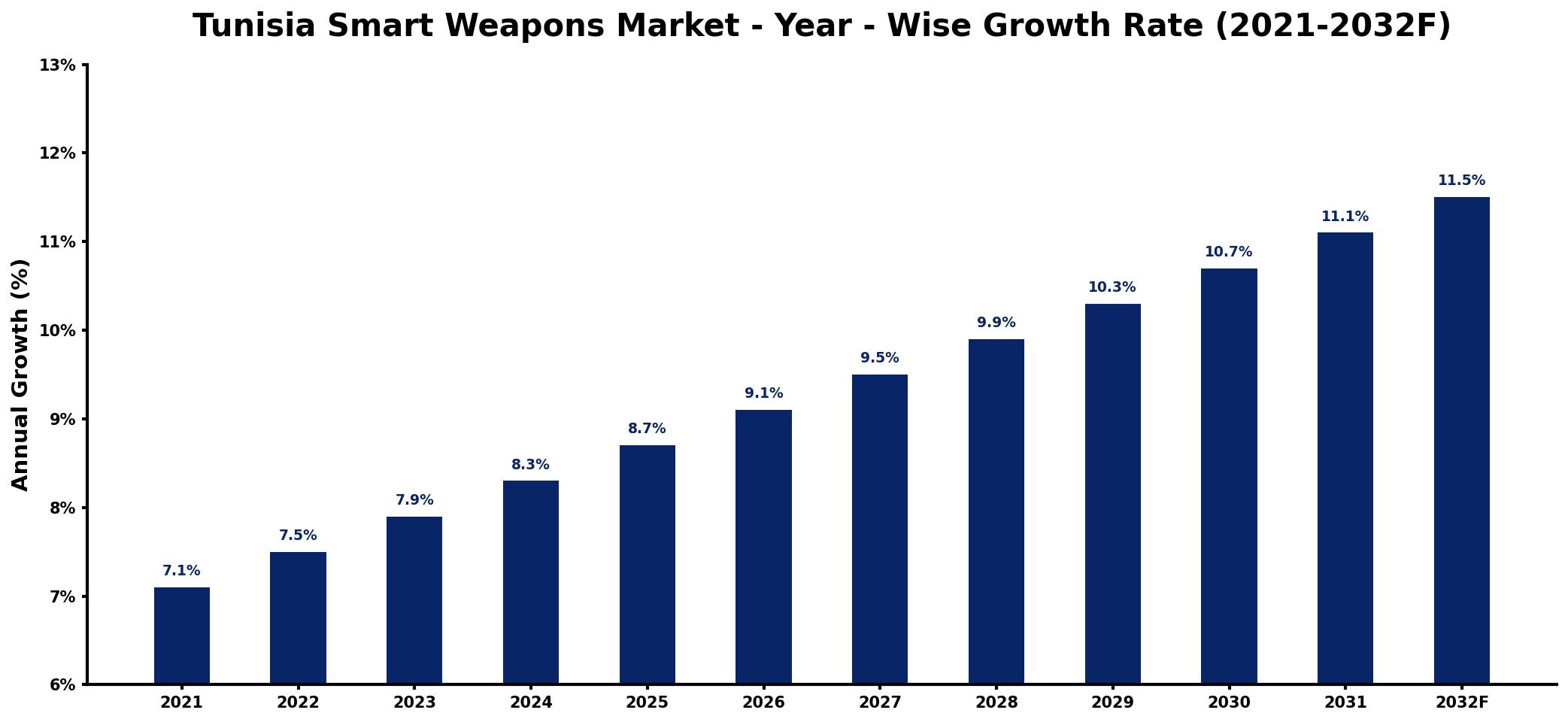
The table below presents the year‑wise growth rates along with the key drivers influencing the market
| Year | Growth Rate | Major Drivers |
| 2021 | 7.1% | rising procurement volume requirements |
| 2022 | 7.5% | Emerging technology adoption trends |
| 2023 | 7.9% | Growing regional security concerns |
| 2024 | 8.3% | Advancements in military technologies |
| 2025 | 8.7% | Rising demand for precision systems |
| 2026 | 9.1% | growing downstream application demand |
| 2027 | 9.5% | Investment in defense modernization |
| 2028 | 9.9% | Enhanced training and simulation programs |
| 2029 | 10.3% | Focus on intelligence capabilities |
| 2030 | 10.7% | Expansion of defense industrial base |
| 2031 | 11.1% | Integration of autonomous systems |
| 2032 | 11.5% | Collaboration with private sector |
Note: Market size estimations and growth projections presented in this report are based on 6Wresearch's proprietary forecasting methodology, utilizing the latest available industry data, government publications, and primary research inputs.
Tunisia Smart Weapons Market Synopsis
Recent momentum in the Tunisia Smart Weapons Market reflects a significant shift towards modernizing defense capabilities, showcasing the country's proactive response to regional threats. With enhanced national security as a primary objective, Tunisia is aligning its military strategies with contemporary technological advancements.
As the market evolves, the adoption of sophisticated technologies is becoming increasingly vital. Emphasizing precision and minimal collateral damage, Tunisia's defense forces are prioritizing smart weapons that enable more effective and efficient military operations, ensuring they remain robust against emerging challenges.
Tunisia Smart Weapons Market Key Takeaways
- Significant growth projected, with the market expected to reach USD 1229 Million by 2032.
- Strategic investments in advanced military technology are reshaping defense operations.
- Collaborations with international partners are fostering technology transfers and innovation.
- Market trends indicate a pronounced focus on UAVs and precision-guided munitions.
- Government policies are enhancing regulatory frameworks for smart weapons development.
Evaluation of Restraints in Tunisia Smart Weapons Market
Despite its growth potential, the Tunisia Smart Weapons Market faces several constraints that could limit its expansion. A primary challenge is the government's constrained defense budget, which limits investments in advanced smart weapon systems. Furthermore, regulatory hurdles and international sanctions restrict access to foreign suppliers, which could delay procurement timelines. The continuous need for technological upgrades and personnel training adds another layer of complexity, requiring considerable investment in research and development. Ensuring cybersecurity and safeguarding smart weapon operations against breaches is also crucial, demanding innovative solutions and strategic planning.
Tunisia Smart Weapons Market Trends
The market is witnessing several notable trends, including a surge in demand for precision-guided munitions and advanced targeting systems. The focus on effective military operations is driving the Tunisian armed forces to integrate unmanned aerial vehicles (UAVs) for reconnaissance and strike missions, enhancing battlefield intelligence. Additionally, there is a growing emphasis on developing anti-tank guided missiles for improved defense against armored threats. The integration of artificial intelligence and data analytics further bolsters targeting capabilities, reflecting a shift towards network-centric warfare systems that facilitate real-time communication among military units.
Tunisia Smart Weapons Market Opportunities
The evolving landscape of the Tunisia Smart Weapons Market presents numerous investment opportunities for stakeholders. With a strategic focus on modernizing military capabilities, there is a robust demand for state-of-the-art smart weapons systems. Investors can explore avenues in supplying cutting-edge technologies such as guided missiles and UAVs, aligning with the Tunisian armed forces' needs. Furthermore, partnerships with local defense contractors and investments in research and development of innovative technologies could be pivotal in harnessing the market's expanding potential, driving sustainable growth in this sector.
Government Initiatives in the Tunisia Smart Weapons Market
The Tunisian government has instituted several initiatives aimed at regulating the development and deployment of smart weapons. These initiatives are primarily geared towards strengthening national security and combating terrorism while ensuring adherence to international arms control standards. The government has established rigorous licensing procedures for smart weapons import and export, alongside comprehensive guidelines for their maintenance and storage. Through these measures, Tunisia aims to modernize its defense capabilities while promoting transparency and accountability within the defense sector.
Future Insights of the Tunisia Smart Weapons Market
Looking forward to the period between 2026 and 2032, the Tunisia Smart Weapons Market is anticipated to experience consistent growth, influenced by an increase in defense expenditures and an unwavering commitment to military modernization. The country's strategic geographical positioning, coupled with the dynamic security landscape, will further incentivize investments in advanced smart weapons systems. The necessity to counter emerging threats, particularly terrorism, will likely intensify demand for innovative military solutions, ensuring that Tunisia's defense capabilities are both agile and effective.
Tunisia Smart Weapons Market Latest Developments (2025 - 2026)
Recent developments within the Tunisia Smart Weapons Market indicate a strong direction towards the integration of next-generation technologies. There has been an observable uptick in military exercises incorporating advanced smart weapon systems, showcasing a commitment to enhancing operational readiness. Additionally, ongoing collaborations with international technology providers are expected to yield beneficial outcomes, as Tunisia aims to refine its defense capabilities. These trends reflect a broader commitment to evolving military strategies and incorporating cutting-edge technologies into national defense planning.
Tunisia Smart Weapons Market - Key Attractiveness of the Report
- 10 Years of Market Numbers
- Historical Data Starting from 2022 to 2025
- Base Year: 2025
- Forecast Data until 2032
- Key Performance Indicators Impacting the Market
- Major Upcoming Developments and Projects
Key Highlights of the Report:
- Tunisia Smart Weapons Market Outlook
- Market Size of Tunisia Smart Weapons Market, 2025
- Forecast of Tunisia Smart Weapons Market, 2032
- Historical Data and Forecast of Tunisia Smart Weapons Revenues & Volume for the Period 2022-2032F
- Tunisia Smart Weapons Market Trend Evolution
- Tunisia Smart Weapons Market Drivers and Challenges
- Tunisia Smart Weapons Price Trends
- Tunisia Smart Weapons Porter's Five Forces
- Tunisia Smart Weapons Industry Life Cycle
- Historical Data and Forecast of Tunisia Smart Weapons Market Revenues & Volume By Product for the Period 2022-2032F
- Historical Data and Forecast of Tunisia Smart Weapons Market Revenues & Volume By Missiles for the Period 2022-2032F
- Historical Data and Forecast of Tunisia Smart Weapons Market Revenues & Volume By Munitions for the Period 2022-2032F
- Historical Data and Forecast of Tunisia Smart Weapons Market Revenues & Volume By Guided Projectiles for the Period 2022-2032F
- Historical Data and Forecast of Tunisia Smart Weapons Market Revenues & Volume By Guided Rockets for the Period 2022-2032F
- Historical Data and Forecast of Tunisia Smart Weapons Market Revenues & Volume By Guided Firearms for the Period 2022-2032F
- Historical Data and Forecast of Tunisia Smart Weapons Market Revenues & Volume By Directed Energy Weapons for the Period 2022-2032F
- Historical Data and Forecast of Tunisia Smart Weapons Market Revenues & Volume By Technology for the Period 2022-2032F
- Historical Data and Forecast of Tunisia Smart Weapons Market Revenues & Volume By Laser for the Period 2022-2032F
- Historical Data and Forecast of Tunisia Smart Weapons Market Revenues & Volume By Infrared for the Period 2022-2032F
- Historical Data and Forecast of Tunisia Smart Weapons Market Revenues & Volume By Radar for the Period 2022-2032F
- Historical Data and Forecast of Tunisia Smart Weapons Market Revenues & Volume By GPS for the Period 2022-2032F
- Historical Data and Forecast of Tunisia Smart Weapons Market Revenues & Volume By Others for the Period 2022-2032F
- Historical Data and Forecast of Tunisia Smart Weapons Market Revenues & Volume By Platform for the Period 2022-2032F
- Historical Data and Forecast of Tunisia Smart Weapons Market Revenues & Volume By Air for the Period 2022-2032F
- Historical Data and Forecast of Tunisia Smart Weapons Market Revenues & Volume By Land for the Period 2022-2032F
- Historical Data and Forecast of Tunisia Smart Weapons Market Revenues & Volume By Naval for the Period 2022-2032F
- Tunisia Smart Weapons Import Export Trade Statistics
- Market Opportunity Assessment By Product
- Market Opportunity Assessment By Technology
- Market Opportunity Assessment By Platform
- Tunisia Smart Weapons Top Companies Market Share
- Tunisia Smart Weapons Competitive Benchmarking By Technical and Operational Parameters
- Tunisia Smart Weapons Company Profiles
- Tunisia Smart Weapons Key Strategic Recommendations






































