Tunisia Structural Steel Fabrication Market Size, Share & Growth Rate
The Tunisia Structural Steel Fabrication Market was estimated at USD 669 Million in 2025 and is projected to reach USD 963 Million by 2032, growing at a CAGR of 5.3% from 2026 to 2032. This upward trend is primarily fueled by a resurgence in construction activities across various sectors, including commercial, industrial, and infrastructure projects. The ongoing governmental efforts to modernize the country's infrastructure further bolster demand, providing a robust foundation for this market's expansion.
Tunisia Structural Steel Fabrication Market Year-wise Growth Rate and Key Drivers
This graph highlights how the Tunisia Structural Steel Fabrication Market has steadily grown over the years, supported by major growth factors.
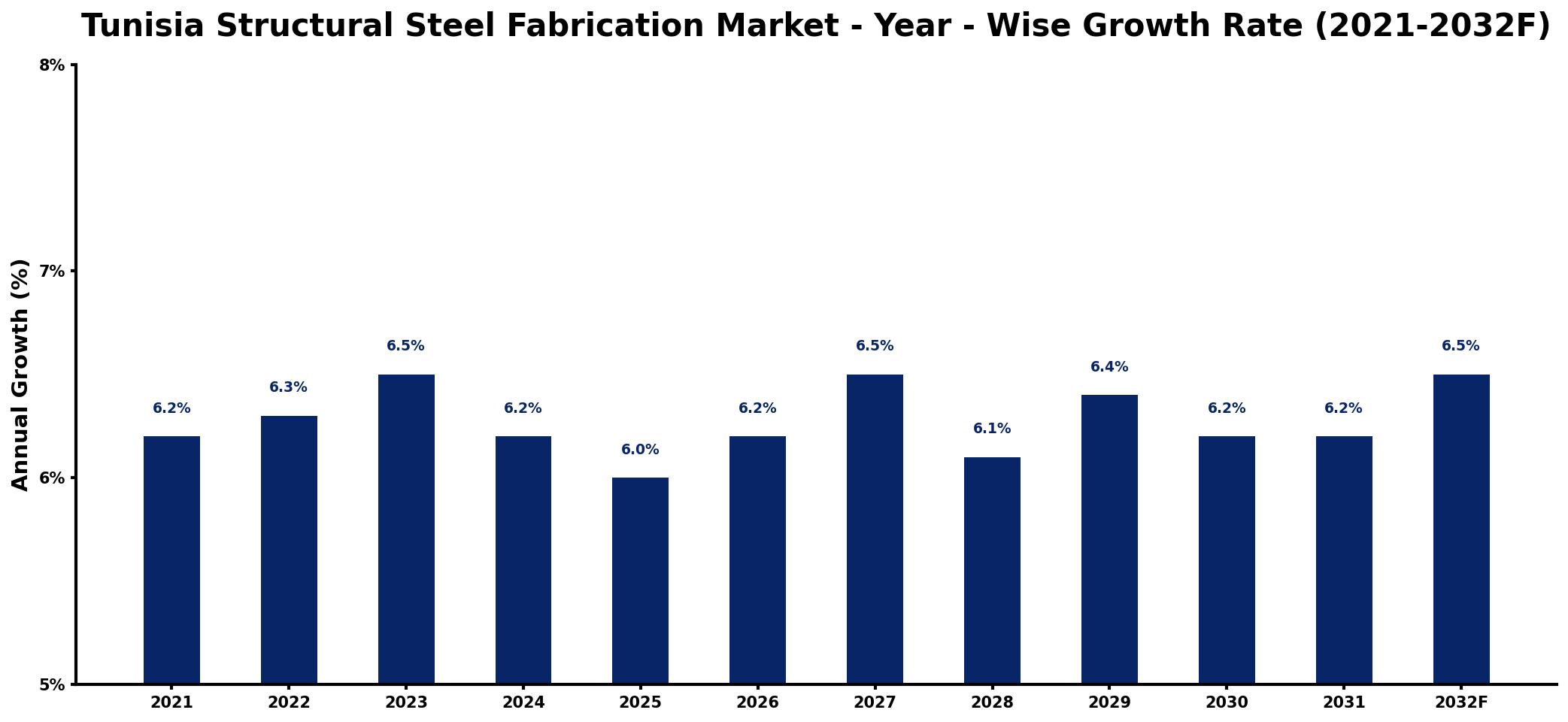
The table below presents the year‑wise growth rates along with the key drivers influencing the market
| Year | Growth Rate | Major Drivers |
| 2021 | 6.2% | Increased construction project investments |
| 2022 | 6.3% | Growing infrastructure development needs |
| 2023 | 6.5% | Rising demand for commercial buildings |
| 2024 | 6.2% | Expansion of renewable energy projects |
| 2025 | 6.0% | Increased residential housing demand |
| 2026 | 6.2% | Boost in transportation infrastructure projects |
| 2027 | 6.5% | Surge in industrial sector growth |
| 2028 | 6.1% | Demand for urban development initiatives |
| 2029 | 6.4% | Increased public sector funding initiatives |
| 2030 | 6.2% | Growth in tourism infrastructure projects |
| 2031 | 6.2% | growing emerging market penetration |
| 2032 | 6.5% | expanding healthcare application demand |
Note: Market size estimations and growth projections presented in this report are based on 6Wresearch's proprietary forecasting methodology, utilizing the latest available industry data, government publications, and primary research inputs.
Tunisia Structural Steel Fabrication Market Synopsis
The increasing preference for structural steel due to its inherent durability and cost-effectiveness is shaping the landscape of the Tunisia Structural Steel Fabrication Market. This growing demand is particularly evident in the construction of energy-efficient buildings and large-scale infrastructure projects, highlighting the material's versatility and adaptability in meeting modern construction challenges.
Technological advancements are playing a crucial role in enhancing the productivity and efficiency of fabrication processes. The adoption of innovative techniques, such as CAD/CAM, is streamlining operations and reducing project timelines, further attracting investment in the sector. This focus on technological progress indicates a competitive market landscape that is increasingly geared towards sustainable practices.
Tunisia Structural Steel Fabrication Market Key Takeaways
- The market is experiencing steady growth driven by rising construction activities and infrastructure projects.
- Government initiatives to support development and attract foreign investments are enhancing market opportunities.
- Technological advancements are improving productivity and efficiency in steel fabrication processes.
- Demand for sustainable and energy-efficient construction practices is increasing, leading to higher adoption of structural steel.
- Challenges such as fluctuating raw material prices and skilled labor shortages are influencing market dynamics.
Evaluation of Restraints in Tunisia Structural Steel Fabrication Market
While the Tunisia Structural Steel Fabrication Market shows promising growth, it faces several restraints that could impact its trajectory. Intense competition from both domestic and international players places pressure on profit margins and market share. Additionally, fluctuating prices of raw materials can significantly affect production costs, creating an unstable business environment. Furthermore, there is a notable shortage of skilled labor, which can lead to inefficiencies in production processes and hinder the overall growth potential of the sector. Addressing these restraints through strategic planning and innovation will be essential for companies to maintain their competitive edge.
Tunisia Structural Steel Fabrication Market Trends
The market is currently witnessing a shift towards more sustainable construction practices, leading to a growing demand for lightweight and durable structural steel materials. Additionally, the integration of advanced technologies, such as modular construction techniques, is gaining traction. These approaches allow for prefabricated steel components to be utilized, streamlining construction timelines while reducing labor costs. Overall, the focus on efficiency and sustainability is shaping the future of the structural steel fabrication market in Tunisia.
Tunisia Structural Steel Fabrication Market Opportunities
With the ongoing developments in Tunisia's construction sector, there are substantial investment opportunities within the structural steel fabrication market. Establishing or expanding steel fabrication facilities presents an opportunity for growth, particularly with the government actively promoting foreign investment and local manufacturing. Additionally, companies can focus on technological upgrades that enhance production efficiency and quality. Forming strategic partnerships with construction firms can also be advantageous, providing avenues for long-term contracts and collaborations.
Government Initiatives in the Tunisia Structural Steel Fabrication Market
The Tunisian government is implementing various policies aimed at bolstering the structural steel fabrication market. Initiatives include offering tax incentives and subsidies to attract foreign investment while supporting local manufacturers. Additionally, regulatory frameworks are being established to ensure compliance with international quality standards, promoting sustainable practices in the industry. Workforce development programs are also being prioritized to enhance the skill level of workers within this sector, ensuring alignment with evolving industry needs.
Future Insights of the Tunisia Structural Steel Fabrication Market
Looking ahead, the Tunisia Structural Steel Fabrication Market is well-positioned for continued growth between 2026 and 2032. Increasing investments in infrastructure, particularly in key sectors like transportation and energy, will drive demand for structural steel fabrication services. Moreover, as the construction industry embraces more sustainable methods, the adoption of steel structures will likely rise. By leveraging its skilled labor force and strategic location, Tunisia stands to attract substantial domestic and international investments, fostering innovation and enhancing market competitiveness.
Tunisia Structural Steel Fabrication Market Latest Developments (2025 - 2026)
Recent developments in the Tunisia Structural Steel Fabrication Market indicate a heightened focus on sustainability and efficiency. Companies are increasingly adopting eco-friendly materials and energy-efficient fabrication techniques to align with market demands. Furthermore, collaborations among construction firms and steel fabricators are becoming more common, as stakeholders seek to streamline project delivery and reduce costs. This period is marked by an overall commitment to innovation within the sector, setting the stage for future advancements.
Tunisia Structural Steel Fabrication Market - Key Attractiveness of the Report
- 10 Years of Market Numbers
- Historical Data Starting from 2022 to 2025
- Base Year: 2025
- Forecast Data until 2032
- Key Performance Indicators Impacting the Market
- Major Upcoming Developments and Projects
Key Highlights of the Report:
- Tunisia Structural Steel Fabrication Market Outlook
- Market Size of Tunisia Structural Steel Fabrication Market, 2025
- Forecast of Tunisia Structural Steel Fabrication Market, 2032
- Historical Data and Forecast of Tunisia Structural Steel Fabrication Revenues & Volume for the Period 2022-2032F
- Tunisia Structural Steel Fabrication Market Trend Evolution
- Tunisia Structural Steel Fabrication Market Drivers and Challenges
- Tunisia Structural Steel Fabrication Price Trends
- Tunisia Structural Steel Fabrication Porter's Five Forces
- Tunisia Structural Steel Fabrication Industry Life Cycle
- Historical Data and Forecast of Tunisia Structural Steel Fabrication Market Revenues & Volume By End-user Industry for the Period 2022-2032F
- Historical Data and Forecast of Tunisia Structural Steel Fabrication Market Revenues & Volume By Manufacturing for the Period 2022-2032F
- Historical Data and Forecast of Tunisia Structural Steel Fabrication Market Revenues & Volume By Power and Energy for the Period 2022-2032F
- Historical Data and Forecast of Tunisia Structural Steel Fabrication Market Revenues & Volume By Construction for the Period 2022-2032F
- Historical Data and Forecast of Tunisia Structural Steel Fabrication Market Revenues & Volume By Oil and Gas for the Period 2022-2032F
- Historical Data and Forecast of Tunisia Structural Steel Fabrication Market Revenues & Volume By Other for the Period 2022-2032F
- Historical Data and Forecast of Tunisia Structural Steel Fabrication Market Revenues & Volume By Product Type for the Period 2022-2032F
- Historical Data and Forecast of Tunisia Structural Steel Fabrication Market Revenues & Volume By Heavy Sectional Steel for the Period 2022-2032F
- Historical Data and Forecast of Tunisia Structural Steel Fabrication Market Revenues & Volume By Light Sectional Steel for the Period 2022-2032F
- Historical Data and Forecast of Tunisia Structural Steel Fabrication Market Revenues & Volume By Other for the Period 2022-2032F
- Tunisia Structural Steel Fabrication Import Export Trade Statistics
- Market Opportunity Assessment By End-user Industry
- Market Opportunity Assessment By Product Type
- Tunisia Structural Steel Fabrication Top Companies Market Share
- Tunisia Structural Steel Fabrication Competitive Benchmarking By Technical and Operational Parameters
- Tunisia Structural Steel Fabrication Company Profiles
- Tunisia Structural Steel Fabrication Key Strategic Recommendations






































