Tunisia Tables Market Summary
The tunisia tables market was estimated at USD 334 Million in 2025 and is projected to reach USD 436 Million by 2032, growing at a CAGR of 4.5% from 2026 to 2032.
Tunisia Tables Market Year-wise Growth Rate and Key Drivers
This graph highlights how the Tunisia Tables Market has steadily grown over the past five years, supported by major growth factors.
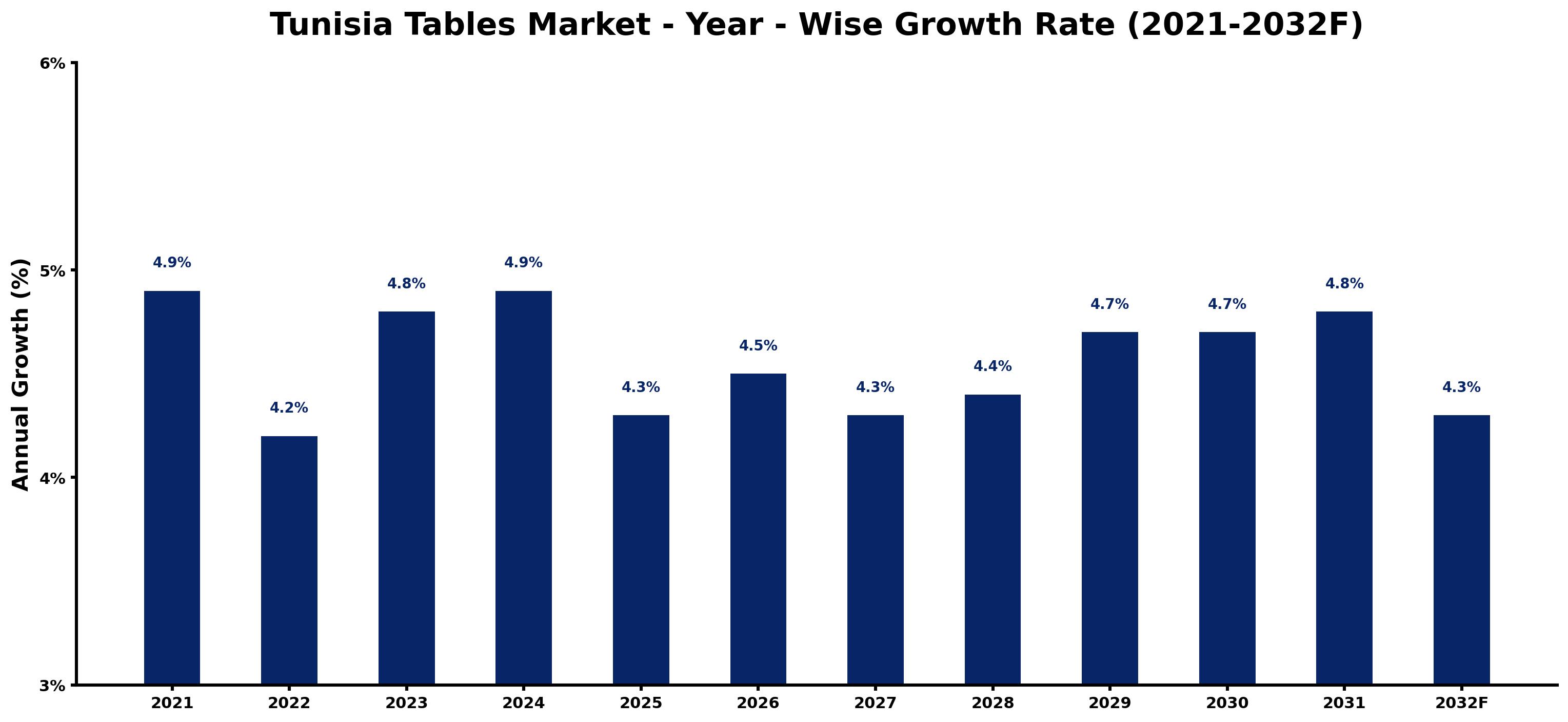
The table below presents the year wise growth rates along with the key drivers influencing the market
| Year | Growth Rate | Major Drivers |
| 2021 | 4.9% | COVID-19 disruptions motivated local artisans to enhance online sales strategies. |
| 2022 | 4.2% | Increased tourism revitalized interest in traditional Tunisian craftsmanship and furniture design. |
| 2023 | 4.8% | Consumers began prioritizing eco-friendly materials in their home décor purchases. |
| 2024 | 4.9% | Emerging interior design trends showcased locally crafted tables as unique statement pieces. |
| 2025 | 4.3% | Local manufacturers expanded their product lines to include multifunctional furniture solutions. |
| 2026 | 4.5% | Investment in supply chain improvements reduced costs and improved table production efficiency. |
| 2027 | 4.3% | Cross-border trade agreements expanded market access for Tunisian furniture exporters. |
| 2028 | 4.4% | Urbanization trends led to higher demand for space-efficient furniture in city dwellings. |
| 2029 | 4.7% | Artistic collaborations between designers and artisans boosted visibility of traditional tables. |
| 2030 | 4.7% | Sustainable tourism initiatives highlighted local craftsmanship, driving consumer interest in tables. |
| 2031 | 4.8% | Digital marketing campaigns effectively reached young consumers seeking unique home furnishings. |
| 2032 | 4.3% | Global lifestyle trends emphasized handmade products, enhancing the appeal of Tunisian tables. |
Note - Market size estimations and growth projections presented in this report are based on 6Wresearch's advanced forecasting approach, validated with industry datasets as of June 2026.
Tunisia Tables Market Synopsis
The Tunisia Tables Market is projected to reach 4.5% and witness significant growth during the forecast period (2026-2032). The steady expansion of this market is largely attributed to increasing demand for tables in both residential and commercial sectors. With rising disposable incomes and evolving consumer preferences leaning towards modern and stylish furniture, the Tunisia tables market is well-positioned for continued development.
Tunisia Tables Market Growth Drivers
Several key factors are driving the growth of the Tunisia tables market. Firstly, the expanding real estate sector is fostering a higher demand for furniture, including dining and coffee tables. Secondly, consumers are increasingly valuing multifunctional furniture that accommodates diverse needs, such as tables that can function as workspaces. Furthermore, disposable income levels are on the rise, enabling consumers to invest in quality furniture pieces that offer both aesthetic appeal and durability. Another significant driver is the growing trend towards sustainability, prompting manufacturers to incorporate eco-friendly materials and production methods. Lastly, the shift towards online retail channels provides consumers with a vast selection of table options, facilitating immediate access to desired products.
Tunisia Tables Market Trends and Opportunities
The Tunisia tables market is currently characterized by several prominent trends. Among these is the increasing preference for modern and minimalist designs that emphasize both functionality and versatility. Consumers are now seeking tables designed with storage capabilities or that can seamlessly transition between dining and workspace settings. Additionally, there is a notable rise in demand for customizable and modular tables that cater to different living spaces and personal aesthetics.
The market's inclination towards sustainability is also notable, with consumers exhibiting a stronger preference for products made from sustainable materials and produced through environmentally responsible methods. This trend offers manufacturers a niche market opportunity to engage eco-conscious consumers. As the online shopping experience becomes increasingly prevalent, businesses can capitalize on e-commerce platforms to reach broader audiences and enhance their sales potential.
Tunisia Tables Market Challenges and Restraints
Despite its growth potential, the Tunisia tables market faces several challenges. A primary concern is the fierce competition posed by imported furniture products, which often benefit from lower production costs. This competitive pricing can hinder local manufacturers' ability to maintain market share while upholding quality standards. Further, fluctuations in raw material prices present additional challenges that can impact production costs and profitability.
Moreover, the need for continuous innovation to keep pace with changing consumer preferences is a critical challenge that requires strategic investment in research and development. Businesses must also be agile and quick to adapt their product offerings to meet evolving trends, ensuring they remain relevant in a dynamic market landscape.
Tunisia Tables Market Investment Opportunities
The Tunisia tables market is ripe with investment opportunities for both local and international stakeholders. As domestic demand for high-quality furniture rises, there is potential for lucrative investments in the manufacturing and sale of tables. The growing emphasis on sustainable and eco-friendly furniture further opens avenues for investment in innovative design and production that resonates with environmentally conscious consumers.
Exploring online sales channels can also facilitate access to a wider customer base. By establishing a robust e-commerce presence, businesses can enhance their visibility and streamline purchasing processes, thus driving growth. Overall, as consumer preferences evolve, investors have the chance to align their offerings with market requirements, enabling them to capitalize on the burgeoning demand within the Tunisia tables market.
Tunisia Tables Market Government Investment and Initiatives
The Tunisian government has implemented several policies aimed at fostering the growth of the local tables market. This includes initiatives that promote local production, ensuring that manufacturers adhere to high-quality standards while sourcing materials domestically. The Ministry of Commerce has established regulations designed to protect local industries from the pressures of lower-cost imports by imposing relevant tariffs.
Additionally, the government offers various financial incentives and support programs to enhance competitiveness among table manufacturers. These initiatives are geared towards boosting the domestic market, creating job opportunities, and ensuring compliance with safety and environmental standards in table production. Overall, the government's focus on supporting local manufacturing is crucial for the sustainable development of the Tunisia tables market.
Tunisia Tables Market Latest Developments (May 2025 - June 2026)
In the period from May 2025 to June 2026, the Tunisia tables market has witnessed several noteworthy developments. There has been a marked increase in consumer demand for innovative and multifunctional table designs, aligning with contemporary lifestyle needs. This period also saw a stronger emphasis on sustainability, with manufacturers prioritizing eco-friendly materials and processes in their product lines.
The trend towards online shopping escalated, prompting businesses to enhance their digital presence and streamline e-commerce operations. As a response to competitive pressures, local manufacturers have begun investing in research and development to innovate their offerings. This includes the introduction of customizable options catering to consumer preferences for unique and personalized furniture pieces.
Tunisia Tables Market - Key Attractiveness of the Report
- 10 Years of Market Numbers
- Historical Data Starting from 2022 to 2025
- Base Year: 2025
- Forecast Data until 2032
- Key Performance Indicators Impacting the Market
- Major Upcoming Developments and Projects
Key Highlights of the Report:
- Tunisia Tables Market Outlook
- Market Size of Tunisia Tables Market, 2025
- Forecast of Tunisia Tables Market, 2032F
- Historical Data and Forecast of Tunisia Tables Revenues & Volume for the Period 2022-2032F
- Tunisia Tables Market Trend Evolution
- Tunisia Tables Market Drivers and Challenges
- Tunisia Tables Price Trends
- Tunisia Tables Porter's Five Forces
- Tunisia Tables Industry Life Cycle
- Historical Data and Forecast of Tunisia Tables Market Revenues & Volume By Types for the Period 2022-2032F
- Historical Data and Forecast of Tunisia Tables Market Revenues & Volume By Fabric for the Period 2022-2032F
- Historical Data and Forecast of Tunisia Tables Market Revenues & Volume By Leather for the Period 2022-2032F
- Historical Data and Forecast of Tunisia Tables Market Revenues & Volume By Metal for the Period 2022-2032F
- Historical Data and Forecast of Tunisia Tables Market Revenues & Volume By Wooden for the Period 2022-2032F
- Historical Data and Forecast of Tunisia Tables Market Revenues & Volume By Others for the Period 2022-2032F
- Historical Data and Forecast of Tunisia Tables Market Revenues & Volume By Applications for the Period 2022-2032F
- Historical Data and Forecast of Tunisia Tables Market Revenues & Volume By Family for the Period 2022-2032F
- Historical Data and Forecast of Tunisia Tables Market Revenues & Volume By Office for the Period 2022-2032F
- Historical Data and Forecast of Tunisia Tables Market Revenues & Volume By Others for the Period 2022-2032F
- Tunisia Tables Import Export Trade Statistics
- Market Opportunity Assessment By Types
- Market Opportunity Assessment By Applications
- Tunisia Tables Top Companies Market Share
- Tunisia Tables Competitive Benchmarking By Technical and Operational Parameters
- Tunisia Tables Company Profiles
- Tunisia Tables Key Strategic Recommendations






































