Tunisia Thermoplastic Composites Market Size, Share & Growth Rate
The Tunisia Thermoplastic Composites Market was estimated at USD 368 Million in 2025 and is projected to reach USD 508 Million by 2032, growing at a CAGR of 4.7% from 2026 to 2032. This growth trajectory is primarily driven by the increasing demand for lightweight and durable materials, particularly in the automotive and aerospace sectors, where efficiency and performance are critical. Additionally, a heightened focus on sustainability is prompting manufacturers to adopt recyclable materials, further propelling market dynamics.
Tunisia Thermoplastic Composites Market Year-wise Growth Rate and Key Drivers
This graph highlights how the Tunisia Thermoplastic Composites Market has steadily grown over the years, supported by major growth factors.
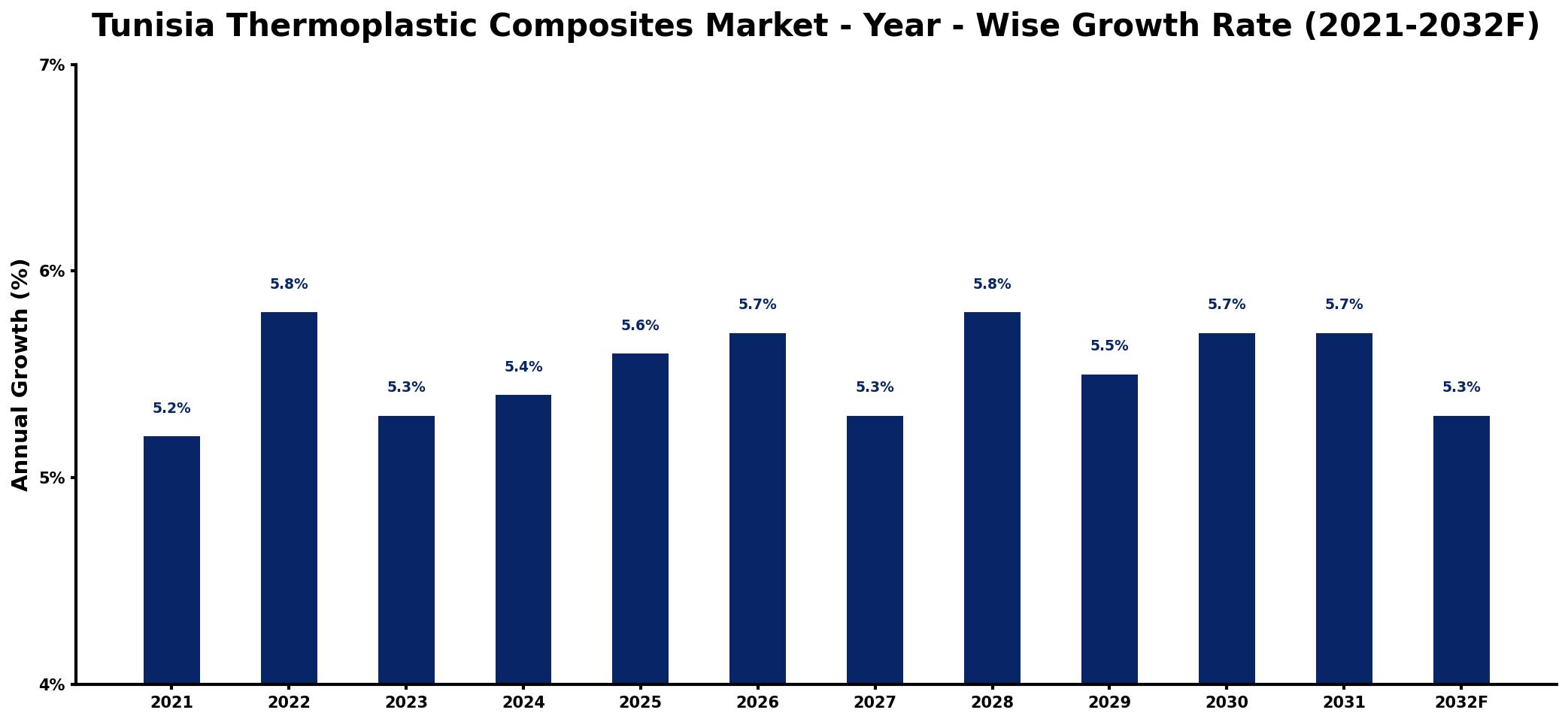
The table below presents the year‑wise growth rates along with the key drivers influencing the market
| Year | Growth Rate | Major Drivers |
| 2021 | 5.2% | Rising automotive sector investments |
| 2022 | 5.8% | Increased construction project demands |
| 2023 | 5.3% | Growing aerospace manufacturing activities |
| 2024 | 5.4% | Expansion of renewable energy initiatives |
| 2025 | 5.6% | Technological advancements in production |
| 2026 | 5.7% | Growth in consumer electronics sector |
| 2027 | 5.3% | Increased demand for lightweight materials |
| 2028 | 5.8% | Emerging applications in healthcare industry |
| 2029 | 5.5% | Surge in infrastructure development projects |
| 2030 | 5.7% | Heightened focus on sustainability practices |
| 2031 | 5.7% | Rising demand in marine applications |
| 2032 | 5.3% | Increased investment in research innovation |
Note: Market size estimations and growth projections presented in this report are based on 6Wresearch's proprietary forecasting methodology, utilizing the latest available industry data, government publications, and primary research inputs.
Tunisia Thermoplastic Composites Market Synopsis
In Tunisia, the adoption of thermoplastic composites is gaining momentum, particularly in industries demanding innovative materials that meet rigorous performance standards. The automotive sector, in particular, is moving towards composites that provide weight savings and improved fuel efficiency.
With an increasing awareness of environmental impact, companies are motivated to explore alternatives to traditional materials. This shift is not just about compliance with regulations but also about leveraging the competitive advantages that thermoplastic composites can offer in terms of recyclability and mechanical strength.
Tunisia Thermoplastic Composites Market Key Takeaways
- The market is witnessing a notable shift towards sustainable practices, with recyclability being a key factor in material selection.
- Technological advancements in manufacturing processes are enhancing the viability of thermoplastic composites in various applications.
- Government incentives aimed at industrial modernization are encouraging investments in thermoplastic composite technologies.
- End-user industries are increasingly recognizing the long-term cost benefits associated with lightweight materials.
- There is a growing need for educational initiatives to inform potential users about the advantages of thermoplastic composites.
Evaluation of Restraints in Tunisia Thermoplastic Composites Market
Despite the promising growth of the thermoplastic composites market in Tunisia, several restraints remain. The high initial costs associated with production and the investment required for specialized processing equipment can deter potential manufacturers. Moreover, thermoplastic composites face competition from established materials, such as metals and traditional composites, which are often more cost-effective for specific applications. Finally, a lack of awareness and understanding among potential users about the benefits and applications of thermoplastic composites also presents a challenge that needs to be addressed for broader market penetration.
Tunisia Thermoplastic Composites Market Trends
Current trends in the Tunisia Thermoplastic Composites Market reflect a strong inclination towards innovation and sustainability. Companies are increasingly investing in research to develop new formulations that enhance performance while maintaining recyclability. Additionally, collaborations between manufacturers and research institutions are fostering the exploration of advanced composites that can be tailored for specific industrial applications. This synergy is driving technology advancements, ensuring that the market stays responsive to evolving consumer preferences.
Tunisia Thermoplastic Composites Market Opportunities
The Tunisia Thermoplastic Composites Market presents significant growth opportunities, particularly in the automotive and aerospace sectors. As industries push for lightweight solutions that do not compromise on strength, there is room for innovation in product development. Furthermore, as sustainability becomes a non-negotiable aspect of material sourcing, companies that invest in eco-friendly composites are likely to gain a competitive edge. The ongoing support from the government for research and modernization also opens avenues for new players to enter the market.
Government Initiatives in the Tunisia Thermoplastic Composites Market
The Tunisian government is playing a pivotal role in fostering the thermoplastic composites market through supportive policies and initiatives. By providing incentives such as tax breaks and grants for companies focusing on the production of thermoplastic composite technologies, the government is encouraging industrial modernization. Additionally, regulatory measures are established to ensure the safety and quality of materials, facilitating broader acceptance both domestically and in international markets. Investments in R&D initiatives further underpin the government's commitment to advancing this sector.
Future Insights of the Tunisia Thermoplastic Composites Market
Looking ahead to the period from 2026 to 2032, the Tunisia Thermoplastic Composites Market is set to experience robust growth, driven by the convergence of technological advancements and sustainability imperatives. As manufacturers continue to innovate and refine production techniques, the efficiency and applicability of thermoplastic composites will likely expand. Additionally, the growing environmental consciousness among consumers will place further emphasis on recyclable materials, positioning thermoplastic composites as a favorable alternative in various industries.
Tunisia Thermoplastic Composites Market Latest Developments (2025 - 2026)
Recent developments in the Tunisia Thermoplastic Composites Market indicate a strong push towards innovation and collaboration within the industry. Manufacturers are increasingly entering partnerships with research institutions to explore new composite formulations that cater to specific industrial needs. Furthermore, there is a marked increase in initiatives aimed at enhancing awareness around the benefits and applications of thermoplastic composites, paving the way for wider market adoption.
Tunisia Thermoplastic Composites Market - Key Attractiveness of the Report
- 10 Years of Market Numbers
- Historical Data Starting from 2022 to 2025
- Base Year: 2025
- Forecast Data until 2032
- Key Performance Indicators Impacting the Market
- Major Upcoming Developments and Projects
Key Highlights of the Report:
- Tunisia Thermoplastic Composites Market Outlook
- Market Size of Tunisia Thermoplastic Composites Market, 2025
- Forecast of Tunisia Thermoplastic Composites Market, 2032
- Historical Data and Forecast of Tunisia Thermoplastic Composites Revenues & Volume for the Period 2022-2032F
- Tunisia Thermoplastic Composites Market Trend Evolution
- Tunisia Thermoplastic Composites Market Drivers and Challenges
- Tunisia Thermoplastic Composites Price Trends
- Tunisia Thermoplastic Composites Porter's Five Forces
- Tunisia Thermoplastic Composites Industry Life Cycle
- Historical Data and Forecast of Tunisia Thermoplastic Composites Market Revenues & Volume By Resin Type for the Period 2022-2032F
- Historical Data and Forecast of Tunisia Thermoplastic Composites Market Revenues & Volume By PA for the Period 2022-2032F
- Historical Data and Forecast of Tunisia Thermoplastic Composites Market Revenues & Volume By PP for the Period 2022-2032F
- Historical Data and Forecast of Tunisia Thermoplastic Composites Market Revenues & Volume By PEEK for the Period 2022-2032F
- Historical Data and Forecast of Tunisia Thermoplastic Composites Market Revenues & Volume By Hybrid for the Period 2022-2032F
- Historical Data and Forecast of Tunisia Thermoplastic Composites Market Revenues & Volume By Others for the Period 2022-2032F
- Historical Data and Forecast of Tunisia Thermoplastic Composites Market Revenues & Volume By Fiber Type for the Period 2022-2032F
- Historical Data and Forecast of Tunisia Thermoplastic Composites Market Revenues & Volume By Carbon for the Period 2022-2032F
- Historical Data and Forecast of Tunisia Thermoplastic Composites Market Revenues & Volume By Glass for the Period 2022-2032F
- Historical Data and Forecast of Tunisia Thermoplastic Composites Market Revenues & Volume By Mineral for the Period 2022-2032F
- Historical Data and Forecast of Tunisia Thermoplastic Composites Market Revenues & Volume By Others for the Period 2022-2032F
- Historical Data and Forecast of Tunisia Thermoplastic Composites Market Revenues & Volume By Product Type for the Period 2022-2032F
- Historical Data and Forecast of Tunisia Thermoplastic Composites Market Revenues & Volume By Short Fiber Thermoplastics for the Period 2022-2032F
- Historical Data and Forecast of Tunisia Thermoplastic Composites Market Revenues & Volume By Glass Mat Thermoplastics for the Period 2022-2032F
- Historical Data and Forecast of Tunisia Thermoplastic Composites Market Revenues & Volume By Long Fiber Thermoplastics for the Period 2022-2032F
- Historical Data and Forecast of Tunisia Thermoplastic Composites Market Revenues & Volume By Continuous Fiber Thermoplastics for the Period 2022-2032F
- Historical Data and Forecast of Tunisia Thermoplastic Composites Market Revenues & Volume By Application for the Period 2022-2032F
- Historical Data and Forecast of Tunisia Thermoplastic Composites Market Revenues & Volume By Automotive & Transportation for the Period 2022-2032F
- Historical Data and Forecast of Tunisia Thermoplastic Composites Market Revenues & Volume By Oil & Gas for the Period 2022-2032F
- Historical Data and Forecast of Tunisia Thermoplastic Composites Market Revenues & Volume By Aerospace for the Period 2022-2032F
- Historical Data and Forecast of Tunisia Thermoplastic Composites Market Revenues & Volume By Agriculture for the Period 2022-2032F
- Historical Data and Forecast of Tunisia Thermoplastic Composites Market Revenues & Volume By Marine for the Period 2022-2032F
- Historical Data and Forecast of Tunisia Thermoplastic Composites Market Revenues & Volume By Construction for the Period 2022-2032F
- Historical Data and Forecast of Tunisia Thermoplastic Composites Market Revenues & Volume By Electrical & Electronics for the Period 2022-2032F
- Historical Data and Forecast of Tunisia Thermoplastic Composites Market Revenues & Volume By Others for the Period 2022-2032F
- Tunisia Thermoplastic Composites Import Export Trade Statistics
- Market Opportunity Assessment By Resin Type
- Market Opportunity Assessment By Fiber Type
- Market Opportunity Assessment By Product Type
- Market Opportunity Assessment By Application
- Tunisia Thermoplastic Composites Top Companies Market Share
- Tunisia Thermoplastic Composites Competitive Benchmarking By Technical and Operational Parameters
- Tunisia Thermoplastic Composites Company Profiles
- Tunisia Thermoplastic Composites Key Strategic Recommendations






































