Tunisia Toilet seat Market Size Growth Rate
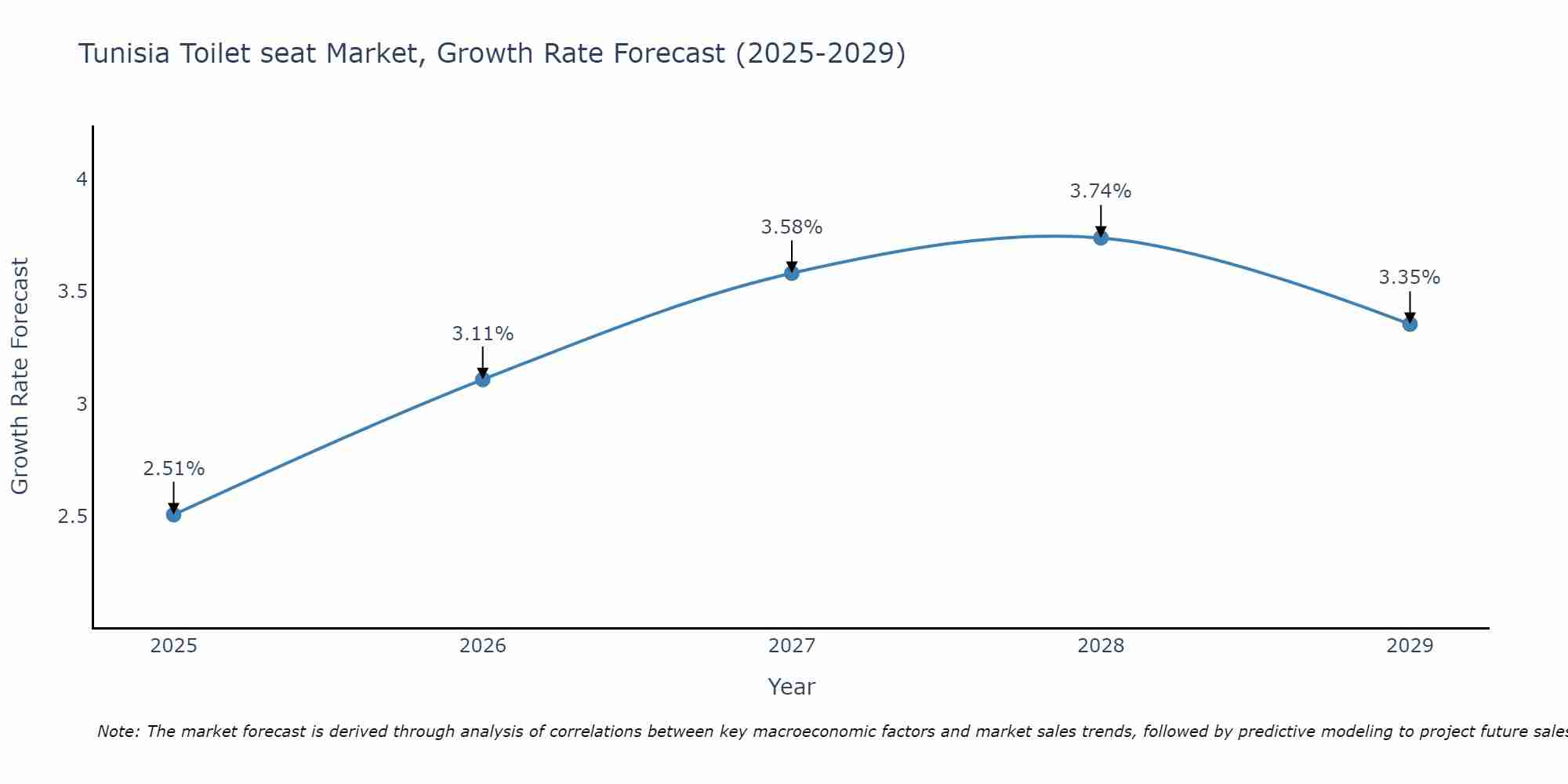
The Tunisia Toilet seat Market is projected to witness mixed growth rate patterns during 2025 to 2029. The growth rate begins at 2.51% in 2025, climbs to a high of 3.74% in 2028, and moderates to 3.35% by 2029.
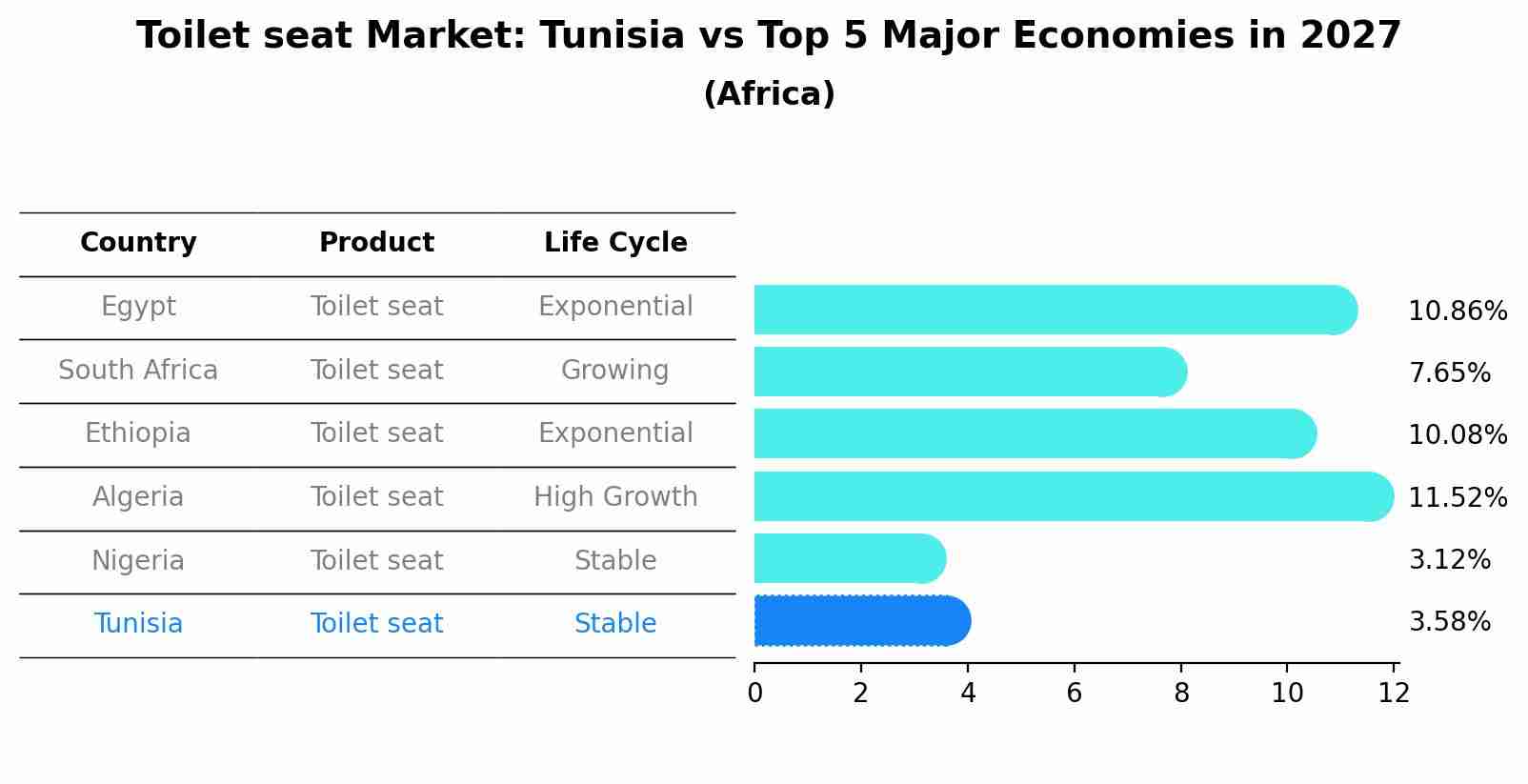
Toilet seat Market: Tunisia vs Top 5 Major Economies in 2027 (Africa)
Tunisia's Toilet seat market is anticipated to experience a stable growth rate of 3.58% by 2027, reflecting trends observed in the largest economy Egypt, followed by South Africa, Ethiopia, Algeria and Nigeria.
Tunisia Toilet seat Market Overview
The Tunisia toilet seat market is experiencing steady growth driven by increasing urbanization, rising disposable incomes, and a growing awareness of hygiene and sanitation. The market is characterized by a variety of products including traditional plastic seats, modern soft-close seats, and advanced bidet seats with smart functionalities. Key players in the market offer a range of designs, materials, and price points to cater to diverse consumer preferences. The market is also witnessing a trend towards eco-friendly and sustainable toilet seats made from recyclable materials. With a focus on innovation and product differentiation, manufacturers are constantly introducing new features such as antimicrobial coatings and easy installation mechanisms to enhance consumer experience. Overall, the Tunisia toilet seat market presents opportunities for growth and expansion in line with evolving consumer demands.
Tunisia Toilet seat Market Trends
The Tunisia toilet seat market is currently experiencing a shift towards more modern and advanced toilet seat designs. Consumers are showing increased interest in features such as soft-close hinges, quick-release mechanisms for easy cleaning, and antimicrobial surfaces. Additionally, there is a growing demand for eco-friendly and water-saving toilet seat options to promote sustainability. Customization options, such as heated seats and bidet functionalities, are also gaining popularity among Tunisian consumers. As hygiene and comfort become top priorities for customers, manufacturers in the Tunisia toilet seat market are focusing on innovation and product differentiation to meet these evolving consumer preferences.
Tunisia Toilet seat Market Challenges
In the Tunisia toilet seat market, some of the key challenges faced include price competition from lower-cost alternatives, lack of awareness about the importance of quality and hygiene in toilet seats, and limited product differentiation among competitors. The market is also impacted by fluctuations in raw material prices, which can affect production costs and pricing strategies. Additionally, infrastructure limitations in some areas may hinder distribution channels and access to target customers. To succeed in this market, companies need to focus on innovation in design and materials, invest in marketing campaigns to educate consumers about the benefits of high-quality toilet seats, and establish strong partnerships with distributors to improve market reach and penetration.
Tunisia Toilet seat Market Investment Opportunities
The Tunisia toilet seat market presents various investment opportunities for both domestic and international investors. With an increasing focus on hygiene and sanitation, there is a growing demand for high-quality, durable toilet seats in the country. Investing in innovative and eco-friendly toilet seat designs could cater to the rising consumer preferences for modern and stylish bathroom fixtures. Additionally, targeting the hospitality sector, which includes hotels, resorts, and restaurants, presents a lucrative opportunity for supplying bulk orders of toilet seats. Collaborating with local distributors and retailers to expand market reach and establish a strong distribution network can also be a strategic investment move. Overall, tapping into the Tunisia toilet seat market offers the potential for sustainable growth and profitability in the long run.
Tunisia Toilet seat Market Government Policy
In Tunisia, government policies related to the toilet seat market primarily focus on product quality, safety, and environmental sustainability. The Tunisian Standards Institute (INNORPI) sets standards for toilet seats to ensure they meet quality and safety requirements. Additionally, there are regulations in place to promote the use of eco-friendly materials in manufacturing toilet seats to reduce environmental impact. The government also encourages local production and supports small businesses in the industry through incentives and subsidies. Import regulations are enforced to ensure that imported toilet seats meet the same standards as domestically produced ones. Overall, the government aims to protect consumer rights, promote sustainable practices, and boost the domestic toilet seat market in Tunisia.
Tunisia Toilet seat Market Future Outlook
The future outlook for the Tunisia toilet seat market is expected to show steady growth driven by factors such as increasing urbanization, rising disposable income, and a growing awareness of hygiene and sanitation. With a growing focus on home improvement and bathroom renovations, demand for innovative and stylish toilet seats is likely to increase. Additionally, the trend towards smart and eco-friendly products in the home sector may drive the market towards more sustainable and technologically advanced toilet seat options. Manufacturers may also focus on introducing customizable and easy-to-install toilet seats to cater to consumer preferences. Overall, the Tunisia toilet seat market is poised for gradual expansion and product diversification in the coming years.
Key Highlights of the Report:
- Tunisia Toilet seat Market Outlook
- Market Size of Tunisia Toilet seat Market, 2021
- Forecast of Tunisia Toilet seat Market, 2027
- Historical Data and Forecast of Tunisia Toilet seat Revenues & Volume for the Period 2018 - 2027
- Tunisia Toilet seat Market Trend Evolution
- Tunisia Toilet seat Market Drivers and Challenges
- Tunisia Toilet seat Price Trends
- Tunisia Toilet seat Porter's Five Forces
- Tunisia Toilet seat Industry Life Cycle
- Historical Data and Forecast of Tunisia Toilet seat Market Revenues & Volume By Bowl Shape for the Period 2018 - 2027
- Historical Data and Forecast of Tunisia Toilet seat Market Revenues & Volume By Elongated for the Period 2018 - 2027
- Historical Data and Forecast of Tunisia Toilet seat Market Revenues & Volume By Round for the Period 2018 - 2027
- Historical Data and Forecast of Tunisia Toilet seat Market Revenues & Volume By Square for the Period 2018 - 2027
- Historical Data and Forecast of Tunisia Toilet seat Market Revenues & Volume By Raw Material for the Period 2018 - 2027
- Historical Data and Forecast of Tunisia Toilet seat Market Revenues & Volume By Plastic for the Period 2018 - 2027
- Historical Data and Forecast of Tunisia Toilet seat Market Revenues & Volume By Wood for the Period 2018 - 2027
- Historical Data and Forecast of Tunisia Toilet seat Market Revenues & Volume By Ceramic for the Period 2018 - 2027
- Historical Data and Forecast of Tunisia Toilet seat Market Revenues & Volume By Urea Molding Compound for the Period 2018 - 2027
- Historical Data and Forecast of Tunisia Toilet seat Market Revenues & Volume By Others for the Period 2018 - 2027
- Historical Data and Forecast of Tunisia Toilet seat Market Revenues & Volume By Category for the Period 2018 - 2027
- Historical Data and Forecast of Tunisia Toilet seat Market Revenues & Volume By Smart for the Period 2018 - 2027
- Historical Data and Forecast of Tunisia Toilet seat Market Revenues & Volume By Ordinary for the Period 2018 - 2027
- Historical Data and Forecast of Tunisia Toilet seat Market Revenues & Volume By Application for the Period 2018 - 2027
- Historical Data and Forecast of Tunisia Toilet seat Market Revenues & Volume By Residential for the Period 2018 - 2027
- Historical Data and Forecast of Tunisia Toilet seat Market Revenues & Volume By Commercial for the Period 2018 - 2027
- Historical Data and Forecast of Tunisia Toilet seat Market Revenues & Volume By Distribution Channel for the Period 2018 - 2027
- Historical Data and Forecast of Tunisia Toilet seat Market Revenues & Volume By Online for the Period 2018 - 2027
- Historical Data and Forecast of Tunisia Toilet seat Market Revenues & Volume By Offline for the Period 2018 - 2027
- Tunisia Toilet seat Import Export Trade Statistics
- Market Opportunity Assessment By Bowl Shape
- Market Opportunity Assessment By Raw Material
- Market Opportunity Assessment By Category
- Market Opportunity Assessment By Application
- Market Opportunity Assessment By Distribution Channel
- Tunisia Toilet seat Top Companies Market Share
- Tunisia Toilet seat Competitive Benchmarking By Technical and Operational Parameters
- Tunisia Toilet seat Company Profiles
- Tunisia Toilet seat Key Strategic Recommendations






































