Tunisia Toys and Hobby Goods Market Summary
The tunisia toys and hobby goods market was estimated at USD 716 Million in 2025 and is projected to reach USD 1019 Million by 2032, growing at a CAGR of 6.2% from 2026 to 2032.
Tunisia Toys and Hobby Goods Market Year-wise Growth Rate and Key Drivers
This graph highlights how the Tunisia Toys and Hobby Goods Market has steadily grown over the past five years, supported by major growth factors.
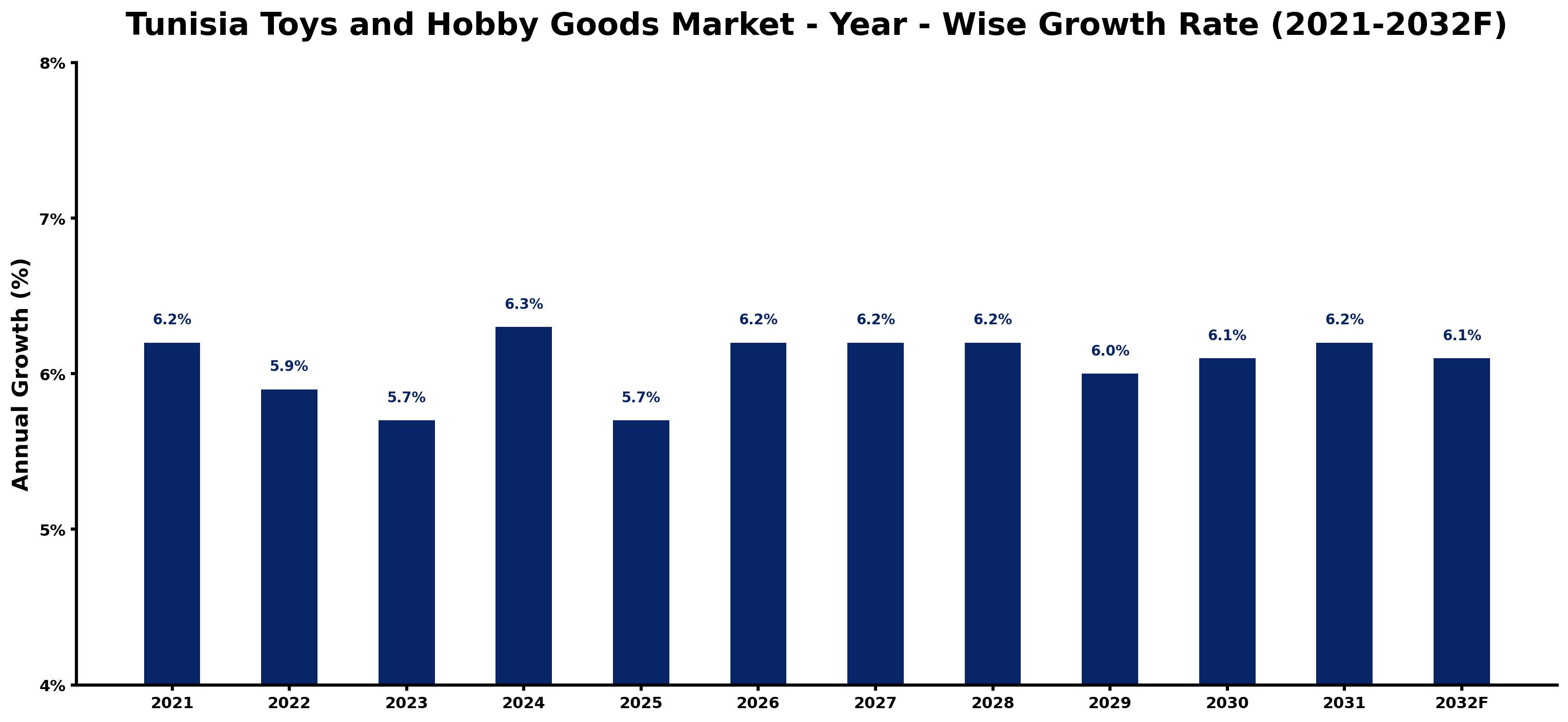
The table below presents the year wise growth rates along with the key drivers influencing the market
| Year | Growth Rate | Major Drivers |
| 2021 | 6.2% | Post-pandemic recovery sparked interest in home-based entertainment and creative hobbies. |
| 2022 | 5.9% | New brands entered the Tunisian market, enhancing product variety and consumer choice. |
| 2023 | 5.7% | Regional economic stability increased disposable incomes, allowing families to spend on toys. |
| 2024 | 6.3% | E-commerce platforms expanded, offering convenient access to a broader range of products. |
| 2025 | 5.7% | Social media influencers showcased innovative toys, significantly impacting consumer purchasing decisions. |
| 2026 | 6.2% | Cultural events and festivals promoted local artisans, boosting handmade toy sales substantially. |
| 2027 | 6.2% | Increasing urbanization led to a greater demand for educational toys and development kits. |
| 2028 | 6.2% | Local manufacturing initiatives emerged, reducing costs and improving product availability in stores. |
| 2029 | 6.0% | Environmental awareness spurred interest in sustainable and eco-friendly toy options among consumers. |
| 2030 | 6.1% | International collaborations with toy brands introduced global trends to the Tunisian market. |
| 2031 | 6.2% | Technological integration into toys captured the interest of tech-savvy younger generations. |
| 2032 | 6.1% | Rising tourism contributed to gift sales, further stimulating the local toys and hobby market. |
Note - Market size estimations and growth projections presented in this report are based on 6Wresearch's advanced forecasting approach, validated with industry datasets as of June 2026.
Tunisia Toys and Hobby Goods Market Synopsis
The Tunisia Toys and Hobby Goods Market is projected to reach 6.2% and witness significant growth during the forecast period (2026-2032). As the nation embraces technological advancements and modern leisure activities, the market is expected to expand at a compound annual growth rate (CAGR) of around 4.8%. The growth trajectory is largely influenced by the rise in disposable incomes, increasing consumer interest in innovative recreational products, and a burgeoning inclination towards outdoor sports and educational toys.
Tunisia Toys and Hobby Goods Market Growth Drivers
Several key factors are driving the expansion of the Tunisia Toys and Hobby Goods Market. Primarily, the increasing consumption of gaming consoles and electronic gadgets has reshaped consumer preferences. Many households now prioritize tech-savvy toys and hobby goods, prompting manufacturers to innovate continuously. Furthermore, the cultural shift towards outdoor recreational activities has heightened the demand for sports-related toys, encapsulating a growing enthusiasm for games such as cricket and football.
- The proliferation of gaming consoles has profoundly changed how children and adults engage in play, establishing a competitive market for video games and related accessories.
- Rising disposable incomes amongst consumers have facilitated the purchase of sophisticated electronic gadgets, thereby augmenting market demand.
- Outdoor activities and sports have gained traction among the youth, resulting in a surge in popularity for toys that promote active engagement.
- The educational trend towards robotics and DIY science projects has spurred demand for innovative play items, aligning with parents' desires for products that stimulate creativity.
- Vendors are increasingly appealing to adults as well, introducing products that cater to a wide demographic, thereby broadening the market base.
Tunisia Toys and Hobby Goods Market Trends and Opportunities
The Tunisia Toys and Hobby Goods Market presents numerous trends that indicate growth potential. The rapid integration of technology into play products is a significant trend, with manufacturers introducing advanced features like gesture recognition technology in robots and electronic toys. This trend aligns with contemporary consumer expectations for smart toys that offer interactive play experiences. Another emerging trend is the focus on sustainability, with eco-friendly materials increasingly sought after by environmentally conscious consumers.
- The rise of smart toys suggests an increasing consumer preference for products that merge technology with traditional play, creating engaging educational experiences.
- Sustainability has become a crucial factor in purchasing decisions, prompting companies to innovate with biodegradable or recyclable materials.
- Virtual reality (VR) and augmented reality (AR) toys are beginning to penetrate the market, offering immersive experiences that attract tech-savvy users.
- Social media platforms play a significant role in marketing trends, with influencers bringing attention to the latest toys and hobby goods.
- There is a growing interest in DIY kits that not only entertain but also educate, suggesting an expanding niche in the market.
Tunisia Toys and Hobby Goods Market Challenges and Restraints
Despite its promising outlook, the Tunisia Toys and Hobby Goods Market faces several challenges. One significant issue is the volatility of raw material prices, which can adversely affect manufacturing costs. Additionally, the market contends with import restrictions and tariffs, complicating the supply chain dynamics for foreign toys and hobby goods. Consumer preferences can be fickle, shifting rapidly towards newer trends, which puts pressure on manufacturers to consistently innovate.
- The fluctuating economy can impact consumer purchasing power, leading to less spending on non-essential items such as toys.
- Import tariffs can obstruct the entry of diverse international products, limiting consumer options.
- Manufacturers must maintain a delicate balance between affordability and quality to meet diverse consumer expectations.
- Rising competition from local and international brands necessitates continuous innovation and marketing efforts.
- Market players must navigate regulatory challenges that can impede product launches or distribution channels.
Tunisia Toys and Hobby Goods Market Government Investment and Initiatives
The Tunisian government plays an influential role in the development of the Toys and Hobby Goods Market through various initiatives aimed at enhancing local production and supporting the creative industries. Policies focused on fostering entrepreneurship and innovation are crucial to revitalizing the manufacturing sector, particularly for domestic toy producers. Furthermore, investments in technology and education through public spending are expected to bolster skills development in the workforce, thereby enhancing the overall market potential for toys that emphasize educational value.
- The government is encouraging startups in the educational and recreational sectors by providing grants and funding opportunities.
- Public investment in technology infrastructure is expected to benefit local manufacturers by improving supply chain efficiencies.
- Supportive policies aimed at stimulating tourism are indirectly enhancing the toys and hobby goods market through increased consumer spending.
- Regulatory frameworks are being streamlined to reduce bureaucratic hurdles for new entrants in the market.
- Government initiatives promoting STEM education reinforce consumer interest in educational tools such as robotics kits.
Tunisia Toys and Hobby Goods Market Latest Developments (May 2025 - June 2026)
From May 2025 to June 2026, the Tunisia Toys and Hobby Goods Market has witnessed notable developments that reflect the trends and dynamics of the industry. The introduction of more technologically advanced toys has been a highlight, aligning with global trends in educational and interactive play. Increased emphasis on sustainability has prompted manufacturers to adopt eco-friendly practices, thereby responding to consumer demand for environmentally responsible products. Additionally, the government has announced measures to stimulate investment in the sector, aimed at fostering a more resilient local industry amidst growing competition.
- Technological advancements in toys have led to a surge in the popularity of interactive and educational products, appealing to tech-savvy consumers.
- Manufacturers are increasingly prioritizing sustainable materials in product development, reflecting changing consumer preferences.
- Government initiatives have focused on reducing import tariffs, allowing for a more diverse range of products in the market.
- Local entrepreneurs are emerging, contributing to a more vibrant and competitive market landscape.
- Efforts to boost sports and outdoor activities have led to a notable increase in the availability of related toys and equipment.
Tunisia Toys and Hobby Goods Market - Key Attractiveness of the Report
- 10 Years of Market Numbers
- Historical Data Starting from 2022 to 2025
- Base Year: 2025
- Forecast Data until 2032
- Key Performance Indicators Impacting the Market
- Major Upcoming Developments and Projects
Key Highlights of the Report:
- Tunisia Toys and Hobby Goods Market Outlook
- Market Size of Tunisia Toys and Hobby Goods Market, 2025
- Forecast of Tunisia Toys and Hobby Goods Market, 2032F
- Historical Data and Forecast of Tunisia Toys and Hobby Goods Revenues & Volume for the Period 2022-2032F
- Tunisia Toys and Hobby Goods Market Trend Evolution
- Tunisia Toys and Hobby Goods Market Drivers and Challenges
- Tunisia Toys and Hobby Goods Price Trends
- Tunisia Toys and Hobby Goods Porter's Five Forces
- Tunisia Toys and Hobby Goods Industry Life Cycle
- Historical Data and Forecast of Tunisia Toys and Hobby Goods Market Revenues & Volume By Type for the Period 2022-2032F
- Historical Data and Forecast of Tunisia Toys and Hobby Goods Market Revenues & Volume By Sports Toys for the Period 2022-2032F
- Historical Data and Forecast of Tunisia Toys and Hobby Goods Market Revenues & Volume By Intellectual Toys for the Period 2022-2032F
- Historical Data and Forecast of Tunisia Toys and Hobby Goods Market Revenues & Volume By Education Toys for the Period 2022-2032F
- Historical Data and Forecast of Tunisia Toys and Hobby Goods Market Revenues & Volume By Decorative Toys for the Period 2022-2032F
- Historical Data and Forecast of Tunisia Toys and Hobby Goods Market Revenues & Volume By Other for the Period 2022-2032F
- Historical Data and Forecast of Tunisia Toys and Hobby Goods Market Revenues & Volume By Application for the Period 2022-2032F
- Historical Data and Forecast of Tunisia Toys and Hobby Goods Market Revenues & Volume By Online Sales for the Period 2022-2032F
- Historical Data and Forecast of Tunisia Toys and Hobby Goods Market Revenues & Volume By Offline Sales for the Period 2022-2032F
- Historical Data and Forecast of Tunisia Toys and Hobby Goods Market Revenues & Volume By Others for the Period 2022-2032F
- Tunisia Toys and Hobby Goods Import Export Trade Statistics
- Market Opportunity Assessment By Type
- Market Opportunity Assessment By Application
- Tunisia Toys and Hobby Goods Top Companies Market Share
- Tunisia Toys and Hobby Goods Competitive Benchmarking By Technical and Operational Parameters
- Tunisia Toys and Hobby Goods Company Profiles
- Tunisia Toys and Hobby Goods Key Strategic Recommendations






































