Tunisia Trolley Market Size, Share & Growth Rate
The Tunisia Trolley Market was estimated at USD 438 Million in 2025 and is projected to reach USD 594 Million by 2032, growing at a CAGR of 4.4% from 2026 to 2032. This growth trajectory is largely influenced by the increasing demand for effective and eco-friendly urban transportation solutions. The government's commitment to tackling urban congestion and pollution through trolley systems, combined with rising urbanization rates, fuels market development. As the population continues to concentrate in urban areas, the reliance on efficient transport methods like trolleys will only intensify.
Tunisia Trolley Market Year-wise Growth Rate and Key Drivers
This graph highlights how the Tunisia Trolley Market has steadily grown over the years, supported by major growth factors.
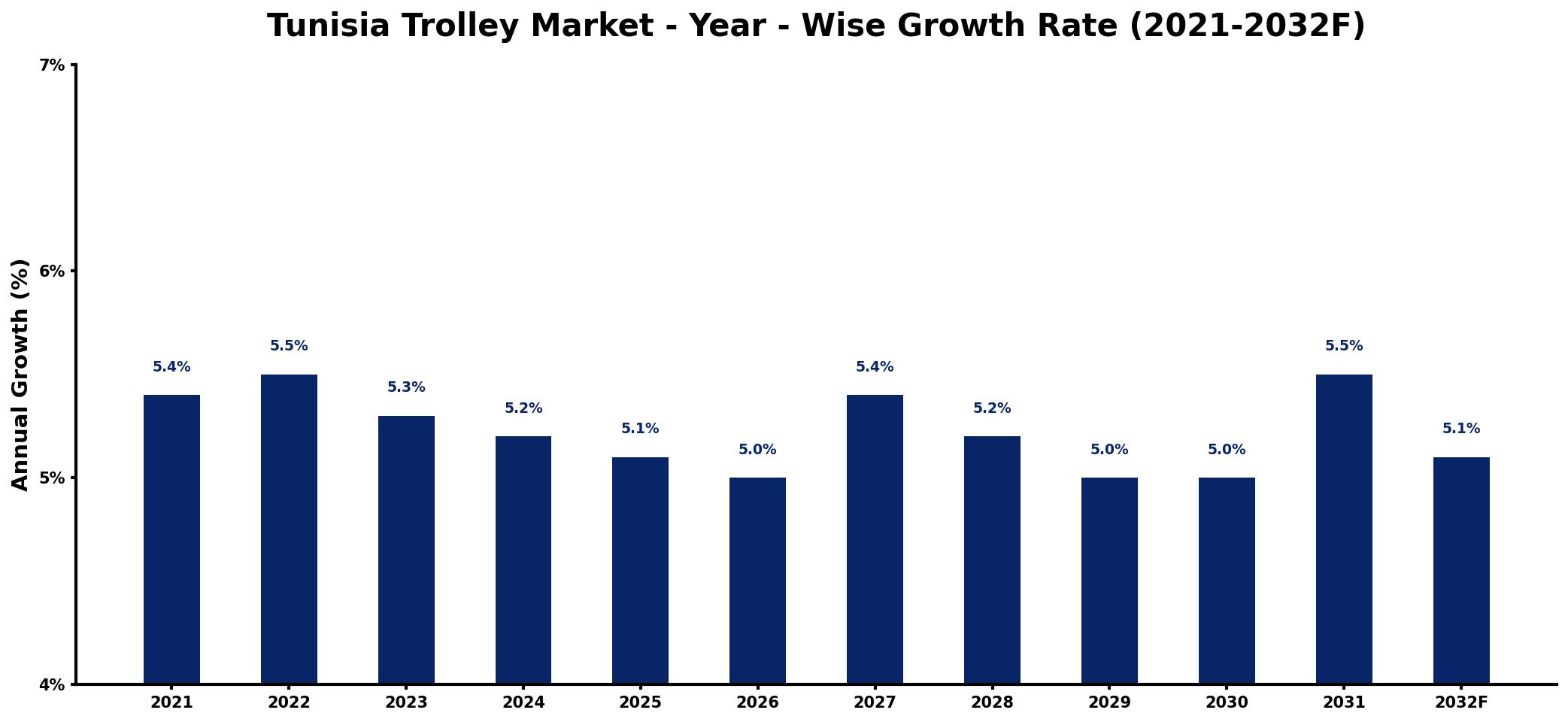
The table below presents the year‑wise growth rates along with the key drivers influencing the market
| Year | Growth Rate | Major Drivers |
| 2021 | 5.4% | Rising consumer demand for convenience |
| 2022 | 5.5% | Increased investment in logistics infrastructure |
| 2023 | 5.3% | Expansion of urban retail spaces |
| 2024 | 5.2% | Growing popularity of online shopping |
| 2025 | 5.1% | Enhanced distribution network capabilities |
| 2026 | 5.0% | Surge in e-commerce delivery services |
| 2027 | 5.4% | Strengthening of local manufacturing capabilities |
| 2028 | 5.2% | Emergence of new market segments |
| 2029 | 5.0% | Development of sustainable packaging solutions |
| 2030 | 5.0% | Focus on urban mobility solutions |
| 2031 | 5.5% | Boost in tourism-related services |
| 2032 | 5.1% | Adoption of smart technology applications |
Note: Market size estimations and growth projections presented in this report are based on 6Wresearch's proprietary forecasting methodology, utilizing the latest available industry data, government publications, and primary research inputs.
Tunisia Trolley Market Synopsis
In Tunisia, trolleys are becoming an increasingly vital part of logistics across various sectors, particularly retail and hospitality. Their ability to transport goods swiftly and efficiently in crowded urban environments highlights their necessity in today's commercial landscape.
Moreover, the healthcare industry is also leveraging trolleys for the efficient movement of medical supplies and equipment. This versatility across sectors underscores the significant potential for growth and innovation in the Tunisia trolley market.
Tunisia Trolley Market Key Takeaways
- Urbanization and government policies are significant drivers for trolley adoption.
- High initial investment costs pose challenges for infrastructure development.
- Advancements in trolley technology enhance operational efficiency.
- Regulatory frameworks dictate safety and operational standards.
- Competition from alternative transport solutions continues to affect market dynamics.
Evaluation of Restraints in Tunisia Trolley Market
The Tunisia trolley market is encountering significant hurdles, notably in the realm of infrastructure development. Limited existing trolley networks restrict the market's potential and adoption rates. Furthermore, high initial costs present a barrier for municipalities and private investors alike, who may hesitate to commit capital without concrete forecasts of profitability. The competitive landscape, featuring buses and taxis, complicates matters further, as these alternatives often offer lower operational costs and established user bases. Funding is a persistent challenge, as the public sector's willingness to invest is often contingent on seeing clear, quantifiable benefits over the long term.
Tunisia Trolley Market Trends
Emerging trends are reshaping the Tunisia trolley market, including the growing emphasis on sustainability in transportation. Innovations in trolley technology, such as electric models, are gaining traction as they align with the national goals of reducing carbon emissions. Additionally, the trend towards smart city initiatives is influencing trolley integration into broader transportation networks, enhancing accessibility and operational efficiency.
Tunisia Trolley Market Opportunities
Genuine growth opportunities exist in expanding trolley routes in urban areas, particularly in regions currently underserved by public transport. The increasing governmental focus on sustainable urban mobility solutions creates a favorable environment for investment in trolley infrastructure. Furthermore, collaboration between public and private sectors could stimulate advancements in technology, enhancing trolley systems' efficiency and appeal.
Government Initiatives in the Tunisia Trolley Market
The Tunisian government is actively promoting sustainable urban mobility, with specific policies aimed at reducing emissions and congestion. Efforts to fund and develop trolley systems are evident, although they face challenges regarding budget allocations and infrastructure investments. Regulatory frameworks are being established to ensure safety and operational efficiency, further influencing the market dynamics for trolley development and deployment.
Future Insights of the Tunisia Trolley Market
As we look toward 2026-2032, the Tunisia trolley market is poised for significant transformations. Continued urbanization will likely accelerate trolley adoption as cities seek effective ways to manage congestion and promote environmentally friendly transportation solutions. Enhanced infrastructure investments, coupled with a focus on technological advancements, will be crucial in establishing a robust trolley network capable of meeting the demands of urban populations.
Tunisia Trolley Market Latest Developments (2025 - 2026)
Recent trends indicate a growing interest in establishing new trolley routes in several key urban areas, as authorities work to alleviate traffic congestion. Moreover, advancements in trolley technology are on the rise, with investments aimed at enhancing energy efficiency and user safety. Public discussions around funding for future trolley initiatives have also gained momentum, reflecting an increasing recognition of the trolley's potential role in transforming urban transport.
Tunisia Trolley Market - Key Attractiveness of the Report
- 10 Years of Market Numbers
- Historical Data Starting from 2022 to 2025
- Base Year: 2025
- Forecast Data until 2032
- Key Performance Indicators Impacting the Market
- Major Upcoming Developments and Projects
Key Highlights of the Report:
- Tunisia Trolley Market Outlook
- Market Size of Tunisia Trolley Market, 2025
- Forecast of Tunisia Trolley Market, 2032
- Historical Data and Forecast of Tunisia Trolley Revenues & Volume for the Period 2022-2032F
- Tunisia Trolley Market Trend Evolution
- Tunisia Trolley Market Drivers and Challenges
- Tunisia Trolley Price Trends
- Tunisia Trolley Porter's Five Forces
- Tunisia Trolley Industry Life Cycle
- Historical Data and Forecast of Tunisia Trolley Market Revenues & Volume By Product for the Period 2022-2032F
- Historical Data and Forecast of Tunisia Trolley Market Revenues & Volume By Manual for the Period 2022-2032F
- Historical Data and Forecast of Tunisia Trolley Market Revenues & Volume By Electric for the Period 2022-2032F
- Historical Data and Forecast of Tunisia Trolley Market Revenues & Volume By Application for the Period 2022-2032F
- Historical Data and Forecast of Tunisia Trolley Market Revenues & Volume By Commercial for the Period 2022-2032F
- Historical Data and Forecast of Tunisia Trolley Market Revenues & Volume By Non-commercial for the Period 2022-2032F
- Historical Data and Forecast of Tunisia Trolley Market Revenues & Volume By Distribution for the Period 2022-2032F
- Historical Data and Forecast of Tunisia Trolley Market Revenues & Volume By Offline for the Period 2022-2032F
- Historical Data and Forecast of Tunisia Trolley Market Revenues & Volume By Online for the Period 2022-2032F
- Tunisia Trolley Import Export Trade Statistics
- Market Opportunity Assessment By Product
- Market Opportunity Assessment By Application
- Market Opportunity Assessment By Distribution
- Tunisia Trolley Top Companies Market Share
- Tunisia Trolley Competitive Benchmarking By Technical and Operational Parameters
- Tunisia Trolley Company Profiles
- Tunisia Trolley Key Strategic Recommendations






































