Tunisia Underground Mining Equipment Market Size, Share & Growth Rate
The Tunisia Underground Mining Equipment Market was estimated at USD 363 Million in 2025 and is projected to reach USD 484 Million by 2032, growing at a CAGR of 4.2% from 2026 to 2032. This growth trajectory is primarily fueled by the increasing demand for phosphate and iron ore, critical to both local and international markets. Investments aimed at modernizing mining operations, coupled with advancements in automation and technology, are also pivotal in enhancing operational efficiency and safety.
Tunisia Underground Mining Equipment Market Year-wise Growth Rate and Key Drivers
This graph highlights how the Tunisia Underground Mining Equipment Market has steadily grown over the years, supported by major growth factors.
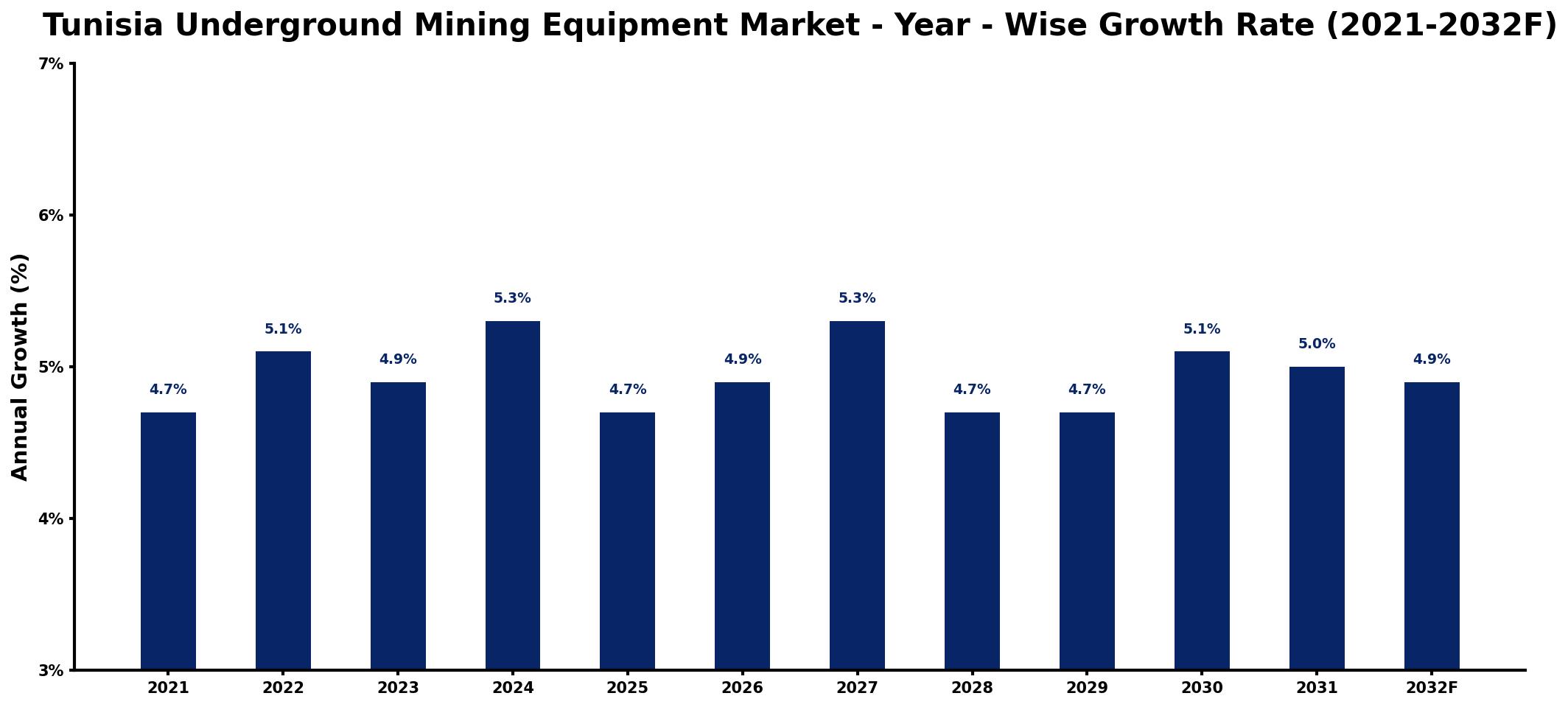
The table below presents the year‑wise growth rates along with the key drivers influencing the market
| Year | Growth Rate | Major Drivers |
| 2021 | 4.7% | Rising demand for natural resources |
| 2022 | 5.1% | Increased investments in infrastructure projects |
| 2023 | 4.9% | Expansion of renewable energy initiatives |
| 2024 | 5.3% | Growth in construction sector activities |
| 2025 | 4.7% | Boost in mineral exploration activities |
| 2026 | 4.9% | Technological advancements in extraction |
| 2027 | 5.3% | Strengthening global commodity prices |
| 2028 | 4.7% | Emergence of new market players |
| 2029 | 4.7% | Enhancement of supply chain efficiencies |
| 2030 | 5.1% | Growing focus on sustainability practices |
| 2031 | 5.0% | Development of regional trade agreements |
| 2032 | 4.9% | Surge in foreign direct investments |
Note: Market size estimations and growth projections presented in this report are based on 6Wresearch's proprietary forecasting methodology, utilizing the latest available industry data, government publications, and primary research inputs.
Tunisia Underground Mining Equipment Market Synopsis
In recent years, Tunisia's underground mining equipment market has witnessed significant momentum, driven by heightened mining activities. However, as the market matures, it is set to face evolving dynamics shaped by technological advances and a pressing need for sustainable practices. The focus will increasingly shift towards integrating advanced machinery that prioritizes both productivity and worker safety.
Looking ahead, the market trajectory is expected to align with global trends favoring automation and efficiency. Although challenges such as operational costs and regulatory pressures remain, the commitment to resource exploration will likely spearhead the adoption of modern underground mining equipment in Tunisia.
Tunisia Underground Mining Equipment Market Key Takeaways
- Strong growth expected due to rising phosphate and iron ore demands.
- Modernization initiatives and technology adoption will drive equipment upgrades.
- Government policies support safety and efficiency in mining operations.
- Challenges include high operational costs and regulatory compliance issues.
- Automation trends are reshaping operational efficiency and workforce safety.
Evaluation of Restraints in Tunisia Underground Mining Equipment Market
The underground mining equipment market in Tunisia faces several constraints that could impede its growth. High operational costs remain a significant concern for many mining companies, impacting their ability to invest in advanced technology and skilled labor. Furthermore, stringent safety regulations and environmental compliance can complicate operational processes. Additionally, fluctuating commodity prices and limited access to funding may hinder new investment, making it critical for stakeholders to navigate these challenges strategically.
Tunisia Underground Mining Equipment Market Trends
Several trends are currently shaping the Tunisia Underground Mining Equipment Market. The increasing focus on automation and smart mining technologies is changing the operational landscape, enabling companies to enhance productivity while minimizing safety risks. Additionally, there is a growing emphasis on environmental sustainability, pushing firms to adopt equipment that reduces their ecological footprint. Finally, the shift towards digital solutions for monitoring and maintenance is likely to gain traction, aligning operational practices with global standards.
Tunisia Underground Mining Equipment Market Opportunities
The market presents various growth and investment opportunities, particularly in the realm of technological innovation. Companies that can introduce advanced equipment designed for safety and efficiency stand to gain significant market share. Moreover, with government incentives encouraging modernization, firms have an avenue to secure funding for research and development in cutting-edge mining technologies. Exploration activities in underdeveloped regions of Tunisia could also provide new opportunities for investment and growth.
Government Initiatives in the Tunisia Underground Mining Equipment Market
The Tunisian government is actively promoting policies aimed at enhancing the mining sector's efficiency and safety. These initiatives include tax incentives for mining companies that invest in modern underground mining equipment. Furthermore, there are funding programs focused on research and development aimed at fostering technological advancements in the industry. Regulatory measures are also reinforced to ensure that mining operations adhere to established safety and environmental standards.
Future Insights of the Tunisia Underground Mining Equipment Market
As we look towards the future of the Tunisia Underground Mining Equipment Market from 2026 to 2032, several key factors will influence its trajectory. The combination of increased mining activity, driven by global demand for minerals, alongside advancements in technology, is set to reshape operational methodologies. Moreover, a collaborative approach involving government support and private investment will likely play a crucial role in fostering a robust and sustainable mining ecosystem in Tunisia.
Tunisia Underground Mining Equipment Market Latest Developments (2025 - 2026)
Recent trends in the Tunisia Underground Mining Equipment Market indicate a notable shift towards automation and digital technologies. Industry players are increasingly investing in smart equipment that enhances operational safety and efficiency. Furthermore, there has been a pronounced focus on sustainability, with several companies seeking to lower their environmental impact through innovative practices and equipment upgrades.
Tunisia Underground Mining Equipment Market - Key Attractiveness of the Report
- 10 Years of Market Numbers
- Historical Data Starting from 2022 to 2025
- Base Year: 2025
- Forecast Data until 2032
- Key Performance Indicators Impacting the Market
- Major Upcoming Developments and Projects
Key Highlights of the Report:
- Tunisia Underground Mining Equipment Market Outlook
- Market Size of Tunisia Underground Mining Equipment Market, 2025
- Forecast of Tunisia Underground Mining Equipment Market, 2032
- Historical Data and Forecast of Tunisia Underground Mining Equipment Revenues & Volume for the Period 2022-2032F
- Tunisia Underground Mining Equipment Market Trend Evolution
- Tunisia Underground Mining Equipment Market Drivers and Challenges
- Tunisia Underground Mining Equipment Price Trends
- Tunisia Underground Mining Equipment Porter's Five Forces
- Tunisia Underground Mining Equipment Industry Life Cycle
- Historical Data and Forecast of Tunisia Underground Mining Equipment Market Revenues & Volume By Product Type for the Period 2022-2032F
- Historical Data and Forecast of Tunisia Underground Mining Equipment Market Revenues & Volume By Mining Loaders for the Period 2022-2032F
- Historical Data and Forecast of Tunisia Underground Mining Equipment Market Revenues & Volume By Mining Trucks for the Period 2022-2032F
- Historical Data and Forecast of Tunisia Underground Mining Equipment Market Revenues & Volume By Mining Drills for the Period 2022-2032F
- Historical Data and Forecast of Tunisia Underground Mining Equipment Market Revenues & Volume By Mining Bolters for the Period 2022-2032F
- Historical Data and Forecast of Tunisia Underground Mining Equipment Market Revenues & Volume By Mining Shearer for the Period 2022-2032F
- Historical Data and Forecast of Tunisia Underground Mining Equipment Market Revenues & Volume By Continuous Miners for the Period 2022-2032F
- Historical Data and Forecast of Tunisia Underground Mining Equipment Market Revenues & Volume By Mining Excavators & Shovels for the Period 2022-2032F
- Historical Data and Forecast of Tunisia Mining Loaders Underground Mining Equipment Market Revenues & Volume By Mining Scalers for the Period 2022-2032F
- Historical Data and Forecast of Tunisia Underground Mining Equipment Market Revenues & Volume By Mining Technique for the Period 2022-2032F
- Historical Data and Forecast of Tunisia Underground Mining Equipment Market Revenues & Volume By Soft Rock Mining for the Period 2022-2032F
- Historical Data and Forecast of Tunisia Underground Mining Equipment Market Revenues & Volume By Hard Rock Mining for the Period 2022-2032F
- Historical Data and Forecast of Tunisia Underground Mining Equipment Market Revenues & Volume By End Users for the Period 2022-2032F
- Historical Data and Forecast of Tunisia Underground Mining Equipment Market Revenues & Volume By Mining Operators for the Period 2022-2032F
- Historical Data and Forecast of Tunisia Underground Mining Equipment Market Revenues & Volume By Rental Service Provider for the Period 2022-2032F
- Tunisia Underground Mining Equipment Import Export Trade Statistics
- Market Opportunity Assessment By Product Type
- Market Opportunity Assessment By Mining Technique
- Market Opportunity Assessment By End Users
- Tunisia Underground Mining Equipment Top Companies Market Share
- Tunisia Underground Mining Equipment Competitive Benchmarking By Technical and Operational Parameters
- Tunisia Underground Mining Equipment Company Profiles
- Tunisia Underground Mining Equipment Key Strategic Recommendations






































