Tunisia Vacuum Pumps Market Summary
The tunisia vacuum pumps market was estimated at USD 484 Million in 2025 and is projected to reach USD 673 Million by 2032, growing at a CAGR of 5.3% from 2026 to 2032.
Tunisia Vacuum Pumps Market Year-wise Growth Rate and Key Drivers
This graph highlights how the Tunisia Vacuum Pumps Market has steadily grown over the past five years, supported by major growth factors.
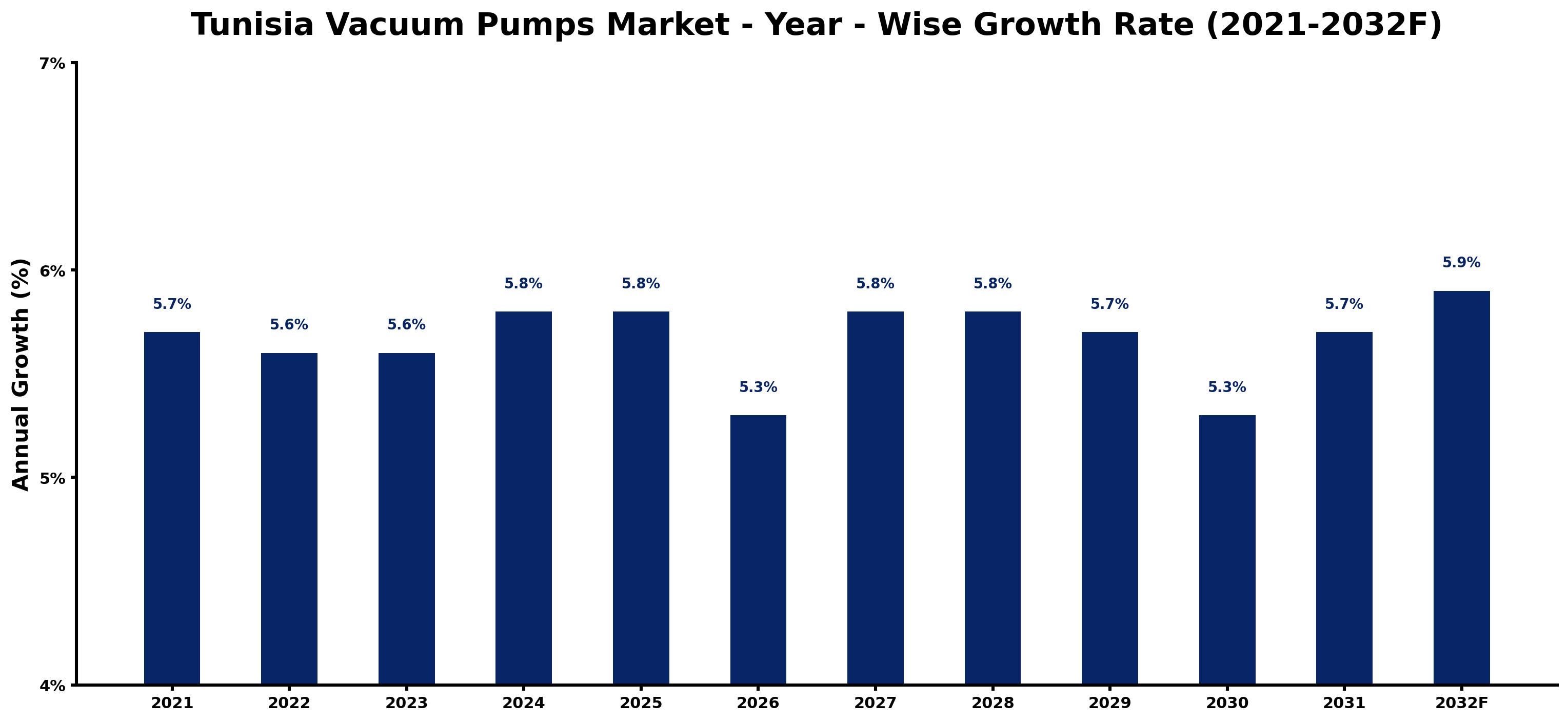
The table below presents the year wise growth rates along with the key drivers influencing the market
| Year | Growth Rate | Major Drivers |
| 2021 | 5.7% | Post-lockdown recovery efforts stimulated industrial output, enhancing vacuum pump demands. |
| 2022 | 5.6% | Infrastructure renovation projects gained momentum, resulting in increased market activity. |
| 2023 | 5.6% | Local manufacturers capitalized on reduced supply chain disruptions, boosting vacuum pump production. |
| 2024 | 5.8% | Emerging sectors, especially pharmaceuticals, created niche opportunities for specialized vacuum pumps. |
| 2025 | 5.8% | Increased collaborations between local suppliers and international brands expanded market reach. |
| 2026 | 5.3% | Technological innovations in energy efficiency attracted environmentally conscious businesses. |
| 2027 | 5.8% | Rising industrial automation trends led to more sophisticated vacuum pump applications. |
| 2028 | 5.8% | Enhanced logistics frameworks supported the expansion of vacuum pump distribution networks. |
| 2029 | 5.7% | Local universities initiated research partnerships, fostering innovation in vacuum technologies. |
| 2030 | 5.3% | The construction sector ramped up, demanding more reliable vacuum solutions. |
| 2031 | 5.7% | Growing awareness of maintenance efficiency improved lifecycle management for vacuum systems. |
| 2032 | 5.9% | Tunisia's positioning as a manufacturing hub attracted foreign investments in vacuum pump production. |
Note - Market size estimations and growth projections presented in this report are based on 6Wresearch's advanced forecasting approach, validated with industry datasets as of June 2026.
Tunisia Vacuum Pumps Market Synopsis
The Tunisia Vacuum Pumps Market is projected to reach 5.3% and witness significant growth during the forecast period (2026-2032). This growth is underpinned by the rising demand from various sectors, particularly in chemical, pharmaceutical, and food processing industries. The need for efficient and reliable vacuum pump systems is increasingly recognized as essential for enhancing manufacturing processes, thereby driving market expansion. As companies strive to optimize their operations, the demand for technologically advanced vacuum solutions is anticipated to escalate, reflecting broader trends in energy efficiency and sustainability.
Tunisia Vacuum Pumps Market Growth Drivers
The growth of the Tunisia Vacuum Pumps Market can be attributed to several pivotal factors:
- The industrial sector's flourishing demand for vacuum pumps, driven by their crucial roles in processes such as material handling, packaging, and processing.
- Technological advancements in vacuum pump design and functionality, resulting in improved performance metrics and operational efficiencies.
- Increased focus on energy-efficient solutions as industries adopt practices to reduce operational costs and minimize their environmental impact.
- The growing trend towards smart and automated vacuum systems that offer advanced features like remote monitoring and control, further enhancing productivity.
- An increase in maintenance outsourcing by companies, which opens new avenues for service providers and fosters industry relationships.
Tunisia Vacuum Pumps Market Trends and Opportunities
Current trends within the Tunisia Vacuum Pumps Market indicate a pronounced shift towards sustainability and technological innovation. Key trends include:
- Heightened demand for environmentally friendly vacuum pump solutions as industries seek to align with global sustainability goals.
- Emerging innovations in vacuum pump technologies that significantly lower energy consumption and emissions, meeting regulatory standards.
- The rise of smart technologies in vacuum systems, enhancing operational efficiencies through better monitoring and control capabilities.
- Expansion opportunities in emerging sectors such as renewable energy and biotechnology, which increasingly require specialized vacuum solutions.
- Collaboration and partnerships within the local market to bolster product offerings and technological advancements in vacuum technology.
Tunisia Vacuum Pumps Market Challenges and Restraints
Despite the positive outlook, the Tunisia Vacuum Pumps Market faces several challenges that could impact growth:
- The limited awareness regarding the advantages and applications of vacuum pumps, which impedes faster adoption within key industries.
- Inadequate distribution networks that complicate the accessibility of vacuum pump technologies to end-users across different regions.
- Challenges in providing effective after-sales support and maintenance services, potentially leading to diminished customer satisfaction.
- Economic fluctuations and political uncertainties influencing investment decisions among local and foreign stakeholders.
- The need for continuous innovation amidst rapid technological advancements, which can increase competitive pressures on existing manufacturers.
Tunisia Vacuum Pumps Market Investment Opportunities
Investment opportunities within the Tunisia Vacuum Pumps Market are increasingly appealing. Key areas for exploration include:
- Investing in local manufacturing facilities that can enhance the supply chain and reduce reliance on imported products, fostering local employment.
- Exploring partnerships with technology developers to innovate eco-friendly vacuum pump solutions that cater to the region's sustainability goals.
- Engaging in the development of smart vacuum systems that offer enhanced automation and efficiency in industrial applications.
- Capitalizing on Tunisia's geographic strategic position as a gateway for access to both European and African markets, facilitating international trade.
- Allocating resources toward marketing and education initiatives to raise awareness about the benefits of vacuum pump technologies among potential users.
Tunisia Vacuum Pumps Market Government Investment and Initiatives
The Tunisian government has implemented several policies aimed at fostering growth in the vacuum pumps market. These initiatives focus on enhancing energy efficiency and promoting environmentally sustainable practices across various industries. Key government actions include:
- Provision of incentives for industries adopting energy-efficient technologies, helping to reduce operational costs and environmental impact.
- Support for local manufacturing initiatives to boost domestic production capabilities and minimize dependence on imported vacuum pump technologies.
- Implementation of regulations ensuring compliance with international quality and safety standards, enhancing product reliability and market competitiveness.
- Investment in research and development initiatives aimed at fostering innovation within the vacuum pump sector, driving technological advancements.
- Collaboration with industry stakeholders to develop frameworks that encourage sustainable practices and growth within the market.
Tunisia Vacuum Pumps Market Latest Developments (May 2025 - June 2026)
In the recent timeframe from May 2025 to June 2026, the Tunisia Vacuum Pumps Market has seen notable developments that reflect its dynamic nature. Significant industry movements include:
- Increased partnerships between local manufacturers and technology innovators focused on developing more efficient vacuum pump solutions.
- A surge in market awareness initiatives aimed at educating potential clients about the benefits and applications of vacuum pumps across various sectors.
- Growth in demand for vacuum pump maintenance and service outsourcing, indicating a trend towards specialized service providers.
- Increased emphasis by manufacturers on integrating sustainable practices within their product lines, aligning with broader environmental goals.
- Ongoing discussions within industry forums about addressing the challenges faced by the sector, particularly in relation to distribution and after-sales service.
Tunisia Vacuum Pumps Market - Key Attractiveness of the Report
- 10 Years of Market Numbers
- Historical Data Starting from 2022 to 2025
- Base Year: 2025
- Forecast Data until 2032
- Key Performance Indicators Impacting the Market
- Major Upcoming Developments and Projects
Key Highlights of the Report:
- Tunisia Vacuum Pumps Market Outlook
- Market Size of Tunisia Vacuum Pumps Market, 2025
- Forecast of Tunisia Vacuum Pumps Market, 2032F
- Historical Data and Forecast of Tunisia Vacuum Pumps Revenues & Volume for the Period 2022-2032F
- Tunisia Vacuum Pumps Market Trend Evolution
- Tunisia Vacuum Pumps Market Drivers and Challenges
- Tunisia Vacuum Pumps Price Trends
- Tunisia Vacuum Pumps Porter's Five Forces
- Tunisia Vacuum Pumps Industry Life Cycle
- Historical Data and Forecast of Tunisia Vacuum Pumps Market Revenues & Volume By Lubrication for the Period 2022-2032F
- Historical Data and Forecast of Tunisia Vacuum Pumps Market Revenues & Volume By Dry for the Period 2022-2032F
- Historical Data and Forecast of Tunisia Vacuum Pumps Market Revenues & Volume By Wet for the Period 2022-2032F
- Historical Data and Forecast of Tunisia Vacuum Pumps Market Revenues & Volume By Technology for the Period 2022-2032F
- Historical Data and Forecast of Tunisia Vacuum Pumps Market Revenues & Volume By Gas Capture/Binding Pumps for the Period 2022-2032F
- Historical Data and Forecast of Tunisia Vacuum Pumps Market Revenues & Volume By Gas Transfer Pumps for the Period 2022-2032F
- Historical Data and Forecast of Tunisia Vacuum Pumps Market Revenues & Volume By Product Type for the Period 2022-2032F
- Historical Data and Forecast of Tunisia Vacuum Pumps Market Revenues & Volume By Low vacuum pumps for the Period 2022-2032F
- Historical Data and Forecast of Tunisia Vacuum Pumps Market Revenues & Volume By Medium vacuum pumps for the Period 2022-2032F
- Historical Data and Forecast of Tunisia Vacuum Pumps Market Revenues & Volume By High vacuum pumps for the Period 2022-2032F
- Historical Data and Forecast of Tunisia Vacuum Pumps Market Revenues & Volume By End-Users for the Period 2022-2032F
- Historical Data and Forecast of Tunisia Vacuum Pumps Market Revenues & Volume By Chemical & pharmaceutical for the Period 2022-2032F
- Historical Data and Forecast of Tunisia Vacuum Pumps Market Revenues & Volume By Semiconductor & electronics for the Period 2022-2032F
- Historical Data and Forecast of Tunisia Vacuum Pumps Market Revenues & Volume By Oil & gas for the Period 2022-2032F
- Historical Data and Forecast of Tunisia Vacuum Pumps Market Revenues & Volume By Food & beverages for the Period 2022-2032F
- Historical Data and Forecast of Tunisia Vacuum Pumps Market Revenues & Volume By Wood, paper & pulp for the Period 2022-2032F
- Historical Data and Forecast of Tunisia Vacuum Pumps Market Revenues & Volume By Other for the Period 2022-2032F
- Tunisia Vacuum Pumps Import Export Trade Statistics
- Market Opportunity Assessment By Lubrication
- Market Opportunity Assessment By Technology
- Market Opportunity Assessment By Product Type
- Market Opportunity Assessment By End-Users
- Tunisia Vacuum Pumps Top Companies Market Share
- Tunisia Vacuum Pumps Competitive Benchmarking By Technical and Operational Parameters
- Tunisia Vacuum Pumps Company Profiles
- Tunisia Vacuum Pumps Key Strategic Recommendations






































