Tunisia Vegetable oils Market Summary
The tunisia vegetable oils market was estimated at USD 284 Million in 2025 and is projected to reach USD 380 Million by 2032, growing at a CAGR of 5.3% from 2026 to 2032.
Tunisia Vegetable oils Market Year-wise Growth Rate and Key Drivers
This graph highlights how the Tunisia Vegetable oils Market has steadily grown over the past five years, supported by major growth factors.
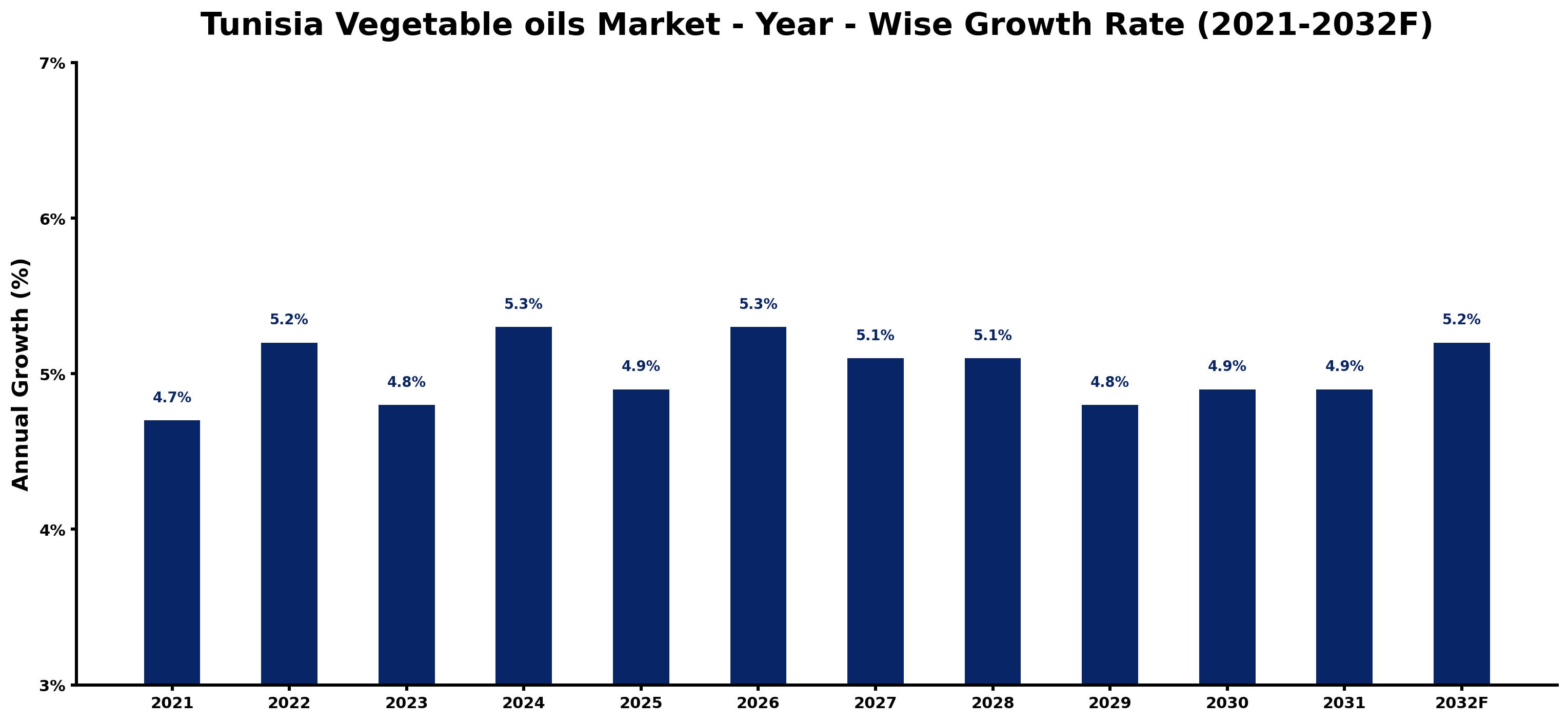
The table below presents the year wise growth rates along with the key drivers influencing the market
| Year | Growth Rate | Major Drivers |
| 2021 | 4.7% | Tunisian consumers increasingly prefer healthy cooking oils, boosting market interest. |
| 2022 | 5.2% | Local producers innovate with diverse vegetable oil blends to capture niche segments. |
| 2023 | 4.8% | International brands enter the market, enhancing competition and product quality. |
| 2024 | 5.3% | Sustainable farming practices gain traction among local farmers, improving oil quality. |
| 2025 | 4.9% | Export opportunities expand as Tunisia enhances its agricultural trade agreements. |
| 2026 | 5.3% | Urbanization shifts consumer preferences towards premium vegetable oil brands. |
| 2027 | 5.1% | Health consciousness prompts reformulation of existing products to lower saturated fats. |
| 2028 | 5.1% | Digital marketing transforms consumer engagement, driving brand loyalty and awareness. |
| 2029 | 4.8% | Retail sector modernization facilitates wider distribution of high-quality vegetable oils. |
| 2030 | 4.9% | Organic certification becomes a key differentiator in the evolving market landscape. |
| 2031 | 4.9% | Cross-border trade agreements enhance accessibility of international oil varieties. |
| 2032 | 5.2% | Emerging culinary trends influence innovative uses for vegetable oils in food preparation. |
Note - Market size estimations and growth projections presented in this report are based on 6Wresearch's advanced forecasting approach, validated with industry datasets as of June 2026.
Tunisia Vegetable oils Market Synopsis
The Tunisia Vegetable oils Market is projected to reach 5.3% and witness significant growth during the forecast period (2026-2032). The increasing utilization of vegetable oils across various sectors, including cooking, food processing, and industrial applications, underpins this expansion. Major oils such as olive oil, sunflower oil, and palm oil have become staple ingredients, driving both domestic consumption and export potential.
Tunisia Vegetable oils Market Growth Drivers
Several factors are propelling the growth of the Tunisia vegetable oils market. First and foremost, the rising health consciousness among consumers has significantly shifted preferences towards vegetable oils known for their health benefits. This shift is characterized by a growing inclination towards oils that contribute to improved cardiovascular health. Secondly, the expanding food service industry is generating higher demand for vegetable oils, as restaurants and catering services prioritize quality ingredients. Thirdly, there is an increasing trend towards bio-based products, which are particularly relevant in industrial applications, further driving market growth. Fourthly, the robust local agricultural practices ensure a steady supply of raw materials, reinforcing the domestic production capacity. Finally, the globalization of food trends has contributed to a surge in both domestic and export demand for high-quality Tunisian oils.
Tunisia Vegetable oils Market Challenges and Restraints
Despite the promising growth prospects, the Tunisia vegetable oils market faces several challenges that could hinder its expansion. Volatility in raw material prices poses a significant risk, as fluctuations can impact production costs and retail prices, thereby affecting overall market stability. Supply chain disruptions also present a challenge, particularly in times of geopolitical tension or economic instability. Additionally, the market is under pressure from imported vegetable oils, which often offer competitive pricing and can impact local producers' market share. Rising consumer awareness regarding the health implications of certain oils, especially with regard to saturated fats and trans fats, has led to shifting demand patterns that local producers must navigate. Lastly, the lack of advanced processing technologies in some areas limits the quality and efficiency of oil extraction and refinement processes.
Tunisia Vegetable oils Market Government Investment and Initiatives
Government initiatives have played a crucial role in shaping the landscape of the Tunisia vegetable oils market. Policies aimed at promoting local agriculture have led to the implementation of subsidies for oilseed cultivation, thereby encouraging domestic production. Investments in modern extraction and processing technologies have enhanced the efficiency and output quality of vegetable oils, making local products more competitive. Furthermore, the government is focused on ensuring food security and self-sufficiency, which has resulted in the development of support mechanisms for local producers. Trade agreements are also being established to promote high-quality Tunisian vegetable oils in international markets, thereby fostering export growth. These initiatives reflect a strategic intent to bolster the domestic vegetable oil industry while enhancing the quality and reputation of Tunisian oils on the global stage.
Tunisia Vegetable oils Market Latest Developments (May 2025 - June 2026)
In the timeframe from May 2025 to June 2026, the Tunisia vegetable oils market has observed several noteworthy developments. The government has intensified its focus on enhancing agricultural productivity through technology transfer and capacity-building initiatives aimed at local farmers. Concurrently, the industry has seen a rise in investment in sustainable practices, with producers adopting environmentally friendly methods to meet consumer demands for sustainability. Efforts to improve supply chain resilience have also gained momentum, with companies seeking partnerships to mitigate potential disruptions. Furthermore, the local market has been characterized by an increase in consumer education campaigns aimed at promoting the health benefits of vegetable oils, which have proven effective in driving sales and preference for domestically produced oils. Collectively, these developments are indicative of a proactive approach by both the government and industry players to navigate the evolving market landscape.
Tunisia Vegetable oils Market - Key Attractiveness of the Report
- 10 Years of Market Numbers
- Historical Data Starting from 2022 to 2025
- Base Year: 2025
- Forecast Data until 2032
- Key Performance Indicators Impacting the Market
- Major Upcoming Developments and Projects
Key Highlights of the Report:
- Tunisia Vegetable oils Market Outlook
- Market Size of Tunisia Vegetable oils Market, 2025
- Forecast of Tunisia Vegetable oils Market, 2032
- Historical Data and Forecast of Tunisia Vegetable oils Revenues & Volume for the Period 2022-2032F
- Tunisia Vegetable oils Market Trend Evolution
- Tunisia Vegetable oils Market Drivers and Challenges
- Tunisia Vegetable oils Price Trends
- Tunisia Vegetable oils Porter's Five Forces
- Tunisia Vegetable oils Industry Life Cycle
- Historical Data and Forecast of Tunisia Vegetable oils Market Revenues & Volume By Types for the Period 2022-2032F
- Historical Data and Forecast of Tunisia Vegetable oils Market Revenues & Volume By Palm Oil for the Period 2022-2032F
- Historical Data and Forecast of Tunisia Vegetable oils Market Revenues & Volume By Soybean Oil for the Period 2022-2032F
- Historical Data and Forecast of Tunisia Vegetable oils Market Revenues & Volume By Rapeseed Oil for the Period 2022-2032F
- Historical Data and Forecast of Tunisia Vegetable oils Market Revenues & Volume By Sunflower Oil for the Period 2022-2032F
- Historical Data and Forecast of Tunisia Vegetable oils Market Revenues & Volume By Olive Oil for the Period 2022-2032F
- Historical Data and Forecast of Tunisia Vegetable oils Market Revenues & Volume By Others for the Period 2022-2032F
- Historical Data and Forecast of Tunisia Vegetable oils Market Revenues & Volume By Applications for the Period 2022-2032F
- Historical Data and Forecast of Tunisia Vegetable oils Market Revenues & Volume By Food for the Period 2022-2032F
- Historical Data and Forecast of Tunisia Vegetable oils Market Revenues & Volume By Feed for the Period 2022-2032F
- Historical Data and Forecast of Tunisia Vegetable oils Market Revenues & Volume By Industrial for the Period 2022-2032F
- Tunisia Vegetable oils Import Export Trade Statistics
- Market Opportunity Assessment By Types
- Market Opportunity Assessment By Applications
- Tunisia Vegetable oils Top Companies Market Share
- Tunisia Vegetable oils Competitive Benchmarking By Technical and Operational Parameters
- Tunisia Vegetable oils Company Profiles
- Tunisia Vegetable oils Key Strategic Recommendations






































