Tunisia Vending machines Market Summary
The tunisia vending machines market was estimated at USD 258 Million in 2025 and is projected to reach USD 343 Million by 2032, growing at a CAGR of 5.1% from 2026 to 2032.
Tunisia Vending machines Market Year-wise Growth Rate and Key Drivers
This graph highlights how the Tunisia Vending machines Market has steadily grown over the past five years, supported by major growth factors.
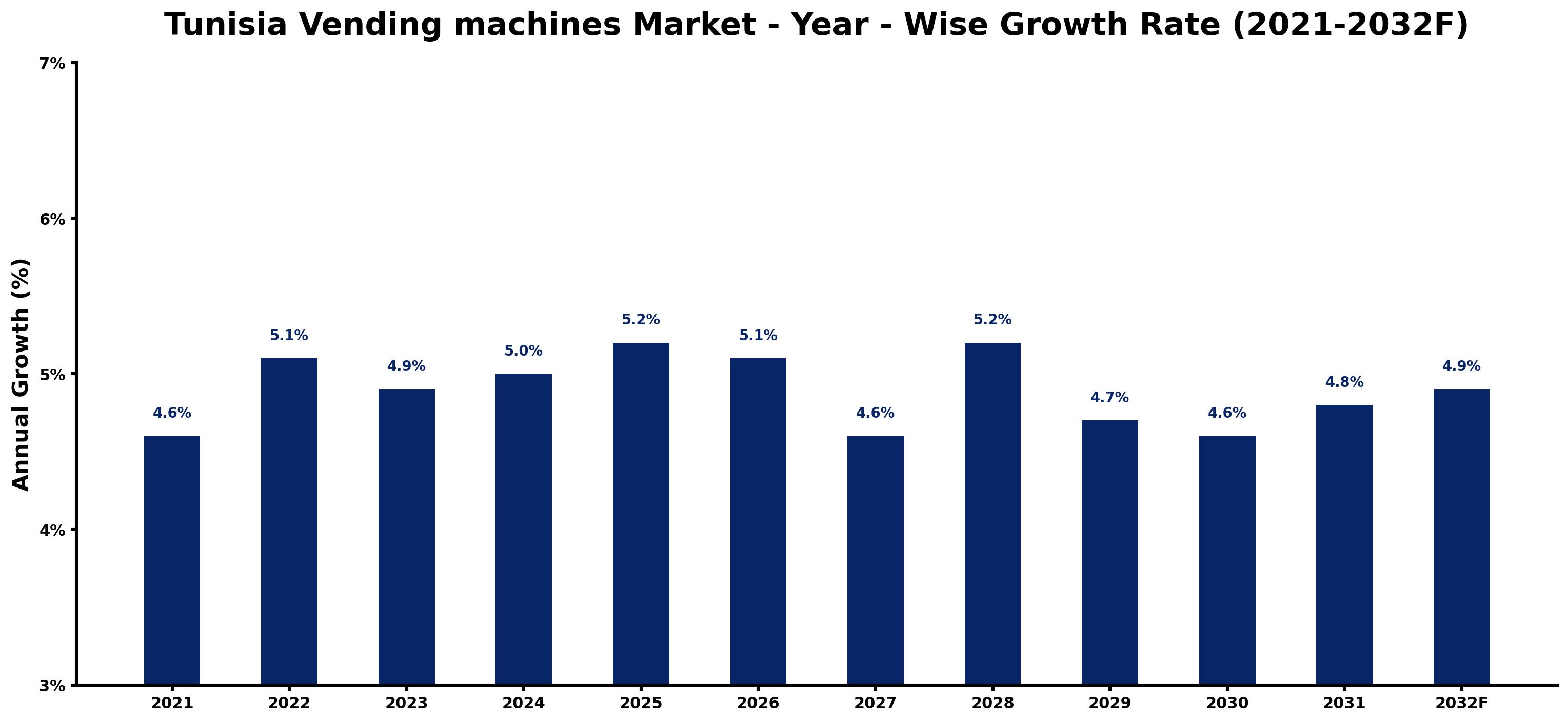
The table below presents the year wise growth rates along with the key drivers influencing the market
| Year | Growth Rate | Major Drivers |
| 2021 | 4.6% | Post-pandemic recovery sparked interest in automated retail solutions across urban areas. |
| 2022 | 5.1% | Increased urbanization led to higher foot traffic and greater vending machine placements. |
| 2023 | 4.9% | Consumer preferences shifted toward convenience, enhancing the appeal of vending solutions. |
| 2024 | 5.0% | Digital payment systems became more widespread, facilitating cashless transactions in vending. |
| 2025 | 5.2% | Local manufacturers began producing machines, reducing costs and improving accessibility. |
| 2026 | 5.1% | Technology integration in vending machines attracted tech-savvy consumers seeking innovation. |
| 2027 | 4.6% | Health-conscious trends prompted vending operators to stock healthier snack options. |
| 2028 | 5.2% | Public spaces expanded, increasing opportunities for vending machine installations and revenue. |
| 2029 | 4.7% | Sustainability concerns encouraged the introduction of eco-friendly vending solutions. |
| 2030 | 4.6% | Partnerships between local businesses and vending operators strengthened product availability. |
| 2031 | 4.8% | Enhanced consumer engagement through mobile apps boosted loyalty to vending brands. |
| 2032 | 4.9% | Evolving lifestyles and work habits ensured a stable demand for convenient retail options. |
Note - Market size estimations and growth projections presented in this report are based on 6Wresearch's advanced forecasting approach, validated with industry datasets as of June 2026.
Tunisia Vending machines Market Synopsis
The Tunisia Vending machines Market is projected to reach 5.1% and witness significant growth during the forecast period (2026-2032). The growing preference for convenient, automated retail solutions is a primary driver of this market's expansion. Factors such as rising urbanization and evolving consumer lifestyles have significantly influenced the demand for vending machines. Furthermore, the increasing inclination towards on-the-go snacks and beverages is reshaping the retail landscape, making vending machines more appealing to consumers. With the continuous proliferation of vending machine installations in public spaces such as airports, shopping malls, and workplaces, the market is positioned for robust growth within the forecast period.
Tunisia Vending machines Market Growth Drivers
A variety of factors are driving the Tunisia Vending machines Market. Primarily, the demand for quick and convenient access to snacks and beverages is accelerating growth. The following points detail the key drivers:
- Urbanization is leading to an increase in foot traffic in public locations, elevating the need for accessible vending solutions that cater to busy lifestyles.
- The rising trend of healthy eating is prompting vending machine operators to diversify their offerings, including healthier snack and beverage options.
- Technological advancements, particularly the incorporation of cashless payment systems, have enhanced user convenience and security, making vending machines more attractive to consumers.
- Retailers are increasingly deploying vending machines in educational institutions and workplaces, recognizing their ability to meet consumer needs around the clock.
- Consumer confidence in vending machines is bolstered by improved machine reliability and the availability of innovative features such as IoT-based inventory management.
Tunisia Vending machines Market Challenges and Restraints
Despite the promising growth prospects, the Tunisia Vending machines Market faces several challenges that could impact its expansion. Some of these challenges include:
- The initial investment costs associated with purchasing and installing vending machines can be prohibitively high for new entrants, limiting market expansion.
- Regular maintenance and servicing of machines are vital to ensure functionality and reliability, which incurs additional operational costs for operators.
- Intense competition from traditional retail outlets, including convenience stores and supermarkets, poses a significant threat to market share.
- The rising popularity of online shopping and delivery services is drawing attention away from vending machines, as consumers seek more personalized shopping experiences.
- Compliance with stringent food safety and hygiene regulations is essential but can be a complex and challenging aspect of operating vending machines.
Tunisia Vending machines Market Trends and Opportunities
The Tunisia Vending machines Market is evolving with various trends that present opportunities for growth. Key trends include:
- The shift towards healthier product offerings among vending machine operators aligns with increasing consumer health consciousness, creating opportunities in the market.
- Integration of smart technology features, such as contactless payment options and real-time inventory tracking, is becoming a standard expectation among consumers.
- There is a growing trend towards environmentally friendly vending solutions, including machines that offer sustainable product choices and utilize energy-efficient technologies.
- The expansion of vending machine networks in high-traffic areas, like airports and hospitals, enhances accessibility and convenience for consumers.
- Innovative marketing strategies and digital engagement initiatives are emerging, allowing operators to attract a technologically-savvy consumer base.
Tunisia Vending machines Market Government Investment and Initiatives
Government policies in Tunisia play a significant role in shaping the vending machines market. The government has implemented various regulations aimed at ensuring hygiene, product quality, and consumer safety. These include:
- Regulatory frameworks that require vending machine operators to adhere to health and safety standards, ensuring the well-being of consumers.
- Support for the installation of vending machines in public spaces, aiming to enhance the accessibility of essential goods and services for the population.
- Incentives for businesses that invest in environmentally sustainable practices, encouraging the adoption of energy-efficient machines and eco-friendly product offerings.
- Regular inspections and compliance checks to ensure that vending operations meet the necessary safety and maintenance criteria.
- Promotional campaigns aimed at educating the public about the benefits of using vending machines, further increasing consumer acceptance and market growth.
Tunisia Vending machines Market Latest Developments (May 2025 - June 2026)
Recent developments in the Tunisia Vending machines Market reflect the dynamic nature of the industry. Notable trends include an increased adoption of cashless payment methods, driven by consumer demand for contactless transactions. Operators are integrating advanced technology, such as remote monitoring, to streamline inventory management and enhance operational efficiency. There is also a notable rise in the diversification of product offerings, with many machines featuring healthier snack options to meet changing consumer preferences. Policy support from the Tunisian government continues to create a favorable environment for growth, focusing on accessible and safe vending solutions. Operators are also exploring innovative marketing strategies to engage consumers digitally, positioning themselves to capture new market segments.
Tunisia Vending machines Market - Key Attractiveness of the Report
- 10 Years of Market Numbers
- Historical Data Starting from 2022 to 2025
- Base Year: 2025
- Forecast Data until 2032
- Key Performance Indicators Impacting the Market
- Major Upcoming Developments and Projects
Key Highlights of the Report:
- Tunisia Vending machines Market Outlook
- Market Size of Tunisia Vending machines Market, 2025
- Forecast of Tunisia Vending machines Market, 2032
- Historical Data and Forecast of Tunisia Vending machines Revenues & Volume for the Period 2022-2032F
- Tunisia Vending machines Market Trend Evolution
- Tunisia Vending machines Market Drivers and Challenges
- Tunisia Vending machines Price Trends
- Tunisia Vending machines Porter's Five Forces
- Tunisia Vending machines Industry Life Cycle
- Historical Data and Forecast of Tunisia Vending machines Market Revenues & Volume By Applications for the Period 2022-2032F
- Historical Data and Forecast of Tunisia Vending machines Market Revenues & Volume By Commercial Places for the Period 2022-2032F
- Historical Data and Forecast of Tunisia Vending machines Market Revenues & Volume By Offices for the Period 2022-2032F
- Historical Data and Forecast of Tunisia Vending machines Market Revenues & Volume By Public Places for the Period 2022-2032F
- Historical Data and Forecast of Tunisia Vending machines Market Revenues & Volume By Others for the Period 2022-2032F
- Historical Data and Forecast of Tunisia Vending machines Market Revenues & Volume By Payment Mode for the Period 2022-2032F
- Historical Data and Forecast of Tunisia Vending machines Market Revenues & Volume By Cash for the Period 2022-2032F
- Historical Data and Forecast of Tunisia Vending machines Market Revenues & Volume By Cashless for the Period 2022-2032F
- Tunisia Vending machines Import Export Trade Statistics
- Market Opportunity Assessment By Applications
- Market Opportunity Assessment By Payment Mode
- Tunisia Vending machines Top Companies Market Share
- Tunisia Vending machines Competitive Benchmarking By Technical and Operational Parameters
- Tunisia Vending machines Company Profiles
- Tunisia Vending machines Key Strategic Recommendations






































