Tunisia Video Conferencing Market Size & Growth Rate (2026-2032)
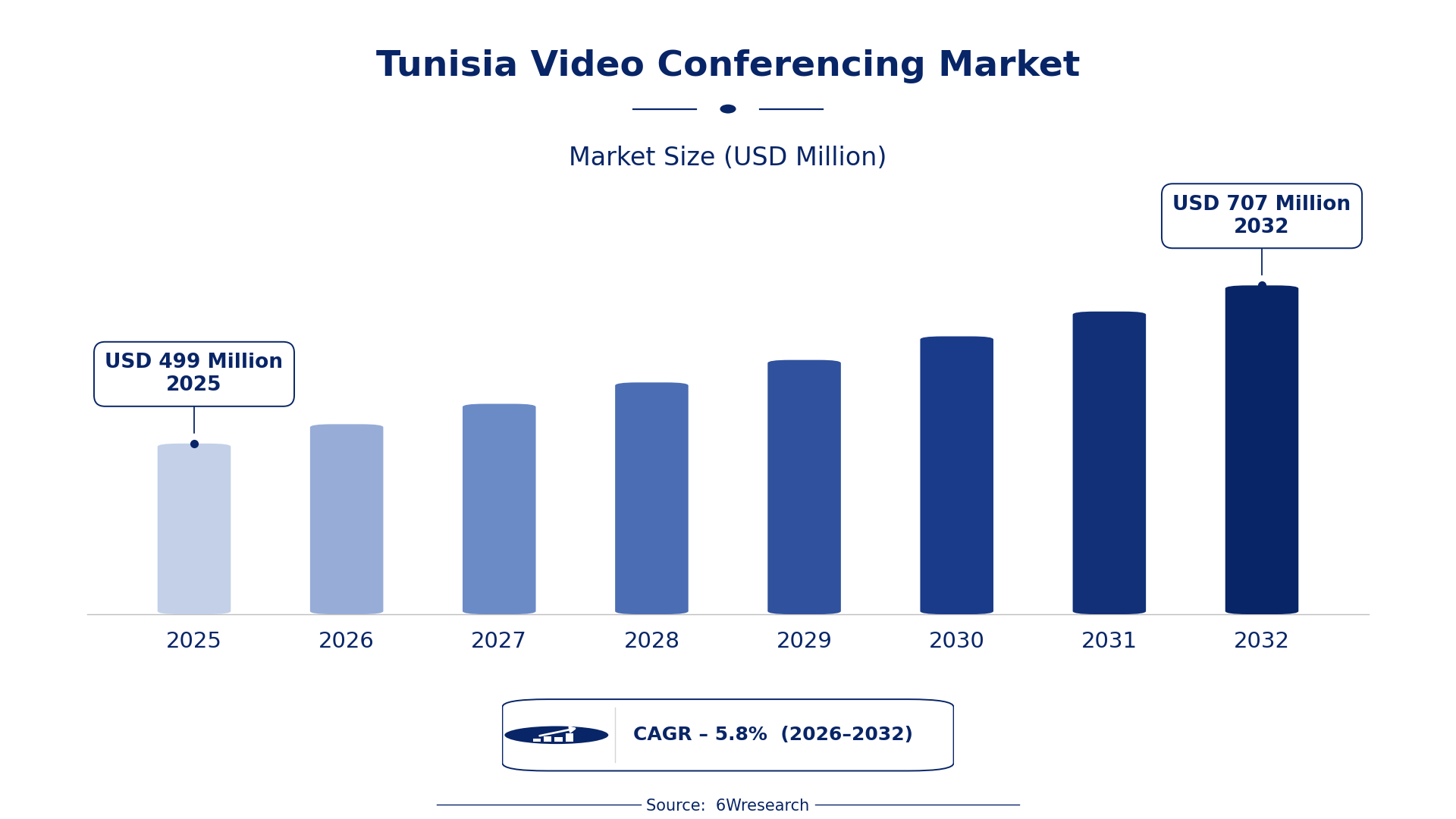
The Tunisia Video Conferencing Market was estimated at USD 499 Million in 2025 and is projected to reach USD 707 Million by 2032, growing at a CAGR of 5.8% from 2026 to 2032.
Tunisia Video Conferencing Market Synopsis
The shift towards remote work and digital communication has fundamentally altered how businesses and educational institutions operate in Tunisia. Video conferencing has emerged as a vital tool for maintaining connectivity and collaboration during the challenges posed by the COVID-19 pandemic.
With a mix of local and international providers in the market, users in Tunisia now have access to an array of options—from basic platforms to advanced systems that integrate AI and real-time translation. However, persistent internet connectivity issues and the need for constant technological updates continue to pose challenges for users.
Tunisia Video Conferencing Market Year-wise Growth Rate and Key Drivers
This graph illustrates the annual growth rates of the Tunisia Video Conferencing Market from 2021 to 2032, highlighting a steady upward trajectory and projected expansion over the forecast period.
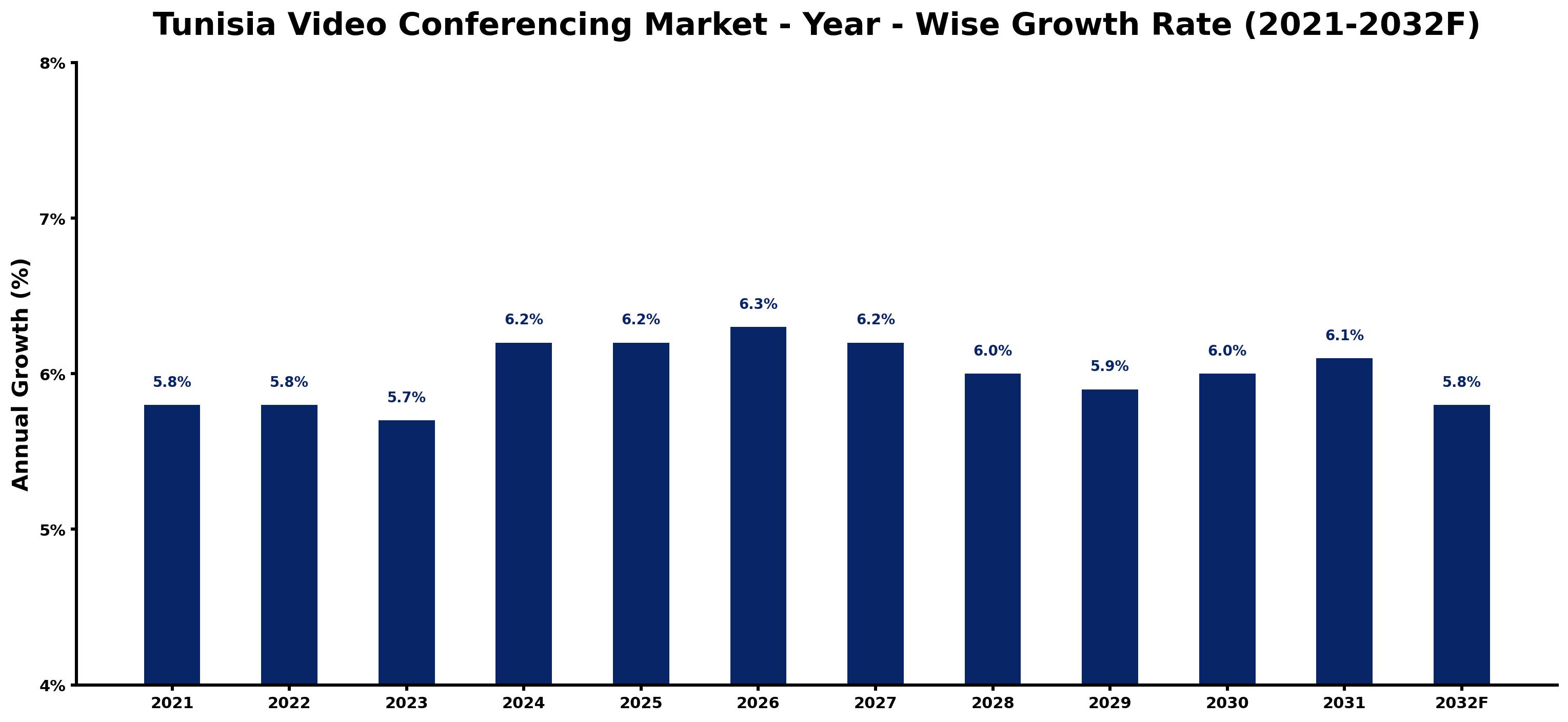
The table below presents the year‑wise growth rates along with the key drivers influencing the market
| Year | Growth Rate | Major Drivers |
| 2021 | 5.8% | Increased remote work adoption during COVID-19 pandemic |
| 2022 | 5.8% | Ministry of Education promotes digital classrooms nationwide |
| 2023 | 5.7% | Rising investment in telecommuting technologies by businesses |
| 2024 | 6.2% | Government incentives for improving digital infrastructure |
| 2025 | 6.2% | Growing telehealth services necessitating virtual consultations |
| 2026 | 6.3% | Increase in online education platforms boosting user engagement |
| 2027 | 6.2% | Corporate training programs transitioning to virtual environments |
| 2028 | 6.0% | Enhanced 4G coverage facilitating better video conferencing |
| 2029 | 5.9% | E-commerce growth fueling demand for virtual meetings |
| 2030 | 6.0% | Local startups leveraging video tools for innovation |
| 2031 | 6.1% | Regulatory support for remote work in private sector |
| 2032 | 5.8% | Cultural shift towards digital communication in workplaces |
Note: Market size estimations and growth projections presented in this report are based on 6Wresearch's proprietary forecasting methodology, utilizing the latest available industry data, government publications, and primary research inputs.
Tunisia Video Conferencing Market Key Takeaways
Below are some of the specific key takeaways from the market, including:
- The market is experiencing a strong upward trend due to increasing digital transformation across sectors.
- Government support for digital initiatives plays a crucial role in market expansion.
- Challenges related to internet infrastructure can impact service quality and user experience.
- AI-driven features are becoming more prevalent, enhancing user interaction and engagement.
- Educational institutions are among the largest adopters of video conferencing technology.
Evaluation of Restraints in Tunisia Video Conferencing Market
Despite its growth, the Tunisia video conferencing market is constrained by inadequate internet infrastructure, particularly in rural areas. Limited bandwidth can lead to disruptions, affecting user experience and satisfaction. Additionally, there’s a notable reluctance in some sectors to embrace new technologies, stemming from concerns about data privacy and security. Budget constraints further hinder the adoption of advanced video conferencing solutions, particularly among small and medium-sized enterprises.
Tunisia Video Conferencing Market Trends
A few trends are currently shaping the Tunisia video conferencing market. The growing preference for hybrid work models is pushing organizations to invest in reliable communication tools. There’s also a rising demand for enhanced features, such as AI-driven analytics and multi-language support, which are becoming essential for effective communication. on top of that, the adoption of cloud-based solutions is increasing, providing flexibility and scalability that traditional systems cannot match.
Tunisia Video Conferencing Market Opportunities
The market presents several avenues for growth and investment. Expansion into underserved regions offers significant potential, as improved connectivity and infrastructure are developed. Additionally, collaboration with technology providers to enhance internet services can create a more favorable environment for video conferencing solutions. Businesses can also explore partnerships with educational institutions, given the increasing demand for online learning solutions.
Government Initiatives in the Tunisia Video Conferencing Market
The Tunisian government is actively fostering the adoption of digital communication tools, particularly in education and public sectors. This support is part of a broader strategy to bridge the digital divide and enhance the nation's connectivity. Recent policies and initiatives aim to improve internet infrastructure, which is vital for effective video conferencing solutions across the country.
- A national digital infrastructure upgrade programme launched in early 2025 is now underway, focusing on expanding high-speed internet access.
- A regulatory framework established in late 2025 mandates transparency in billing for telecom services, promoting fair competition.
- Current initiatives include grants for public organizations to integrate video conferencing systems, aimed at enhancing productivity.
- Plans for an upcoming public-private partnership expected to enhance network resilience and expand access in rural areas by 2028.
- A recent initiative to integrate video conferencing tools in public schools was completed in late 2025, facilitating remote learning.
Future Insights of the Tunisia Video Conferencing Market
Looking ahead to 2026-2032, the Tunisia video conferencing market is likely to continue its upward trajectory, driven by ongoing digital transformation initiatives. The integration of innovative technologies, such as AI and advanced analytics, will shape user experiences and broaden applications. As infrastructure improves and more users come online, the market will likely witness expanded adoption across various sectors, including healthcare and corporate environments.
Tunisia Video Conferencing Market Latest Developments
In the past year, the Tunisia video conferencing market has seen a flurry of activity, with providers introducing new features and services to meet the growing demand. Companies are focusing on enhancing user experience while addressing the challenges posed by infrastructure limitations.
- A major technology vendor launched an upgraded video conferencing platform in early 2025, introducing enhanced security features and better integration capabilities.
- An initiative to roll out mobile-friendly video conferencing solutions began in mid-2025 and remains underway, aimed at increasing accessibility.
- A leading regional operator announced plans for a comprehensive service upgrade, expected to begin in Q3 2026, enhancing overall performance.
- In late 2025, a partnership between educational institutions and video conferencing providers was formed to improve remote learning environments.
- A pilot programme for AI-driven analytics in video conferencing was initiated in early 2026, designed to optimize user engagement and feedback.
Tunisia Video Conferencing Market - Key Attractiveness of the Report
- 10 Years of Market Numbers
- Historical Data Starting from 2022 to 2025
- Base Year: 2025
- Forecast Data until 2032
- Key Performance Indicators Impacting the Market
- Major Upcoming Developments and Projects
Key Highlights of the Report:
- Tunisia Video Conferencing Market Outlook
- Market Size of Tunisia Video Conferencing Market, 2022
- Forecast of Tunisia Video Conferencing Market, 2032
- Historical Data and Forecast of Tunisia Video Conferencing Revenues & Volume for the Period 2022-2032F
- Tunisia Video Conferencing Market Trend Evolution
- Tunisia Video Conferencing Market Drivers and Challenges
- Tunisia Video Conferencing Price Trends
- Tunisia Video Conferencing Porter's Five Forces
- Tunisia Video Conferencing Industry Life Cycle
- Historical Data and Forecast of Tunisia Video Conferencing Market Revenues & Volume By Component for the Period 2022-2032F
- Historical Data and Forecast of Tunisia Video Conferencing Market Revenues & Volume By Hardware for the Period 2022-2032F
- Historical Data and Forecast of Tunisia Video Conferencing Market Revenues & Volume By Solutions for the Period 2022-2032F
- Historical Data and Forecast of Tunisia Video Conferencing Market Revenues & Volume By Services for the Period 2022-2032F
- Historical Data and Forecast of Tunisia Video Conferencing Market Revenues & Volume By Application for the Period 2022-2032F
- Historical Data and Forecast of Tunisia Video Conferencing Market Revenues & Volume By Corporate Communications for the Period 2022-2032F
- Historical Data and Forecast of Tunisia Video Conferencing Market Revenues & Volume By Training for the Period 2022-2032F
- Historical Data and Forecast of Tunisia Video Conferencing Market Revenues & Volume By Development for the Period 2022-2032F
- Historical Data and Forecast of Tunisia Video Conferencing Market Revenues & Volume By Marketing & Client Engagement for the Period 2022-2032F
- Historical Data and Forecast of Tunisia Video Conferencing Market Revenues & Volume By Deployment Mode for the Period 2022-2032F
- Historical Data and Forecast of Tunisia Video Conferencing Market Revenues & Volume By On-premises for the Period 2022-2032F
- Historical Data and Forecast of Tunisia Video Conferencing Market Revenues & Volume By Cloud for the Period 2022-2032F
- Historical Data and Forecast of Tunisia Video Conferencing Market Revenues & Volume By Vertical for the Period 2022-2032F
- Historical Data and Forecast of Tunisia Video Conferencing Market Revenues & Volume By BFSI for the Period 2022-2032F
- Historical Data and Forecast of Tunisia Video Conferencing Market Revenues & Volume By IT and Telecom for the Period 2022-2032F
- Historical Data and Forecast of Tunisia Video Conferencing Market Revenues & Volume By Healthcare & Lifescience for the Period 2022-2032F
- Historical Data and Forecast of Tunisia Video Conferencing Market Revenues & Volume By Education for the Period 2022-2032F
- Historical Data and Forecast of Tunisia Video Conferencing Market Revenues & Volume By Media and Entertainment for the Period 2022-2032F
- Historical Data and Forecast of Tunisia Video Conferencing Market Revenues & Volume By Other Verticals for the Period 2022-2032F
- Tunisia Video Conferencing Import Export Trade Statistics
- Market Opportunity Assessment By Component
- Market Opportunity Assessment By Application
- Market Opportunity Assessment By Deployment Mode
- Market Opportunity Assessment By Vertical
- Tunisia Video Conferencing Top Companies Market Share
- Tunisia Video Conferencing Competitive Benchmarking By Technical and Operational Parameters
- Tunisia Video Conferencing Company Profiles
- Tunisia Video Conferencing Key Strategic Recommendations






































