Tunisia Vitamin D Market Size, Share & Growth Rate
The Tunisia Vitamin D Market was estimated at USD 428 Million in 2025 and is projected to reach USD 583 Million by 2032, growing at a CAGR of 4.5% from 2026 to 2032. This growth is primarily fueled by heightened awareness regarding the essential role of Vitamin D in promoting bone health and boosting immunity, especially in populations vulnerable to deficiency. The increasing prevalence of Vitamin D deficiency among the elderly and those with limited sun exposure further catalyzes demand for Vitamin D supplements in Tunisia.
Tunisia Vitamin D Market Year-wise Growth Rate and Key Drivers
This graph highlights how the Tunisia Vitamin D Market has steadily grown over the years, supported by major growth factors.
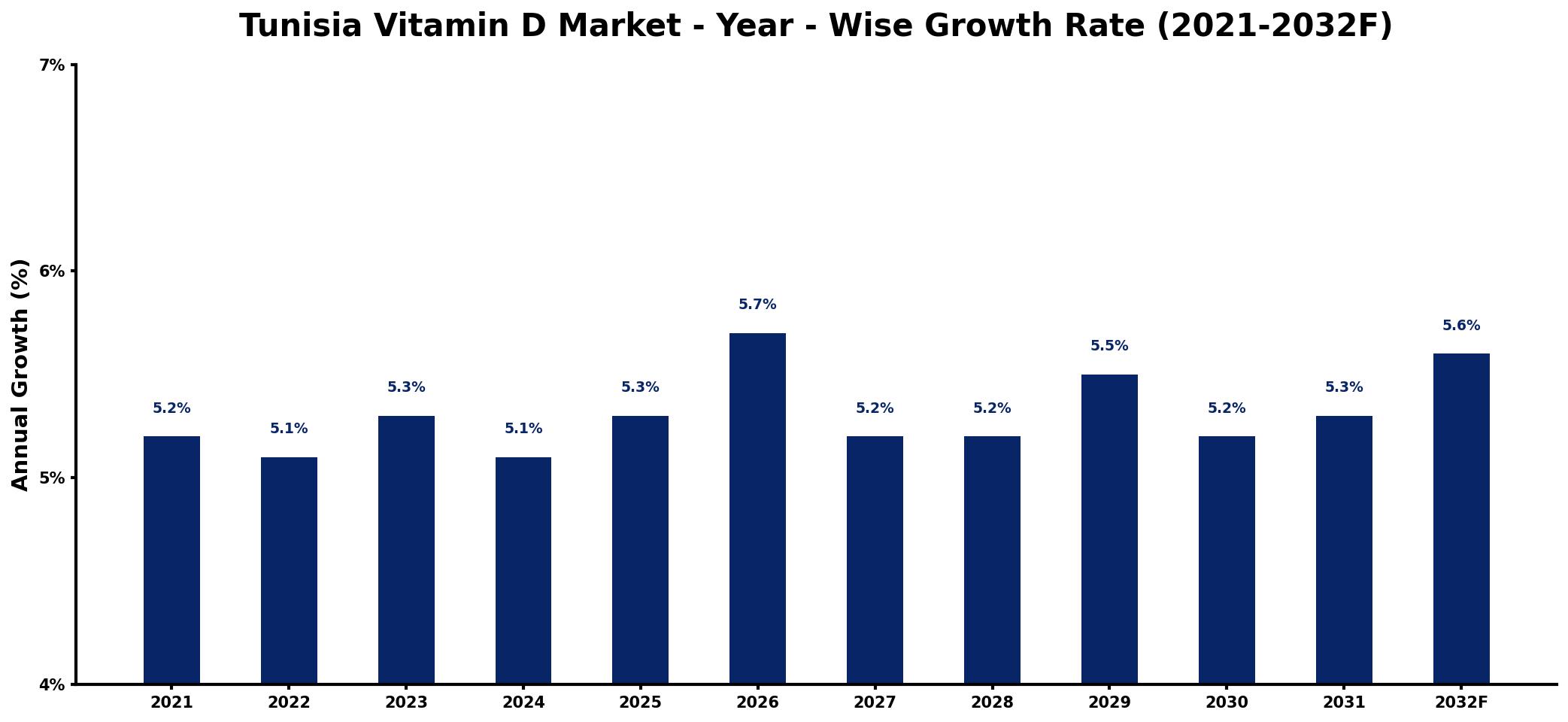
The table below presents the year‑wise growth rates along with the key drivers influencing the market
| Year | Growth Rate | Major Drivers |
| 2021 | 5.2% | Rising health awareness campaigns |
| 2022 | 5.1% | Increased dietary supplement consumption |
| 2023 | 5.3% | Growth in preventive healthcare spending |
| 2024 | 5.1% | Expansion of retail distribution channels |
| 2025 | 5.3% | Innovations in product formulations |
| 2026 | 5.7% | Surge in online sales platforms |
| 2027 | 5.2% | Increased government health initiatives |
| 2028 | 5.2% | growing emerging market penetration |
| 2029 | 5.5% | Rising consumer interest in wellness |
| 2030 | 5.2% | increased overall sector activity |
| 2031 | 5.3% | improved processing technologies adoption |
| 2032 | 5.6% | increased production capacity utilization |
Note: Market size estimations and growth projections presented in this report are based on 6Wresearch's proprietary forecasting methodology, utilizing the latest available industry data, government publications, and primary research inputs.
Tunisia Vitamin D Market Synopsis
Vitamin D deficiency remains a significant public health issue in Tunisia, exacerbated by seasonal changes that limit sunlight exposure, particularly in winter. This situation has led to a growing need for effective supplementation, prompting many consumers to seek fortified foods and nutritional products.
With an expanding healthcare sector and increasing efforts to educate the public on the benefits of Vitamin D, companies are actively developing diverse product offerings. This is evident in the rise of fortified foods and supplements, aimed at a health-conscious consumer base keen on preventing deficiency-related health issues.
Tunisia Vitamin D Market Key Takeaways
- Rising health awareness is propelling demand for Vitamin D supplements.
- Significant focus on public health campaigns targeting Vitamin D deficiency.
- Healthcare sector growth correlates with increased consumer interest in fortified products.
- Collaboration with healthcare professionals is enhancing market penetration.
- Seasonal variations in demand necessitate effective marketing strategies.
Evaluation of Restraints in Tunisia Vitamin D Market
Despite the promising growth trajectory, the Tunisia Vitamin D market faces some notable constraints. Limited public knowledge about the sources and benefits of Vitamin D supplementation hampers consumer uptake. Additionally, dietary habits in certain regions may not naturally include sufficient Vitamin D-rich foods, leading to reliance on supplements. The challenge of ensuring affordable access to fortified products remains critical for enhancing market reach and addressing public health needs effectively.
Tunisia Vitamin D Market Trends
A noticeable trend in the Tunisia Vitamin D market is the increasing integration of fortified foods into consumers' diets, responding to heightened health consciousness. Additionally, innovative marketing strategies are being developed to cater to the varying levels of consumer awareness regarding Vitamin D's health benefits. Digital platforms are increasingly utilized for disseminating educational content, making it easier for consumers to access information and enhance their purchasing decisions.
Tunisia Vitamin D Market Opportunities
As the awareness of health benefits continues to grow, significant investment opportunities are emerging in the sectors of fortified foods and dietary supplements. Companies have the potential to innovate with new delivery formats, including gummies and liquid formulations, to attract a broader audience. Furthermore, collaboration with healthcare institutions for educational campaigns can pave the way for increased market penetration, positioning brands as trusted sources of Vitamin D products.
Government Initiatives in the Tunisia Vitamin D Market
The Tunisian government has implemented various public health initiatives aimed at addressing Vitamin D deficiency. Policies focus on enhancing public awareness through dietary guidelines and recommendations for adequate sun exposure. Programs encouraging the fortification of staple foods with Vitamin D are also being prioritized, especially for at-risk groups such as pregnant women, infants, and the elderly, to mitigate health risks associated with deficiencies.
Future Insights of the Tunisia Vitamin D Market
Looking ahead to the period from 2026 to 2032, the Tunisia Vitamin D market is expected to witness considerable growth, driven by sustained consumer demand for health and wellness products. As educational efforts continue and public awareness rises, the market will likely see increased penetration of fortified foods, along with innovative product offerings. Continued collaboration between private companies and governmental health initiatives will be pivotal in shaping the future landscape of the Vitamin D market in Tunisia.
Tunisia Vitamin D Market Latest Developments (2025 - 2026)
Recent developments in the Tunisia Vitamin D market indicate a surge in the introduction of new fortified products, particularly within the functional food segment. Companies are actively engaging in partnerships with health organizations to promote public health awareness campaigns. Efforts to address seasonal demand fluctuations through targeted marketing strategies are also being implemented, with an emphasis on consumer education regarding Vitamin D's health benefits.
Tunisia Vitamin D Market - Key Attractiveness of the Report
- 10 Years of Market Numbers
- Historical Data Starting from 2022 to 2025
- Base Year: 2025
- Forecast Data until 2032
- Key Performance Indicators Impacting the Market
- Major Upcoming Developments and Projects
Key Highlights of the Report:
- Tunisia Vitamin D Market Outlook
- Market Size of Tunisia Vitamin D Market, 2025
- Forecast of Tunisia Vitamin D Market, 2032
- Historical Data and Forecast of Tunisia Vitamin D Revenues & Volume for the Period 2022-2032F
- Tunisia Vitamin D Market Trend Evolution
- Tunisia Vitamin D Market Drivers and Challenges
- Tunisia Vitamin D Price Trends
- Tunisia Vitamin D Porter's Five Forces
- Tunisia Vitamin D Industry Life Cycle
- Historical Data and Forecast of Tunisia Vitamin D Market Revenues & Volume By Analog for the Period 2022-2032F
- Historical Data and Forecast of Tunisia Vitamin D Market Revenues & Volume By Vitamin D3 for the Period 2022-2032F
- Historical Data and Forecast of Tunisia Vitamin D Market Revenues & Volume By Vitamin D2 for the Period 2022-2032F
- Historical Data and Forecast of Tunisia Vitamin D Market Revenues & Volume By Iu Strength for the Period 2022-2032F
- Historical Data and Forecast of Tunisia Vitamin D Market Revenues & Volume By 500,000 IU for the Period 2022-2032F
- Historical Data and Forecast of Tunisia Vitamin D Market Revenues & Volume By 100,000 IU for the Period 2022-2032F
- Historical Data and Forecast of Tunisia Vitamin D Market Revenues & Volume By 40 Miu for the Period 2022-2032F
- Historical Data and Forecast of Tunisia Vitamin D Market Revenues & Volume By Others for the Period 2022-2032F
- Historical Data and Forecast of Tunisia Vitamin D Market Revenues & Volume By Form for the Period 2022-2032F
- Historical Data and Forecast of Tunisia Vitamin D Market Revenues & Volume By Dry for the Period 2022-2032F
- Historical Data and Forecast of Tunisia Vitamin D Market Revenues & Volume By Liquid for the Period 2022-2032F
- Historical Data and Forecast of Tunisia Vitamin D Market Revenues & Volume By Application for the Period 2022-2032F
- Historical Data and Forecast of Tunisia Vitamin D Market Revenues & Volume By Feed & Pet Food for the Period 2022-2032F
- Historical Data and Forecast of Tunisia Vitamin D Market Revenues & Volume By Animal Feed for the Period 2022-2032F
- Historical Data and Forecast of Tunisia Vitamin D Market Revenues & Volume By Pet Food for the Period 2022-2032F
- Historical Data and Forecast of Tunisia Vitamin D Market Revenues & Volume By Pharmaceuticals for the Period 2022-2032F
- Historical Data and Forecast of Tunisia Vitamin D Market Revenues & Volume By Functional Food & Beverages for the Period 2022-2032F
- Historical Data and Forecast of Tunisia Vitamin D Market Revenues & Volume By Personal Care for the Period 2022-2032F
- Historical Data and Forecast of Tunisia Vitamin D Market Revenues & Volume By End User for the Period 2022-2032F
- Historical Data and Forecast of Tunisia Vitamin D Market Revenues & Volume By Adults for the Period 2022-2032F
- Historical Data and Forecast of Tunisia Vitamin D Market Revenues & Volume By Pregnant Women for the Period 2022-2032F
- Historical Data and Forecast of Tunisia Vitamin D Market Revenues & Volume By Children for the Period 2022-2032F
- Tunisia Vitamin D Import Export Trade Statistics
- Market Opportunity Assessment By Analog
- Market Opportunity Assessment By Iu Strength
- Market Opportunity Assessment By Form
- Market Opportunity Assessment By Application
- Market Opportunity Assessment By End User
- Tunisia Vitamin D Top Companies Market Share
- Tunisia Vitamin D Competitive Benchmarking By Technical and Operational Parameters
- Tunisia Vitamin D Company Profiles
- Tunisia Vitamin D Key Strategic Recommendations






































