Tunisia Washing Machine Market Size, Share & Growth Rate
The Tunisia Washing Machine Market was estimated at USD 207 Million in 2025 and is projected to reach USD 270 Million by 2032, growing at a CAGR of 3.9% from 2026 to 2032. This growth trajectory is driven by a combination of increasing disposable incomes among consumers and a noticeable shift towards urbanization. As more Tunisians embrace modern lifestyles, their demand for efficient, high-tech appliances like washing machines continues to rise.
Tunisia Washing Machine Market Growth Rate Analysis (2021-2032)
The Tunisia washing machine market has exhibited a stable growth pattern, with yearly increases hovering around 4.4% to 4.9% between 2021 and 2032. A notable surge of 4.7% in 2022 can be attributed to heightened consumer demand spurred by urbanization and rising disposable incomes, while subsequent years like 2023 and 2024 maintained a solid 4.5% growth as brands invested in energy-efficient and technologically advanced models. Although growth rates slightly fluctuated, with a dip to 4.3% in 2025, ongoing digitalization in retail channels and a focus on enhancing consumer awareness about sustainable products have sustained market interest. The cumulative effect of these trends is expected to uphold this growth momentum, evidenced by a robust 4.9% increase projected for 2029.
Tunisia Washing Machine Market Year-wise Growth Rate and Key Drivers
This graph highlights how the Tunisia Washing Machine Market has steadily grown over the past five years, supported by major growth factors.
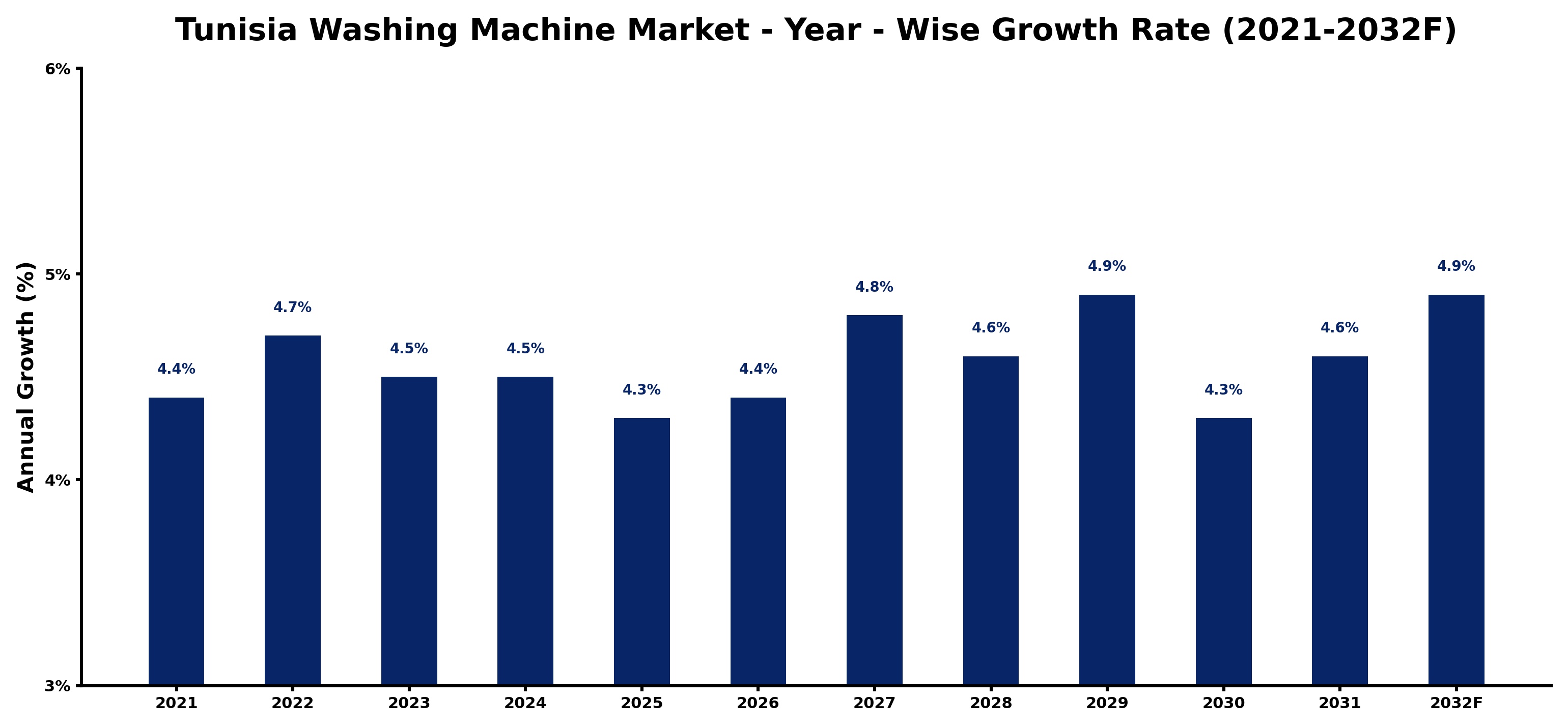
The table below presents the year‑wise growth rates along with the key drivers influencing the market
| Year | Growth Rate | Major Drivers |
| 2021 | 4.4% | Local washing machine manufacturers scale up production to meet demand |
| 2022 | 4.7% | Domestic assembly plants ramped up washing machine production capacity |
| 2023 | 4.5% | Domestic appliance manufacturers adopt IoT technology for smart washing machines |
| 2024 | 4.5% | Increased assembly line automation enhances washing machine production efficiency |
| 2025 | 4.3% | Domestic assembly line upgrades boosted washing machine production efficiency |
| 2026 | 4.4% | Technology integration streamlined assembly processes in washing machine production |
| 2027 | 4.8% | Higher factory throughput enhanced washing machine assembly line productivity |
| 2028 | 4.6% | Local assembly plants boosted domestic washing machine production capacity |
| 2029 | 4.9% | Retail demand resurgence drives local washing machine production expansion |
| 2030 | 4.3% | Modernized assembly lines boost local washing machine production capacity |
| 2031 | 4.6% | Localized manufacturing investments bolstered washing machine assembly capabilities |
| 2032 | 4.9% | Improved retail sales boosted washing machine production capabilities in Tunisia |
Note - Market size estimations and growth projections presented in this report are based on 6Wresearch’s advanced forecasting approach, validated with industry datasets as of June 2026.
Tunisia Washing Machine Market Synopsis
In Tunisia, the rising middle class is particularly influencing the washing machine market, as more households prioritize convenience and sustainability in their purchasing decisions. As urban areas expand, the penetration of modern home appliances becomes critical for meeting consumer needs.
Notably, energy-efficient models are gaining traction, aligning with consumers' preferences for both cost savings and environmental consciousness. With this trend, the market is witnessing an increasing number of technologically advanced washing machines that cater to these evolving demands.
Tunisia Washing Machine Market Key Takeaways
- The market is bolstered by urbanization and the expansion of the middle class.
- Energy-efficient and smart washing machines are leading consumer preferences.
- Raw material cost volatility poses ongoing challenges for manufacturers.
- Government regulations are promoting eco-friendly technologies within the market.
- Strategic partnerships will be essential for brand differentiation in a competitive landscape.
Evaluation of Restraints in Tunisia Washing Machine Market
Despite robust growth prospects, the Tunisia Washing Machine Market faces significant restraints. Fluctuations in raw material prices, particularly for metals and plastics, can severely impact production costs. This unpredictability affects not just pricing strategies but also consumer affordability, making it essential for companies to implement efficient supply chain management practices. Moreover, with growing environmental regulations, manufacturers are challenged to innovate continuously, ensuring compliance while keeping up with market demands.
Tunisia Washing Machine Market Trends
Current trends within the Tunisia Washing Machine Market include a marked shift towards smart technologies that offer features such as remote operation and energy monitoring. As consumers become more tech-savvy, there is an increasing preference for appliances that integrate with home automation systems. Furthermore, sustainability is not merely a buzzword; it's shaping purchasing decisions as consumers opt for products that promise reduced environmental impact and enhanced energy efficiency.
Tunisia Washing Machine Market Opportunities
Investment opportunities in the Tunisia Washing Machine Market are abundant, particularly for manufacturers focusing on energy-efficient and smart appliances. The growing urbanization provides fertile ground for companies to introduce innovative solutions that address the needs of modern households. Additionally, strategic partnerships with local distributors could enhance market penetration, especially in underrepresented rural areas.
Government Initiatives in the Tunisia Washing Machine Market
The Tunisian government is actively promoting energy efficiency through regulations that set specific standards for washing machines regarding energy consumption and water efficiency. These initiatives encourage manufacturers to adopt eco-friendly technologies, paving the way for sustainable practices that reduce the environmental impact of appliances. Additionally, government incentives may support local production and innovation, bolstering the overall market landscape.
Future Insights of the Tunisia Washing Machine Market
Looking forward to 2026-2032, the Tunisia Washing Machine Market is expected to evolve significantly, driven by ongoing technological advancements and shifts in consumer behavior. The emphasis on energy-efficient appliances will likely intensify, as consumers become more aware of their environmental footprint. Additionally, the integration of artificial intelligence and IoT into washing machines will reshape user experiences, making the appliances not only more efficient but also more user-friendly. As these trends unfold, market players must remain agile to capitalize on the evolving landscape.
Tunisia Washing Machine Market Latest Developments (May 2025 - June 2026)
In recent months, the Tunisia Washing Machine Market has seen a surge in interest around smart appliances equipped with advanced connectivity features. Manufacturers are focusing on developing products that not only meet regulatory standards but also appeal to tech-oriented consumers. Additionally, marketing strategies have shifted towards highlighting energy-saving benefits, aiming to align with consumer priorities as awareness of sustainable practices continues to grow.
Tunisia Washing Machine Market - Key Attractiveness of the Report
- 10 Years of Market Numbers
- Historical Data Starting from 2022 to 2025
- Base Year: 2025
- Forecast Data until 2032
- Key Performance Indicators Impacting the Market
- Major Upcoming Developments and Projects
Key Highlights of the Report:
- Tunisia Washing Machine Market Outlook
- Market Size of Tunisia Washing Machine Market, 2025
- Forecast of Tunisia Washing Machine Market, 2032
- Historical Data and Forecast of Tunisia Washing Machine Revenues & Volume for the Period 2022-2032F
- Tunisia Washing Machine Market Trend Evolution
- Tunisia Washing Machine Market Drivers and Challenges
- Tunisia Washing Machine Price Trends
- Tunisia Washing Machine Porter's Five Forces
- Tunisia Washing Machine Industry Life Cycle
- Historical Data and Forecast of Tunisia Washing Machine Market Revenues & Volume By Product for the Period 2022-2032F
- Historical Data and Forecast of Tunisia Washing Machine Market Revenues & Volume By Fully automatic for the Period 2022-2032F
- Historical Data and Forecast of Tunisia Washing Machine Market Revenues & Volume By Semi-automatic for the Period 2022-2032F
- Historical Data and Forecast of Tunisia Washing Machine Market Revenues & Volume By Dryers for the Period 2022-2032F
- Historical Data and Forecast of Tunisia Washing Machine Market Revenues & Volume By Technology for the Period 2022-2032F
- Historical Data and Forecast of Tunisia Washing Machine Market Revenues & Volume By Smart connected washing machine for the Period 2022-2032F
- Historical Data and Forecast of Tunisia Washing Machine Market Revenues & Volume By Conventional washing machine for the Period 2022-2032F
- Historical Data and Forecast of Tunisia Washing Machine Market Revenues & Volume By Capacity for the Period 2022-2032F
- Historical Data and Forecast of Tunisia Washing Machine Market Revenues & Volume By Below 6 kg for the Period 2022-2032F
- Historical Data and Forecast of Tunisia Washing Machine Market Revenues & Volume By 6.1 to 8 kg for the Period 2022-2032F
- Historical Data and Forecast of Tunisia Washing Machine Market Revenues & Volume By Above 8 kg for the Period 2022-2032F
- Historical Data and Forecast of Tunisia Washing Machine Market Revenues & Volume By End-use for the Period 2022-2032F
- Historical Data and Forecast of Tunisia Washing Machine Market Revenues & Volume By Commercial for the Period 2022-2032F
- Historical Data and Forecast of Tunisia Washing Machine Market Revenues & Volume By Residential for the Period 2022-2032F
- Historical Data and Forecast of Tunisia Washing Machine Market Revenues & Volume By Application for the Period 2022-2032F
- Historical Data and Forecast of Tunisia Washing Machine Market Revenues & Volume By Healthcare for the Period 2022-2032F
- Historical Data and Forecast of Tunisia Washing Machine Market Revenues & Volume By Hospitality for the Period 2022-2032F
- Historical Data and Forecast of Tunisia Washing Machine Market Revenues & Volume By Others for the Period 2022-2032F
- Tunisia Washing Machine Import Export Trade Statistics
- Market Opportunity Assessment By Product
- Market Opportunity Assessment By Technology
- Market Opportunity Assessment By Capacity
- Market Opportunity Assessment By End-use
- Market Opportunity Assessment By Application
- Tunisia Washing Machine Top Companies Market Share
- Tunisia Washing Machine Competitive Benchmarking By Technical and Operational Parameters
- Tunisia Washing Machine Company Profiles
- Tunisia Washing Machine Key Strategic Recommendations






































