Tunisia Water Desalination Equipment Market Size, Share & Growth Rate
The Tunisia Water Desalination Equipment Market was estimated at USD 205 Million in 2025 and is projected to reach USD 289 Million by 2032, growing at a CAGR of 5.0% from 2026 to 2032. This growth trajectory is driven by the urgent need to address the increasing water scarcity in Tunisia, spurred by climate challenges and demographic shifts. Additionally, government initiatives to bolster water infrastructure and the growing industrial sector are further amplifying the demand for desalination technologies.
Tunisia Water Desalination Equipment Market Year-wise Growth Rate and Key Drivers
This graph highlights how the Tunisia Water Desalination Equipment Market has steadily grown over the years, supported by major growth factors.
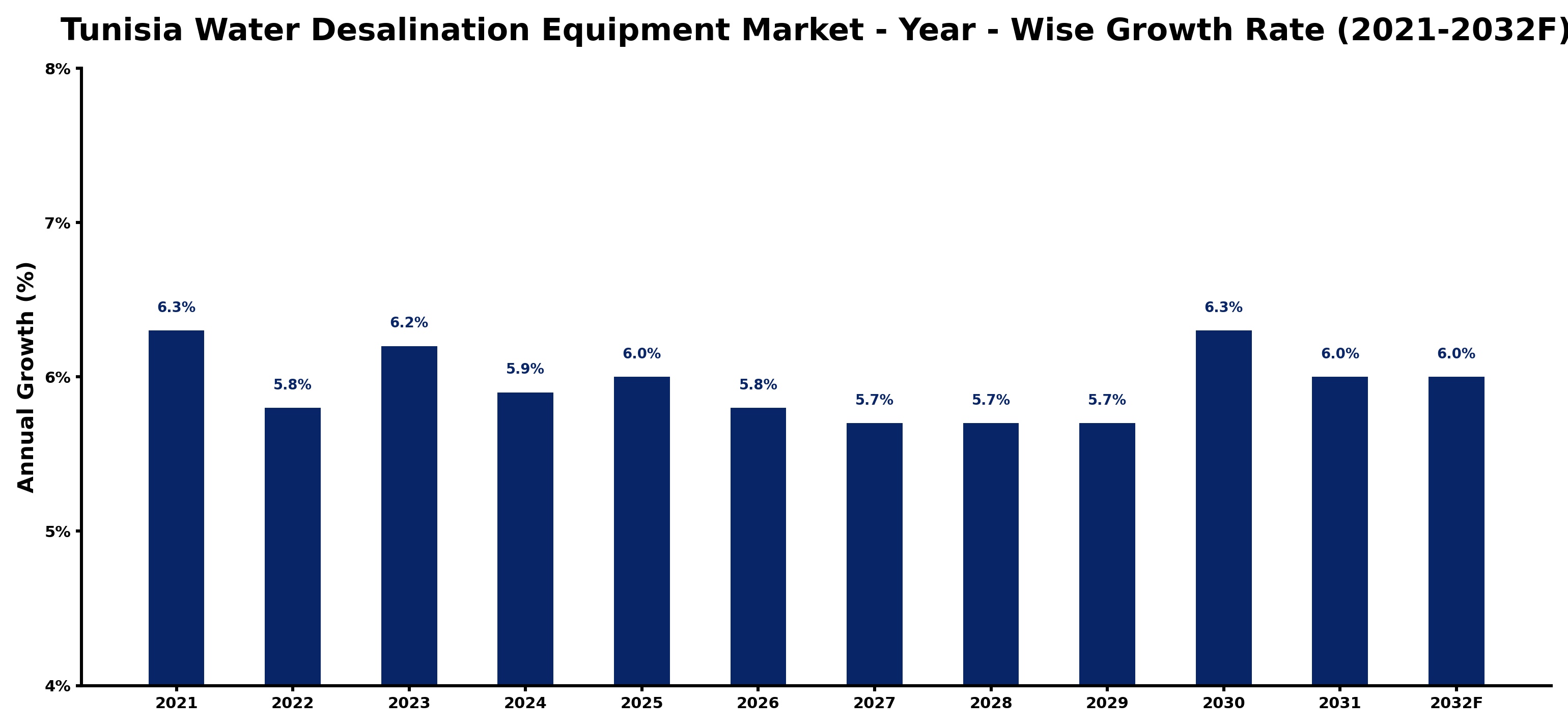
The table below presents the year‑wise growth rates along with the key drivers influencing the market
| Year | Growth Rate | Major Drivers |
| 2021 | 6.3% | Expansion of manufacturing activities |
| 2022 | 5.8% | Expansion of commercial construction activities |
| 2023 | 6.2% | Increasing industrial automation investments |
| 2024 | 5.9% | Expansion of transportation and logistics networks |
| 2025 | 6.0% | Growing renewable energy integration projects |
| 2026 | 5.8% | Growing urbanization and commercial development |
| 2027 | 5.7% | Growing renewable energy integration projects |
| 2028 | 5.7% | Increasing adoption of advanced technologies |
| 2029 | 5.7% | Expansion of commercial construction activities |
| 2030 | 6.3% | Government infrastructure modernization initiatives |
| 2031 | 6.0% | Increasing industrial automation investments |
| 2032 | 6.0% | Increasing adoption of advanced technologies |
Note - Market size estimations and growth projections presented in this report are based on 6Wresearch's advanced forecasting approach, validated with industry datasets as of June 2026.
Tunisia Water Desalination Equipment Market Synopsis
Tunisia faces a critical water shortage due to its predominantly arid climate, which compels the government and industries to seek alternative water sources, particularly through desalination. The adoption of advanced technologies such as reverse osmosis is becoming commonplace, as these solutions efficiently convert seawater into potable water while addressing cost-effectiveness.
As urbanization accelerates and the population continues to grow, the necessity for reliable and safe drinking water is more pressing than ever. Consequently, a robust framework of public and private partnerships is emerging, focusing on large-scale desalination projects to alleviate these water scarcity challenges in both urban and rural areas.
Tunisia Water Desalination Equipment Market Key Takeaways
- The market is set for substantial growth, with a projected increase in demand for desalination equipment driven by water scarcity and urbanization.
- Technological innovation in desalination processes is pivotal to enhancing efficiency and sustainability.
- Public-private partnerships are increasingly crucial for expanding desalination capacity in response to water shortages.
- Investment in research and development is being prioritized by market players to improve desalination technologies.
- Government policies favoring infrastructure improvements support a favorable environment for market expansion.
Evaluation of Restraints in Tunisia Water Desalination Equipment Market
Despite the growth prospects, the market faces significant challenges. High initial capital investments required for establishing desalination plants can deter new entrants. Moreover, the energy-intensive nature of desalination processes raises concerns about operational costs and sustainability. Additionally, there exists a shortage of skilled labor necessary to operate and maintain these advanced technologies, hampering efficiency. Infrastructure inadequacies for distributing desalinated water further complicate market dynamics, posing hurdles that must be addressed to fully capitalize on growth opportunities.
Tunisia Water Desalination Equipment Market Trends
A noticeable trend within the Tunisia Water Desalination Equipment Market is the shift toward more sustainable and energy-efficient technologies. Growing environmental awareness and the need for cost reduction have propelled interest in alternative desalination methods, including solar-powered desalination and energy recovery systems. Furthermore, decentralized desalination solutions are gaining traction, particularly in remote coastal areas, enabling localized water supply solutions tailored to specific community needs.
Tunisia Water Desalination Equipment Market Opportunities
The market is rife with investment opportunities as the demand for desalination equipment rises. Key areas for growth include advanced membrane filtration systems and reverse osmosis technologies, which are critical in the desalination landscape. Collaborative ventures with local entities for large-scale projects present lucrative possibilities. Additionally, the focus on enhancing energy efficiency can lead to innovative product offerings that appeal to cost-conscious customers while aligning with sustainability goals.
Government Initiatives in the Tunisia Water Desalination Equipment Market
The Tunisian government is actively fostering the growth of the desalination equipment market through various initiatives. These include providing financial incentives for companies adopting desalination technologies and simplifying regulatory frameworks for equipment importation and installation. Emphasis on public-private partnerships has led to increased collaboration in addressing water scarcity, paving the way for successful long-term desalination projects. Moreover, the government is investing in research and development to enhance the efficiency and sustainability of existing technologies.
Future Insights of the Tunisia Water Desalination Equipment Market
Looking ahead to 2026-2032, the Tunisia Water Desalination Equipment Market is poised for significant advancements driven by technological innovation and an escalating demand for sustainable water management solutions. The government's commitment to improving water infrastructure will play a pivotal role in enhancing capacity and reliability of desalination facilities. As urbanization continues to shape the landscape, the market is expected to witness a surge in the integration of cutting-edge technologies that not only provide fresh water but also align with broader environmental goals.
Tunisia Water Desalination Equipment Market Latest Developments (May 2025 - June 2026)
Recent industry developments indicate a concerted push towards upgrading existing desalination facilities to enhance their operational efficiency. Initiatives focusing on reducing energy consumption through innovative technologies are gaining traction. Furthermore, stakeholders are actively exploring opportunities for collaboration in research endeavors aimed at improving desalination processes and environmental sustainability. This evolving landscape is indicative of a dynamic response to the pressing water challenges faced by Tunisia.
Tunisia Water Desalination Equipment Market - Key Attractiveness of the Report
- 10 Years of Market Numbers
- Historical Data Starting from 2022 to 2025
- Base Year: 2025
- Forecast Data until 2032
- Key Performance Indicators Impacting the Market
- Major Upcoming Developments and Projects
Key Highlights of the Report:
- Tunisia Water Desalination Equipment Market Outlook
- Market Size of Tunisia Water Desalination Equipment Market, 2025
- Forecast of Tunisia Water Desalination Equipment Market, 2032
- Historical Data and Forecast of Tunisia Water Desalination Equipment Revenues & Volume for the Period 2022-2032F
- Tunisia Water Desalination Equipment Market Trend Evolution
- Tunisia Water Desalination Equipment Market Drivers and Challenges
- Tunisia Water Desalination Equipment Price Trends
- Tunisia Water Desalination Equipment Porter's Five Forces
- Tunisia Water Desalination Equipment Industry Life Cycle
- Historical Data and Forecast of Tunisia Water Desalination Equipment Market Revenues & Volume By Technology for the Period 2022-2032F
- Historical Data and Forecast of Tunisia Water Desalination Equipment Market Revenues & Volume By Reverse Osmosis for the Period 2022-2032F
- Historical Data and Forecast of Tunisia Water Desalination Equipment Market Revenues & Volume By Multi-Stage Flash (MSF) Distillation for the Period 2022-2032F
- Historical Data and Forecast of Tunisia Water Desalination Equipment Market Revenues & Volume By Multi-Effect Distillation (MED) for the Period 2022-2032F
- Historical Data and Forecast of Tunisia Water Desalination Equipment Market Revenues & Volume By Others for the Period 2022-2032F
- Historical Data and Forecast of Tunisia Water Desalination Equipment Market Revenues & Volume By Source for the Period 2022-2032F
- Historical Data and Forecast of Tunisia Water Desalination Equipment Market Revenues & Volume By Seawater for the Period 2022-2032F
- Historical Data and Forecast of Tunisia Water Desalination Equipment Market Revenues & Volume By Brackish water for the Period 2022-2032F
- Historical Data and Forecast of Tunisia Water Desalination Equipment Market Revenues & Volume By River water for the Period 2022-2032F
- Historical Data and Forecast of Tunisia Water Desalination Equipment Market Revenues & Volume By Others for the Period 2022-2032F
- Historical Data and Forecast of Tunisia Water Desalination Equipment Market Revenues & Volume By Application for the Period 2022-2032F
- Historical Data and Forecast of Tunisia Water Desalination Equipment Market Revenues & Volume By Municipal for the Period 2022-2032F
- Historical Data and Forecast of Tunisia Water Desalination Equipment Market Revenues & Volume By Industrial for the Period 2022-2032F
- Historical Data and Forecast of Tunisia Water Desalination Equipment Market Revenues & Volume By Others for the Period 2022-2032F
- Tunisia Water Desalination Equipment Import Export Trade Statistics
- Market Opportunity Assessment By Technology
- Market Opportunity Assessment By Source
- Market Opportunity Assessment By Application
- Tunisia Water Desalination Equipment Top Companies Market Share
- Tunisia Water Desalination Equipment Competitive Benchmarking By Technical and Operational Parameters
- Tunisia Water Desalination Equipment Company Profiles
- Tunisia Water Desalination Equipment Key Strategic Recommendations






































