Tunisia Water Treatment Market Summary
The tunisia water treatment market was estimated at USD 353 Million in 2025 and is projected to reach USD 476 Million by 2032, growing at a CAGR of 5.4% from 2026 to 2032.
Tunisia Water Treatment Market Year-wise Growth Rate and Key Drivers
This graph highlights how the Tunisia Water Treatment Market has steadily grown over the past five years, supported by major growth factors.
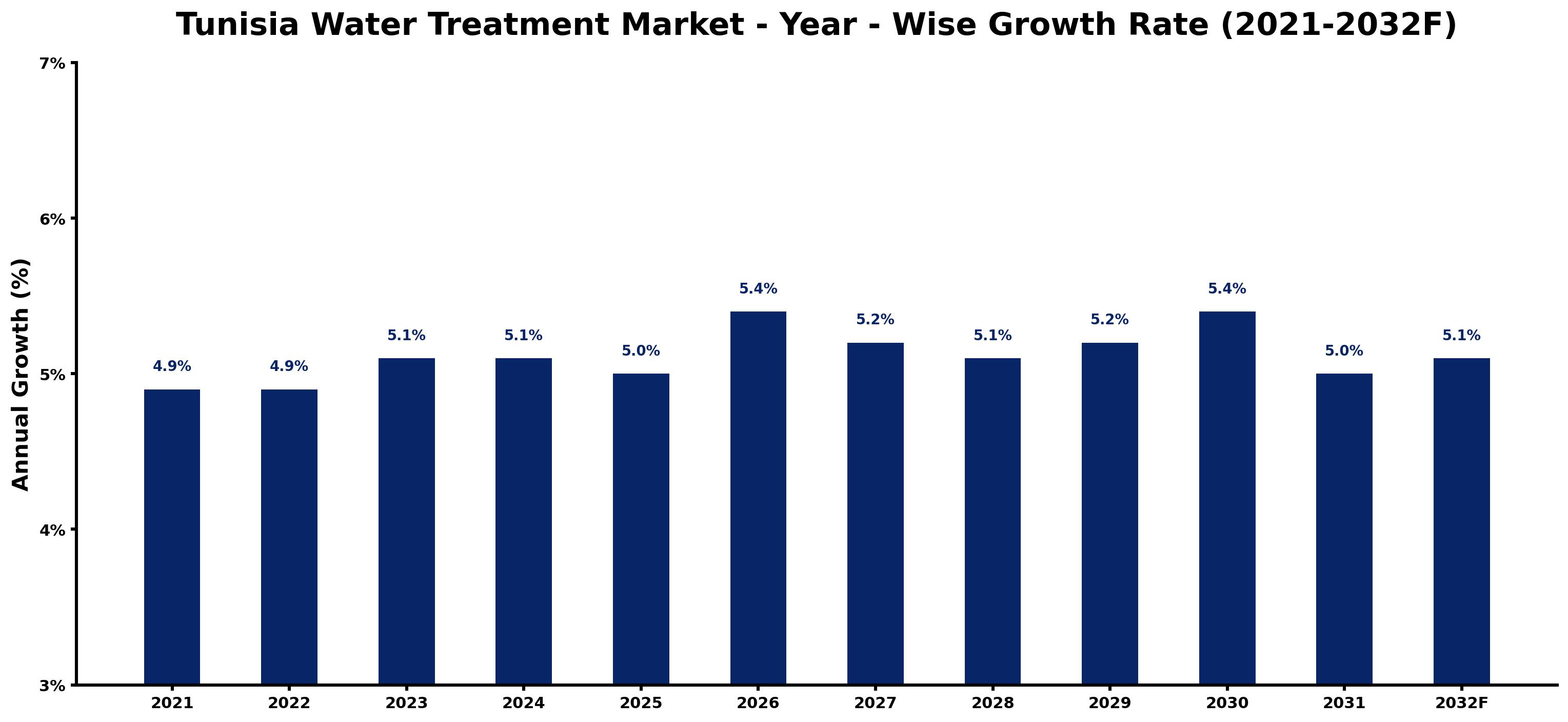
The table below presents the year wise growth rates along with the key drivers influencing the market
| Year | Growth Rate | Major Drivers |
| 2021 | 4.9% | Water scarcity issues prompted local authorities to seek innovative treatment solutions. |
| 2022 | 4.9% | Private sector investments began to target advanced filtration technologies for municipal systems. |
| 2023 | 5.1% | Rising awareness around health impacts led to increased consumer demand for purified water. |
| 2024 | 5.1% | New partnerships emerged between local firms and international water tech companies. |
| 2025 | 5.0% | Urbanization trends drove a surge in residential water treatment installations and services. |
| 2026 | 5.4% | Increasing industrial activities highlighted the need for efficient wastewater management solutions. |
| 2027 | 5.2% | Affordability of compact treatment systems encouraged adoption in rural areas across Tunisia. |
| 2028 | 5.1% | Public-private collaborations supported large-scale desalination projects along the coastline. |
| 2029 | 5.2% | Enhanced regulations focused on pollution control required businesses to upgrade treatment facilities. |
| 2030 | 5.4% | Technological innovations reduced operational costs for both industrial and residential treatment. |
| 2031 | 5.0% | Changing climate patterns led to heightened investment in sustainable water solutions and practices. |
| 2032 | 5.1% | Consumer preferences shifted towards eco-friendly products, influencing market offerings and growth. |
Note - Market size estimations and growth projections presented in this report are based on 6Wresearch's advanced forecasting approach, validated with industry datasets as of June 2026.
Tunisia Water Treatment Market Synopsis
The Tunisia Water Treatment Market is projected to reach 5.4% and witness significant growth during the forecast period (2026-2032). The market serves as a cornerstone for ensuring the availability of clean water across various sectors, including domestic, industrial, and agricultural uses. The growth trajectory of this market is significantly influenced by increasing regulatory pressures, rising water pollution levels, and the pressing need for sustainable water management solutions.
Tunisia Water Treatment Market Growth Drivers
Several factors are propelling the growth of the Tunisia water treatment market. The drive to provide safe drinking water amid escalating concerns regarding water pollution and scarcity is one of the primary catalysts. Additionally, government regulations aimed at enhancing water quality standards are pivotal in fostering market expansion. Urbanization and industrialization further amplify the necessity for efficient wastewater treatment solutions, creating robust demand within the industry.
- The necessity to deliver safe drinking water is amplifying demand for advanced water treatment technologies across the country.
- Stringent government regulations aimed at maintaining and enhancing water quality are crucial for market growth.
- The rapid pace of industrialization and urbanization has led to an increased requirement for efficient wastewater treatment options.
- Technological advancements, particularly in membrane filtration and desalination, are enhancing the effectiveness and reach of water treatment solutions.
- Rising public awareness regarding water quality issues is driving demand for improved treatment processes and sustainable practices.
Tunisia Water Treatment Market Challenges and Restraints
Despite its growth potential, the Tunisia water treatment market is facing several challenges. Key issues include inadequate investment in treatment infrastructure, particularly in rural areas, which limits access to clean water and sanitation services. Economic constraints are a significant barrier, as limited financial resources hinder the development of treatment facilities and the adoption of innovative technologies. Regulatory complexities also contribute to increased operational costs and uncertainties for market entities.
- Insufficient investment in water treatment infrastructure, especially in rural areas, hampers access to essential services.
- Economic constraints and limited financing options impede the expansion of treatment facilities across the country.
- Regulatory complexities create additional operational costs, adding pressure on market participants.
- Public education regarding water quality remains insufficient, which limits consumer demand for improved services.
- Technological advancements must be balanced with financial viability, posing challenges for market growth.
Tunisia Water Treatment Market Government Investment and Initiatives
The Tunisia water treatment market is significantly shaped by government investments and initiatives aimed at promoting clean water access and environmental sustainability. Comprehensive government policies are in place to ensure adherence to water quality standards and efficient treatment processes. These regulations stimulate demand for advanced treatment technologies while fostering public-private partnerships designed to enhance investment in water treatment infrastructure.
- Government policies prioritize the provision of clean water and environmental protection, influencing market dynamics.
- Regulatory frameworks ensure compliance with stringent water quality standards, guiding industry practices.
- Public-private partnerships are encouraged to stimulate investments in infrastructure, facilitating market growth.
- Government incentives support the adoption of advanced water treatment technologies and sustainable practices.
- Policy initiatives are aligned with sustainable development goals, promoting a competitive environment for innovations.
Tunisia Water Treatment Market Latest Developments (May 2025 - June 2026)
The period from May 2025 to June 2026 has witnessed significant developments in the Tunisia water treatment market, reflecting the evolving landscape and emerging priorities in water management. Emphasis has been placed on enhancing wastewater treatment capacity to meet increasing industrial and domestic demands. Additionally, the government has intensified its focus on public education campaigns related to water quality and conservation, seeking to elevate community awareness and participation in sustainable water practices.
- Increased investments in wastewater treatment facilities are being observed, driven by industrial and population growth.
- Public education campaigns have been launched to raise community awareness around water conservation and quality.
- Government initiatives are focusing on integrating advanced technologies in existing water treatment systems.
- Sustainability within water treatment practices has become a priority for upcoming infrastructure projects.
- Regulatory updates are being introduced to streamline compliance processes for water treatment operators.
Tunisia Water Treatment Market - Key Attractiveness of the Report
- 10 Years of Market Numbers
- Historical Data Starting from 2022 to 2025
- Base Year: 2025
- Forecast Data until 2032
- Key Performance Indicators Impacting the Market
- Major Upcoming Developments and Projects
Key Highlights of the Report:
- Tunisia Water Treatment Market Outlook
- Market Size of Tunisia Water Treatment Market, 2025
- Forecast of Tunisia Water Treatment Market, 2032
- Historical Data and Forecast of Tunisia Water Treatment Revenues & Volume for the Period 2022-2032F
- Tunisia Water Treatment Market Trend Evolution
- Tunisia Water Treatment Market Drivers and Challenges
- Tunisia Water Treatment Price Trends
- Tunisia Water Treatment Porter's Five Forces
- Tunisia Water Treatment Industry Life Cycle
- Historical Data and Forecast of Tunisia Water Treatment Market Revenues & Volume By Types for the Period 2022-2032F
- Historical Data and Forecast of Tunisia Water Treatment Market Revenues & Volume By Distillation? for the Period 2022-2032F
- Historical Data and Forecast of Tunisia Water Treatment Market Revenues & Volume By Filtration? for the Period 2022-2032F
- Historical Data and Forecast of Tunisia Water Treatment Market Revenues & Volume By Disinfection for the Period 2022-2032F
- Historical Data and Forecast of Tunisia Water Treatment Market Revenues & Volume By Reverse Osmosis for the Period 2022-2032F
- Historical Data and Forecast of Tunisia Water Treatment Market Revenues & Volume By Applications for the Period 2022-2032F
- Historical Data and Forecast of Tunisia Water Treatment Market Revenues & Volume By Residential? for the Period 2022-2032F
- Historical Data and Forecast of Tunisia Water Treatment Market Revenues & Volume By Non-Residential? for the Period 2022-2032F
- Historical Data and Forecast of Tunisia Water Treatment Market Revenues & Volume By Installations for the Period 2022-2032F
- Historical Data and Forecast of Tunisia Water Treatment Market Revenues & Volume By Point Of Use for the Period 2022-2032F
- Historical Data and Forecast of Tunisia Water Treatment Market Revenues & Volume By Point Of Entry for the Period 2022-2032F
- Tunisia Water Treatment Import Export Trade Statistics
- Market Opportunity Assessment By Types
- Market Opportunity Assessment By Applications
- Market Opportunity Assessment By Installations
- Tunisia Water Treatment Top Companies Market Share
- Tunisia Water Treatment Competitive Benchmarking By Technical and Operational Parameters
- Tunisia Water Treatment Company Profiles
- Tunisia Water Treatment Key Strategic Recommendations






































