Tunisia Water & Wastewater Treatment Market Summary
The tunisia water & wastewater treatment market was estimated at USD 1011 Million in 2025 and is projected to reach USD 1469 Million by 2032, growing at a CAGR of 6.3% from 2026 to 2032.
Tunisia Water & Wastewater Treatment Market Year-wise Growth Rate and Key Drivers
This graph highlights how the Tunisia Water & Wastewater Treatment Market has steadily grown over the past five years, supported by major growth factors.
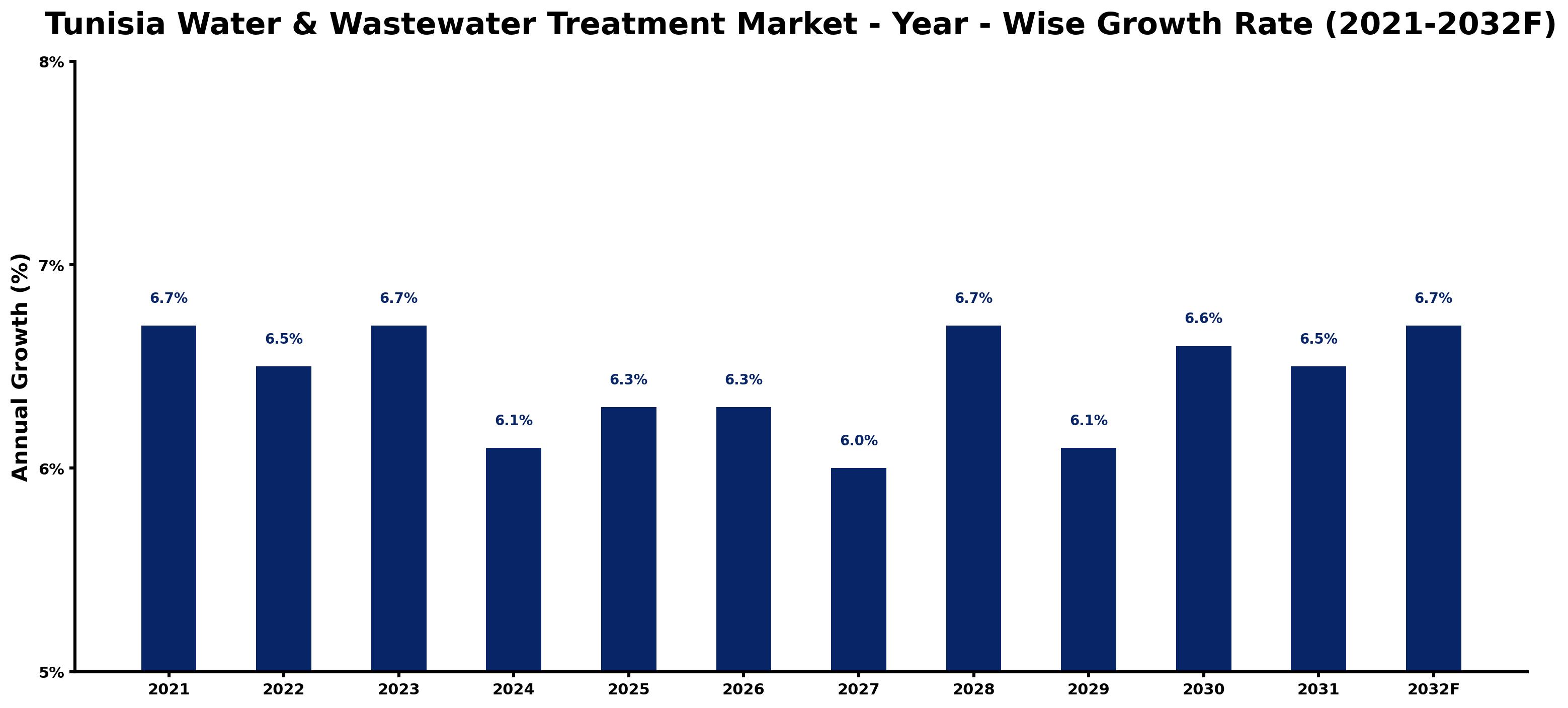
The table below presents the year wise growth rates along with the key drivers influencing the market
| Year | Growth Rate | Major Drivers |
| 2021 | 6.7% | COVID-19 highlighted sanitation needs, prompting discussions on water quality improvements. |
| 2022 | 6.5% | Municipalities focused on infrastructure upgrades to handle wastewater more effectively. |
| 2023 | 6.7% | Investment in desalination technology emerged as a solution for freshwater scarcity issues. |
| 2024 | 6.1% | Increased public-private partnerships aimed at enhancing water treatment efficiency. |
| 2025 | 6.3% | Climate change impacts prompted urgent initiatives for sustainable water management practices. |
| 2026 | 6.3% | Regional cooperation on water resources fostered innovative treatment technologies development. |
| 2027 | 6.0% | Emerging technologies in water recycling drew attention for urban water challenges. |
| 2028 | 6.7% | Local companies began collaborating with global experts on treatment solutions. |
| 2029 | 6.1% | Awareness of water scarcity issues led to heightened community engagement in conservation. |
| 2030 | 6.6% | Investment in smart water management systems supported real-time monitoring capabilities. |
| 2031 | 6.5% | Declining groundwater levels necessitated advanced treatment methods for sustainability. |
| 2032 | 6.7% | A holistic approach to wastewater management gained traction among urban planners. |
Note - Market size estimations and growth projections presented in this report are based on 6Wresearch's advanced forecasting approach, validated with industry datasets as of June 2026.
Tunisia Water & Wastewater Treatment Market Synopsis
The Tunisia Water Wastewater Treatment Market is projected to reach 6.3% and witness significant growth during the forecast period (2026-2032). The market is driven by increasing demands for sustainable water management and pollution control initiatives. As urbanization accelerates and industrial activity intensifies, the requirement for efficient and robust wastewater treatment solutions has become more pressing. However, this growth trajectory faces several challenges, including the need to upgrade aging infrastructure, ensure compliance with evolving regulations, and secure adequate funding for large-scale projects.
Tunisia Water & Wastewater Treatment Market Growth Drivers
A multitude of factors is propelling the Tunisia Water & Wastewater Treatment Market forward. Firstly, the escalating demand for clean and safe drinking water is paramount, as public health concerns mount alongside population growth. Secondly, governmental regulations aimed at enhancing water quality and promoting responsible water resource management are crucial. Additionally, the rise of industrial activities necessitates comprehensive wastewater treatment approaches, further stimulating market expansion.
- The necessity to meet international water quality standards has driven investments in advanced treatment technologies.
- Urbanization is leading to a higher concentration of wastewater production, thereby increasing the demand for efficient treatment facilities.
- Environmental awareness among consumers is prompting industries to adopt sustainable practices in wastewater management.
- Government initiatives targeting water conservation are encouraging public and private sector collaboration in infrastructure development.
- The integration of smart technologies in water treatment processes is enhancing operational efficiency and reducing costs.
Tunisia Water & Wastewater Treatment Market Challenges and Restraints
While the Tunisia Water & Wastewater Treatment Market shows promise, it encounters significant barriers that can impede its progress. Aging infrastructure is a critical issue, as many existing facilities are unable to meet current demand adequately. Furthermore, financial constraints restrict the government's ability to fund necessary upgrades and expansions of water treatment systems. The reliance on outdated technologies exacerbates operational inefficiencies, often resulting in excessive energy consumption and high maintenance costs.
- Limited access to clean water sources presents a major public health risk, compounding the urgency for effective treatment solutions.
- Inadequate funding for maintenance and upgrades of existing treatment plants hampers the sector's capacity to fulfill demand.
- Regulatory compliance poses challenges for operators, particularly in adapting to evolving environmental standards.
- Technological barriers hinder the adoption of modern treatment methodologies and practices in many facilities.
- Public-private partnerships are often underdeveloped, limiting collaborative efforts necessary for infrastructure enhancements.
Tunisia Water & Wastewater Treatment Market Government Investment and Initiatives
The Tunisian government plays a pivotal role in shaping the Water & Wastewater Treatment Market through various investment strategies and policy frameworks. National objectives aimed at improving sanitation infrastructure include substantial public spending on modernizing treatment facilities and enhancing water quality. The government has established regulatory standards that guide the implementation of advanced treatment technologies and define acceptable effluent discharge limits. Public-private partnerships are encouraged to leverage additional funding and expertise for infrastructure projects. Initiatives focus on sustainable practices and are complemented by international collaborations that aim to enhance investment in critical water infrastructure.
Tunisia Water & Wastewater Treatment Market Latest Developments (May 2025 - June 2026)
Recent activities in the Tunisia Water & Wastewater Treatment Market have signaled a shift towards modernization and efficiency. The government has initiated several projects aimed at upgrading existing wastewater treatment plants, reflecting a commitment to enhancing public health and environmental standards. Additionally, innovative pilot programs focusing on smart water management technologies are being explored, demonstrating a forward-thinking approach to addressing water scarcity and treatment challenges. Partnerships with international organizations are increasingly common, providing technical assistance and funding support for critical infrastructure enhancements.
Tunisia Water & Wastewater Treatment Market - Key Attractiveness of the Report
- 10 Years of Market Numbers
- Historical Data Starting from 2022 to 2025
- Base Year: 2025
- Forecast Data until 2032
- Key Performance Indicators Impacting the Market
- Major Upcoming Developments and Projects
Key Highlights of the Report:
- Tunisia Water & Wastewater Treatment Market Outlook
- Market Size of Tunisia Water & Wastewater Treatment Market, 2025
- Forecast of Tunisia Water & Wastewater Treatment Market, 2032
- Historical Data and Forecast of Tunisia Water & Wastewater Treatment Revenues & Volume for the Period 2022-2032F
- Tunisia Water & Wastewater Treatment Market Trend Evolution
- Tunisia Water & Wastewater Treatment Market Drivers and Challenges
- Tunisia Water & Wastewater Treatment Price Trends
- Tunisia Water & Wastewater Treatment Porter's Five Forces
- Tunisia Water & Wastewater Treatment Industry Life Cycle
- Historical Data and Forecast of Tunisia Water & Wastewater Treatment Market Revenues & Volume By Product Category????????????? for the Period 2022-2032F
- Historical Data and Forecast of Tunisia Water & Wastewater Treatment Market Revenues & Volume By Treatment Technologies for the Period 2022-2032F
- Historical Data and Forecast of Tunisia Water & Wastewater Treatment Market Revenues & Volume By Delivery Equipment for the Period 2022-2032F
- Historical Data and Forecast of Tunisia Water & Wastewater Treatment Market Revenues & Volume By Treatment Chemicals for the Period 2022-2032F
- Historical Data and Forecast of Tunisia Water & Wastewater Treatment Market Revenues & Volume By Instrumentation for the Period 2022-2032F
- Historical Data and Forecast of Tunisia Water & Wastewater Treatment Market Revenues & Volume By Applications for the Period 2022-2032F
- Historical Data and Forecast of Tunisia Water & Wastewater Treatment Market Revenues & Volume By Municipal for the Period 2022-2032F
- Historical Data and Forecast of Tunisia Water & Wastewater Treatment Market Revenues & Volume By Industrial for the Period 2022-2032F
- Tunisia Water & Wastewater Treatment Import Export Trade Statistics
- Market Opportunity Assessment By Product Category?????????????
- Market Opportunity Assessment By Applications
- Tunisia Water & Wastewater Treatment Top Companies Market Share
- Tunisia Water & Wastewater Treatment Competitive Benchmarking By Technical and Operational Parameters
- Tunisia Water & Wastewater Treatment Company Profiles
- Tunisia Water & Wastewater Treatment Key Strategic Recommendations






































