Tunisia Wheat Starch Market Size, Share & Growth Rate
The Tunisia Wheat Starch Market was estimated at USD 1169 Million in 2025 and is projected to reach USD 1659 Million by 2032, growing at a CAGR of 5.1% from 2026 to 2032. This growth trajectory is largely fueled by a surge in demand across key sectors such as food and beverage, pharmaceuticals, and cosmetics. As consumer preferences shift towards healthier, gluten-free, and clean-label products, wheat starch's versatile applications are becoming increasingly recognized, driving manufacturers to innovate and expand their offerings.
Tunisia Wheat Starch Market Year-wise Growth Rate and Key Drivers
This graph highlights how the Tunisia Wheat Starch Market has steadily grown over the years, supported by major growth factors.
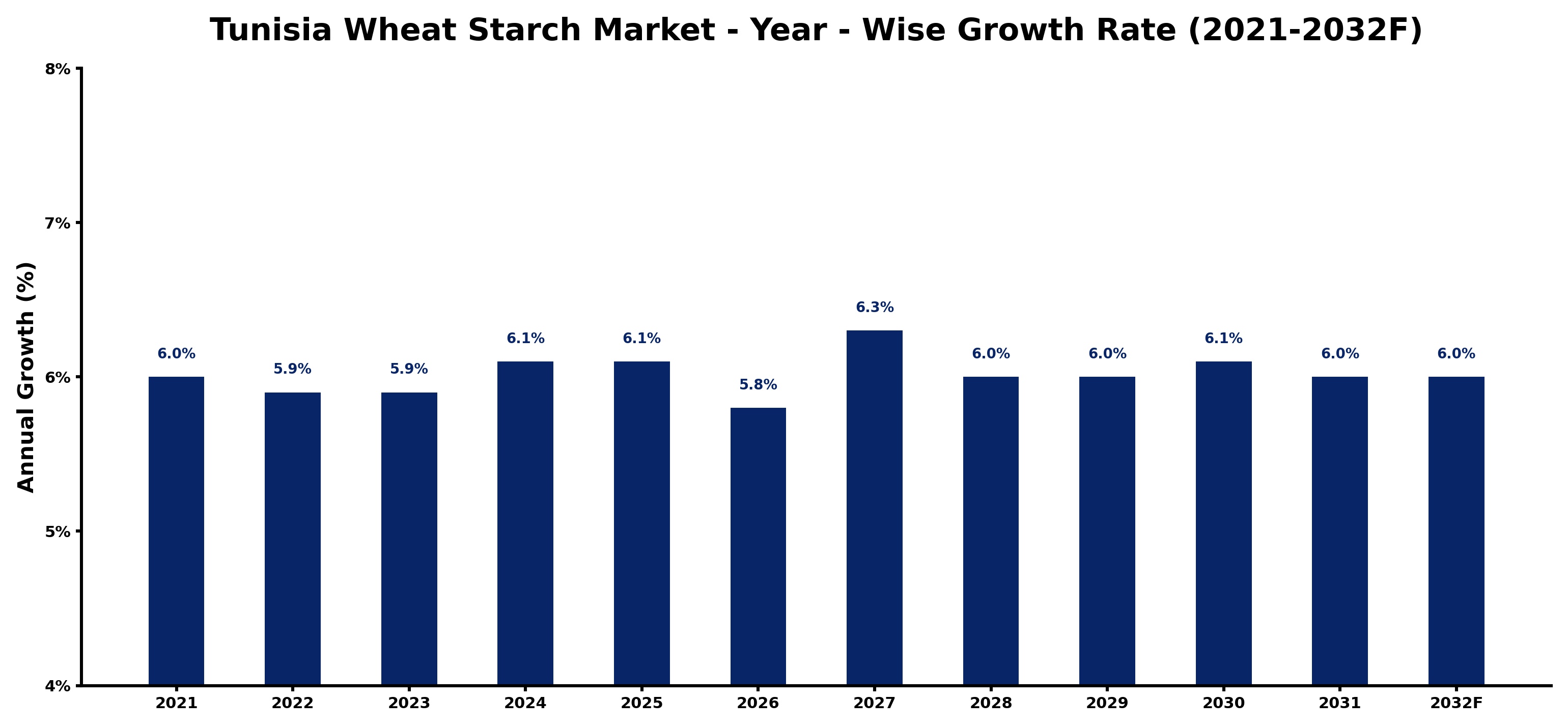
The table below presents the year‑wise growth rates along with the key drivers influencing the market
| Year | Growth Rate | Major Drivers |
| 2021 | 6.0% | Rising demand for gluten alternatives |
| 2022 | 5.9% | Increased health awareness among consumers |
| 2023 | 5.9% | Food processing innovations enhanced quality |
| 2024 | 6.1% | Export opportunities expanded significantly |
| 2025 | 6.1% | Sustainable sourcing practices gained traction |
| 2026 | 5.8% | Local production capabilities improved efficiency |
| 2027 | 6.3% | Diverse applications in food industry |
| 2028 | 6.0% | Growing popularity of plant-based diets |
| 2029 | 6.0% | Investment in research and development |
| 2030 | 6.1% | Technological advancements in processing |
| 2031 | 6.0% | Consumer preference for natural ingredients |
| 2032 | 6.0% | Collaboration with food manufacturers increased |
Note - Market size estimations and growth projections presented in this report are based on 6Wresearch’s advanced forecasting approach, validated with industry datasets as of June 2026.
Tunisia Wheat Starch Market Synopsis
The Tunisia Wheat Starch Market is currently characterized by a robust demand for natural food ingredients, which has prompted local producers to adapt their offerings. Wheat starch is gaining traction not only as a thickening and stabilizing agent but also as a sought-after ingredient in gluten-free products.
This market is significantly influenced by consumer awareness regarding health and nutrition, steering preferences towards clean-label and gluten-free options. Manufacturers are responding to these trends by investing in innovative processing techniques, enhancing the quality and functionality of wheat starch.
Tunisia Wheat Starch Market Key Takeaways
- The market is witnessing a steady rise in demand for gluten-free and natural ingredients.
- Government initiatives are promoting agricultural production, enhancing local wheat starch supply.
- Product innovation remains a priority for manufacturers to cater to evolving consumer preferences.
- Challenges such as fluctuating wheat prices and competition from imports persist in the market.
- Investment in wheat starch processing facilities is a promising opportunity for future growth.
Evaluation of Restraints in Tunisia Wheat Starch Market
Despite its growth potential, the Tunisia Wheat Starch Market faces notable challenges that could impede progress. One significant factor is the volatility in wheat prices, which directly affects production costs and can squeeze profit margins. Additionally, certain regions may have limited access to modern technology and efficient machinery, leading to inconsistencies in production quality and output efficiency. Furthermore, the presence of imported wheat starch products at competitive prices due to economies of scale poses a threat to local producers, who need to enhance their value proposition to maintain market share.
Tunisia Wheat Starch Market Trends
The market is experiencing an increasing trend towards natural and gluten-free food products, with consumers becoming more health-conscious. This shift is resulting in wheat starch being utilized prominently in a variety of food applications, including baked goods and sauces. Additionally, the clean label movement is encouraging manufacturers to leverage wheat starch as a natural, multifunctional ingredient, catering to consumer demands for transparency in food labeling.
Tunisia Wheat Starch Market Opportunities
Significant growth opportunities lie in the development of wheat starch processing facilities, particularly in response to the rising demand for gluten-free and natural food ingredients. Furthermore, with Tunisia's strategic position in North Africa, the potential for exporting wheat starch to neighboring markets remains untapped. This export potential can provide avenues for revenue growth, especially as neighboring regions also seek gluten-free alternatives and healthier food options.
Government Initiatives in the Tunisia Wheat Starch Market
The Tunisian government is actively supporting the wheat starch market through various policies aimed at boosting domestic agricultural production and ensuring food security. Measures such as import tariffs are implemented to protect local farmers and manufacturers, fostering a self-sufficient wheat starch industry. Additionally, the government oversees quality control regulations for imported starches to safeguard consumer health while providing a framework that encourages growth within the local market.
Future Insights of the Tunisia Wheat Starch Market
Looking ahead to 2026-2032, the Tunisia Wheat Starch Market is poised for promising growth driven by continuous shifts in consumer demand towards clean label products and gluten-free options. Innovations in production processes are expected to enhance product quality while increasing the availability of wheat starch. Furthermore, with sustainability on the rise, wheat starch's application as a renewable ingredient could position it favorably against synthetic alternatives, reinforcing its role in various industries.
Tunisia Wheat Starch Market Latest Developments (May 2025 - June 2026)
Recent developments in the Tunisia Wheat Starch Market indicate a heightened focus on innovation and sustainability. Manufacturers are exploring advanced processing techniques that promise to improve the quality and functionality of wheat starch. Additionally, there is a noticeable trend towards collaborations aimed at research and development, fostering new product formulations that align with consumer demands for healthier and more natural ingredients.
Tunisia Wheat Starch Market - Key Attractiveness of the Report
- 10 Years of Market Numbers
- Historical Data Starting from 2022 to 2025
- Base Year: 2025
- Forecast Data until 2032
- Key Performance Indicators Impacting the Market
- Major Upcoming Developments and Projects
Key Highlights of the Report:
- Tunisia Wheat Starch Market Outlook
- Market Size of Tunisia Wheat Starch Market, 2025
- Forecast of Tunisia Wheat Starch Market, 2032
- Historical Data and Forecast of Tunisia Wheat Starch Revenues & Volume for the Period 2022-2032F
- Tunisia Wheat Starch Market Trend Evolution
- Tunisia Wheat Starch Market Drivers and Challenges
- Tunisia Wheat Starch Price Trends
- Tunisia Wheat Starch Porter's Five Forces
- Tunisia Wheat Starch Industry Life Cycle
- Historical Data and Forecast of Tunisia Wheat Starch Market Revenues & Volume By Type for the Period 2022-2032F
- Historical Data and Forecast of Tunisia Wheat Starch Market Revenues & Volume By Native Wheat Starch for the Period 2022-2032F
- Historical Data and Forecast of Tunisia Wheat Starch Market Revenues & Volume By Modified Wheat Starch for the Period 2022-2032F
- Historical Data and Forecast of Tunisia Wheat Starch Market Revenues & Volume By Grade for the Period 2022-2032F
- Historical Data and Forecast of Tunisia Wheat Starch Market Revenues & Volume By Food Grade for the Period 2022-2032F
- Historical Data and Forecast of Tunisia Wheat Starch Market Revenues & Volume By Industrial Grade for the Period 2022-2032F
- Historical Data and Forecast of Tunisia Wheat Starch Market Revenues & Volume By End-Users Industry for the Period 2022-2032F
- Historical Data and Forecast of Tunisia Wheat Starch Market Revenues & Volume By Food and Beverages for the Period 2022-2032F
- Historical Data and Forecast of Tunisia Wheat Starch Market Revenues & Volume By Cosmetics for the Period 2022-2032F
- Historical Data and Forecast of Tunisia Wheat Starch Market Revenues & Volume By Others for the Period 2022-2032F
- Tunisia Wheat Starch Import Export Trade Statistics
- Market Opportunity Assessment By Type
- Market Opportunity Assessment By Grade
- Market Opportunity Assessment By End-Users Industry
- Tunisia Wheat Starch Top Companies Market Share
- Tunisia Wheat Starch Competitive Benchmarking By Technical and Operational Parameters
- Tunisia Wheat Starch Company Profiles
- Tunisia Wheat Starch Key Strategic Recommendations






































