Tunisia Wheel Loader Market Size, Share & Growth Rate
The Tunisia Wheel Loader Market was estimated at USD 1485 Million in 2025 and is projected to reach USD 2155 Million by 2032, growing at a CAGR of 5.5% from 2026 to 2032. This growth trajectory is driven largely by significant investments in infrastructure development and a rising need for efficient material handling solutions across various sectors, including construction and mining. Furthermore, increasing urbanization and government initiatives to enhance public infrastructure are set to contribute to this upward trend.
Tunisia Wheel Loader Market Year-wise Growth Rate and Key Drivers
This graph highlights how the Tunisia Wheel Loader Market has steadily grown over the years, supported by major growth factors.
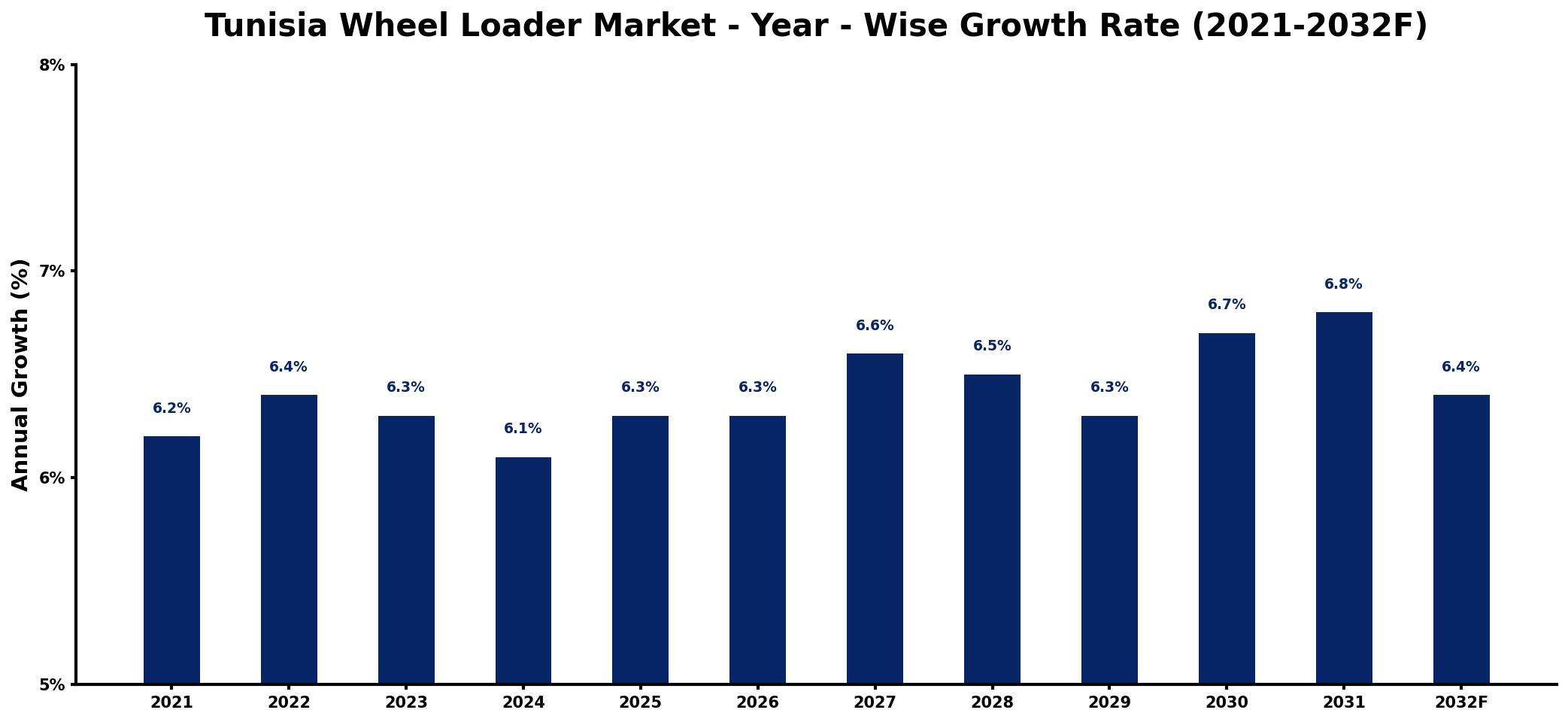
The table below presents the year‑wise growth rates along with the key drivers influencing the market
| Year | Growth Rate | Major Drivers |
| 2021 | 6.2% | Increased construction project investments |
| 2022 | 6.4% | Expansion of mining operations demand |
| 2023 | 6.3% | Rising infrastructure development projects |
| 2024 | 6.1% | Growing agricultural sector needs |
| 2025 | 6.3% | Boost in public sector spending |
| 2026 | 6.3% | Surge in urbanization trends |
| 2027 | 6.6% | Higher demand for material handling |
| 2028 | 6.5% | Investments in renewable energy projects |
| 2029 | 6.3% | Development of logistics and transportation |
| 2030 | 6.7% | Increased foreign direct investments |
| 2031 | 6.8% | growing downstream application demand |
| 2032 | 6.4% | Growth in tourism infrastructure projects |
Note: Market size estimations and growth projections presented in this report are based on 6Wresearch's proprietary forecasting methodology, utilizing the latest available industry data, government publications, and primary research inputs.
Tunisia Wheel Loader Market Synopsis
As Tunisia undergoes substantial infrastructure development, the demand for wheel loaders has surged, particularly for models that offer versatility and efficiency in material handling. Local players are adapting to market needs by introducing innovative wheel loader models that align with modern construction requirements.
The presence of both local and international manufacturers has led to a competitive landscape, offering a spectrum of wheel loader models with varying capacities. This diversification caters to distinct customer segments, emphasizing the need for high-performance machines that are also environmentally friendly.
Tunisia Wheel Loader Market Key Takeaways
- The market is driven by ongoing infrastructure projects and increasing urbanization.
- There is a growing demand for compact wheel loaders across multiple sectors, including agriculture and landscaping.
- Technological advancements and eco-friendly engines are becoming crucial differentiators among manufacturers.
- Market players are focusing on enhancing product features such as operator comfort and safety.
- Government policies are influencing import regulations and local manufacturing incentives.
Evaluation of Restraints in Tunisia Wheel Loader Market
Despite its growth potential, the Tunisia Wheel Loader Market faces notable restraints. Economic instability and political uncertainties can impede investment in infrastructure projects, leading to fluctuating demand for heavy machinery. Additionally, the market's competitive nature often results in price wars, putting pressure on margins. Furthermore, a shortage of skilled operators and maintenance technicians complicates the effective use and servicing of these machines, highlighting a critical gap that must be addressed for sustained growth.
Tunisia Wheel Loader Market Trends
The market is witnessing a pronounced trend towards the adoption of compact wheel loaders, which offer enhanced maneuverability and efficiency in various applications. Customers are increasingly prioritizing machines that not only excel in performance but also boast fuel efficiency and advanced technological features. Additionally, the shift towards eco-friendly engines is becoming more pronounced, reflecting a growing commitment to sustainability and compliance with environmental regulations.
Tunisia Wheel Loader Market Opportunities
Investment opportunities abound in the Tunisia Wheel Loader Market, largely driven by government-led infrastructure initiatives. Stakeholders can leverage this momentum by collaborating with local manufacturers or establishing rental services for heavy machinery. Moreover, providing maintenance and repair services represents a lucrative avenue, catering to the expanding construction sector's demand for reliable support for wheel loader operations.
Government Initiatives in the Tunisia Wheel Loader Market
The Tunisian government plays a crucial role in shaping the wheel loader market through various policies aimed at regulating the importation and sale of heavy machinery. Tariffs and taxes on imported equipment are enforced to support domestic manufacturers, while compliance with environmental and safety standards is mandatory for operational legitimacy. Additionally, the government offers incentives for companies investing in local production, aiming to foster a robust manufacturing base in the sector.
Future Insights of the Tunisia Wheel Loader Market
Looking ahead to 2026-2032, the Tunisia Wheel Loader Market is set to experience steady growth driven by ongoing infrastructure initiatives and urbanization. Government programs aimed at improving transportation networks and industrial activity will further stimulate demand for wheel loaders. The integration of advanced technologies, including telematics and automation, promises to enhance operational efficiency, positioning the market for sustainable growth despite potential challenges related to economic fluctuations and regulatory pressures.
Tunisia Wheel Loader Market Latest Developments (2025 - 2026)
In recent months, the wheel loader market in Tunisia has seen increased focus on innovative machinery that incorporates advanced safety features and user-friendly technology. Market players have begun prioritizing the development of models that address the growing environmental concerns and efficiency demands. Moreover, collaborations between local and international firms are on the rise, aiming to enhance product offerings and meet the diverse needs of customers in the region.
Tunisia Wheel Loader Market - Key Attractiveness of the Report
- 10 Years of Market Numbers
- Historical Data Starting from 2022 to 2025
- Base Year: 2025
- Forecast Data until 2032
- Key Performance Indicators Impacting the Market
- Major Upcoming Developments and Projects
Key Highlights of the Report:
- Tunisia Wheel Loader Market Outlook
- Market Size of Tunisia Wheel Loader Market, 2025
- Forecast of Tunisia Wheel Loader Market, 2032
- Historical Data and Forecast of Tunisia Wheel Loader Revenues & Volume for the Period 2022-2032F
- Tunisia Wheel Loader Market Trend Evolution
- Tunisia Wheel Loader Market Drivers and Challenges
- Tunisia Wheel Loader Price Trends
- Tunisia Wheel Loader Porter's Five Forces
- Tunisia Wheel Loader Industry Life Cycle
- Historical Data and Forecast of Tunisia Wheel Loader Market Revenues & Volume By Types for the Period 2022-2032F
- Historical Data and Forecast of Tunisia Wheel Loader Market Revenues & Volume By Armored Wheel Loaders for the Period 2022-2032F
- Historical Data and Forecast of Tunisia Wheel Loader Market Revenues & Volume By Tractor Front Loaders for the Period 2022-2032F
- Historical Data and Forecast of Tunisia Wheel Loader Market Revenues & Volume By Compact Front End Loaders for the Period 2022-2032F
- Historical Data and Forecast of Tunisia Wheel Loader Market Revenues & Volume By Skid Loaders & Track Loaders for the Period 2022-2032F
- Historical Data and Forecast of Tunisia Wheel Loader Market Revenues & Volume By Operating Power for the Period 2022-2032F
- Historical Data and Forecast of Tunisia Wheel Loader Market Revenues & Volume By 20 ?? 40 Hp for the Period 2022-2032F
- Historical Data and Forecast of Tunisia Wheel Loader Market Revenues & Volume By 40 ?? 80 Hp for the Period 2022-2032F
- Historical Data and Forecast of Tunisia Wheel Loader Market Revenues & Volume By 80 ?? 120 Hp for the Period 2022-2032F
- Historical Data and Forecast of Tunisia Wheel Loader Market Revenues & Volume By 120 ?? 160 Hp for the Period 2022-2032F
- Historical Data and Forecast of Tunisia Wheel Loader Market Revenues & Volume By 160 Hp for the Period 2022-2032F
- Historical Data and Forecast of Tunisia Wheel Loader Market Revenues & Volume By Above for the Period 2022-2032F
- Historical Data and Forecast of Tunisia Wheel Loader Market Revenues & Volume By Types Of Bucket for the Period 2022-2032F
- Historical Data and Forecast of Tunisia Wheel Loader Market Revenues & Volume By Bottom Bucket for the Period 2022-2032F
- Historical Data and Forecast of Tunisia Wheel Loader Market Revenues & Volume By Flat Bottom Bucket for the Period 2022-2032F
- Historical Data and Forecast of Tunisia Wheel Loader Market Revenues & Volume By Backhoe Bucket for the Period 2022-2032F
- Historical Data and Forecast of Tunisia Wheel Loader Market Revenues & Volume By Demolition Bucket for the Period 2022-2032F
- Historical Data and Forecast of Tunisia Wheel Loader Market Revenues & Volume By Excavating Buckets for the Period 2022-2032F
- Historical Data and Forecast of Tunisia Wheel Loader Market Revenues & Volume By Others for the Period 2022-2032F
- Historical Data and Forecast of Tunisia Wheel Loader Market Revenues & Volume By End-use Application for the Period 2022-2032F
- Historical Data and Forecast of Tunisia Wheel Loader Market Revenues & Volume By Stone Quarries for the Period 2022-2032F
- Historical Data and Forecast of Tunisia Wheel Loader Market Revenues & Volume By Mining Zones for the Period 2022-2032F
- Historical Data and Forecast of Tunisia Wheel Loader Market Revenues & Volume By Construction Sites for the Period 2022-2032F
- Historical Data and Forecast of Tunisia Wheel Loader Market Revenues & Volume By Military & Defense for the Period 2022-2032F
- Historical Data and Forecast of Tunisia Wheel Loader Market Revenues & Volume By Public Sectors for the Period 2022-2032F
- Tunisia Wheel Loader Import Export Trade Statistics
- Market Opportunity Assessment By Types
- Market Opportunity Assessment By Operating Power
- Market Opportunity Assessment By Types Of Bucket
- Market Opportunity Assessment By End-use Application
- Tunisia Wheel Loader Top Companies Market Share
- Tunisia Wheel Loader Competitive Benchmarking By Technical and Operational Parameters
- Tunisia Wheel Loader Company Profiles
- Tunisia Wheel Loader Key Strategic Recommendations






































