Tunisia Wholesale Market Summary
The tunisia wholesale market was estimated at USD 310 Million in 2025 and is projected to reach USD 416 Million by 2032, growing at a CAGR of 5.2% from 2026 to 2032.
Tunisia Wholesale Market Year-wise Growth Rate and Key Drivers
This graph highlights how the Tunisia Wholesale Market has steadily grown over the past five years, supported by major growth factors.
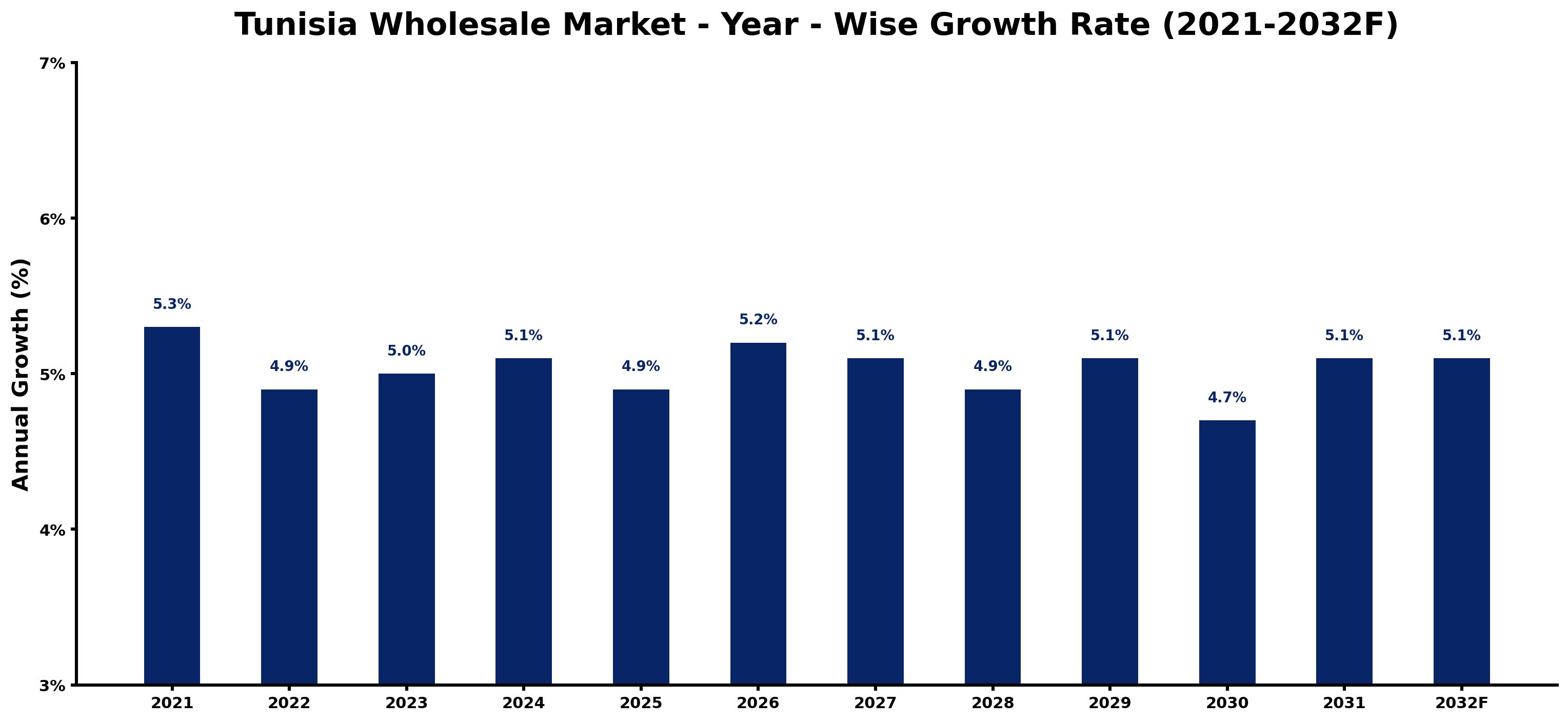
The table below presents the year wise growth rates along with the key drivers influencing the market
| Year | Growth Rate | Major Drivers |
| 2021 | 5.3% | Economic stabilization post-revolution boosted consumer confidence in wholesale transactions. |
| 2022 | 4.9% | Increased focus on digital transformation led to more online wholesale platforms emerging. |
| 2023 | 5.0% | Local sourcing initiatives prompted wholesalers to establish stronger ties with farmers. |
| 2024 | 5.1% | Regional trade agreements enhanced market access for Tunisian wholesale products abroad. |
| 2025 | 4.9% | Emerging micro-entrepreneurship trends empowered small businesses to engage in wholesale activities. |
| 2026 | 5.2% | Investment in logistics infrastructure streamlined distribution channels across urban centers. |
| 2027 | 5.1% | Market consolidation began as larger wholesalers absorbed smaller entities for efficiency. |
| 2028 | 4.9% | Consumer preference shifted towards sustainable products, influencing wholesaler inventory choices. |
| 2029 | 5.1% | Technological innovations, such as AI, improved inventory management for wholesalers. |
| 2030 | 4.7% | Rising urbanization rates increased demand for diverse wholesale goods in cities. |
| 2031 | 5.1% | Enhanced financial services support enabled wholesalers to navigate cash flow challenges. |
| 2032 | 5.1% | Expanding regional tourism created new opportunities for wholesale food and beverage sectors. |
Note - Market size estimations and growth projections presented in this report are based on 6Wresearch's advanced forecasting approach, validated with industry datasets as of June 2026.
Tunisia Wholesale Market Synopsis
The Tunisia Wholesale Market is projected to reach 5.2% and witness significant growth during the forecast period (2026-2032). This robust expansion is driven by multiple factors, including a steady increase in disposable income among consumers, which in turn raises demand for various consumer goods. The rise of e-commerce platforms and online shopping is also reshaping how businesses distribute their products, making the wholesale market increasingly pivotal in supply chain dynamics. Moreover, government initiatives aimed at promoting digital transformation across different sectors are expected to play a vital role in enhancing operational efficiencies and broadening market reach.
Tunisia Wholesale Market Growth Drivers
Several key drivers are propelling the growth of the Tunisia wholesale market. Firstly, the increment in disposable income is leading to elevated purchasing power among consumers, which naturally stimulates demand for a wider range of products. Secondly, the proliferation of e-commerce businesses has revolutionized traditional wholesale models, allowing for faster distribution and improved inventory management.
- The shift toward digital solutions is being amplified by increasing internet penetration, which has made online shopping more accessible for a broader audience.
- Government policies aimed at improving infrastructure are enhancing logistics capabilities, making it easier for wholesalers to distribute products regionally and internationally.
- Investment in local manufacturing across sectors such as food & beverages, electronics, and automotive parts is establishing a more self-sufficient economy, thereby strengthening the wholesale market.
- The growing consumer awareness of quality and variety is pushing wholesalers to diversify their product offerings to meet changing preferences.
- Lastly, strategic partnerships and collaborative ventures in the wholesale sector are fostering innovation, efficiency, and competitiveness.
Tunisia Wholesale Market Investment Opportunities
Investment opportunities within the Tunisia wholesale market are expanding, driven by various socio-economic factors. As international companies respond to the favorable business climate, they are seeking opportunities in local industries.
- Foreign direct investment in the food and beverage sector is anticipated to surge, offering wholesalers a chance to diversify their product lines.
- The electronics market is also witnessing increased interest, given the rapid technological advancements and consumer demand for innovative products.
- With automotive parts manufacturing on the rise, wholesalers in this domain can capitalize on the growing demand for locally produced components.
- Additionally, initiatives focused on sustainability are creating a niche for wholesalers specializing in eco-friendly products, appealing to environmentally conscious consumers.
- The digital transformation of retail offers significant avenues for investment in e-commerce platforms and logistics solutions, crucial to the evolving landscape of the wholesale market.
Tunisia Wholesale Market Government Investment and Initiatives
Government investment and initiatives play a crucial role in shaping the landscape of the Tunisia wholesale market. Recent policies aim to foster economic growth through enhanced infrastructure, promoting sectors that directly impact the wholesale environment. Infrastructure improvements are a priority, with significant public spending allocated towards developing transportation and logistics networks, which facilitate smoother product distribution.
- The government is also focusing on enhancing digital literacy and accessibility through various educational programs, allowing more individuals to participate in e-commerce.
- Incentives for local manufacturers to adhere to global quality standards have emerged, bolstering the reputation of Tunisian products in international markets.
- Public-private partnerships are being encouraged to stimulate innovation and investment, particularly in technology-driven sectors that intersect with wholesale.
- Furthermore, regulations aimed at simplifying business operations are being implemented, making it easier for small and medium enterprises to thrive in the wholesale landscape.
- Policy initiatives centered around sustainability are promoting eco-friendly practices within the wholesale sector, which could lead to new market segments and consumer bases.
Tunisia Wholesale Market Latest Developments (May 2025 - June 2026)
The period from May 2025 to June 2026 has witnessed significant developments in the Tunisia wholesale market. The growth in e-commerce continues to disrupt traditional sales channels, leading to an increased focus on digital platforms by wholesalers. As a result, many businesses are investing in enhancing their online presence to capture the growing consumer base leaning towards online shopping.
- Training programs aimed at upskilling workforce members in digital marketing and logistics have been introduced, thereby enhancing operational efficiencies.
- In response to the increasing demand for sustainable and eco-friendly products, some wholesalers are beginning to incorporate green practices into their supply chains.
- The government's commitment to infrastructure development is beginning to show tangible results, with reports of improved transportation networks aiding in faster and more reliable delivery.
- Collaborative initiatives among businesses aimed at sharing logistics resources have begun to surface, allowing for cost savings and improved service delivery.
- Overall, the market is poised to become more competitive as new players enter and existing firms adapt to emerging trends and consumer preferences.
Tunisia Wholesale Market - Key Attractiveness of the Report
- 10 Years of Market Numbers
- Historical Data Starting from 2022 to 2025
- Base Year: 2025
- Forecast Data until 2032
- Key Performance Indicators Impacting the Market
- Major Upcoming Developments and Projects
Key Highlights of the Report:
- Tunisia Wholesale Market Outlook
- Market Size of Tunisia Wholesale Market, 2025
- Forecast of Tunisia Wholesale Market, 2032F
- Historical Data and Forecast of Tunisia Wholesale Revenues & Volume for the Period 2022-2032F
- Tunisia Wholesale Market Trend Evolution
- Tunisia Wholesale Market Drivers and Challenges
- Tunisia Wholesale Price Trends
- Tunisia Wholesale Porter's Five Forces
- Tunisia Wholesale Industry Life Cycle
- Historical Data and Forecast of Tunisia Wholesale Market Revenues & Volume By Type for the Period 2022-2032F
- Historical Data and Forecast of Tunisia Wholesale Market Revenues & Volume By Non-Durable Goods Merchant Wholesalers for the Period 2022-2032F
- Historical Data and Forecast of Tunisia Wholesale Market Revenues & Volume By Wholesale Electronic Markets And Agents And Brokers for the Period 2022-2032F
- Historical Data and Forecast of Tunisia Wholesale Market Revenues & Volume By Durable Goods Merchant Wholesalers for the Period 2022-2032F
- Historical Data and Forecast of Tunisia Wholesale Market Revenues & Volume By Ownership for the Period 2022-2032F
- Historical Data and Forecast of Tunisia Wholesale Market Revenues & Volume By Wholesale/Distribution Chain for the Period 2022-2032F
- Historical Data and Forecast of Tunisia Wholesale Market Revenues & Volume By Independent Wholesalers for the Period 2022-2032F
- Tunisia Wholesale Import Export Trade Statistics
- Market Opportunity Assessment By Type
- Market Opportunity Assessment By Ownership
- Tunisia Wholesale Top Companies Market Share
- Tunisia Wholesale Competitive Benchmarking By Technical and Operational Parameters
- Tunisia Wholesale Company Profiles
- Tunisia Wholesale Key Strategic Recommendations






































