Tunisia Wireless Connectivity Market Size, Share & Growth Rate
The Tunisia Wireless Connectivity Market was estimated at USD 1121 Million in 2025 and is projected to reach USD 1632 Million by 2032, growing at a CAGR of 5.5% from 2026 to 2032. This growth trajectory is primarily fueled by rising internet penetration and an increasing demand for mobile services among the population. Furthermore, government initiatives aimed at enhancing digital infrastructure are set to play a pivotal role in expanding connectivity options throughout the country.
Tunisia Wireless Connectivity Market Growth Rate Analysis (2021-2032)
The Tunisia Wireless Connectivity Market has shown a stable growth pattern, starting with an increase of 6.5% in 2021 and gradually rising to 6.7% in 2023. This growth is fueled by a surge in consumer demand for robust digital services and ongoing investments in telecommunications infrastructure aimed at enhancing urban coverage and rural connectivity. However, a slight dip to 6.4% in 2024 can be attributed to market saturation, as established players face stiff competition and pricing pressures. Yet, the growth trajectory rebounds again to 6.7% by 2028, bolstered by advancements in technology and policy shifts promoting energy transitions. As Tunisia continues to embrace digitalization, the market remains poised for sustained expansion moving towards 2032.
Tunisia Wireless Connectivity Market Year-wise Growth Rate and Key Drivers
This graph highlights how the Tunisia Wireless Connectivity Market has steadily grown over the past five years, supported by major growth factors.
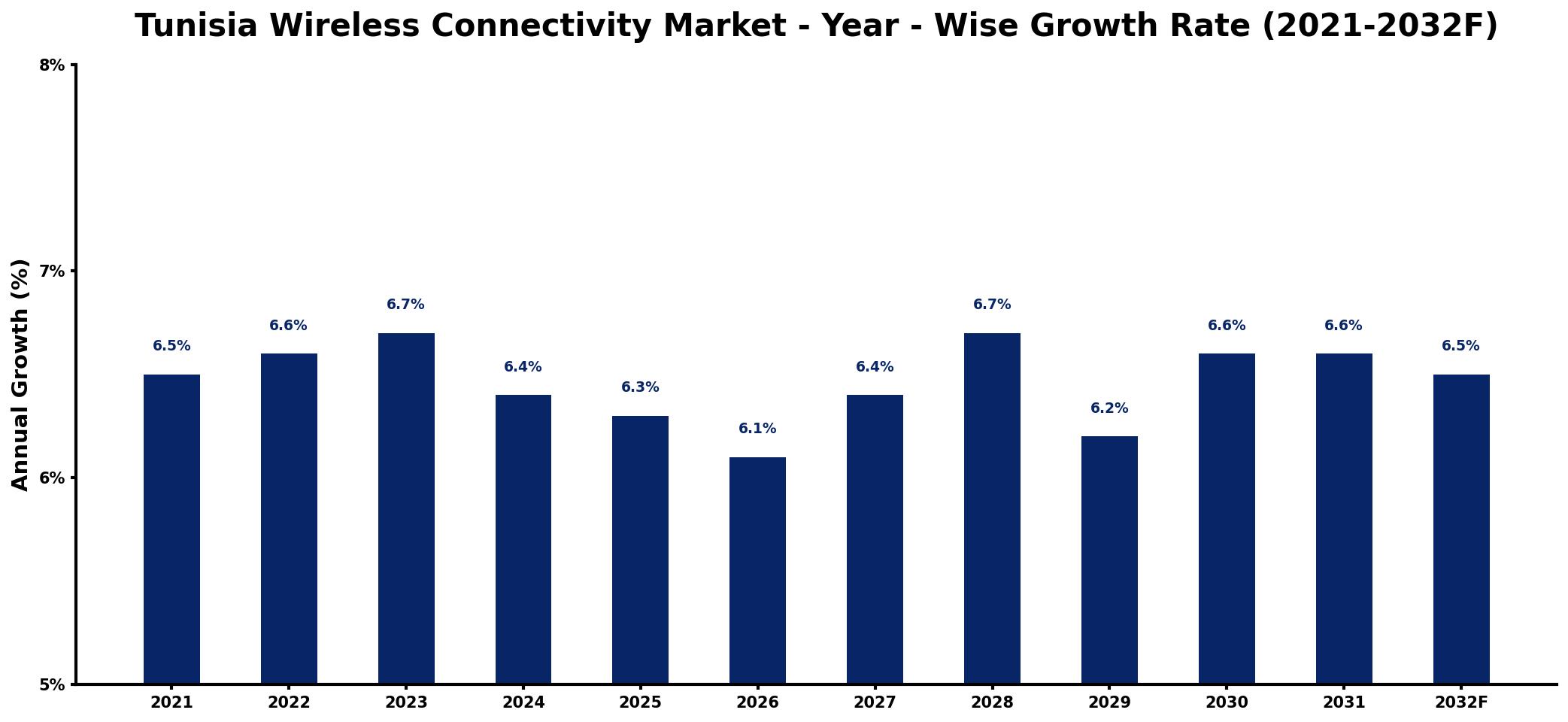
The table below presents the year‑wise growth rates along with the key drivers influencing the market
| Year | Growth Rate | Major Drivers |
| 2021 | 6.5% | Increased smartphone penetration rates |
| 2022 | 6.6% | Expansion of mobile payment systems |
| 2023 | 6.7% | Growing demand for remote work |
| 2024 | 6.4% | Rise in digital education initiatives |
| 2025 | 6.3% | Investment in smart city projects |
| 2026 | 6.1% | Enhanced e-commerce adoption rates |
| 2027 | 6.4% | Development of IoT applications |
| 2028 | 6.7% | Surge in social media usage |
| 2029 | 6.2% | Growth in telehealth services |
| 2030 | 6.6% | Increased demand for streaming services |
| 2031 | 6.6% | expanding manufacturing base activity |
| 2032 | 6.5% | Improvement in public Wi-Fi access |
Note: Market size estimations and growth projections presented in this report are based on 6Wresearch's proprietary forecasting methodology, utilizing the latest available industry data, government publications, and primary research inputs.
Tunisia Wireless Connectivity Market Synopsis
Recently, the Tunisia Wireless Connectivity Market has witnessed a surge in consumer demand, driven by advancements in mobile technology and the expansion of internet services. Looking ahead, the focus on 5G technology and enhanced digital solutions promises to transform the connectivity landscape, thereby enabling a broader range of applications and services.
With major investments in infrastructure from mobile network operators and a shift towards comprehensive digital solutions, the market is poised for robust growth. Initiatives aimed at improving access in rural areas further indicate a forward momentum that seeks to bridge existing gaps in connectivity.
Tunisia Wireless Connectivity Market Key Takeaways
- The market is set for significant expansion, driven by mobile service demand and enhanced internet access.
- 5G technology will play a crucial role in revolutionizing connectivity options across various sectors.
- Government policies are focused on improving infrastructure and ensuring competitive market conditions.
- Public Wi-Fi initiatives are on the rise, catering to urban populations seeking convenient access.
- Challenges remain, including infrastructure limitations and regulatory hurdles that could impact growth.
Evaluation of Restraints in Tunisia Wireless Connectivity Market
Despite the promising outlook, the Tunisia Wireless Connectivity Market faces notable restraints. Limited infrastructure development, particularly in rural areas, continues to hinder access to reliable internet services for a significant segment of the population. Furthermore, regulatory frameworks can present challenges for new entrants, stifling competition and innovation. Additionally, the cost of data plans relative to income levels remains a barrier, as does network congestion during peak usage times in urban locales.
Tunisia Wireless Connectivity Market Trends
A prominent trend in the market is the swift adoption of 5G technology, anticipated to yield faster and more reliable wireless connections. This transition is not only elevating demand for high-speed internet but also facilitating the rise of innovative applications such as smart cities and IoT solutions. The expansion of wireless coverage into rural areas further emphasizes efforts to ensure inclusivity in connectivity.
Tunisia Wireless Connectivity Market Opportunities
Investment opportunities abound in the Tunisia Wireless Connectivity Market, particularly in the development of 5G networks and broadband services. The government's commitment to enhancing digital infrastructure presents fertile ground for investors looking to capitalize on the growing demand for reliable connectivity. Innovations in mobile payment systems and e-commerce platforms are also ripe for exploration, aligning with the countrys broader digital transformation efforts.
Government Initiatives in the Tunisia Wireless Connectivity Market
The Tunisian government has implemented several initiatives aimed at fostering growth in the Wireless Connectivity Market. Key among these is the establishment of a regulatory framework designed to encourage competition and drive investment in digital infrastructure. Emphasis is placed on expanding broadband access in underserved areas to facilitate widespread internet adoption and technological advancements, particularly in line with the anticipated rollout of 5G technology.
Future Insights of the Tunisia Wireless Connectivity Market
The Tunisia Wireless Connectivity Market is on the brink of significant evolution between 2026 and 2032. The anticipated rollout of 5G will not only enhance user experiences but also open doors to new service offerings and applications across various sectors. With a focus on improving digital infrastructure, increasing smartphone adoption, and expanding broadband coverage, the market stands ready for considerable growth, particularly in light of ongoing digitalization trends that demand robust wireless connectivity.
Tunisia Wireless Connectivity Market Latest Developments (2025 - 2026)
Recent developments in the Tunisia Wireless Connectivity Market highlight a continued push towards enhancing digital infrastructure. Initiatives are underway to expand 5G capabilities, with several urban centers experiencing upgrades to their existing networks. Public-private partnerships are becoming more prominent as stakeholders collaborate to address connectivity challenges, particularly in rural regions. The focus on deploying public Wi-Fi in urban spaces also remains a strategic priority to meet the increasing demand for mobile internet access.
Tunisia Wireless Connectivity Market - Key Attractiveness of the Report
- 10 Years of Market Numbers
- Historical Data Starting from 2022 to 2025
- Base Year: 2025
- Forecast Data until 2032
- Key Performance Indicators Impacting the Market
- Major Upcoming Developments and Projects
Key Highlights of the Report:
- Tunisia Wireless Connectivity Market Outlook
- Market Size of Tunisia Wireless Connectivity Market, 2025
- Forecast of Tunisia Wireless Connectivity Market, 2032
- Historical Data and Forecast of Tunisia Wireless Connectivity Revenues & Volume for the Period 2022-2032F
- Tunisia Wireless Connectivity Market Trend Evolution
- Tunisia Wireless Connectivity Market Drivers and Challenges
- Tunisia Wireless Connectivity Price Trends
- Tunisia Wireless Connectivity Porter's Five Forces
- Tunisia Wireless Connectivity Industry Life Cycle
- Historical Data and Forecast of Tunisia Wireless Connectivity Market Revenues & Volume By Connectivity Type for the Period 2022-2032F
- Historical Data and Forecast of Tunisia Wireless Connectivity Market Revenues & Volume By Wi-Fi for the Period 2022-2032F
- Historical Data and Forecast of Tunisia Wireless Connectivity Market Revenues & Volume By Bluetooth Classic for the Period 2022-2032F
- Historical Data and Forecast of Tunisia Wireless Connectivity Market Revenues & Volume By Bluetooth 4X for the Period 2022-2032F
- Historical Data and Forecast of Tunisia Wireless Connectivity Market Revenues & Volume By Bluetooth 5X for the Period 2022-2032F
- Historical Data and Forecast of Tunisia Wireless Connectivity Market Revenues & Volume By ZigBee for the Period 2022-2032F
- Historical Data and Forecast of Tunisia Wireless Connectivity Market Revenues & Volume By Z-Wave for the Period 2022-2032F
- Historical Data and Forecast of Tunisia Wireless Connectivity Market Revenues & Volume By UWB for the Period 2022-2032F
- Historical Data and Forecast of Tunisia Wi-Fi Wireless Connectivity Market Revenues & Volume By NFC for the Period 2022-2032F
- Historical Data and Forecast of Tunisia Wireless Connectivity Market Revenues & Volume By End Use for the Period 2022-2032F
- Historical Data and Forecast of Tunisia Wireless Connectivity Market Revenues & Volume By Wearable Devices for the Period 2022-2032F
- Historical Data and Forecast of Tunisia Wireless Connectivity Market Revenues & Volume By Healthcare for the Period 2022-2032F
- Historical Data and Forecast of Tunisia Wireless Connectivity Market Revenues & Volume By Consumer Electronics for the Period 2022-2032F
- Historical Data and Forecast of Tunisia Wireless Connectivity Market Revenues & Volume By Building Automation for the Period 2022-2032F
- Historical Data and Forecast of Tunisia Wireless Connectivity Market Revenues & Volume By Automotive & Transportation for the Period 2022-2032F
- Historical Data and Forecast of Tunisia Wireless Connectivity Market Revenues & Volume By Others for the Period 2022-2032F
- Historical Data and Forecast of Tunisia Wireless Connectivity Market Revenues & Volume By Type for the Period 2022-2032F
- Historical Data and Forecast of Tunisia Wireless Connectivity Market Revenues & Volume By LPWAN for the Period 2022-2032F
- Historical Data and Forecast of Tunisia Wireless Connectivity Market Revenues & Volume By Cellular M2M for the Period 2022-2032F
- Historical Data and Forecast of Tunisia Wireless Connectivity Market Revenues & Volume By WPAN for the Period 2022-2032F
- Historical Data and Forecast of Tunisia Wireless Connectivity Market Revenues & Volume By Satellite (GNSS) for the Period 2022-2032F
- Historical Data and Forecast of Tunisia Wireless Connectivity Market Revenues & Volume By WLAN for the Period 2022-2032F
- Tunisia Wireless Connectivity Import Export Trade Statistics
- Market Opportunity Assessment By Connectivity Type
- Market Opportunity Assessment By End Use
- Market Opportunity Assessment By Type
- Tunisia Wireless Connectivity Top Companies Market Share
- Tunisia Wireless Connectivity Competitive Benchmarking By Technical and Operational Parameters
- Tunisia Wireless Connectivity Company Profiles
- Tunisia Wireless Connectivity Key Strategic Recommendations






































