Tunisia Wooden Toys Market Size, Share & Growth Rate
The Tunisia Wooden Toys Market was estimated at USD 1475 Million in 2025 and is projected to reach USD 2109 Million by 2032, growing at a CAGR of 5.2% from 2026 to 2032. This growth trajectory is driven by a rising awareness among parents about the benefits of eco-friendly toys, particularly in terms of safety and durability. Additionally, the educational value provided by wooden toys continues to resonate with educators and parents alike, enhancing their appeal in a market increasingly concerned with sustainability.
Tunisia Wooden Toys Market Year-wise Growth Rate and Key Drivers
This graph highlights how the Tunisia Wooden Toys Market has steadily grown over the years, supported by major growth factors.
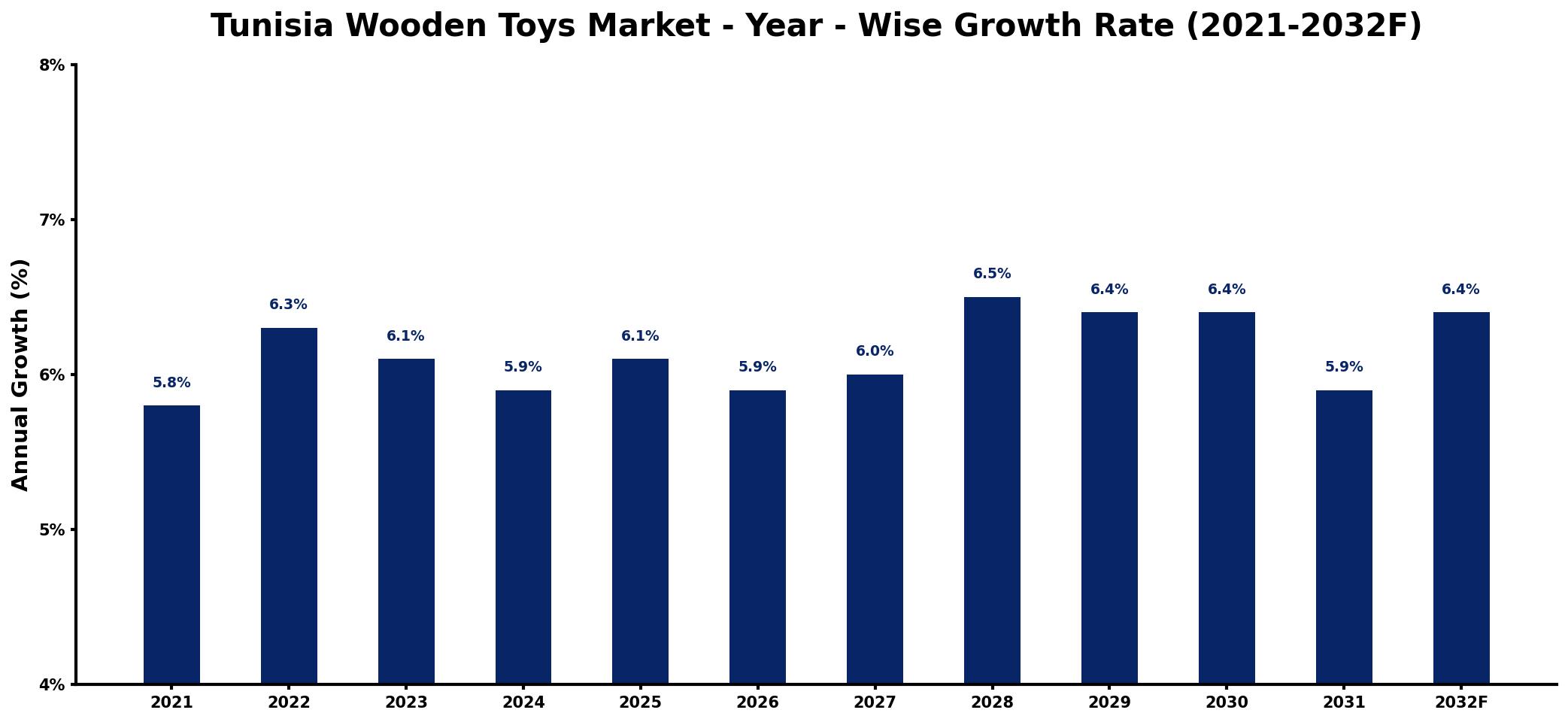
The table below presents the year‑wise growth rates along with the key drivers influencing the market
| Year | Growth Rate | Major Drivers |
| 2021 | 5.8% | Increased demand for eco-friendly products |
| 2022 | 6.3% | Growing popularity of sustainable manufacturing |
| 2023 | 6.1% | Expansion of local craftsmanship initiatives |
| 2024 | 5.9% | improved processing technologies adoption |
| 2025 | 6.1% | Investment in educational product development |
| 2026 | 5.9% | Strengthening of distribution networks |
| 2027 | 6.0% | Boost in family-oriented retail spaces |
| 2028 | 6.5% | Emergence of online shopping platforms |
| 2029 | 6.4% | Growth in international market access |
| 2030 | 6.4% | Enhanced marketing strategies for sustainability |
| 2031 | 5.9% | increased overall sector activity |
| 2032 | 6.4% | Increased collaboration with local artisans |
Note: Market size estimations and growth projections presented in this report are based on 6Wresearch's proprietary forecasting methodology, utilizing the latest available industry data, government publications, and primary research inputs.
Tunisia Wooden Toys Market Synopsis
The demand for wooden toys in Tunisia is characterized by a unique blend of traditional craftsmanship and modern design, with artisans creating products that not only look beautiful but also provide sensory benefits for children. This artisanal focus not only supports local economies but also appeals to consumers seeking distinctive, handcrafted items.
Supply chains in the Tunisia Wooden Toys Market are increasingly influenced by sustainable practices. Manufacturers are prioritizing the use of natural materials, a trend that aligns with the growing consumer preference for products that reflect environmental consciousness. This focus on sustainability is set to further boost demand within this niche market.
Tunisia Wooden Toys Market Key Takeaways
- The market is expanding due to increased consumer preference for safe and eco-friendly toys.
- Artisanal craftsmanship and unique designs distinguish Tunisian wooden toys from mass-produced alternatives.
- Educational value associated with wooden toys is a significant driver of market growth.
- Compliance with international safety standards is a key focus for manufacturers.
- The demand for sustainable toys is set to rise, impacting product development strategies.
Evaluation of Restraints in Tunisia Wooden Toys Market
Despite the positive outlook, the Tunisia Wooden Toys Market encounters several restraints that could hinder its growth. Compliance with safety certifications remains a significant hurdle, as manufacturers must ensure that their products meet international standards, which can be costly and time-consuming. Additionally, competition from plastic and electronic toys poses challenges, as these alternatives often offer more customization and interactivity, potentially drawing consumers away from traditional wooden options. Fluctuations in consumer spending patterns can also impact demand, necessitating agility in product innovation and marketing strategies.
Tunisia Wooden Toys Market Trends
Current trends show a marked shift toward eco-friendly and educational toys. The integration of technology in play is also gaining traction, with some wooden toy manufacturers exploring ways to incorporate interactive features while maintaining the integrity of their products. Additionally, sustainability remains at the forefront, with a growing emphasis on sourcing materials responsibly and reducing carbon footprints in production.
Tunisia Wooden Toys Market Opportunities
Investment opportunities are abundant in the Tunisia Wooden Toys Market. Companies that focus on innovating traditional designs while integrating modern safety standards are likely to capture a significant share of the market. Furthermore, establishing partnerships with educational institutions could provide avenues for bulk sales, while a strong online presence can tap into the expanding digital marketplace driven by changing consumer habits.
Government Initiatives in the Tunisia Wooden Toys Market
The Tunisian government has implemented various safety and quality standards designed to protect children's health and ensure the reliability of toys available in the market. These regulations encompass all aspects of toy production, from materials used to manufacturing processes. Additionally, public spending initiatives are encouraging local artisans to participate in the market, thereby promoting craftsmanship and sustainability.
Future Insights of the Tunisia Wooden Toys Market
Looking ahead to 2026-2032, the Tunisia Wooden Toys Market is poised for robust growth. As awareness around environmental issues continues to rise, the demand for products that are both educational and sustainable is expected to increase. Manufacturers who adapt to these trends and innovate their offerings will likely find new avenues for expansion, positioning themselves advantageously in a competitive landscape.
Tunisia Wooden Toys Market Latest Developments (2025 - 2026)
Recent developments in the Tunisia Wooden Toys Market indicate a shift towards greater collaboration between manufacturers and local artisans. This approach aims to enhance product authenticity and sustainability while catering to a more discerning consumer base. Additionally, growing digital marketing efforts have been noted, as companies strive to establish a stronger online presence in response to changing purchasing behaviors.
Tunisia Wooden Toys Market - Key Attractiveness of the Report
- 10 Years of Market Numbers
- Historical Data Starting from 2022 to 2025
- Base Year: 2025
- Forecast Data until 2032
- Key Performance Indicators Impacting the Market
- Major Upcoming Developments and Projects
Key Highlights of the Report:
- Tunisia Wooden Toys Market Outlook
- Market Size of Tunisia Wooden Toys Market, 2025
- Forecast of Tunisia Wooden Toys Market, 2032
- Historical Data and Forecast of Tunisia Wooden Toys Revenues & Volume for the Period 2022-2032F
- Tunisia Wooden Toys Market Trend Evolution
- Tunisia Wooden Toys Market Drivers and Challenges
- Tunisia Wooden Toys Price Trends
- Tunisia Wooden Toys Porter's Five Forces
- Tunisia Wooden Toys Industry Life Cycle
- Historical Data and Forecast of Tunisia Wooden Toys Market Revenues & Volume By Product Type for the Period 2022-2032F
- Historical Data and Forecast of Tunisia Wooden Toys Market Revenues & Volume By Educational Toys for the Period 2022-2032F
- Historical Data and Forecast of Tunisia Wooden Toys Market Revenues & Volume By Construction Toys for the Period 2022-2032F
- Historical Data and Forecast of Tunisia Wooden Toys Market Revenues & Volume By Musical Toys for the Period 2022-2032F
- Historical Data and Forecast of Tunisia Wooden Toys Market Revenues & Volume By Game Toys for the Period 2022-2032F
- Historical Data and Forecast of Tunisia Wooden Toys Market Revenues & Volume By Dolls & Miniatures for the Period 2022-2032F
- Historical Data and Forecast of Tunisia Wooden Toys Market Revenues & Volume By Automotive Toys for the Period 2022-2032F
- Historical Data and Forecast of Tunisia Wooden Toys Market Revenues & Volume By Pretend Play Toys for the Period 2022-2032F
- Historical Data and Forecast of Tunisia Wooden Toys Market Revenues & Volume By Wood Type for the Period 2022-2032F
- Historical Data and Forecast of Tunisia Wooden Toys Market Revenues & Volume By Softwood for the Period 2022-2032F
- Historical Data and Forecast of Tunisia Wooden Toys Market Revenues & Volume By Hardwood for the Period 2022-2032F
- Historical Data and Forecast of Tunisia Wooden Toys Market Revenues & Volume By Age Group for the Period 2022-2032F
- Historical Data and Forecast of Tunisia Wooden Toys Market Revenues & Volume By Below 1 Year for the Period 2022-2032F
- Historical Data and Forecast of Tunisia Wooden Toys Market Revenues & Volume By Age 1-3 for the Period 2022-2032F
- Historical Data and Forecast of Tunisia Wooden Toys Market Revenues & Volume By Age 3-5 for the Period 2022-2032F
- Historical Data and Forecast of Tunisia Wooden Toys Market Revenues & Volume By Age 5-12 for the Period 2022-2032F
- Historical Data and Forecast of Tunisia Wooden Toys Market Revenues & Volume By Age 12+ for the Period 2022-2032F
- Historical Data and Forecast of Tunisia Wooden Toys Market Revenues & Volume By Distribution Channel for the Period 2022-2032F
- Historical Data and Forecast of Tunisia Wooden Toys Market Revenues & Volume By Online for the Period 2022-2032F
- Historical Data and Forecast of Tunisia Wooden Toys Market Revenues & Volume By Offline for the Period 2022-2032F
- Tunisia Wooden Toys Import Export Trade Statistics
- Market Opportunity Assessment By Product Type
- Market Opportunity Assessment By Wood Type
- Market Opportunity Assessment By Age Group
- Market Opportunity Assessment By Distribution Channel
- Tunisia Wooden Toys Top Companies Market Share
- Tunisia Wooden Toys Competitive Benchmarking By Technical and Operational Parameters
- Tunisia Wooden Toys Company Profiles
- Tunisia Wooden Toys Key Strategic Recommendations






































