Tunisia Zinc Sulphate Market Size, Share & Growth Rate
The Tunisia Zinc Sulphate Market was estimated at USD 1330 Million in 2025 and is projected to reach USD 1938 Million by 2032, growing at a CAGR of 5.5% from 2026 to 2032. This promising trajectory can be attributed to the burgeoning agricultural sector, which increasingly recognizes zinc sulphate as a vital micronutrient for enhancing soil health and crop yields. Furthermore, the industrial applications of zinc sulphate in processes such as water treatment and the production of other zinc compounds are further propelling market growth.
Tunisia Zinc Sulphate Market Year-wise Growth Rate and Key Drivers
This graph highlights how the Tunisia Zinc Sulphate Market has steadily grown over the years, supported by major growth factors.
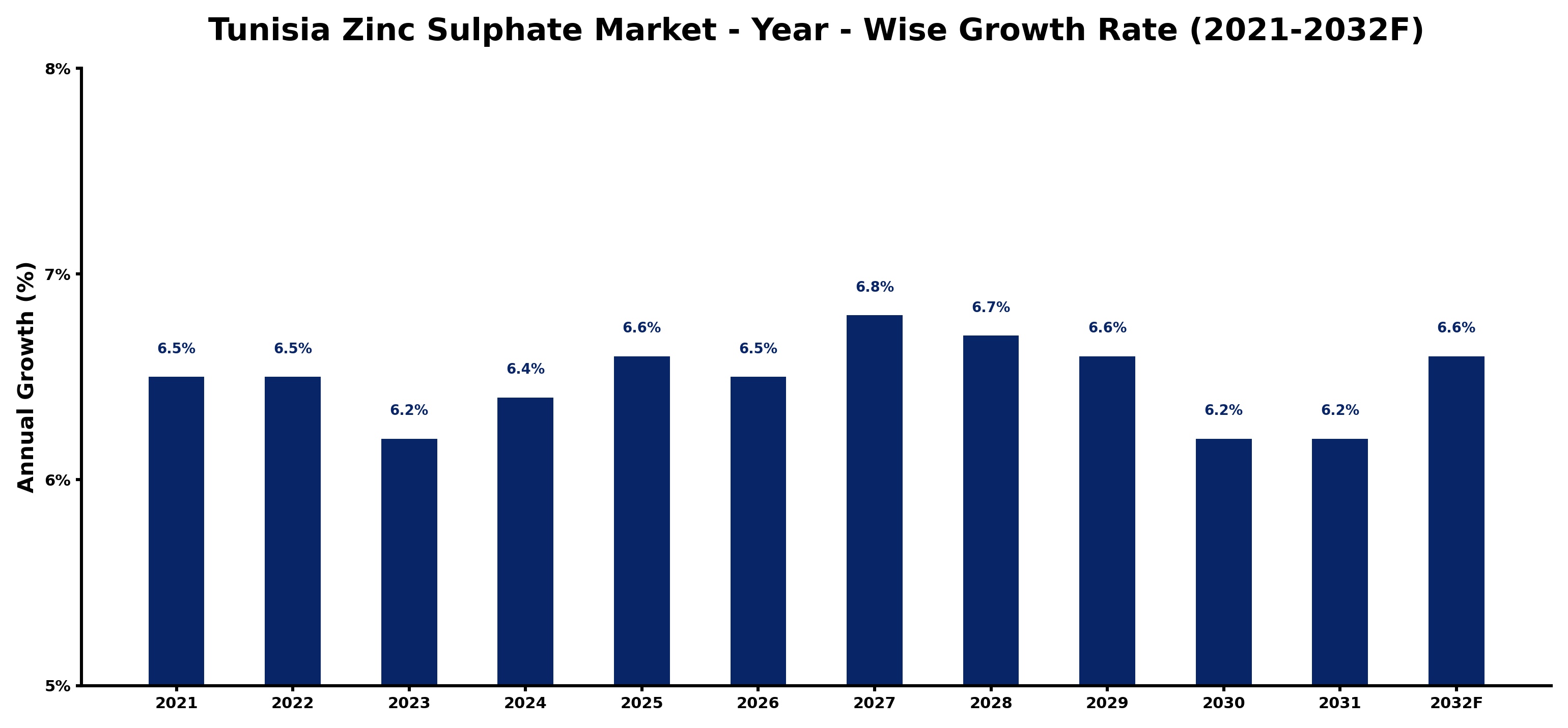
The table below presents the year‑wise growth rates along with the key drivers influencing the market
| Year | Growth Rate | Major Drivers |
| 2021 | 6.5% | Agricultural sector demand increased |
| 2022 | 6.5% | Fertilizer usage expanded significantly |
| 2023 | 6.2% | Crop yield improvement initiatives launched |
| 2024 | 6.4% | Sustainable farming practices adopted widely |
| 2025 | 6.6% | Livestock nutrition awareness heightened |
| 2026 | 6.5% | Soil health programs gained traction |
| 2027 | 6.8% | Export opportunities for zinc products |
| 2028 | 6.7% | Research funding for agriculture increased |
| 2029 | 6.6% | Government support for farmers expanded |
| 2030 | 6.2% | Technological advancements in agriculture |
| 2031 | 6.2% | Consumer awareness of micronutrients grew |
| 2032 | 6.6% | Partnerships with agricultural cooperatives formed |
Note - Market size estimations and growth projections presented in this report are based on 6Wresearch’s advanced forecasting approach, validated with industry datasets as of June 2026.
Tunisia Zinc Sulphate Market Synopsis
The Tunisia Zinc Sulphate Market is currently characterized by a significant demand surge driven by the agricultural sector. Farmers are increasingly adopting zinc sulphate to optimize crop quality, highlighting its critical role in contemporary farming practices. This growing acceptance is a direct response to heightened awareness surrounding nutrient management and soil health.
In addition to agriculture, industrial applications of zinc sulphate are gaining traction, further enhancing its market presence. The chemical industry in Tunisia is leveraging zinc sulphate for manufacturing various compounds, thereby diversifying the demand and supporting overall market growth.
Tunisia Zinc Sulphate Market Key Takeaways
- The market is poised for steady growth, driven by increased agricultural awareness and nutrient management practices.
- A strong reliance on zinc sulphate in the industrial sector is broadening its applications and demand.
- Challenges related to raw material procurement may impact cost structures and market dynamics.
- Government policies and agricultural initiatives will play a pivotal role in shaping market trends and growth potential.
- Competition from international suppliers necessitates strategic positioning for local producers to maintain market share.
Evaluation of Restraints in Tunisia Zinc Sulphate Market
Despite the favorable growth trajectory, the Tunisia Zinc Sulphate Market faces significant restraints. Chief among these are the challenges associated with raw material procurement, as the dependency on zinc ore availability renders the market susceptible to global supply chain disruptions and price fluctuations. Furthermore, the necessity to adhere to stringent regulatory standards regarding quality and environmental compliance adds layers of complexity and cost. These factors, combined with fierce competition from international entities, compel local manufacturers to enhance operational efficiencies while adapting to fluctuating demand patterns.
Tunisia Zinc Sulphate Market Trends
A prominent trend in the Tunisia Zinc Sulphate Market is the increasing integration of precision agriculture techniques. Farmers are leveraging advanced technologies to optimize nutrient application, enhancing the efficiency of zinc sulphate usage. Moreover, there is a noticeable shift towards organic and sustainable farming practices, fueling the demand for micronutrient-rich fertilizers. As sustainability becomes a cornerstone of agricultural policy, the focus on environmentally-friendly production processes is also expected to shape future market dynamics.
Tunisia Zinc Sulphate Market Opportunities
The Tunisia Zinc Sulphate Market is ripe with opportunities, particularly for innovation in product formulation and applications. With increasing awareness regarding soil health, there is a growing demand for specialized fertilizers that incorporate zinc sulphate as a core component. Additionally, investments in agricultural technology and initiatives aimed at enhancing crop resilience against climate change open avenues for growth. The industrial sector's evolving needs also present opportunities for the development of new zinc sulphate derivatives for niche applications.
Government Initiatives in the Tunisia Zinc Sulphate Market
The Tunisian government is actively promoting agricultural sustainability through various initiatives aimed at enhancing crop production. Policies that support the adoption of micronutrients, including zinc sulphate, are being implemented to improve soil fertility and agricultural output. Furthermore, public investments in agricultural infrastructure and research programs are designed to bolster the local farming community, ultimately facilitating the growth of the zinc sulphate market.
Future Insights of the Tunisia Zinc Sulphate Market
Looking ahead to 2026-2032, the Tunisia Zinc Sulphate Market is expected to experience robust growth fueled by ongoing agricultural advancements and industrial demands. Enhanced focus on nutrient management and sustainable farming will likely drive the adoption of zinc sulphate in fertilizer applications. As producers adapt to emerging trends and regulatory frameworks, the market's resilience will be tested but should ultimately lead to heightened stability and profitability.
Tunisia Zinc Sulphate Market Latest Developments (May 2025 - June 2026)
In recent months, there has been a noticeable shift towards partnerships between local agricultural stakeholders and research institutions, aiming to develop innovative applications of zinc sulphate. Additionally, policy discussions surrounding the need for enhanced agricultural productivity in Tunisia have prompted regulatory updates, aligning with global sustainability goals. The industrial sector is also exploring new technologies for zinc sulphate production, potentially increasing efficiency and reducing costs.
Tunisia Zinc Sulphate Market - Key Attractiveness of the Report
- 10 Years of Market Numbers
- Historical Data Starting from 2022 to 2025
- Base Year: 2025
- Forecast Data until 2032
- Key Performance Indicators Impacting the Market
- Major Upcoming Developments and Projects
Key Highlights of the Report:
- Tunisia Zinc Sulphate Market Outlook
- Market Size of Tunisia Zinc Sulphate Market, 2025
- Forecast of Tunisia Zinc Sulphate Market, 2032
- Historical Data and Forecast of Tunisia Zinc Sulphate Revenues & Volume for the Period 2022-2032F
- Tunisia Zinc Sulphate Market Trend Evolution
- Tunisia Zinc Sulphate Market Drivers and Challenges
- Tunisia Zinc Sulphate Price Trends
- Tunisia Zinc Sulphate Porter's Five Forces
- Tunisia Zinc Sulphate Industry Life Cycle
- Historical Data and Forecast of Tunisia Zinc Sulphate Market Revenues & Volume By Type for the Period 2022-2032F
- Historical Data and Forecast of Tunisia Zinc Sulphate Market Revenues & Volume By Zinc Sulphate Anhydrous for the Period 2022-2032F
- Historical Data and Forecast of Tunisia Zinc Sulphate Market Revenues & Volume By Zinc Sulphate Hexahydrate for the Period 2022-2032F
- Historical Data and Forecast of Tunisia Zinc Sulphate Market Revenues & Volume By Zinc Sulphate Heptahydrate for the Period 2022-2032F
- Historical Data and Forecast of Tunisia Zinc Sulphate Market Revenues & Volume By Zinc Sulphate Monohydrate for the Period 2022-2032F
- Historical Data and Forecast of Tunisia Zinc Sulphate Market Revenues & Volume By Application for the Period 2022-2032F
- Historical Data and Forecast of Tunisia Zinc Sulphate Market Revenues & Volume By Agrochemicals for the Period 2022-2032F
- Historical Data and Forecast of Tunisia Zinc Sulphate Market Revenues & Volume By Chemicals for the Period 2022-2032F
- Historical Data and Forecast of Tunisia Zinc Sulphate Market Revenues & Volume By Pharmaceuticals for the Period 2022-2032F
- Historical Data and Forecast of Tunisia Zinc Sulphate Market Revenues & Volume By Synthetic Fibers for the Period 2022-2032F
- Historical Data and Forecast of Tunisia Zinc Sulphate Market Revenues & Volume By Water Treatment for the Period 2022-2032F
- Historical Data and Forecast of Tunisia Zinc Sulphate Market Revenues & Volume By Others for the Period 2022-2032F
- Tunisia Zinc Sulphate Import Export Trade Statistics
- Market Opportunity Assessment By Type
- Market Opportunity Assessment By Application
- Tunisia Zinc Sulphate Top Companies Market Share
- Tunisia Zinc Sulphate Competitive Benchmarking By Technical and Operational Parameters
- Tunisia Zinc Sulphate Company Profiles
- Tunisia Zinc Sulphate Key Strategic Recommendations






































