Turkey AC Power Sources Market Size, Share & Growth Rate
The Turkey AC Power Sources Market was estimated at USD 434 Million in 2025 and is projected to reach USD 574 Million by 2032, growing at a CAGR of 4.1% from 2026 to 2032. This growth is propelled by increasing industrialization and substantial investments in infrastructure development. Additionally, the transition towards renewable energy sources and the burgeoning demand for smart grid technologies are further shaping the landscape of the market, ensuring a steady momentum in demand for efficient AC power solutions.
Turkey AC Power Sources Market Year-wise Growth Rate and Key Drivers
This graph highlights how the Turkey AC Power Sources Market has steadily grown over the years, supported by major growth factors.
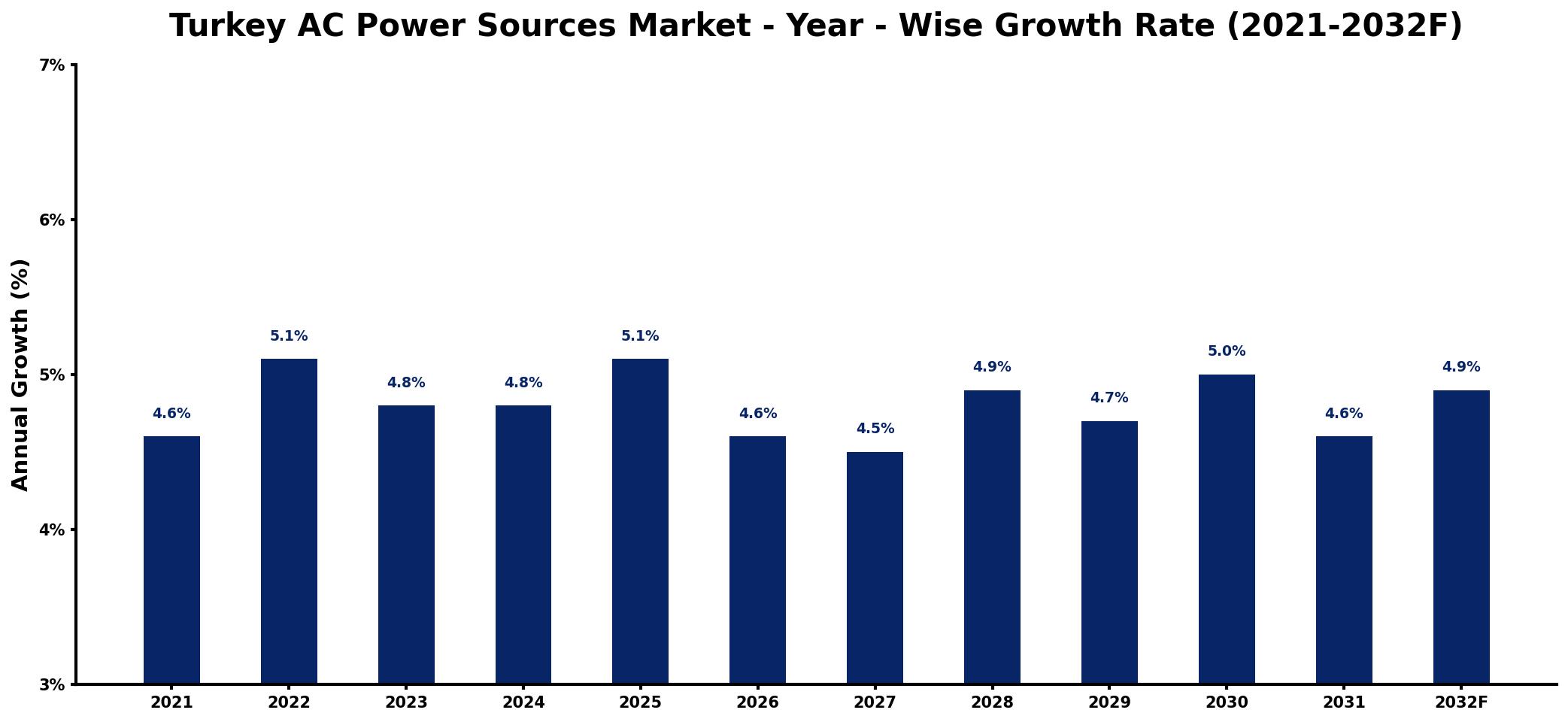
The table below presents the year‑wise growth rates along with the key drivers influencing the market
| Year | Growth Rate | Major Drivers |
| 2021 | 4.6% | Rising renewable energy investments |
| 2022 | 5.1% | Increased industrial electricity demand |
| 2023 | 4.8% | Growing urban infrastructure projects |
| 2024 | 4.8% | Expansion of electric vehicle market |
| 2025 | 5.1% | Higher residential energy consumption |
| 2026 | 4.6% | Development of smart grid technologies |
| 2027 | 4.5% | Surge in commercial construction activities |
| 2028 | 4.9% | Adoption of energy efficiency standards |
| 2029 | 4.7% | Enhanced government energy policies |
| 2030 | 5.0% | Investment in green technology initiatives |
| 2031 | 4.6% | Growth in data center requirements |
| 2032 | 4.9% | Rise in electric appliance usage |
Note: Market size estimations and growth projections presented in this report are based on 6Wresearch's proprietary forecasting methodology, utilizing the latest available industry data, government publications, and primary research inputs.
Turkey AC Power Sources Market Synopsis
The Turkey AC Power Sources Market is currently witnessing a paradigm shift driven by technological innovations and the pressing need for sustainable energy solutions. As various sectors, including manufacturing and healthcare, expand, their need for reliable power sources has never been more critical.
Moreover, the market is increasingly gravitating towards energy-efficient systems and renewable power sources, reflecting a broader commitment to environmental sustainability. This trend is indicative of the country's changing energy landscape, where smart technologies are becoming a cornerstone of future growth.
Turkey AC Power Sources Market Key Takeaways
- The market is projected to grow at a CAGR of 4.1% from 2026 to 2032.
- Increased industrial activities and infrastructure development are major growth drivers.
- The shift towards renewable energy is shaping demand for AC power solutions.
- Investment opportunities exist in advanced energy-efficient technologies.
- Government policies are aimed at promoting cleaner and more efficient energy sources.
Evaluation of Restraints in Turkey AC Power Sources Market
Despite the optimistic growth projections, the Turkey AC Power Sources Market faces several noteworthy restraints. One significant challenge is the intense competition that has emerged as both domestic and international players vie for market share. This competition can lead to price wars, ultimately squeezing profit margins and impacting overall sustainability.
Additionally, fluctuating raw material prices, particularly for metals essential in manufacturing, can create uncertainties in cost structures. Stricter regulations aimed at enhancing energy efficiency and reducing environmental impact require ongoing investments in technology and compliance, which can be daunting for many companies in this sector.
Turkey AC Power Sources Market Trends
The market is currently trending towards eco-friendly and energy-efficient solutions, a shift that reflects heightened awareness among consumers and businesses alike. There is a notable increase in the development and utilization of power sources boasting higher efficiency ratings and lower carbon emissions.
Another significant trend is the rise of smart technologies that offer enhanced monitoring and control capabilities, facilitating better energy management and operational efficiency. These innovations are not only meeting current demands but are also shaping the future of power sourcing in Turkey.
Turkey AC Power Sources Market Opportunities
Significant investment opportunities abound in the Turkey AC Power Sources Market, driven by increasing needs across various sectors like telecommunications, healthcare, and manufacturing. As infrastructure projects proliferate and energy demands rise, the production and distribution of AC power sources—such as generators and UPS systems—are particularly promising.
Furthermore, the growing emphasis on sustainability opens doors for innovations in eco-friendly power solutions. Collaborations with local manufacturers can provide insights into consumer preferences and broaden market penetration, enhancing overall investment attractiveness.
Government Initiatives in the Turkey AC Power Sources Market
The Turkish government is actively promoting renewable energy and energy efficiency through various policies and incentives. These initiatives are designed to encourage the development of renewable technologies, including solar and wind power, while fostering an environment that prioritizes energy conservation and sustainability.
Regulatory frameworks are being established to enhance the energy efficiency of AC power sources, thereby reducing reliance on fossil fuels and improving energy security. This government focus aligns with broader national goals of transitioning to a greener energy landscape, presenting both challenges and opportunities for market participants.
Future Insights of the Turkey AC Power Sources Market
Looking ahead to 2026-2032, the Turkey AC Power Sources Market is poised for continuous growth, underpinned by evolving demands across various sectors and the ongoing transition to renewable energy. The increasing adoption of electric vehicles and the necessity for reliable power supplies in critical applications further bolster this market's expansion.
Technological advancements will play a crucial role, with innovations in power management systems enhancing the reliability and stability of AC power solutions. As companies adapt to these shifts and invest in next-generation technologies, the markets trajectory appears promising, marking Turkey as a pivotal player in the evolving energy sector.
Turkey AC Power Sources Market Latest Developments (2025 - 2026)
Recent developments in the Turkey AC Power Sources Market indicate a strong push towards innovation and sustainability. Many companies are unveiling new products designed to meet rising energy efficiency standards, while others are investing in renewable energy projects to comply with government regulations. Furthermore, collaborations between technology providers and local manufacturers are becoming increasingly common as firms aim to enhance their market position and broaden their service offerings.
Turkey AC Power Sources Market - Key Attractiveness of the Report
- 10 Years of Market Numbers
- Historical Data Starting from 2022 to 2025
- Base Year: 2025
- Forecast Data until 2032
- Key Performance Indicators Impacting the Market
- Major Upcoming Developments and Projects
Key Highlights of the Report:
- Turkey AC Power Sources Market Outlook
- Market Size of Turkey AC Power Sources Market, 2025
- Forecast of Turkey AC Power Sources Market, 2032
- Historical Data and Forecast of Turkey AC Power Sources Revenues & Volume for the Period 2022-2032F
- Turkey AC Power Sources Market Trend Evolution
- Turkey AC Power Sources Market Drivers and Challenges
- Turkey AC Power Sources Price Trends
- Turkey AC Power Sources Porter's Five Forces
- Turkey AC Power Sources Industry Life Cycle
- Historical Data and Forecast of Turkey AC Power Sources Market Revenues & Volume By Phase Type for the Period 2022-2032F
- Historical Data and Forecast of Turkey AC Power Sources Market Revenues & Volume By Single-phase for the Period 2022-2032F
- Historical Data and Forecast of Turkey AC Power Sources Market Revenues & Volume By Three-phase for the Period 2022-2032F
- Historical Data and Forecast of Turkey AC Power Sources Market Revenues & Volume By Modulation Type for the Period 2022-2032F
- Historical Data and Forecast of Turkey AC Power Sources Market Revenues & Volume By PWM for the Period 2022-2032F
- Historical Data and Forecast of Turkey AC Power Sources Market Revenues & Volume By Linear for the Period 2022-2032F
- Historical Data and Forecast of Turkey AC Power Sources Market Revenues & Volume By Application for the Period 2022-2032F
- Historical Data and Forecast of Turkey AC Power Sources Market Revenues & Volume By Aerospace for the Period 2022-2032F
- Historical Data and Forecast of Turkey AC Power Sources Market Revenues & Volume By Defense & Government Services for the Period 2022-2032F
- Historical Data and Forecast of Turkey AC Power Sources Market Revenues & Volume By Energy for the Period 2022-2032F
- Historical Data and Forecast of Turkey AC Power Sources Market Revenues & Volume By Wireless Communication & Infrastructure for the Period 2022-2032F
- Historical Data and Forecast of Turkey AC Power Sources Market Revenues & Volume By Consumer Electronics & Appliances for the Period 2022-2032F
- Historical Data and Forecast of Turkey AC Power Sources Market Revenues & Volume By Others for the Period 2022-2032F
- Turkey AC Power Sources Import Export Trade Statistics
- Market Opportunity Assessment By Phase Type
- Market Opportunity Assessment By Modulation Type
- Market Opportunity Assessment By Application
- Turkey AC Power Sources Top Companies Market Share
- Turkey AC Power Sources Competitive Benchmarking By Technical and Operational Parameters
- Turkey AC Power Sources Company Profiles
- Turkey AC Power Sources Key Strategic Recommendations






































