Turkey Aerosol Market Size, Share & Growth Rate
The Turkey Aerosol Market was estimated at USD 179 Million in 2025 and is projected to reach USD 240 Million by 2032, growing at a CAGR of 4.3% from 2026 to 2032. This growth trajectory is primarily driven by an increase in consumer demand for convenient packaging solutions across personal care, household products, and automotive sectors. Furthermore, rising disposable incomes and heightened awareness of hygiene are acting as significant catalysts for market expansion.
Turkey Aerosol Market Year-wise Growth Rate and Key Drivers
This graph highlights how the Turkey Aerosol Market has steadily grown over the years, supported by major growth factors.
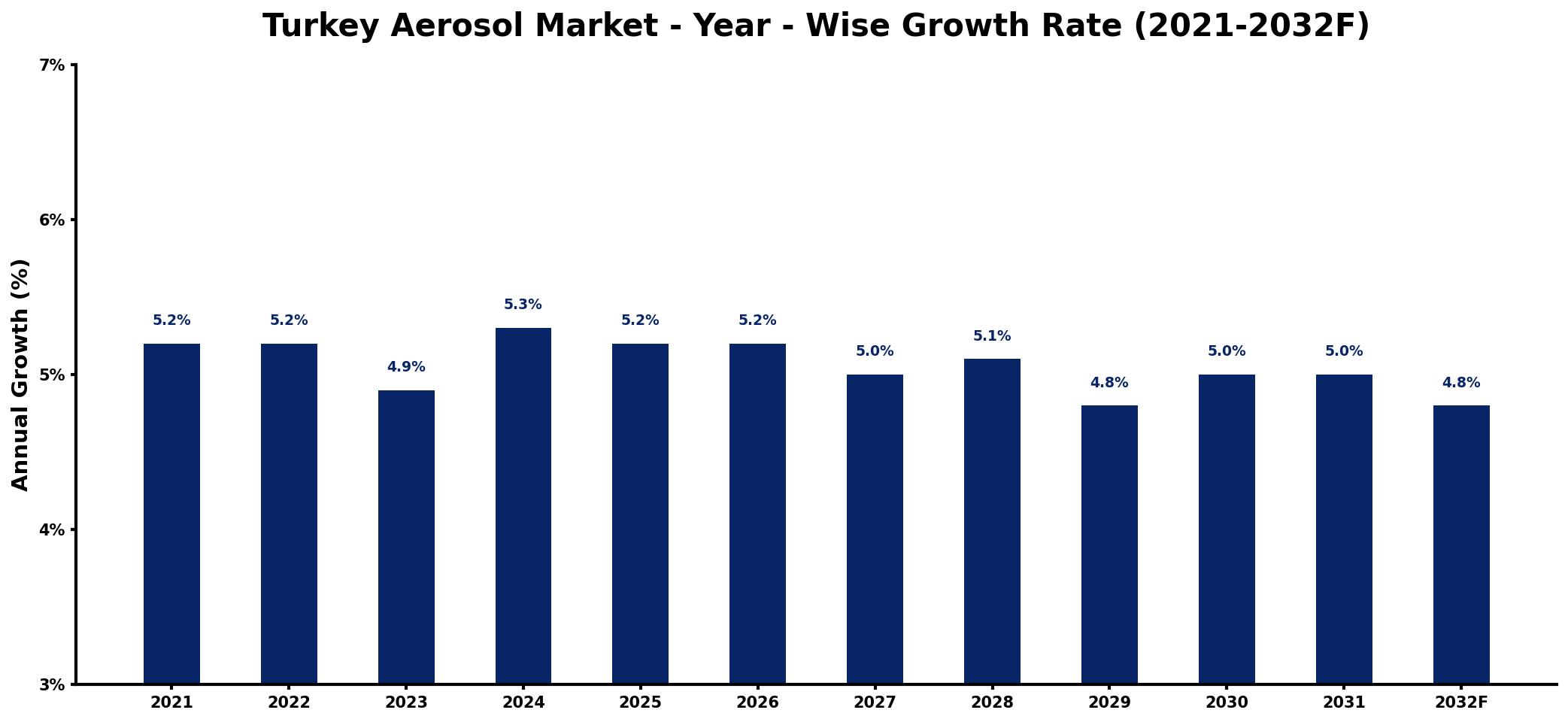
The table below presents the year‑wise growth rates along with the key drivers influencing the market
| Year | Growth Rate | Major Drivers |
| 2021 | 5.2% | Rising consumer health awareness |
| 2022 | 5.2% | Increased investment in production |
| 2023 | 4.9% | Growing demand for convenience products |
| 2024 | 5.3% | Expansion of distribution channels |
| 2025 | 5.2% | increased domestic production output |
| 2026 | 5.2% | Innovative packaging solutions emerging |
| 2027 | 5.0% | Boost in personal care usage |
| 2028 | 5.1% | Rising popularity of home care |
| 2029 | 4.8% | Increased adoption of DIY products |
| 2030 | 5.0% | Growth in industrial applications |
| 2031 | 5.0% | Surge in online retail sales |
| 2032 | 4.8% | Enhanced product diversification strategies |
Note: Market size estimations and growth projections presented in this report are based on 6Wresearch's proprietary forecasting methodology, utilizing the latest available industry data, government publications, and primary research inputs.
Turkey Aerosol Market Synopsis
The strongest force currently shaping the Turkey Aerosol Market is the shift towards eco-friendly and sustainable aerosol products. Turkish consumers are increasingly inclined to support brands that prioritize environmental responsibility, leading manufacturers to innovate and modify their product lines.
Additionally, the growing urban population and evolving consumer lifestyles are fueling the demand for diverse aerosol offerings, including personal care items like deodorants and household essentials such as air fresheners. This dynamic has propelled brands to rethink their strategies and adapt to a more environmentally conscious market landscape.
Turkey Aerosol Market Key Takeaways
- The market is expected to see steady growth influenced by changing consumer preferences for convenience and sustainability.
- Advancements in aerosol technology are leading to innovative products with enhanced functionality and eco-friendliness.
- There is a notable increase in demand for natural and organic aerosol products, particularly in personal and home care sectors.
- Investment opportunities abound in R&D for new formulations and sustainable packaging solutions.
- Compliance with government regulations around chemical usage remains crucial for manufacturers in this sector.
Evaluation of Restraints in Turkey Aerosol Market
Despite its potential, the Turkey Aerosol Market faces several restraints that could hinder growth. Stringent government regulations surrounding the use of certain chemicals pose challenges for manufacturers aiming to comply while maintaining product efficacy. Additionally, increasing consumer scrutiny regarding environmental impact raises the stakes for aerosol producers. Competing alternatives in packaging are also gaining traction, prompting traditional aerosol products to innovate continually to meet market expectations. These factors necessitate a proactive approach from industry stakeholders, requiring investment in sustainable practices and innovative solutions.
Turkey Aerosol Market Trends
The Turkey Aerosol Market is undergoing a significant transformation, with eco-friendliness at the forefront of industry trends. Brands are increasingly focused on using recyclable materials and low-impact propellants, reflecting a broader societal movement towards sustainability. Additionally, the trend toward natural ingredients is becoming more pronounced in personal care products, aligning with consumer preferences for health and wellness. Innovations in aerosol delivery systems are also emerging, enhancing product performance and consumer experience. This convergence of trends underscores a critical shift toward environmentally responsible consumerism within the aerosol sector.
Turkey Aerosol Market Opportunities
Investment opportunities in the Turkey aerosol market are ripe, particularly for those targeting the personal care and household products sectors. With consumer income levels on the rise and a clear shift toward eco-friendly products, investors have the chance to capitalize on innovative companies that prioritize sustainability. Moreover, the demand for specialized aerosol solutions in healthcare and automotive applications is growing, indicating untapped market segments ripe for exploration. Investing in R&D to develop new formulations could position businesses favorably within this evolving landscape.
Government Initiatives in the Turkey Aerosol Market
The Turkish government has implemented rigorous regulations to ensure the safety and environmental integrity of aerosol products. These policies include restrictions on harmful chemicals, such as chlorofluorocarbons (CFCs), which protect the ozone layer. Furthermore, stringent labeling requirements ensure that consumers are adequately informed about product contents and proper usage. By setting standards for manufacturing and packaging, the government aims to uphold quality and promote sustainable practices within the aerosol market. Such initiatives foster a safer market environment while encouraging manufacturers to innovate responsibly.
Future Insights of the Turkey Aerosol Market
The future of the Turkey Aerosol Market looks promising as consumer demand continues to evolve. The anticipated growth in personal care and household products driven by increased hygiene awareness will likely propel market expansion. Furthermore, as eco-friendly practices become more mainstream, companies that invest in innovative and sustainable aerosol solutions will capture the interest of an increasingly conscientious consumer base. Although regulatory challenges will persist, they will also drive innovation, creating a marketplace ripe for progress and development.
Turkey Aerosol Market Latest Developments (2025 - 2026)
In recent months, there have been notable shifts in the Turkey aerosol market landscape. Manufacturers are increasingly adopting sustainable practices, driven by consumer demand for eco-friendly products. There have also been announcements regarding collaborative efforts among companies aiming to develop innovative aerosol technologies that minimize environmental impact. Additionally, the market has seen a rise in the availability of organic aerosol products, aligning with the broader trend toward natural consumer goods.
Turkey Aerosol Market - Key Attractiveness of the Report
- 10 Years of Market Numbers
- Historical Data Starting from 2022 to 2025
- Base Year: 2025
- Forecast Data until 2032
- Key Performance Indicators Impacting the Market
- Major Upcoming Developments and Projects
Key Highlights of the Report:
- Turkey Aerosol Market Outlook
- Market Size of Turkey Aerosol Market, 2025
- Forecast of Turkey Aerosol Market, 2032
- Historical Data and Forecast of Turkey Aerosol Revenues & Volume for the Period 2022-2032F
- Turkey Aerosol Market Trend Evolution
- Turkey Aerosol Market Drivers and Challenges
- Turkey Aerosol Price Trends
- Turkey Aerosol Porter's Five Forces
- Turkey Aerosol Industry Life Cycle
- Historical Data and Forecast of Turkey Aerosol Market Revenues & Volume By Material for the Period 2022-2032F
- Historical Data and Forecast of Turkey Aerosol Market Revenues & Volume By Steel for the Period 2022-2032F
- Historical Data and Forecast of Turkey Aerosol Market Revenues & Volume By Aluminum for the Period 2022-2032F
- Historical Data and Forecast of Turkey Aerosol Market Revenues & Volume By Others for the Period 2022-2032F
- Historical Data and Forecast of Turkey Aerosol Market Revenues & Volume By Type for the Period 2022-2032F
- Historical Data and Forecast of Turkey Aerosol Market Revenues & Volume By Bag-In-Valve for the Period 2022-2032F
- Historical Data and Forecast of Turkey Aerosol Market Revenues & Volume By Standard for the Period 2022-2032F
- Historical Data and Forecast of Turkey Aerosol Market Revenues & Volume By Application for the Period 2022-2032F
- Historical Data and Forecast of Turkey Aerosol Market Revenues & Volume By Personal Care for the Period 2022-2032F
- Historical Data and Forecast of Turkey Aerosol Market Revenues & Volume By Household for the Period 2022-2032F
- Historical Data and Forecast of Turkey Aerosol Market Revenues & Volume By Automotive & Industrial for the Period 2022-2032F
- Historical Data and Forecast of Turkey Aerosol Market Revenues & Volume By Food for the Period 2022-2032F
- Historical Data and Forecast of Turkey Aerosol Market Revenues & Volume By Paints for the Period 2022-2032F
- Historical Data and Forecast of Turkey Aerosol Market Revenues & Volume By Medical for the Period 2022-2032F
- Historical Data and Forecast of Turkey Aerosol Market Revenues & Volume By Others for the Period 2022-2032F
- Turkey Aerosol Import Export Trade Statistics
- Market Opportunity Assessment By Material
- Market Opportunity Assessment By Type
- Market Opportunity Assessment By Application
- Turkey Aerosol Top Companies Market Share
- Turkey Aerosol Competitive Benchmarking By Technical and Operational Parameters
- Turkey Aerosol Company Profiles
- Turkey Aerosol Key Strategic Recommendations






































