Turkey Aluminium Sulphate Market Size, Share & Growth Rate
The Turkey Aluminium Sulphate Market was estimated at USD 186 Million in 2025 and is projected to reach USD 246 Million by 2032, growing at a CAGR of 4.1% from 2026 to 2032. This growth trajectory is fueled by the escalating demand across vital sectors, particularly water treatment and paper production. As industrial activities expand and environmental regulations become more stringent, Aluminium Sulphate's role as an essential coagulant in water purification is increasingly recognized, further driving market growth.
Turkey Aluminium Sulphate Market Year-wise Growth Rate and Key Drivers
This graph highlights how the Turkey Aluminium Sulphate Market has steadily grown over the years, supported by major growth factors.
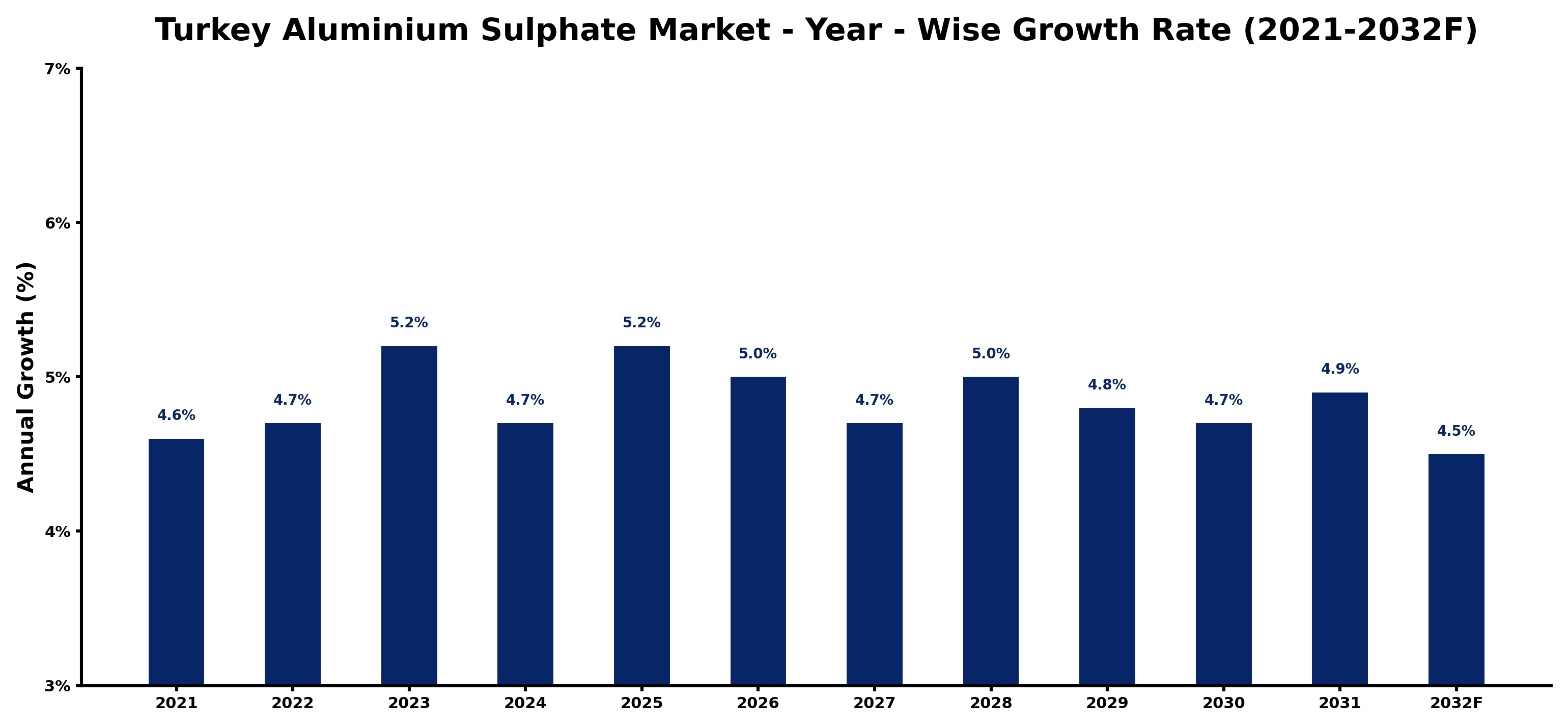
The table below presents the year‑wise growth rates along with the key drivers influencing the market
| Year | Growth Rate | Major Drivers |
| 2021 | 4.6% | Infrastructure projects increased demand |
| 2022 | 4.7% | Water treatment applications expanded usage |
| 2023 | 5.2% | Construction industry growth drove consumption |
| 2024 | 4.7% | Agricultural sector demand rose significantly |
| 2025 | 5.2% | Chemical manufacturing expansion boosted sales |
| 2026 | 5.0% | Environmental regulations enhanced adoption |
| 2027 | 4.7% | Food processing industry growth accelerated |
| 2028 | 5.0% | Urbanization trends fueled market growth |
| 2029 | 4.8% | Industrial applications increased product usage |
| 2030 | 4.7% | Sustainability initiatives drove market expansion |
| 2031 | 4.9% | Research and development investments increased |
| 2032 | 4.5% | Export opportunities enhanced market potential |
Note - Market size estimations and growth projections presented in this report are based on 6Wresearch’s advanced forecasting approach, validated with industry datasets as of June 2026.
Turkey Aluminium Sulphate Market Synopsis
The strongest force shaping the Turkey Aluminium Sulphate market is the heightened focus on water treatment processes. The use of Aluminium Sulphate as a key coagulant is pivotal in addressing the challenges of water quality and safety, thereby directly influencing demand.
Additionally, the rapid expansion of the paper and pulp industry in Turkey is propelling market dynamics. Aluminium Sulphate's application in paper sizing and coloring not only enhances product quality but also supports the industry's growth, contributing to the overall demand for this chemical compound.
Turkey Aluminium Sulphate Market Key Takeaways
- The Turkey Aluminium Sulphate market is set for steady growth, primarily driven by the water treatment sector.
- Regulatory pressures for sustainable practices are pushing the industry towards eco-friendly alternatives.
- Investment in manufacturing facilities presents lucrative opportunities amid rising demand.
- Innovations in production processes are essential to maintaining competitiveness in a changing market.
- The pharmaceutical sector is emerging as a significant user of Aluminium Sulphate, expanding its market scope.
Evaluation of Restraints in Turkey Aluminium Sulphate Market
Despite the optimistic growth outlook, the Turkey Aluminium Sulphate market faces significant challenges. Fluctuating raw material prices are a primary concern, as these variations can directly impact production costs and, consequently, profit margins for manufacturers. Furthermore, the market is increasingly encountering competition from alternative water treatment chemicals that may provide similar benefits at lower costs, putting pressure on Aluminium Sulphate's market position. Stringent environmental regulations surrounding its use and disposal are also creating compliance challenges, leading to increased operational costs. Addressing these challenges through effective cost management, innovation, and regulatory compliance will be critical for stakeholders in the market.
Turkey Aluminium Sulphate Market Trends
The Turkey Aluminium Sulphate market is witnessing significant trends such as a shift towards eco-friendly formulations in response to consumer preferences and environmental regulations. As sustainability becomes a central theme in industrial practices, manufacturers are investing in the development of innovative, less harmful alternatives to traditional Aluminium Sulphate products. Additionally, the ongoing expansion of the construction sector is increasing demand for Aluminium Sulphate in the production of fireproof materials and ceramics, further diversifying its application landscape.
Turkey Aluminium Sulphate Market Opportunities
There are substantial investment opportunities within the Turkey Aluminium Sulphate market, particularly in expanding manufacturing capabilities to meet rising demand from key sectors. The ongoing need for effective water treatment solutions, coupled with the increasing interest in sustainable chemical alternatives, positions companies well for growth. Investing in research and development to refine production processes and explore novel applications can yield significant returns. Moreover, tapping into the growing pharmaceutical sector for Aluminium Sulphate usage presents an attractive avenue for expansion.
Government Initiatives in the Turkey Aluminium Sulphate Market
The Turkish government is actively involved in regulating the Aluminium Sulphate market to ensure quality and sustainability. Through the Ministry of Environment and Urbanization, the government sets strict standards for production processes to minimize environmental impacts. Additionally, the Ministry of Trade oversees the import and export of Aluminium Sulphate to maintain market equilibrium and prevent unfair practices. Incentives for domestic production are also provided to reduce dependence on imports, fostering growth within the local industry.
Future Insights of the Turkey Aluminium Sulphate Market
Looking ahead, the Turkey Aluminium Sulphate market appears well-positioned for growth from 2026 to 2032. The convergence of increasing industrial activity, particularly in water treatment and pharmaceuticals, coupled with heightened environmental awareness, suggests a robust demand for Aluminium Sulphate. While challenges such as fluctuating raw material prices and regulatory compliance persist, the overall market dynamics support a positive outlook. Continued investment in innovation and sustainable practices will be crucial for companies seeking to capitalize on these opportunities.
Turkey Aluminium Sulphate Market Latest Developments (May 2025 - June 2026)
Recent developments in the Turkey Aluminium Sulphate market indicate a clear trend towards sustainability and innovation. Companies are increasingly adopting eco-friendly production methods and formulating products that align with stringent environmental standards. Moreover, partnerships within the industry are emerging to drive advancements in Aluminium Sulphate applications, particularly in water purification and pharmaceuticals, reflecting a commitment to enhance product performance while minimizing environmental impacts.
Turkey Aluminium Sulphate Market - Key Attractiveness of the Report
- 10 Years of Market Numbers
- Historical Data Starting from 2022 to 2025
- Base Year: 2025
- Forecast Data until 2032
- Key Performance Indicators Impacting the Market
- Major Upcoming Developments and Projects
Key Highlights of the Report:
- Turkey Aluminium Sulphate Market Outlook
- Market Size of Turkey Aluminium Sulphate Market, 2025
- Forecast of Turkey Aluminium Sulphate Market, 2032
- Historical Data and Forecast of Turkey Aluminium Sulphate Revenues & Volume for the Period 2022-2032F
- Turkey Aluminium Sulphate Market Trend Evolution
- Turkey Aluminium Sulphate Market Drivers and Challenges
- Turkey Aluminium Sulphate Price Trends
- Turkey Aluminium Sulphate Porter's Five Forces
- Turkey Aluminium Sulphate Industry Life Cycle
- Historical Data and Forecast of Turkey Aluminium Sulphate Market Revenues & Volume By Applications for the Period 2022-2032F
- Historical Data and Forecast of Turkey Aluminium Sulphate Market Revenues & Volume By Food and beverages industry for the Period 2022-2032F
- Historical Data and Forecast of Turkey Aluminium Sulphate Market Revenues & Volume By Health care industry for the Period 2022-2032F
- Historical Data and Forecast of Turkey Aluminium Sulphate Market Revenues & Volume By Water purification and water treatment plants for the Period 2022-2032F
- Historical Data and Forecast of Turkey Aluminium Sulphate Market Revenues & Volume By Pepper industry for the Period 2022-2032F
- Historical Data and Forecast of Turkey Aluminium Sulphate Market Revenues & Volume By Others for the Period 2022-2032F
- Historical Data and Forecast of Turkey Aluminium Sulphate Market Revenues & Volume By Functionality for the Period 2022-2032F
- Historical Data and Forecast of Turkey Aluminium Sulphate Market Revenues & Volume By As an additive for the Period 2022-2032F
- Historical Data and Forecast of Turkey Aluminium Sulphate Market Revenues & Volume By As BOD and COD removal for the Period 2022-2032F
- Historical Data and Forecast of Turkey Aluminium Sulphate Market Revenues & Volume By Colour removal for the Period 2022-2032F
- Historical Data and Forecast of Turkey Aluminium Sulphate Market Revenues & Volume By Cell separation for the Period 2022-2032F
- Historical Data and Forecast of Turkey Aluminium Sulphate Market Revenues & Volume By Product Form for the Period 2022-2032F
- Historical Data and Forecast of Turkey Aluminium Sulphate Market Revenues & Volume By Liquid for the Period 2022-2032F
- Historical Data and Forecast of Turkey Aluminium Sulphate Market Revenues & Volume By Solid for the Period 2022-2032F
- Turkey Aluminium Sulphate Import Export Trade Statistics
- Market Opportunity Assessment By Applications
- Market Opportunity Assessment By Functionality
- Market Opportunity Assessment By Product Form
- Turkey Aluminium Sulphate Top Companies Market Share
- Turkey Aluminium Sulphate Competitive Benchmarking By Technical and Operational Parameters
- Turkey Aluminium Sulphate Company Profiles
- Turkey Aluminium Sulphate Key Strategic Recommendations






































