Turkey Apparel Accessories Market Size, Share & Growth Rate
The Turkey Apparel Accessories Market was estimated at USD 440 Million in 2025 and is projected to reach USD 570 Million by 2032, growing at a CAGR of 3.8% from 2026 to 2032. This growth trajectory is significantly driven by increasing disposable incomes, a rising interest in fashion, and a shift towards more personalized and unique accessory options among consumers. Additionally, the expanding e-commerce landscape further supports market expansion, providing brands with access to a broader customer base.
Turkey Apparel Accessories Market Year-wise Growth Rate and Key Drivers
This graph highlights how the Turkey Apparel Accessories Market has steadily grown over the years, supported by major growth factors.
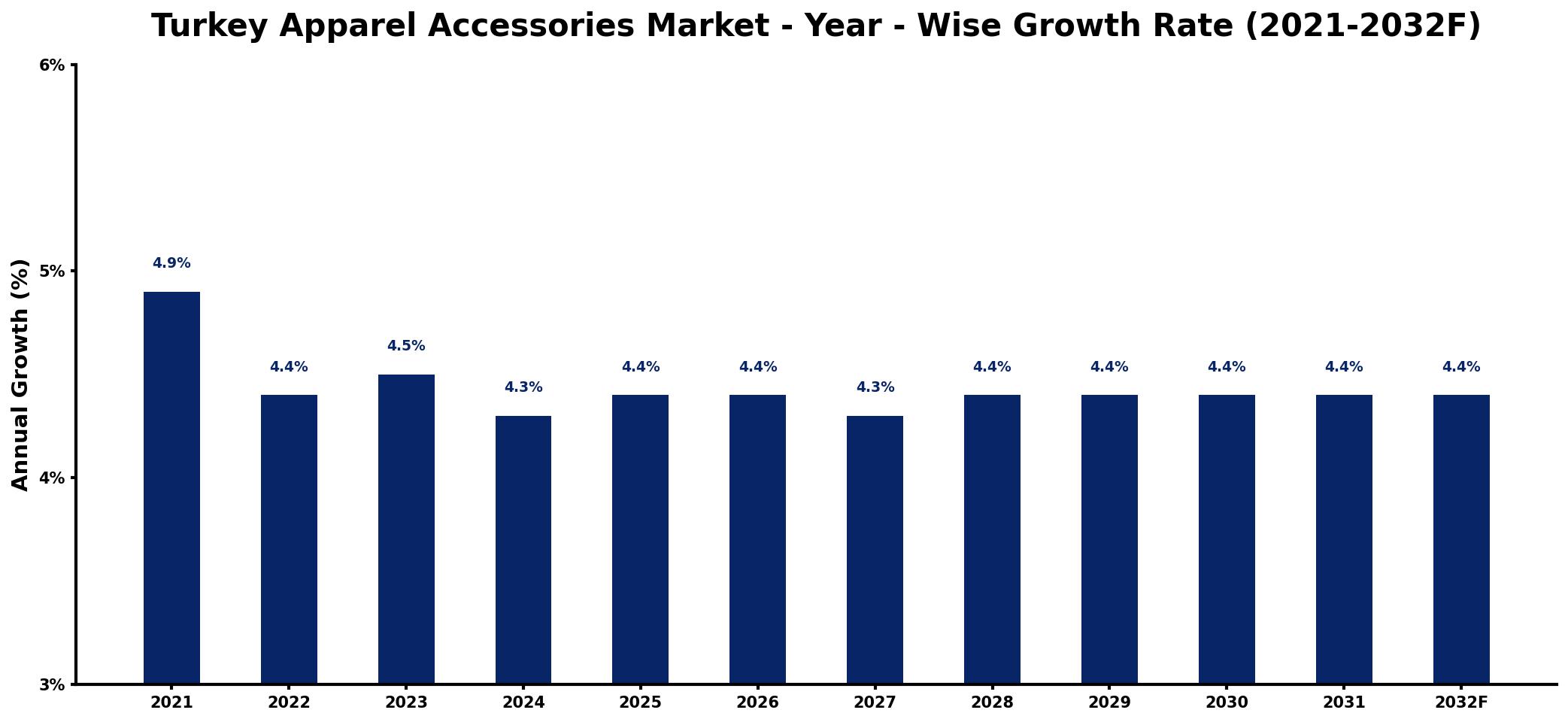
The table below presents the year‑wise growth rates along with the key drivers influencing the market
| Year | Growth Rate | Major Drivers |
| 2021 | 4.9% | Rising consumer spending power |
| 2022 | 4.4% | Innovations in sustainable materials |
| 2023 | 4.5% | Growth of online retail platforms |
| 2024 | 4.3% | Increased fashion industry collaborations |
| 2025 | 4.4% | Expansion of local manufacturing hubs |
| 2026 | 4.4% | Emergence of influencer marketing strategies |
| 2027 | 4.3% | Shifts towards personalized shopping experiences |
| 2028 | 4.4% | Growing demand for eco-friendly options |
| 2029 | 4.4% | Investments in digital marketing technologies |
| 2030 | 4.4% | Enhanced supply chain efficiencies |
| 2031 | 4.4% | Adoption of smart retail technologies |
| 2032 | 4.4% | Rising awareness of fashion trends |
Note: Market size estimations and growth projections presented in this report are based on 6Wresearch's proprietary forecasting methodology, utilizing the latest available industry data, government publications, and primary research inputs.
Turkey Apparel Accessories Market Synopsis
Recently, the Turkey apparel accessories market has witnessed vibrant momentum, as consumers gravitate towards both traditional and contemporary styles. However, as the market continues to evolve, the future is shaping up to be increasingly centered around customization, sustainability, and digital accessibility, particularly through online shopping.
The competitive landscape remains robust, with numerous domestic and international brands battling for market share. This competitive nature, paired with shifting consumer preferences, suggests that innovation and strategic partnerships will be essential for brands aiming to capture the attention of fashion-conscious consumers.
Turkey Apparel Accessories Market Key Takeaways
- The market is estimated to grow from USD 440 Million in 2025 to USD 570 Million by 2032.
- Personalization and eco-friendly materials are key drivers of consumer preferences.
- E-commerce platforms are increasingly vital for market reach and consumer engagement.
- Collaboration with influencers is enhancing brand visibility and consumer appeal.
- Government initiatives aim to bolster local manufacturing and promote fair competition.
Evaluation of Restraints in Turkey Apparel Accessories Market
The Turkey apparel accessories market faces certain restraints that could impede growth. Increasing competition from both local and international brands adds pressure on pricing and innovation. Moreover, the saturation of the market makes it challenging for new entrants to establish a foothold. As consumer preferences evolve rapidly, brands must remain agile, adapting to trends without compromising on quality or sustainability. Additionally, traditional retailers must enhance their digital strategies to remain relevant in the growing e-commerce environment, while economic uncertainties can also sway consumer spending habits.
Turkey Apparel Accessories Market Trends
The Turkey apparel accessories market is currently influenced by several emerging trends. The demand for sustainability is rising sharply; consumers increasingly prefer accessories made from eco-friendly materials and ethically sourced components. Personalization has become a significant trend, with many consumers seeking unique pieces that reflect their individual styles. Furthermore, the shift towards online shopping is altering how consumers interact with brands, prompting companies to improve their digital presence and offer seamless shopping experiences.
Turkey Apparel Accessories Market Opportunities
Investors looking at the Turkey apparel accessories market will find numerous opportunities for growth. The increasing adoption of online shopping presents a lucrative avenue for businesses to expand their reach. Investing in local designers and established Turkish brands that focus on unique and trendy accessories could yield substantial returns. Furthermore, leveraging Turkey's geographical position as a bridge between Europe and Asia opens doors for exporting high-quality accessories to neighboring regions, capitalizing on the rising demand for diverse fashion choices.
Government Initiatives in the Turkey Apparel Accessories Market
The Turkish government is actively promoting the apparel accessories market through various initiatives aimed at enhancing domestic production and increasing exports. Incentives such as tax breaks and subsidies encourage local manufacturers to innovate and compete on a global scale. Furthermore, regulations are in place to ensure compliance with labor standards and environmental protection, supporting ethical practices within the industry. Collaboration with stakeholders is also key in developing growth strategies, positioning Turkey favorably within the global apparel accessories market.
Future Insights of the Turkey Apparel Accessories Market
Looking ahead to 2026-2032, the Turkey apparel accessories market is poised for steady growth. With rising disposable incomes and increasing consumer awareness about personal grooming and style, demand for various accessories such as scarves, hats, and jewelry will likely surge. E-commerce's role will become more pronounced, offering consumers convenience and a broader selection of products. As the focus on sustainability continues to grow, brands that prioritize ethical fashion practices and eco-friendly production methods will resonate more with the modern consumer, setting the stage for future success.
Turkey Apparel Accessories Market Latest Developments (2025 - 2026)
In recent months, the Turkey apparel accessories market has seen a surge in collaboration between fashion brands and social media influencers, enhancing brand visibility and reaching new audiences. Innovations in product design have been noted, particularly around the themes of personalization and sustainability, with companies increasingly launching collections that cater to eco-conscious consumers. Additionally, the e-commerce sector is witnessing advancements in user experience, with brands optimizing their online platforms to attract a growing base of digital shoppers.
Turkey Apparel Accessories Market - Key Attractiveness of the Report
- 10 Years of Market Numbers
- Historical Data Starting from 2022 to 2025
- Base Year: 2025
- Forecast Data until 2032
- Key Performance Indicators Impacting the Market
- Major Upcoming Developments and Projects
Key Highlights of the Report:
- Turkey Apparel Accessories Market Outlook
- Market Size of Turkey Apparel Accessories Market, 2025
- Forecast of Turkey Apparel Accessories Market, 2032
- Historical Data and Forecast of Turkey Apparel Accessories Revenues & Volume for the Period 2022-2032F
- Turkey Apparel Accessories Market Trend Evolution
- Turkey Apparel Accessories Market Drivers and Challenges
- Turkey Apparel Accessories Price Trends
- Turkey Apparel Accessories Porter's Five Forces
- Turkey Apparel Accessories Industry Life Cycle
- Historical Data and Forecast of Turkey Apparel Accessories Market Revenues & Volume By Product for the Period 2022-2032F
- Historical Data and Forecast of Turkey Apparel Accessories Market Revenues & Volume By Belts for the Period 2022-2032F
- Historical Data and Forecast of Turkey Apparel Accessories Market Revenues & Volume By Handbags for the Period 2022-2032F
- Historical Data and Forecast of Turkey Apparel Accessories Market Revenues & Volume By Scarves for the Period 2022-2032F
- Historical Data and Forecast of Turkey Apparel Accessories Market Revenues & Volume By Eye wear for the Period 2022-2032F
- Historical Data and Forecast of Turkey Apparel Accessories Market Revenues & Volume By Jewelry for the Period 2022-2032F
- Historical Data and Forecast of Turkey Apparel Accessories Market Revenues & Volume By Neckties for the Period 2022-2032F
- Historical Data and Forecast of Turkey Apparel Accessories Market Revenues & Volume By Gloves for the Period 2022-2032F
- Historical Data and Forecast of Turkey Belts Apparel Accessories Market Revenues & Volume By Others for the Period 2022-2032F
- Historical Data and Forecast of Turkey Apparel Accessories Market Revenues & Volume By Demographic for the Period 2022-2032F
- Historical Data and Forecast of Turkey Apparel Accessories Market Revenues & Volume By Men for the Period 2022-2032F
- Historical Data and Forecast of Turkey Apparel Accessories Market Revenues & Volume By Women for the Period 2022-2032F
- Historical Data and Forecast of Turkey Apparel Accessories Market Revenues & Volume By Children for the Period 2022-2032F
- Historical Data and Forecast of Turkey Apparel Accessories Market Revenues & Volume By Price for the Period 2022-2032F
- Historical Data and Forecast of Turkey Apparel Accessories Market Revenues & Volume By Economical Apparel Accessories for the Period 2022-2032F
- Historical Data and Forecast of Turkey Apparel Accessories Market Revenues & Volume By Mid-range Apparel Accessories for the Period 2022-2032F
- Historical Data and Forecast of Turkey Apparel Accessories Market Revenues & Volume By Premium Apparel Accessories for the Period 2022-2032F
- Historical Data and Forecast of Turkey Apparel Accessories Market Revenues & Volume By Super-premium Apparel Accessories for the Period 2022-2032F
- Historical Data and Forecast of Turkey Apparel Accessories Market Revenues & Volume By Sales Channel for the Period 2022-2032F
- Historical Data and Forecast of Turkey Apparel Accessories Market Revenues & Volume By Apparel Accessories Sold through Modern Trade for the Period 2022-2032F
- Historical Data and Forecast of Turkey Apparel Accessories Market Revenues & Volume By Apparel Accessories Sold at Franchise Outlets for the Period 2022-2032F
- Historical Data and Forecast of Turkey Apparel Accessories Market Revenues & Volume By Apparel Accessories Sold at Specialty Stores for the Period 2022-2032F
- Historical Data and Forecast of Turkey Apparel Accessories Market Revenues & Volume By Others for the Period 2022-2032F
- Turkey Apparel Accessories Import Export Trade Statistics
- Market Opportunity Assessment By Product
- Market Opportunity Assessment By Demographic
- Market Opportunity Assessment By Price
- Market Opportunity Assessment By Sales Channel
- Turkey Apparel Accessories Top Companies Market Share
- Turkey Apparel Accessories Competitive Benchmarking By Technical and Operational Parameters
- Turkey Apparel Accessories Company Profiles
- Turkey Apparel Accessories Key Strategic Recommendations






































