Turkey Auto Parts And Accessories Market Size, Share & Growth Rate
The Turkey Auto Parts And Accessories Market was estimated at USD 356 Million in 2025 and is projected to reach USD 470 Million by 2032, growing at a CAGR of 4.0% from 2026 to 2032. This growth is driven by an increasing number of vehicles on the road, with consumer preferences shifting towards customization and performance-enhancing products. Additionally, the expanding aftermarket sector is fueling demand for high-quality parts and accessories that meet consumer expectations.
Turkey Auto Parts And Accessories Market Year-wise Growth Rate and Key Drivers
This graph highlights how the Turkey Auto Parts And Accessories Market has steadily grown over the years, supported by major growth factors.
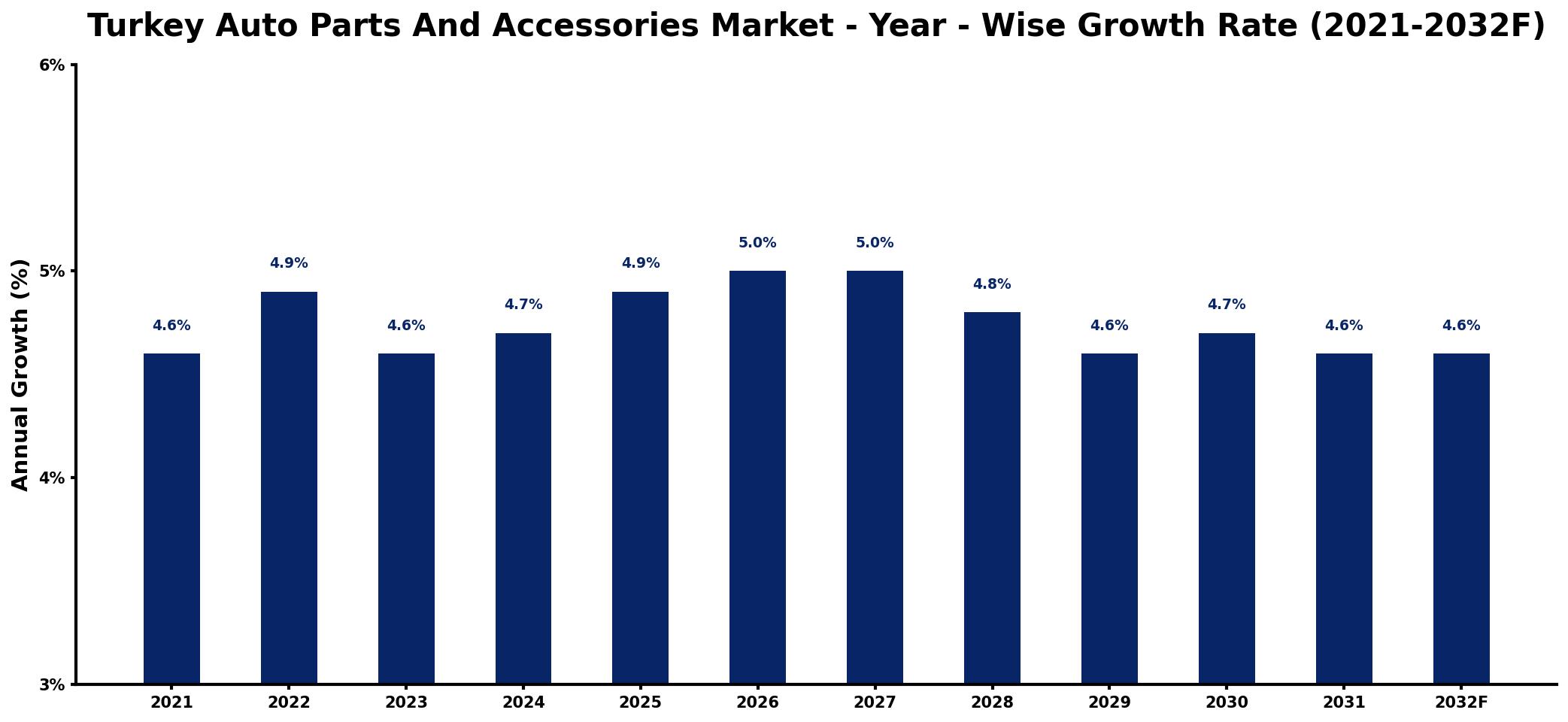
The table below presents the year‑wise growth rates along with the key drivers influencing the market
| Year | Growth Rate | Major Drivers |
| 2021 | 4.6% | Rising consumer vehicle ownership rates |
| 2022 | 4.9% | Increased urbanization and infrastructure development |
| 2023 | 4.6% | Growing demand for electric vehicles |
| 2024 | 4.7% | Expansion of local manufacturing capabilities |
| 2025 | 4.9% | Investment in renewable energy vehicles |
| 2026 | 5.0% | Adoption of advanced vehicle technology |
| 2027 | 5.0% | Strengthening of regional trade agreements |
| 2028 | 4.8% | Surge in vehicle leasing services |
| 2029 | 4.6% | Growth in e-commerce delivery services |
| 2030 | 4.7% | Increased focus on sustainability initiatives |
| 2031 | 4.6% | Development of smart city projects |
| 2032 | 4.6% | increased production capacity utilization |
Note: Market size estimations and growth projections presented in this report are based on 6Wresearch's proprietary forecasting methodology, utilizing the latest available industry data, government publications, and primary research inputs.
Turkey Auto Parts And Accessories Market Synopsis
In Turkey, the auto parts and accessories market is witnessing a notable increase in the demand for electric vehicle components as the government pushes for sustainability. This shift towards eco-friendly transportation is expected to reshape the market landscape, presenting a wealth of opportunities for innovative suppliers.
The market encompasses a diverse range of products including engine components, electrical parts, and both interior and exterior accessories. With rising consumer awareness regarding vehicle maintenance, there is also a heightened demand for premium-quality auto parts that ensure durability and performance.
Turkey Auto Parts And Accessories Market Key Takeaways
- The market is set for steady growth, driven by rising vehicle ownership and consumer demand for enhanced vehicle customization.
- Emerging trends in electric vehicle technology and connected car solutions are shaping product offerings.
- Intense competition exists among domestic and international players, impacting market dynamics and pricing.
- E-commerce is revolutionizing the distribution of auto parts, offering consumers greater access and convenience.
- Investment opportunities abound in manufacturing, especially in components related to eco-friendly vehicles.
Evaluation of Restraints in Turkey Auto Parts And Accessories Market
Despite the promising growth trajectory, the Turkey Auto Parts and Accessories Market faces several challenges. The competitive landscape is fiercely contested, with local and international players striving for market share. Additionally, fluctuating raw material prices pose risks to production costs, while economic volatility can hinder consumer spending on automotive products. Regulatory changes concerning environmental standards also require manufacturers to adapt, potentially increasing operational expenses.
Turkey Auto Parts And Accessories Market Trends
Several trends are reshaping the Turkey Auto Parts and Accessories Market. There is a significant shift towards electric vehicle components as consumers and manufacturers embrace sustainable practices. Furthermore, the integration of advanced safety features and connected car technologies is driving demand for specialized auto parts. Customization remains a key focus, with consumers increasingly seeking unique accessories to personalize their vehicles. The rise of e-commerce platforms further facilitates this trend, providing a seamless shopping experience.
Turkey Auto Parts And Accessories Market Opportunities
The market presents diverse investment opportunities, particularly in the manufacturing of essential components such as engines, brakes, and suspension systems. The increasing focus on electric vehicles opens avenues for suppliers of EV components and accessories. Collaborating with local automotive firms can enhance market access and efficiency for new entrants. With the automotive industry in Turkey poised for growth, investing in high-quality auto parts and accessories stands to be a lucrative venture.
Government Initiatives in the Turkey Auto Parts And Accessories Market
The Turkish government has rolled out several initiatives to bolster the auto parts and accessories market. These include financial incentives such as tax breaks and subsidies aimed at attracting foreign investment. Additionally, there is a strong emphasis on research and development, which is intended to elevate the competitiveness of local manufacturers. The government is also focused on establishing partnerships between domestic suppliers and global automotive brands to enhance export potential.
Future Insights of the Turkey Auto Parts And Accessories Market
Looking ahead to 2026-2032, the Turkey Auto Parts and Accessories Market is expected to thrive, buoyed by the countrys expanding automotive sector and increased per capita income. The shift towards electric and hybrid vehicles will continue to create new demand for specialized components. However, companies must remain agile to navigate challenges, including increasing competition and fluctuations in raw material costs. Innovative strategies and collaborations will be crucial for capitalizing on emerging trends.
Turkey Auto Parts And Accessories Market Latest Developments (2025 - 2026)
Recent developments in the Turkey Auto Parts and Accessories Market indicate a growing emphasis on innovation and sustainability. Companies are increasingly focusing on developing high-quality, eco-friendly products to cater to the rising consumer demand for electric vehicle components. Moreover, partnerships between local manufacturers and international firms are on the rise, aiming to enhance technological capabilities and expand market reach.
Turkey Auto Parts And Accessories Market - Key Attractiveness of the Report
- 10 Years of Market Numbers
- Historical Data Starting from 2022 to 2025
- Base Year: 2025
- Forecast Data until 2032
- Key Performance Indicators Impacting the Market
- Major Upcoming Developments and Projects
Key Highlights of the Report:
- Turkey Auto Parts And Accessories Market Outlook
- Market Size of Turkey Auto Parts And Accessories Market, 2025
- Forecast of Turkey Auto Parts And Accessories Market, 2032
- Historical Data and Forecast of Turkey Auto Parts And Accessories Revenues & Volume for the Period 2022-2032F
- Turkey Auto Parts And Accessories Market Trend Evolution
- Turkey Auto Parts And Accessories Market Drivers and Challenges
- Turkey Auto Parts And Accessories Price Trends
- Turkey Auto Parts And Accessories Porter's Five Forces
- Turkey Auto Parts And Accessories Industry Life Cycle
- Historical Data and Forecast of Turkey Auto Parts And Accessories Market Revenues & Volume By Product for the Period 2022-2032F
- Historical Data and Forecast of Turkey Auto Parts And Accessories Market Revenues & Volume By Driveline & Powertrain for the Period 2022-2032F
- Historical Data and Forecast of Turkey Auto Parts And Accessories Market Revenues & Volume By Interiors & Exteriors for the Period 2022-2032F
- Historical Data and Forecast of Turkey Auto Parts And Accessories Market Revenues & Volume By Electronics for the Period 2022-2032F
- Historical Data and Forecast of Turkey Auto Parts And Accessories Market Revenues & Volume By Bodies & Chassis for the Period 2022-2032F
- Historical Data and Forecast of Turkey Auto Parts And Accessories Market Revenues & Volume By Wheel & Tires for the Period 2022-2032F
- Historical Data and Forecast of Turkey Auto Parts And Accessories Market Revenues & Volume By Others for the Period 2022-2032F
- Historical Data and Forecast of Turkey Auto Parts And Accessories Market Revenues & Volume By Application for the Period 2022-2032F
- Historical Data and Forecast of Turkey Auto Parts And Accessories Market Revenues & Volume By OEMs for the Period 2022-2032F
- Historical Data and Forecast of Turkey Auto Parts And Accessories Market Revenues & Volume By Aftermarket for the Period 2022-2032F
- Turkey Auto Parts And Accessories Import Export Trade Statistics
- Market Opportunity Assessment By Product
- Market Opportunity Assessment By Application
- Turkey Auto Parts And Accessories Top Companies Market Share
- Turkey Auto Parts And Accessories Competitive Benchmarking By Technical and Operational Parameters
- Turkey Auto Parts And Accessories Company Profiles
- Turkey Auto Parts And Accessories Key Strategic Recommendations






































