Automotive Brake Pads Market: Turkiye vs Top 5 Major Economies in 2027 (Europe)
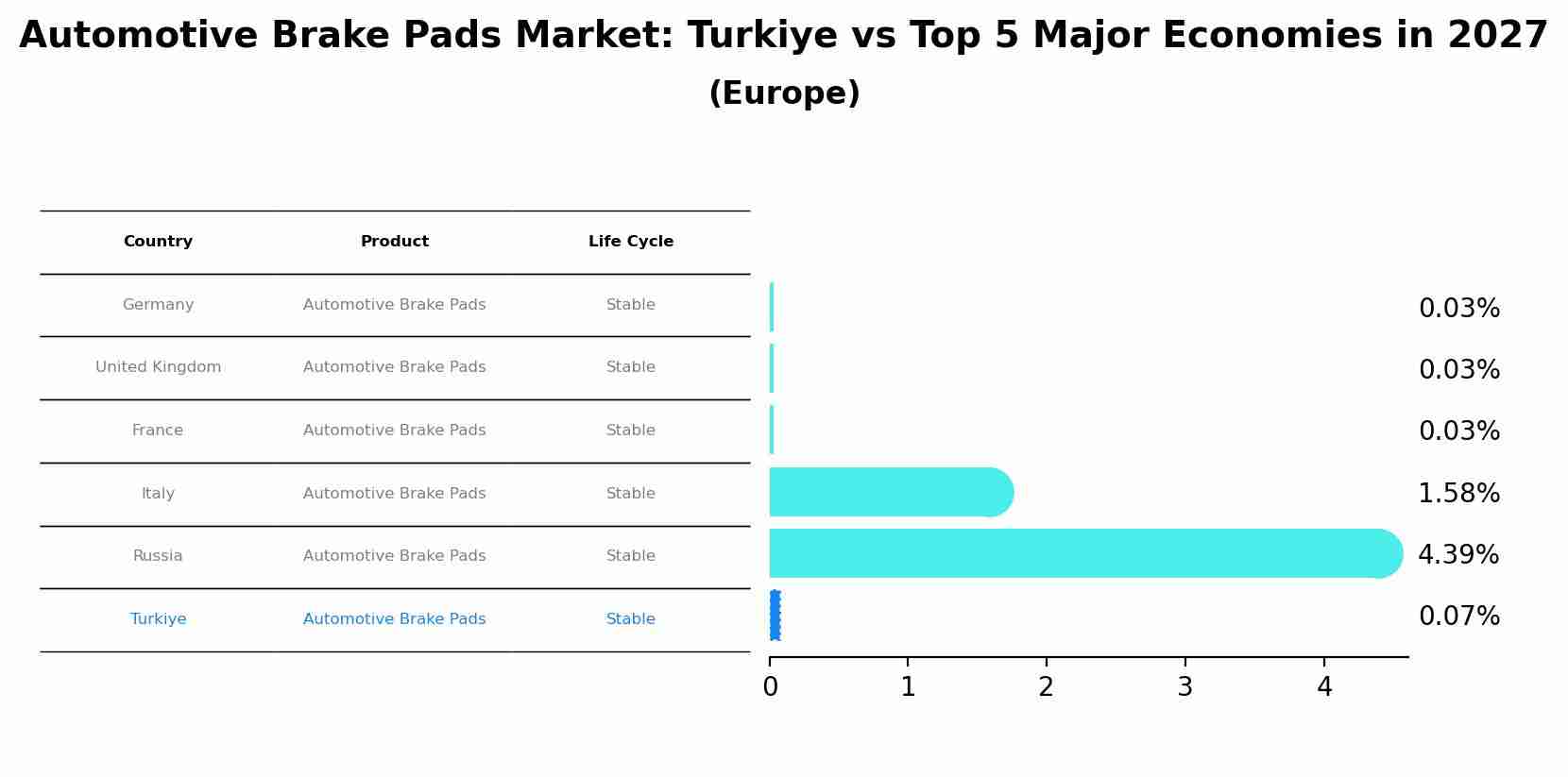
By 2027, Turkiye's Automotive Brake Pads market is forecasted to achieve a stable growth rate of 0.07%, with Germany leading the Europe region, followed by United Kingdom, France, Italy and Russia.
Turkey Automotive Brake Pads Market Overview
The Turkey Automotive Brake Pads Market is experiencing steady growth due to factors such as increasing vehicle production, rising demand for passenger and commercial vehicles, and strict regulations on vehicle safety standards. The market is highly competitive, with key players focusing on product innovation, quality, and pricing strategies to gain a competitive edge. Additionally, the shift towards electric vehicles and the growing focus on sustainability are driving the demand for eco-friendly brake pads in the market. The aftermarket segment is also witnessing growth, driven by the increasing vehicle fleet and the need for regular maintenance and replacement of brake pads. Overall, the Turkey Automotive Brake Pads Market is poised for further expansion, driven by technological advancements and changing consumer preferences.
Turkey Automotive Brake Pads Market Trends
The Turkey Automotive Brake Pads Market is experiencing a shift towards environmentally-friendly materials and advanced technologies. There is a growing demand for brake pads made from ceramic and low-metallic compounds due to their superior performance, reduced noise levels, and longer lifespan compared to traditional semi-metallic options. Additionally, the market is witnessing an increased focus on safety features such as anti-lock braking systems (ABS) and electronic brake-force distribution (EBD), driving the adoption of high-quality brake pads that ensure optimal braking performance in various driving conditions. Market players are also investing in research and development to introduce innovative brake pad designs that enhance overall vehicle efficiency and reduce carbon emissions, aligning with the industry`s sustainability goals.
Turkey Automotive Brake Pads Market Challenges
The Turkey Automotive Brake Pads Market faces several challenges, including intense competition among market players leading to price wars and margin pressures. Additionally, fluctuating raw material prices, particularly for metals and ceramics used in brake pad production, can impact the overall cost structure for manufacturers. Another challenge is the increasing demand for electric vehicles, which require different braking systems, forcing traditional brake pad manufacturers to adapt and innovate. Moreover, the market also grapples with the issue of counterfeit products, which not only affects the revenue of legitimate players but also poses safety risks for consumers. Overall, navigating these challenges requires companies to invest in research and development, maintain strong supplier relationships, and stay abreast of technological advancements in the automotive industry.
Turkey Automotive Brake Pads Market Investment Opportunities
The Turkey Automotive Brake Pads Market offers promising investment opportunities due to the increasing demand for brake pads driven by a growing automotive industry in the country. With a rising number of vehicles on the road, there is a continuous need for high-quality brake pads to ensure safety and performance. Investors can explore opportunities in manufacturing and supplying brake pads to both OEMs and aftermarket retailers. Additionally, the shift towards electric vehicles presents a new market segment for specialized brake pads that cater to the unique requirements of these vehicles. Investing in research and development for innovative brake pad materials and technologies could also provide a competitive edge in the market. Overall, the Turkey Automotive Brake Pads Market is poised for growth, making it an attractive sector for investment.
Turkey Automotive Brake Pads Market Government Policy
The Turkish government has implemented various policies to regulate the automotive brake pads market in the country. These policies primarily focus on ensuring the safety and quality of brake pads, as well as promoting environmental sustainability. The government has set standards and regulations for brake pad manufacturing and testing to ensure that products meet safety requirements and performance standards. Additionally, there are policies in place to encourage the use of environmentally friendly materials in brake pad production to reduce pollution and promote sustainability in the automotive industry. Overall, the government`s regulations aim to protect consumers, promote innovation in the market, and contribute to a safer and more sustainable automotive sector in Turkey.
Turkey Automotive Brake Pads Market Future Outlook
The Turkey Automotive Brake Pads Market is poised for steady growth in the coming years, driven by increasing vehicle sales, a growing aftermarket segment, and rising awareness about road safety. With the implementation of stringent regulations on vehicle safety standards, there is a growing demand for high-quality brake pads that offer improved performance and durability. Additionally, advancements in technology, such as the development of ceramic and semi-metallic brake pads, are expected to further fuel market growth. As consumers prioritize safety and performance in their vehicles, the demand for premium brake pads is likely to increase, presenting opportunities for manufacturers to innovate and expand their product offerings in the Turkey Automotive Brake Pads Market.
Key Highlights of the Report:
- Turkey Automotive Brake Pads Market Outlook
- Market Size of Turkey Automotive Brake Pads Market, 2021
- Forecast of Turkey Automotive Brake Pads Market, 2031
- Historical Data and Forecast of Turkey Automotive Brake Pads Revenues & Volume for the Period 2018 - 2031
- Turkey Automotive Brake Pads Market Trend Evolution
- Turkey Automotive Brake Pads Market Drivers and Challenges
- Turkey Automotive Brake Pads Price Trends
- Turkey Automotive Brake Pads Porter's Five Forces
- Turkey Automotive Brake Pads Industry Life Cycle
- Historical Data and Forecast of Turkey Automotive Brake Pads Market Revenues & Volume By Vehicle for the Period 2018 - 2031
- Historical Data and Forecast of Turkey Automotive Brake Pads Market Revenues & Volume By Passenger Car for the Period 2018 - 2031
- Historical Data and Forecast of Turkey Automotive Brake Pads Market Revenues & Volume By LCV for the Period 2018 - 2031
- Historical Data and Forecast of Turkey Automotive Brake Pads Market Revenues & Volume By HCV for the Period 2018 - 2031
- Historical Data and Forecast of Turkey Automotive Brake Pads Market Revenues & Volume By Two-wheelers for the Period 2018 - 2031
- Historical Data and Forecast of Turkey Automotive Brake Pads Market Revenues & Volume By Material for the Period 2018 - 2031
- Historical Data and Forecast of Turkey Automotive Brake Pads Market Revenues & Volume By Semi-metallic for the Period 2018 - 2031
- Historical Data and Forecast of Turkey Automotive Brake Pads Market Revenues & Volume By Non-asbestos Organic (NAO) for the Period 2018 - 2031
- Historical Data and Forecast of Turkey Automotive Brake Pads Market Revenues & Volume By Low-metallic NAO for the Period 2018 - 2031
- Historical Data and Forecast of Turkey Automotive Brake Pads Market Revenues & Volume By Ceramic for the Period 2018 - 2031
- Historical Data and Forecast of Turkey Automotive Brake Pads Market Revenues & Volume By Sales Outlet for the Period 2018 - 2031
- Historical Data and Forecast of Turkey Automotive Brake Pads Market Revenues & Volume By OEM for the Period 2018 - 2031
- Historical Data and Forecast of Turkey Automotive Brake Pads Market Revenues & Volume By Aftermarket for the Period 2018 - 2031
- Historical Data and Forecast of Turkey Automotive Brake Pads Market Revenues & Volume By Position for the Period 2018 - 2031
- Historical Data and Forecast of Turkey Automotive Brake Pads Market Revenues & Volume By Front for the Period 2018 - 2031
- Historical Data and Forecast of Turkey Automotive Brake Pads Market Revenues & Volume By Front & Rear for the Period 2018 - 2031
- Turkey Automotive Brake Pads Import Export Trade Statistics
- Market Opportunity Assessment By Vehicle
- Market Opportunity Assessment By Material
- Market Opportunity Assessment By Sales Outlet
- Market Opportunity Assessment By Position
- Turkey Automotive Brake Pads Top Companies Market Share
- Turkey Automotive Brake Pads Competitive Benchmarking By Technical and Operational Parameters
- Turkey Automotive Brake Pads Company Profiles
- Turkey Automotive Brake Pads Key Strategic Recommendations






































