Turkey Automotive Seat Belts Market Size, Share & Growth Rate
The Turkey Automotive Seat Belts Market was estimated at USD 221 Million in 2025 and is projected to reach USD 300 Million by 2032, growing at a CAGR of 4.5% from 2026 to 2032. This growth trajectory is being driven by increasing government regulations focused on enhancing passenger safety and a significant rise in vehicle sales across the country. The burgeoning awareness among consumers about the role of seat belts in injury prevention also plays a critical role in sustaining this market expansion.
Turkey Automotive Seat Belts Market Year-wise Growth Rate and Key Drivers
This graph highlights how the Turkey Automotive Seat Belts Market has steadily grown over the years, supported by major growth factors.
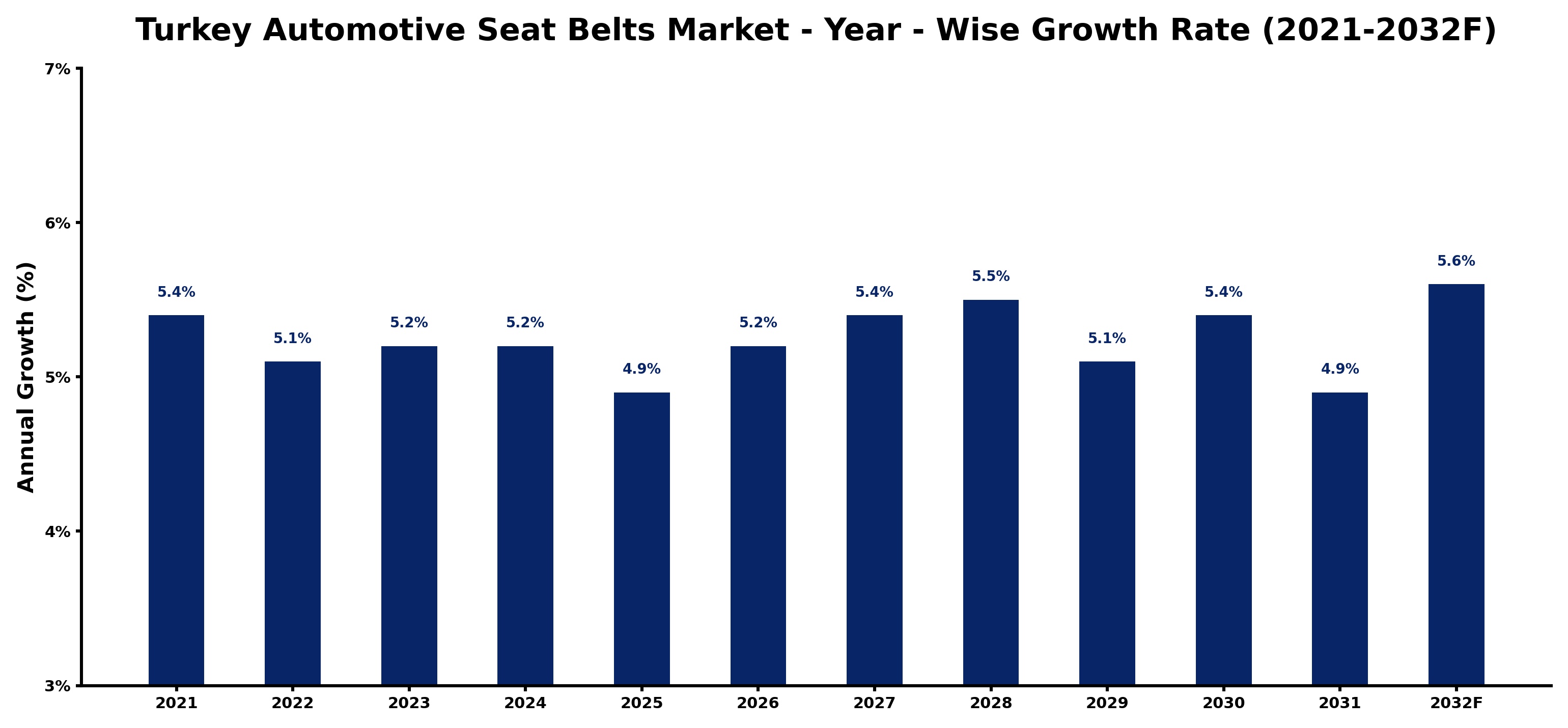
The table below presents the year‑wise growth rates along with the key drivers influencing the market
| Year | Growth Rate | Major Drivers |
| 2021 | 5.4% | Increased vehicle production rates |
| 2022 | 5.1% | Rising consumer safety awareness |
| 2023 | 5.2% | Technological advancements in manufacturing |
| 2024 | 5.2% | Government regulations enhanced standards |
| 2025 | 4.9% | Electric vehicle market expansion |
| 2026 | 5.2% | Growing automotive aftermarket services |
| 2027 | 5.4% | Enhanced seat belt designs launched |
| 2028 | 5.5% | Sustainability trends influenced materials |
| 2029 | 5.1% | Rising demand for luxury vehicles |
| 2030 | 5.4% | Integration of smart technologies |
| 2031 | 4.9% | Increased collaboration with OEMs |
| 2032 | 5.6% | Focus on autonomous vehicle safety |
Note - Market size estimations and growth projections presented in this report are based on 6Wresearch’s advanced forecasting approach, validated with industry datasets as of June 2026.
Turkey Automotive Seat Belts Market Synopsis
The primary force shaping the Turkey Automotive Seat Belts Market is the heightened focus on road safety regulations. Government mandates regarding seat belt usage for all passengers, combined with strict enforcement measures, are compelling manufacturers to innovate and meet these standards.
In parallel, there is a growing consumer demand for advanced safety features in vehicles, including smarter seat belt technologies. This includes innovations such as seat belts equipped with sensors and pretensioners, underscoring a shift towards more sophisticated safety mechanisms within the automotive industry.
Turkey Automotive Seat Belts Market Key Takeaways
- Increasing government regulations emphasize passenger safety and seat belt compliance.
- Technological advancements are leading to the development of smart seat belts with enhanced features.
- Consumer awareness regarding the significance of seat belts is on the rise, driving demand.
- Investment opportunities abound in innovative seat belt technologies and sustainable materials.
- The competitive landscape is intensifying, with manufacturers striving to differentiate their offerings.
Evaluation of Restraints in Turkey Automotive Seat Belts Market
Despite its growth potential, the Turkey Automotive Seat Belts Market faces several real constraints. Intensifying competition among manufacturers often leads to price wars, squeezing profit margins. Additionally, stringent safety regulations necessitate continuous innovation and compliance, placing a strain on resources. Fluctuating raw material prices can also impact production costs, further complicating the operational landscape. Furthermore, there exists a segment of the population that remains unaware of the life-saving benefits of seat belts, hindering broader adoption and consumer commitment.
Turkey Automotive Seat Belts Market Trends
Emerging trends in the Turkey Automotive Seat Belts Market highlight a pronounced focus on safety technologies. The integration of features like load limiters and seat belt reminders are becoming commonplace, as both consumers and manufacturers prioritize safety. Additionally, there is a rising interest in creating seat belt designs that improve comfort while maintaining safety standards. Sustainability is also influencing design and production, with manufacturers exploring eco-friendly materials to align with broader environmental initiatives.
Turkey Automotive Seat Belts Market Opportunities
The Turkey Automotive Seat Belts Market offers several promising investment opportunities. The increasing demand for safety features presents a lucrative avenue for companies focusing on innovative technologies such as adaptive restraint systems. Collaborations with automotive manufacturers can enhance market reach, allowing for expanded sales and market presence. Moreover, the market's shift towards sustainable practices could open additional channels for growth, as environmentally conscious consumers actively seek products that minimize ecological footprints.
Government Initiatives in the Turkey Automotive Seat Belts Market
Government policies in Turkey focus on ensuring stringent passenger safety standards through the mandatory use of seat belts. These regulations not only enforce compliance but also advocate for the implementation of advanced safety features to enhance occupant protection. The Turkish government actively supports initiatives that align with international safety benchmarks, which further facilitates progress within the automotive sector.
Future Insights of the Turkey Automotive Seat Belts Market
Looking ahead to the period between 2026 and 2032, the Turkey Automotive Seat Belts Market is expected to flourish, driven by both regulatory changes and consumer advocacy for safety. The rise in vehicle sales, coupled with increased public awareness regarding road safety, is projected to intensify demand for high-quality seat belts. Innovations, particularly in smart seat belt technology, will likely further propel market growth, reinforcing the ongoing transformation within the automotive safety landscape.
Turkey Automotive Seat Belts Market Latest Developments (May 2025 - June 2026)
Recent developments within the Turkey Automotive Seat Belts Market indicate a trend toward greater integration of technology in safety mechanisms. The automotive sector is beginning to emphasize real-time monitoring systems within seat belts, enhancing both comfort and safety. Additionally, manufacturers are increasingly adopting sustainable production practices, aligning with global demands for eco-friendly automotive solutions.
Turkey Automotive Seat Belts Market - Key Attractiveness of the Report
- 10 Years of Market Numbers
- Historical Data Starting from 2022 to 2025
- Base Year: 2025
- Forecast Data until 2032
- Key Performance Indicators Impacting the Market
- Major Upcoming Developments and Projects
Key Highlights of the Report:
- Turkey Automotive Seat Belts Market Outlook
- Market Size of Turkey Automotive Seat Belts Market, 2025
- Forecast of Turkey Automotive Seat Belts Market, 2032
- Historical Data and Forecast of Turkey Automotive Seat Belts Revenues & Volume for the Period 2022-2032F
- Turkey Automotive Seat Belts Market Trend Evolution
- Turkey Automotive Seat Belts Market Drivers and Challenges
- Turkey Automotive Seat Belts Price Trends
- Turkey Automotive Seat Belts Porter's Five Forces
- Turkey Automotive Seat Belts Industry Life Cycle
- Historical Data and Forecast of Turkey Automotive Seat Belts Market Revenues & Volume By Type for the Period 2022-2032F
- Historical Data and Forecast of Turkey Automotive Seat Belts Market Revenues & Volume By 2-point Seatbelt for the Period 2022-2032F
- Historical Data and Forecast of Turkey Automotive Seat Belts Market Revenues & Volume By 3-point Seatbelt for the Period 2022-2032F
- Historical Data and Forecast of Turkey Automotive Seat Belts Market Revenues & Volume By Vehicle for the Period 2022-2032F
- Historical Data and Forecast of Turkey Automotive Seat Belts Market Revenues & Volume By Passenger Cars for the Period 2022-2032F
- Historical Data and Forecast of Turkey Automotive Seat Belts Market Revenues & Volume By Light Commercial Vehicles for the Period 2022-2032F
- Historical Data and Forecast of Turkey Automotive Seat Belts Market Revenues & Volume By Heavy Commercial Vehicles for the Period 2022-2032F
- Historical Data and Forecast of Turkey Automotive Seat Belts Market Revenues & Volume By Component for the Period 2022-2032F
- Historical Data and Forecast of Turkey Automotive Seat Belts Market Revenues & Volume By Webbing strap for the Period 2022-2032F
- Historical Data and Forecast of Turkey Automotive Seat Belts Market Revenues & Volume By Retractor for the Period 2022-2032F
- Historical Data and Forecast of Turkey Automotive Seat Belts Market Revenues & Volume By Buckle for the Period 2022-2032F
- Historical Data and Forecast of Turkey Automotive Seat Belts Market Revenues & Volume By Tongue for the Period 2022-2032F
- Historical Data and Forecast of Turkey Automotive Seat Belts Market Revenues & Volume By Pillar Loop for the Period 2022-2032F
- Historical Data and Forecast of Turkey Automotive Seat Belts Market Revenues & Volume By Distribution Channels for the Period 2022-2032F
- Historical Data and Forecast of Turkey Automotive Seat Belts Market Revenues & Volume By OEM for the Period 2022-2032F
- Historical Data and Forecast of Turkey Automotive Seat Belts Market Revenues & Volume By Aftermarket for the Period 2022-2032F
- Turkey Automotive Seat Belts Import Export Trade Statistics
- Market Opportunity Assessment By Type
- Market Opportunity Assessment By Vehicle
- Market Opportunity Assessment By Component
- Market Opportunity Assessment By Distribution Channels
- Turkey Automotive Seat Belts Top Companies Market Share
- Turkey Automotive Seat Belts Competitive Benchmarking By Technical and Operational Parameters
- Turkey Automotive Seat Belts Company Profiles
- Turkey Automotive Seat Belts Key Strategic Recommendations






































