Battery Materials Market: Turkiye vs Top 5 Major Economies in 2027 (Europe)
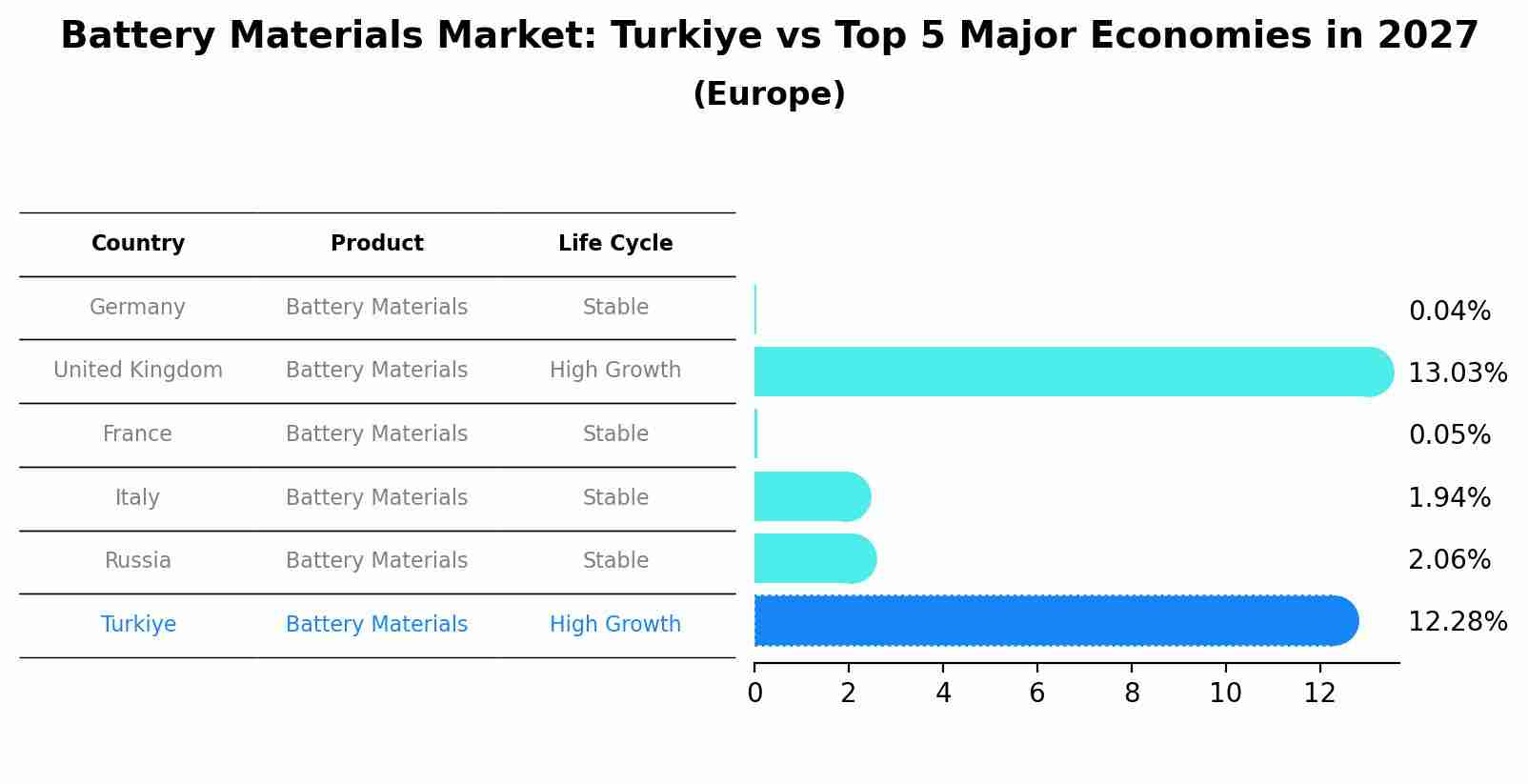
The Battery Materials market in Turkiye is projected to grow at a high growth rate of 12.28% by 2027, highlighting the country's increasing focus on advanced technologies within the Europe region, where Germany holds the dominant position, followed closely by United Kingdom, France, Italy and Russia, shaping overall regional demand.
Turkey Battery Materials Market Overview
The Turkey Battery Materials Market is witnessing steady growth driven by the rising demand for electric vehicles and energy storage solutions. Key materials in the market include lithium-ion battery components such as lithium, cobalt, nickel, and graphite. The increasing focus on sustainable energy sources and government initiatives promoting the adoption of electric vehicles are driving the demand for battery materials in Turkey. The market is characterized by the presence of both domestic and international players, with a growing emphasis on research and development to enhance the performance and efficiency of battery materials. However, challenges such as raw material procurement and environmental concerns regarding battery production processes are factors that need to be addressed for sustainable growth in the Turkey Battery Materials Market.
Turkey Battery Materials Market Trends
The Turkey battery materials market is experiencing a shift towards more sustainable and efficient solutions, driven by the increasing demand for electric vehicles and renewable energy storage systems. Key trends in the market include a growing focus on lithium-ion batteries due to their high energy density and longer lifespan, as well as the development of advanced materials such as silicon anodes and solid-state electrolytes to improve battery performance. Additionally, there is a rising emphasis on recycling and circular economy practices to reduce the environmental impact of battery production and disposal. Overall, the Turkey battery materials market is moving towards innovation, sustainability, and cost-efficiency to meet the evolving needs of the energy storage industry.
Turkey Battery Materials Market Challenges
In the Turkey Battery Materials Market, some key challenges include rising raw material costs, increasing competition from global suppliers, and the need to comply with stringent environmental regulations. The fluctuating prices of raw materials like lithium, cobalt, and nickel can impact the overall production costs for battery manufacturers in Turkey. Additionally, the market faces competition from international players who may offer lower prices or more advanced technology. Ensuring compliance with environmental standards and regulations presents another hurdle, as the industry strives to reduce its carbon footprint and minimize waste generation. Overall, navigating these challenges requires strategic planning, innovation, and a strong focus on sustainability within the Turkey Battery Materials Market.
Turkey Battery Materials Market Investment Opportunities
The Turkey Battery Materials Market presents promising investment opportunities in the production and supply chain of key materials used in battery manufacturing, such as lithium, cobalt, nickel, and graphite. As the global shift towards electric vehicles and renewable energy sources accelerates, the demand for these materials is expected to soar. Investing in Turkish companies involved in the extraction, processing, or trading of battery materials could yield significant returns. Additionally, supporting research and development initiatives focused on improving battery technology and sustainability practices in Turkey could position investors at the forefront of innovation in the industry. Partnering with local manufacturers to establish a strong presence in the market and leverage Turkey`s strategic geographical location for trade with European and Middle Eastern markets could also be a lucrative investment strategy.
Turkey Battery Materials Market Government Policy
Government policies related to the Turkey Battery Materials Market focus on promoting local production, research, and development in the battery sector to reduce dependence on imports and enhance energy security. The government has implemented incentives and subsidies to support domestic battery material manufacturers, including tax breaks, grants for R&D projects, and financial support for establishing production facilities. Additionally, there are regulations in place to ensure environmental sustainability and compliance with international standards in battery material production. The government aims to create a favorable business environment for the growth of the battery materials market in Turkey by fostering innovation, increasing competitiveness, and attracting investments in the sector.
Turkey Battery Materials Market Future Outlook
The future outlook for the Turkey Battery Materials Market appears promising, driven by the increasing demand for electric vehicles (EVs) and renewable energy storage solutions. As the country aims to reduce its dependence on fossil fuels and transition towards a more sustainable energy ecosystem, the demand for lithium-ion batteries and other battery materials is expected to rise significantly. This growth is further supported by government initiatives and investments in EV infrastructure and clean energy projects. Additionally, advancements in technology and the push towards energy efficiency are likely to fuel innovation and development in battery materials, creating opportunities for market players in Turkey. Overall, the Turkey Battery Materials Market is poised for expansion in the coming years, presenting lucrative prospects for industry participants.
Key Highlights of the Report:
- Turkey Battery Materials Market Outlook
- Market Size of Turkey Battery Materials Market, 2021
- Forecast of Turkey Battery Materials Market, 2031
- Historical Data and Forecast of Turkey Battery Materials Revenues & Volume for the Period 2018 - 2031
- Turkey Battery Materials Market Trend Evolution
- Turkey Battery Materials Market Drivers and Challenges
- Turkey Battery Materials Price Trends
- Turkey Battery Materials Porter's Five Forces
- Turkey Battery Materials Industry Life Cycle
- Historical Data and Forecast of Turkey Battery Materials Market Revenues & Volume By Battery Type for the Period 2018 - 2031
- Historical Data and Forecast of Turkey Battery Materials Market Revenues & Volume By Lithium-Ion for the Period 2018 - 2031
- Historical Data and Forecast of Turkey Battery Materials Market Revenues & Volume By Lead Acid for the Period 2018 - 2031
- Historical Data and Forecast of Turkey Battery Materials Market Revenues & Volume By Others for the Period 2018 - 2031
- Historical Data and Forecast of Turkey Battery Materials Market Revenues & Volume By Material for the Period 2018 - 2031
- Historical Data and Forecast of Turkey Battery Materials Market Revenues & Volume By Lithium-Ion for the Period 2018 - 2031
- Historical Data and Forecast of Turkey Battery Materials Market Revenues & Volume By Lead Acid for the Period 2018 - 2031
- Turkey Battery Materials Import Export Trade Statistics
- Market Opportunity Assessment By Battery Type
- Market Opportunity Assessment By Material
- Turkey Battery Materials Top Companies Market Share
- Turkey Battery Materials Competitive Benchmarking By Technical and Operational Parameters
- Turkey Battery Materials Company Profiles
- Turkey Battery Materials Key Strategic Recommendations






































