Turkey Bcg Vaccine Market Size, Share & Growth Rate
The Turkey Bcg Vaccine Market was estimated at USD 290 Million in 2025 and is projected to reach USD 381 Million by 2032, growing at a CAGR of 4.0% from 2026 to 2032. This growth is primarily fueled by the increased governmental focus on tuberculosis prevention, as well as robust public health initiatives aimed at expanding vaccination coverage among vulnerable populations. Furthermore, rising healthcare expenditures and an overall enhancement of healthcare infrastructure are expected to sustain this upward trend.
Turkey Bcg Vaccine Market Year-wise Growth Rate and Key Drivers
This graph highlights how the Turkey Bcg Vaccine Market has steadily grown over the years, supported by major growth factors.
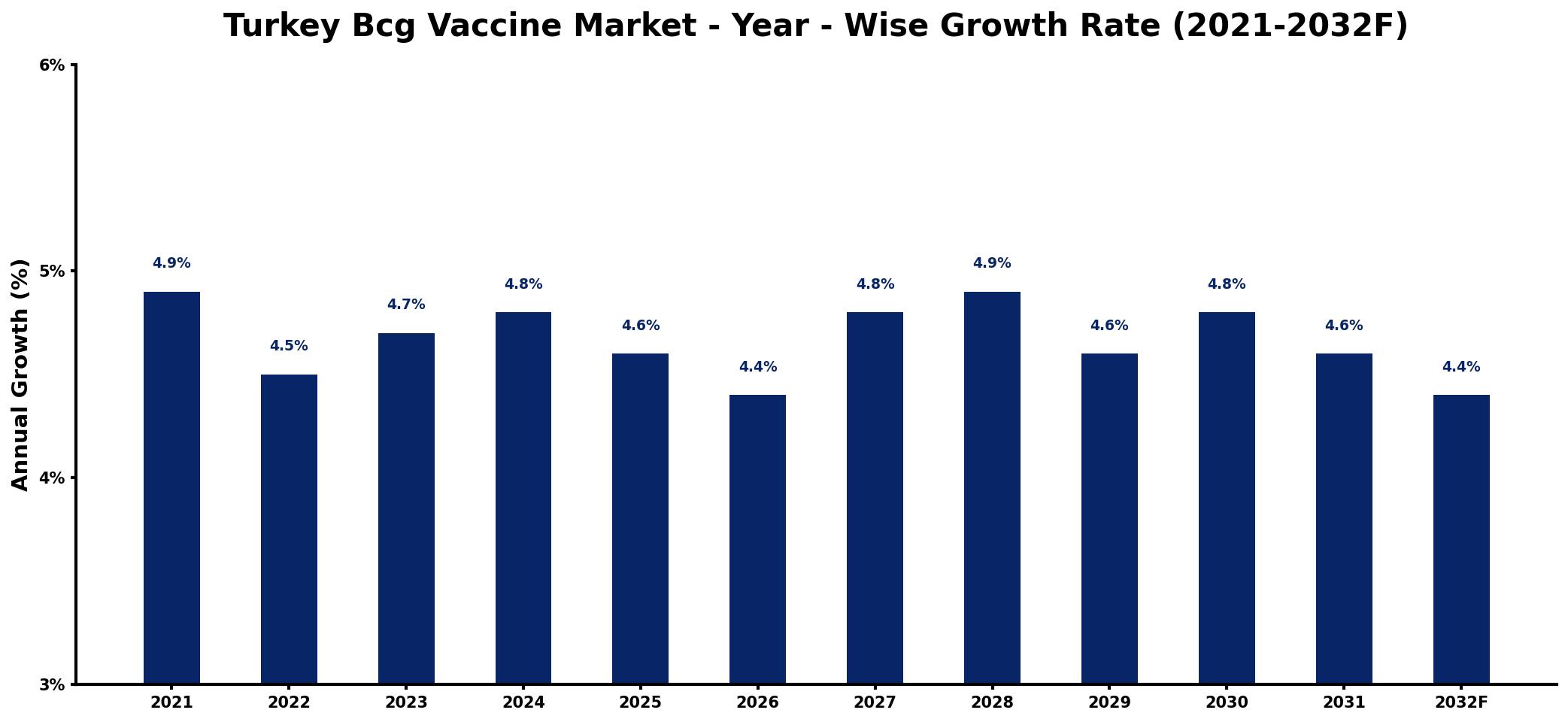
The table below presents the year‑wise growth rates along with the key drivers influencing the market
| Year | Growth Rate | Major Drivers |
| 2021 | 4.9% | Rising healthcare expenditure trends |
| 2022 | 4.5% | Increased public health awareness |
| 2023 | 4.7% | Growing immunization program initiatives |
| 2024 | 4.8% | Expansion of healthcare infrastructure |
| 2025 | 4.6% | Strengthening disease prevention policies |
| 2026 | 4.4% | Surge in international collaborations |
| 2027 | 4.8% | Innovations in healthcare technologies |
| 2028 | 4.9% | Increased funding for research |
| 2029 | 4.6% | Higher demand for preventative care |
| 2030 | 4.8% | Advancements in distribution networks |
| 2031 | 4.6% | Growing support from NGOs |
| 2032 | 4.4% | growing emerging market penetration |
Note: Market size estimations and growth projections presented in this report are based on 6Wresearch's proprietary forecasting methodology, utilizing the latest available industry data, government publications, and primary research inputs.
Turkey Bcg Vaccine Market Synopsis
In Turkey, the BCG vaccine plays a crucial role in the national immunization program, ensuring that newborns are protected against tuberculosis from birth. Recent efforts have heightened awareness of the importance of vaccinations, leading to greater acceptance and uptake among parents and healthcare professionals alike.
The market is evolving with several established pharmaceutical firms engaged in the development and distribution of BCG vaccines. Government initiatives are increasingly focused on combating tuberculosis, particularly in high-risk demographics, which has further stimulated the demand for BCG vaccination across the nation.
Turkey Bcg Vaccine Market Key Takeaways
- The market is positioned for steady growth, driven by proactive government policies focused on tuberculosis prevention.
- Awareness campaigns and national immunization strategies are key to increasing vaccination rates among newborns and high-risk groups.
- Investment in healthcare infrastructure is enhancing access to vaccinations, particularly in rural areas.
- Technological advancements in vaccine formulation are improving safety and efficacy, positively influencing market demand.
- The market remains competitive, with both local and international players contributing to product diversity.
Evaluation of Restraints in Turkey Bcg Vaccine Market
Despite the positive outlook, the Turkey BCG vaccine market faces several challenges that could impede growth. One significant barrier is the limited access to healthcare services in rural regions, where the awareness of the necessity for vaccination can also be lower. This contributes to an uneven uptake of the BCG vaccine across different demographic segments. Additionally, the threat of counterfeit vaccines complicates public health efforts, as it undermines trust in vaccination programs. Regulatory hurdles and pricing pressures also play a role in shaping market dynamics, making it imperative for stakeholders to devise strategic responses to these limitations.
Turkey Bcg Vaccine Market Trends
The Turkey BCG vaccine market is currently witnessing a surge in demand due to various emergent trends. A noticeable increase in government-led vaccination initiatives targeting healthcare workers and newborns is shaping the market landscape. Concurrently, manufacturers are investing in R&D to innovate and enhance the efficacy of BCG vaccines. Increased attention to preventive healthcare measures also indicates a cultural shift towards proactive health management, further bolstering vaccine uptake.
Turkey Bcg Vaccine Market Opportunities
Investment opportunities within the Turkey BCG vaccine market are abundant, particularly as the government prioritizes healthcare access and immunization efforts. Companies engaged in the manufacturing and distribution of BCG vaccines stand to benefit significantly from ongoing initiatives aimed at combating tuberculosis. Collaborating with local health organizations to expand outreach and vaccination campaigns presents another avenue for growth, as public health awareness continues to rise.
Government Initiatives in the Turkey Bcg Vaccine Market
The Turkish government is committed to providing universal access to the BCG vaccine, ensuring that newborns receive this critical immunization without charge. The Ministry of Health actively oversees the vaccines procurement and distribution through the national immunization program, reinforcing the importance of public awareness campaigns about the value of vaccination in reducing tuberculosis incidence. These initiatives are complemented by strict monitoring of vaccine quality and safety to maintain the effectiveness of the BCG vaccination strategy.
Future Insights of the Turkey Bcg Vaccine Market
Looking ahead to the period between 2026 and 2032, the Turkey BCG vaccine market is expected to continue its growth trajectory, bolstered by increasing governmental support for immunization programs and a sustained focus on tackling tuberculosis. As healthcare infrastructure improves, the introduction of innovative BCG formulations and advancements in production technology will likely enhance market dynamics. However, stakeholders must remain vigilant to navigate regulatory challenges and competition from alternative therapies.
Turkey Bcg Vaccine Market Latest Developments (2025 - 2026)
Recent industry developments indicate a strong shift toward enhancing distribution networks to improve vaccine accessibility across Turkey. Furthermore, manufacturers are increasingly collaborating with public health authorities to facilitate vaccination drives in underserved areas. Theres also an ongoing emphasis on research to develop next-generation BCG vaccines that promise to enhance safety and efficacy, ensuring continued commitment to tuberculosis prevention.
Turkey Bcg Vaccine Market - Key Attractiveness of the Report
- 10 Years of Market Numbers
- Historical Data Starting from 2022 to 2025
- Base Year: 2025
- Forecast Data until 2032
- Key Performance Indicators Impacting the Market
- Major Upcoming Developments and Projects
Key Highlights of the Report:
- Turkey Bcg Vaccine Market Outlook
- Market Size of Turkey Bcg Vaccine Market, 2025
- Forecast of Turkey Bcg Vaccine Market, 2032
- Historical Data and Forecast of Turkey Bcg Vaccine Revenues & Volume for the Period 2022-2032F
- Turkey Bcg Vaccine Market Trend Evolution
- Turkey Bcg Vaccine Market Drivers and Challenges
- Turkey Bcg Vaccine Price Trends
- Turkey Bcg Vaccine Porter's Five Forces
- Turkey Bcg Vaccine Industry Life Cycle
- Historical Data and Forecast of Turkey Bcg Vaccine Market Revenues & Volume By Demographics for the Period 2022-2032F
- Historical Data and Forecast of Turkey Bcg Vaccine Market Revenues & Volume By Pediatrics (0-18 Years) for the Period 2022-2032F
- Historical Data and Forecast of Turkey Bcg Vaccine Market Revenues & Volume By Adults (19-35 years) for the Period 2022-2032F
- Turkey Bcg Vaccine Import Export Trade Statistics
- Market Opportunity Assessment By Demographics
- Turkey Bcg Vaccine Top Companies Market Share
- Turkey Bcg Vaccine Competitive Benchmarking By Technical and Operational Parameters
- Turkey Bcg Vaccine Company Profiles
- Turkey Bcg Vaccine Key Strategic Recommendations






































