Turkey Blenders Market Summary
The turkey blenders market was estimated at USD 361 Million in 2025 and is projected to reach USD 477 Million by 2032, growing at a CAGR of 4.7% from 2026 to 2032.
Turkey Blenders Market Year-wise Growth Rate and Key Drivers
This graph highlights how the Turkey Blenders Market has steadily grown over the past five years, supported by major growth factors.
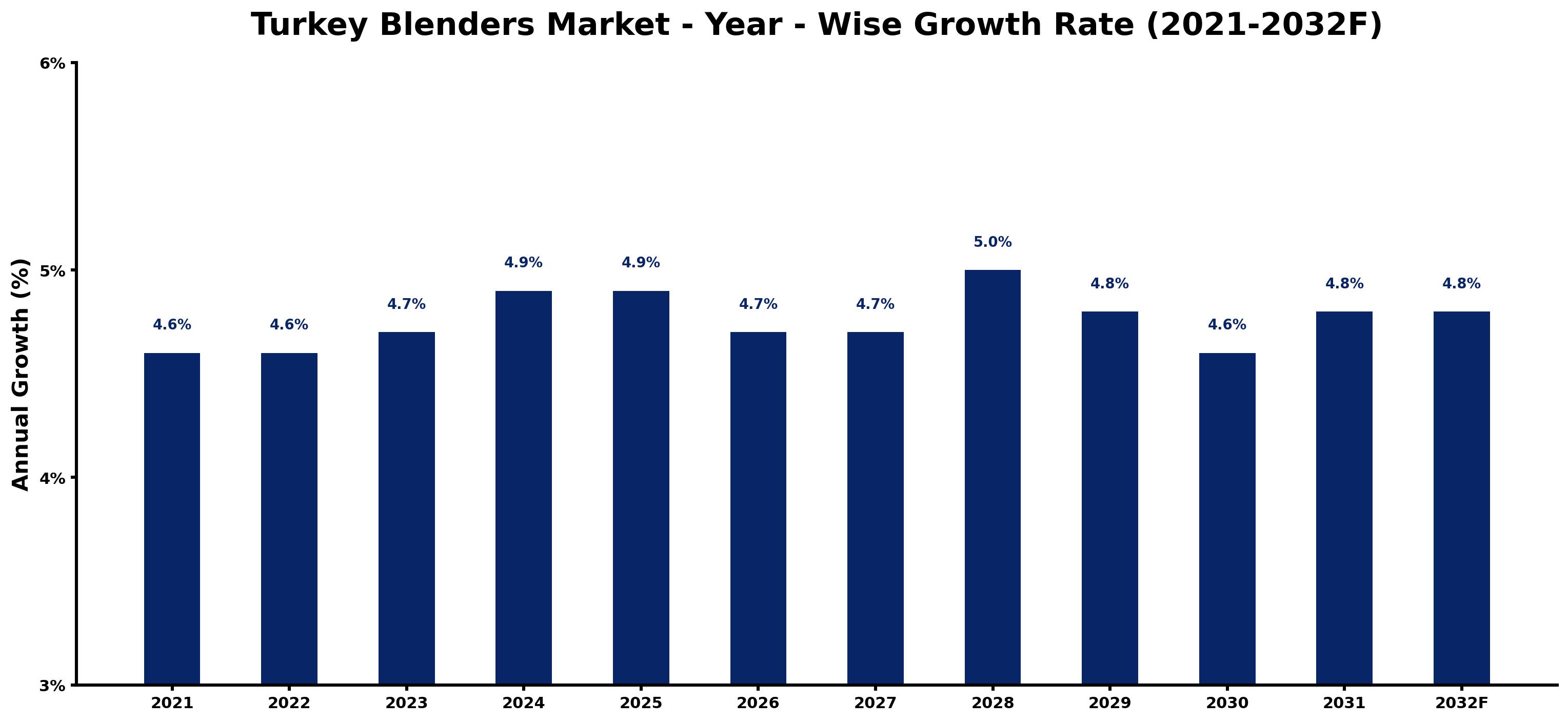
The table below presents the year wise growth rates along with the key drivers influencing the market
| Year | Growth Rate | Major Drivers |
| 2021 | 4.6% | Consumer interest in home cooking elevates blender sales significantly throughout Turkey. |
| 2022 | 4.6% | Health consciousness prompts demand for multifunctional blenders with advanced features. |
| 2023 | 4.7% | E-commerce platforms expand reach, making blenders accessible to a wider audience. |
| 2024 | 4.9% | Local manufacturers innovate, introducing regionally adapted designs and functionalities. |
| 2025 | 4.9% | Sustainable practices resonate with consumers, boosting eco-friendly blender models in stores. |
| 2026 | 4.7% | Rising disposable incomes enable households to invest in premium kitchen appliances. |
| 2027 | 4.7% | Social media influencers promote blending recipes, enhancing blender popularity among youth. |
| 2028 | 5.0% | Urban migration increases, driving demand for compact appliances in smaller living spaces. |
| 2029 | 4.8% | Product diversification emerges, offering specialized blenders for smoothies and soups. |
| 2030 | 4.6% | Technological integration, such as smart features, captures the tech-savvy consumer segment. |
| 2031 | 4.8% | Trends in meal prep encourage consumers to seek reliable, efficient blending solutions. |
| 2032 | 4.8% | Collaborations with culinary schools elevate brand visibility and consumer trust in blenders. |
Note - Market size estimations and growth projections presented in this report are based on 6Wresearch's advanced forecasting approach, validated with industry datasets as of June 2026.
Turkey Blenders Market Synopsis
The Turkey Blenders Market is projected to reach 4.7% and witness significant growth during the forecast period (2026-2032). As a leading manufacturer and exporter of blenders, Turkey ranks among the top 10 countries globally in blender production. The robust manufacturing capabilities of Turkish companies enable them to supply products to over 100 countries, showcasing the global reach and influence of the Turkey Blenders Market.
Turkey Blenders Market Growth Drivers
The Turkey Blenders Market is propelled by several key growth drivers that reflect changing consumer preferences and economic conditions. First, the increasing domestic demand driven by a growing focus on healthy eating habits has significantly enhanced the popularity of smoothies and juices in households across the country. This trend is supported by rising interest in health and wellness among consumers.
- The health-conscious trend among consumers is contributing to the rising demand for blenders as more individuals seek to prepare nutritious beverages at home.
- Additionally, rising disposable incomes among Turkish consumers are enabling households to invest in modern kitchen appliances, including high-quality blenders.
- The blend of competitive pricing and high-quality standards in Turkey attracts international buyers, further driving market growth.
- Advancements in technology are leading to innovative blender designs and features, catering to diverse consumer needs, thereby expanding market opportunities.
- Moreover, the convenience of preparing fresh drinks at home is elevating the importance of blenders among modern consumers, reinforcing their essential role in contemporary kitchen setups.
Turkey Blenders Market Trends and Opportunities
Several trends are shaping the Turkey Blenders Market, creating opportunities for expansion and innovation. One notable trend is the growing demand for multifunctional kitchen appliances that offer additional capabilities beyond basic blending. Consumers are increasingly favoring blenders that can serve multiple purposes, leading manufacturers to innovate in product design.
- Eco-friendly blenders made from sustainable materials are gaining traction as consumers become more environmentally conscious and seek to reduce their carbon footprint.
- Smart technology integration, such as app connectivity for remote operation, is becoming a popular feature, appealing to tech-savvy consumers.
- The rise in online shopping and e-commerce platforms is enabling broader distribution channels, increasing accessibility for consumers seeking high-quality blenders.
- Health and wellness awareness is driving the introduction of specialized blenders designed for specific diets, such as smoothies and protein shakes, capitalizing on the fitness trend.
- Local manufacturers are focusing on branding and marketing strategies to enhance consumer awareness and reinforce the visibility of Turkish-made products in global markets.
Turkey Blenders Market Challenges and Restraints
Despite the positive outlook, the Turkey Blenders Market faces several challenges that could hinder growth. The key challenge lies in intense competition, both from domestic manufacturers and international brands that offer a variety of products at competitive prices. This necessitates continuous innovation and quality improvement among local producers to maintain market share.
- Supply chain disruptions, often caused by global events, can affect the availability of raw materials required for blender production, impacting overall output.
- Consumer preferences can shift rapidly, leading to potential mismatches between market offerings and actual demand, which could affect sales.
- Economic fluctuations and inflationary pressures can limit consumer spending on non-essential items, including kitchen appliances, thereby impacting market growth.
- Regulatory compliance regarding manufacturing standards and safety requirements can pose additional challenges for manufacturers, particularly if they aim to penetrate international markets.
- Furthermore, marketing and distribution limitations may restrict the reach of Turkish manufacturers in certain regions, affecting competitiveness.
Turkey Blenders Market Government Investment and Initiatives
The Turkish government has shown significant interest in supporting the local manufacturing sector, including the blenders market. Various policies and initiatives focus on fostering innovation and enhancing productivity in manufacturing. Government incentives aimed at research and development encourage companies to invest in new technologies and product design, which is crucial for remaining competitive in the global market.
- Investment in infrastructure improvements has facilitated better transportation and logistics, benefiting manufacturers by reducing operational costs.
- Public spending on technology and skills development programs aims to ensure a skilled workforce capable of meeting the evolving demands of the manufacturing sector.
- Regional development plans prioritize industrial zones, attracting both local and foreign investments into the production of kitchen appliances, including blenders.
- Import regulations and tariffs are often adjusted to support local manufacturers while ensuring that international competition aligns with fair trade practices.
- Collaboration between government bodies and industry stakeholders promotes knowledge sharing and best practices, which is vital for advancing the sector's growth.
Turkey Blenders Market Latest Developments (May 2025 - June 2026)
The Turkey Blenders Market has witnessed several noteworthy developments from May 2025 to June 2026. Innovations in product design have led to the introduction of new blender models featuring advanced technology, catering to the modern consumer's demand for multifunctionality and convenience.
- Manufacturers have increasingly focused on sustainability by launching eco-friendly blenders made from recyclable materials, aligning with global trends towards greener products.
- Rising collaboration among local manufacturers has aimed to consolidate resources for research and development, leading to enhanced product offerings and market competitiveness.
- The expansion of online retail channels has significantly changed the distribution landscape, enabling consumers to access a wider range of products easily.
- Trade fairs and industry exhibitions have provided platforms for showcasing innovative products, facilitating networking opportunities among stakeholders in the blender manufacturing industry.
- The emphasis on health and wellness remains a dominant theme, influencing marketing strategies and product development initiatives across the sector.
Turkey Blenders Market - Key Attractiveness of the Report
- 10 Years of Market Numbers
- Historical Data Starting from 2022 to 2025
- Base Year: 2025
- Forecast Data until 2032
- Key Performance Indicators Impacting the Market
- Major Upcoming Developments and Projects
Government initiatives aimed at supporting local manufacturing, investing in infrastructure, and promoting R&D have created a conducive environment for the growth of the blenders market.
Key Highlights of the Report:
- Turkey Blenders Market Outlook
- Market Size of Turkey Blenders Market, 2025
- Forecast of Turkey Blenders Market, 2032
- Historical Data and Forecast of Turkey Blenders Revenues & Volume for the Period 2022-2032
- Turkey Blenders Market Trend Evolution
- Turkey Blenders Market Drivers and Challenges
- Turkey Blenders Price Trends
- Turkey Blenders Porter's Five Forces
- Turkey Blenders Industry Life Cycle
- Historical Data and Forecast of Turkey Blenders Market Revenues & Volume By Types for the Period 2022-2032
- Historical Data and Forecast of Turkey Blenders Market Revenues & Volume By Hand Blenders for the Period 2022-2032
- Historical Data and Forecast of Turkey Blenders Market Revenues & Volume By Single-Serve Blenders for the Period 2022-2032
- Historical Data and Forecast of Turkey Blenders Market Revenues & Volume By Full-Size Blenders for the Period 2022-2032
- Historical Data and Forecast of Turkey Blenders Market Revenues & Volume By Applications for the Period 2022-2032
- Historical Data and Forecast of Turkey Blenders Market Revenues & Volume By Commercial for the Period 2022-2032
- Historical Data and Forecast of Turkey Blenders Market Revenues & Volume By Household for the Period 2022-2032
- Turkey Blenders Import Export Trade Statistics
- Market Opportunity Assessment By Types
- Market Opportunity Assessment By Applications
- Turkey Blenders Top Companies Market Share
- Turkey Blenders Competitive Benchmarking By Technical and Operational Parameters
- Turkey Blenders Company Profiles
- Turkey Blenders Key Strategic Recommendations






































