Turkey Building Construction Market Size, Share & Growth Rate
The Turkey Building Construction Market was estimated at USD 1113 Million in 2025 and is projected to reach USD 1596 Million by 2032, growing at a CAGR of 5.3% from 2026 to 2032. This growth trajectory is primarily fueled by rapid urbanization and population increases, alongside significant investments in infrastructure and commercial properties. Additionally, government initiatives aimed at urban transformation and sustainability are playing a pivotal role in enhancing market dynamics.
Turkey Building Construction Market Year-wise Growth Rate and Key Drivers
This graph highlights how the Turkey Building Construction Market has steadily grown over the years, supported by major growth factors.
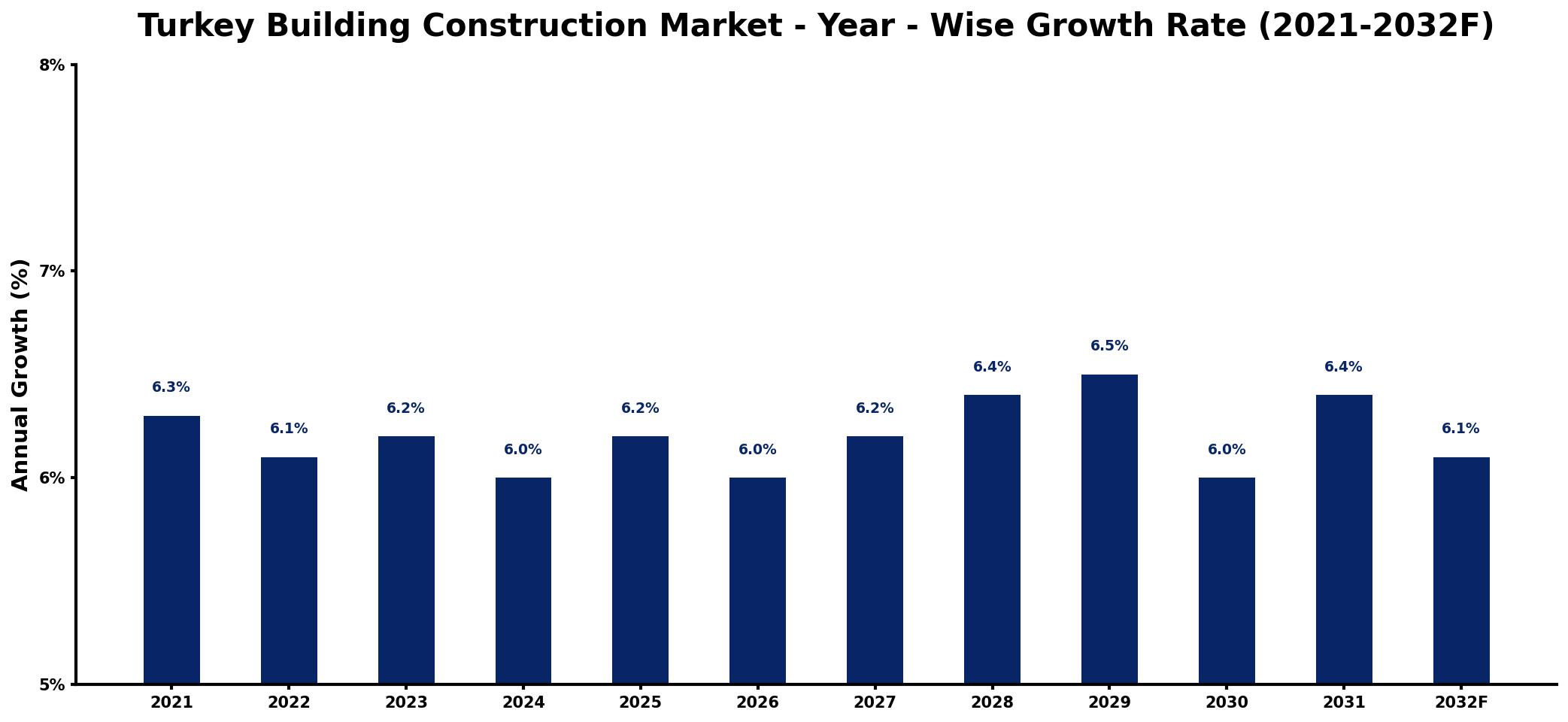
The table below presents the year‑wise growth rates along with the key drivers influencing the market
| Year | Growth Rate | Major Drivers |
| 2021 | 6.3% | Increased infrastructure project funding |
| 2022 | 6.1% | Rising urban population demand |
| 2023 | 6.2% | Expansion of renewable energy projects |
| 2024 | 6.0% | Growth in residential housing sector |
| 2025 | 6.2% | Investment in smart city initiatives |
| 2026 | 6.0% | Surge in foreign direct investments |
| 2027 | 6.2% | Development of transportation networks |
| 2028 | 6.4% | Boost in tourism-related projects |
| 2029 | 6.5% | Demand for sustainable materials |
| 2030 | 6.0% | Increase in public-private partnerships |
| 2031 | 6.4% | growing regional consumption patterns |
| 2032 | 6.1% | Rising interest in eco-friendly designs |
Note: Market size estimations and growth projections presented in this report are based on 6Wresearch's proprietary forecasting methodology, utilizing the latest available industry data, government publications, and primary research inputs.
Turkey Building Construction Market Synopsis
As urban centers expand, the demand for residential housing and mixed-use developments in Turkey is surging. The government's commitment to urban renewal through various projects encourages the reconstruction of older structures, particularly in earthquake-prone areas. This creates a unique opportunity for construction firms to engage in projects that not only enhance housing quality but also prioritize safety.
Moreover, the influx of tourists into key metropolitan areas continues to drive commercial construction, including hotels and entertainment venues. Both local and international firms are competing vigorously in this thriving market, showcasing the increasing interest and investment in Turkey's construction landscape.
Turkey Building Construction Market Key Takeaways
- Significant growth anticipated due to urbanization and infrastructure development.
- Government policies promote sustainable and energy-efficient building practices.
- Investment opportunities in mixed-use and residential real estate are expanding.
- Technological advancements are shaping the future of construction methods and materials.
- Competitive landscape with numerous local and international players vying for market share.
Evaluation of Restraints in Turkey Building Construction Market
The Turkey Building Construction Market encounters several significant challenges that could impede growth. Economic instability often disrupts investment decisions, leading to project delays or cancellations. Additionally, fluctuating costs of materials, particularly steel and cement, create unpredictability in budgeting. Regulatory complexities, including evolving building codes and lengthy permitting processes, further complicate project execution. These factors necessitate a proactive approach from industry players to remain adaptable and competitive within the dynamic market environment.
Turkey Building Construction Market Trends
Current trends in the Turkey Building Construction Market indicate a strong shift towards sustainable and energy-efficient construction. Government regulations are increasingly encouraging builders to adopt environmentally friendly practices, meeting both regulatory requirements and consumer demands. The rise of smart buildings, integrating technology for greater efficiency, is becoming a staple feature in new projects. Furthermore, modular construction methods are gaining traction due to their cost-effectiveness and quicker project timelines, representing a significant evolution in construction methodologies.
Turkey Building Construction Market Opportunities
Investment opportunities abound in the Turkey Building Construction Market, especially in residential and commercial sectors. The rising urban population demands modern housing, while mixed-use developments cater to both living and working needs. Infrastructure projects, such as roads, bridges, and public transport facilities, are also ripe for investment, particularly as the government prioritizes urban renewal. Additionally, the emphasis on sustainable construction presents a lucrative avenue for investments in green technologies and eco-friendly projects, ensuring future growth and relevance.
Government Initiatives in the Turkey Building Construction Market
The Turkish government has launched various initiatives aimed at revitalizing the building construction sector. Key among these is the Urban Transformation Law, which promotes urban renewal and the reconstruction of aging structures that do not meet safety standards. Incentives such as tax breaks for energy-efficient projects and subsidies for sustainable construction further facilitate market growth. Additionally, stringent regulations ensure adherence to environmental and safety standards, thereby enhancing the overall quality and safety of building practices in the country.
Future Insights of the Turkey Building Construction Market
Looking ahead to 2026-2032, the Turkey Building Construction Market is positioned for sustained growth. Urbanization and population expansion will continue to drive demand, particularly in urban areas. As the government increases its investment in infrastructure, both residential and commercial construction sectors will see enhanced activity. Furthermore, the ongoing emphasis on sustainable and smart building technologies will significantly influence future projects, making the sector increasingly aligned with global construction trends. However, stakeholders must remain vigilant to navigate regulatory changes and cost fluctuations to maximize their opportunities in this vibrant market.
Turkey Building Construction Market Latest Developments (2025 - 2026)
Recent developments within the Turkey Building Construction Market highlight a growing commitment to integrating advanced technologies into construction practices. There has been an uptick in projects that emphasize smart city concepts, promoting connectivity and efficiency in urban environments. Furthermore, numerous firms are exploring innovative materials that enhance sustainability and reduce environmental impact, reflecting the industry's shift towards greener practices. Additionally, the government continues to roll out various urban transformation initiatives, further stimulating construction activity across the nation.
Turkey Building Construction Market - Key Attractiveness of the Report
- 10 Years of Market Numbers
- Historical Data Starting from 2022 to 2025
- Base Year: 2025
- Forecast Data until 2032
- Key Performance Indicators Impacting the Market
- Major Upcoming Developments and Projects
Key Highlights of the Report:
- Turkey Building Construction Market Outlook
- Market Size of Turkey Building Construction Market, 2025
- Forecast of Turkey Building Construction Market, 2032
- Historical Data and Forecast of Turkey Building Construction Revenues & Volume for the Period 2022-2032F
- Turkey Building Construction Market Trend Evolution
- Turkey Building Construction Market Drivers and Challenges
- Turkey Building Construction Price Trends
- Turkey Building Construction Porter's Five Forces
- Turkey Building Construction Industry Life Cycle
- Historical Data and Forecast of Turkey Building Construction Market Revenues & Volume By Type for the Period 2022-2032F
- Historical Data and Forecast of Turkey Building Construction Market Revenues & Volume By Residential for the Period 2022-2032F
- Historical Data and Forecast of Turkey Building Construction Market Revenues & Volume By Non-residential for the Period 2022-2032F
- Historical Data and Forecast of Turkey Building Construction Market Revenues & Volume By Construction Type for the Period 2022-2032F
- Historical Data and Forecast of Turkey Building Construction Market Revenues & Volume By New Construction for the Period 2022-2032F
- Historical Data and Forecast of Turkey Building Construction Market Revenues & Volume By Renovation for the Period 2022-2032F
- Historical Data and Forecast of Turkey Building Construction Market Revenues & Volume By Application for the Period 2022-2032F
- Historical Data and Forecast of Turkey Building Construction Market Revenues & Volume By Owned for the Period 2022-2032F
- Historical Data and Forecast of Turkey Building Construction Market Revenues & Volume By Rental for the Period 2022-2032F
- Historical Data and Forecast of Turkey Building Construction Market Revenues & Volume By End User for the Period 2022-2032F
- Historical Data and Forecast of Turkey Building Construction Market Revenues & Volume By Private for the Period 2022-2032F
- Historical Data and Forecast of Turkey Building Construction Market Revenues & Volume By Public for the Period 2022-2032F
- Turkey Building Construction Import Export Trade Statistics
- Market Opportunity Assessment By Type
- Market Opportunity Assessment By Construction Type
- Market Opportunity Assessment By Application
- Market Opportunity Assessment By End User
- Turkey Building Construction Top Companies Market Share
- Turkey Building Construction Competitive Benchmarking By Technical and Operational Parameters
- Turkey Building Construction Company Profiles
- Turkey Building Construction Key Strategic Recommendations






































