Turkey Car Air Fresheners Market Size, Share & Growth Rate
The Turkey Car Air Fresheners Market was estimated at USD 311 Million in 2025 and is projected to reach USD 542 Million by 2032, growing at a CAGR of 8.3% from 2026 to 2032. This growth trajectory is driven by an increasing number of car owners in Turkey, who are progressively prioritizing their in-car experience and the need for effective odor control solutions. The shift towards sustainable and eco-friendly products is also shaping consumer preferences, compelling manufacturers to innovate and adapt to market demands.
Turkey Car Air Fresheners Market Year-wise Growth Rate and Key Drivers
This graph highlights how the Turkey Car Air Fresheners Market has steadily grown over the years, supported by major growth factors.
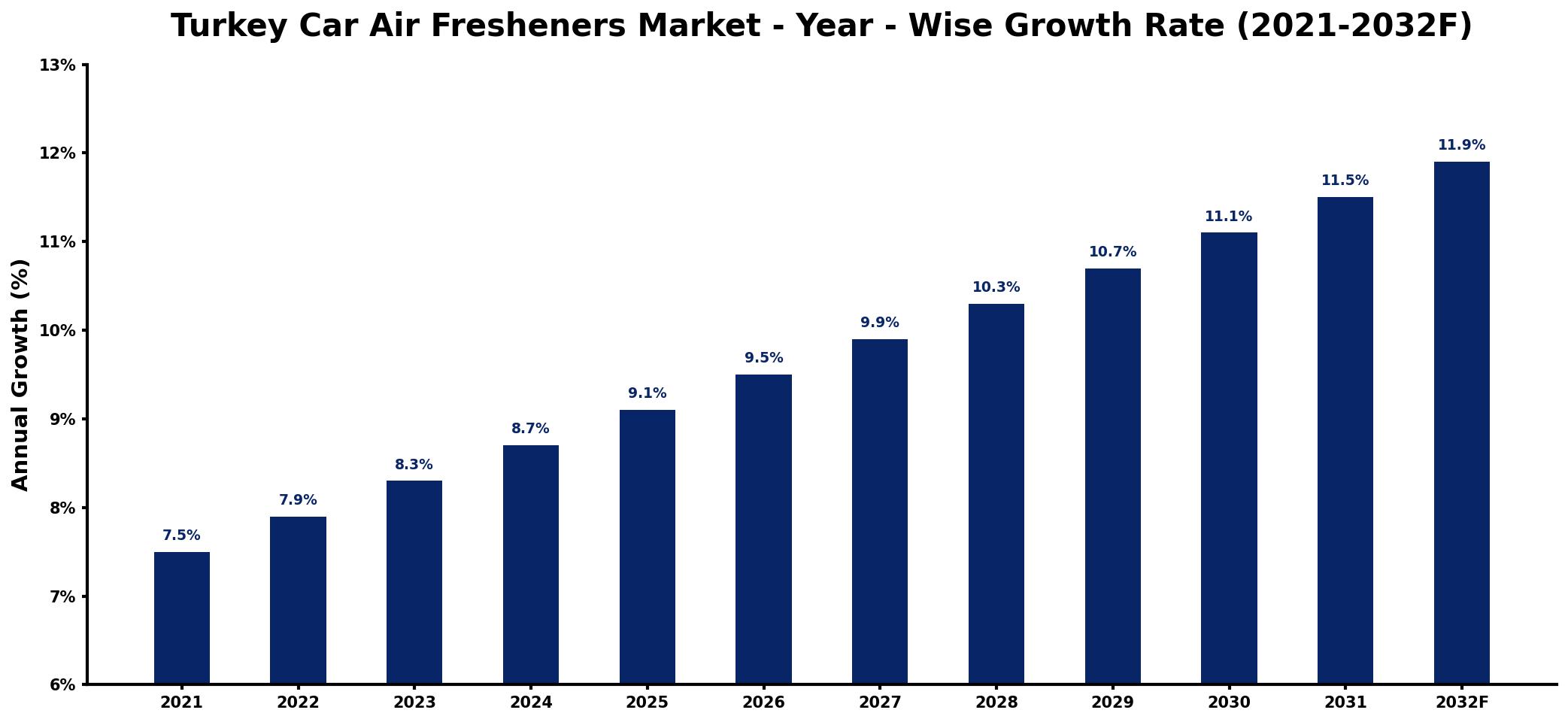
The table below presents the year‑wise growth rates along with the key drivers influencing the market
| Year | Growth Rate | Major Drivers |
| 2021 | 7.5% | Rising consumer disposable income |
| 2022 | 7.9% | Increased focus on hygiene |
| 2023 | 8.3% | Growth in automotive sector |
| 2024 | 8.7% | Expansion of retail distribution |
| 2025 | 9.1% | Technological advancements in scents |
| 2026 | 9.5% | Growing demand for luxury items |
| 2027 | 9.9% | Increase in urban population density |
| 2028 | 10.3% | Shift towards eco-friendly products |
| 2029 | 10.7% | Emergence of innovative fragrances |
| 2030 | 11.1% | Rising trend of personalization |
| 2031 | 11.5% | Enhanced marketing strategies adopted |
| 2032 | 11.9% | Expansion into online marketplaces |
Note: Market size estimations and growth projections presented in this report are based on 6Wresearch's proprietary forecasting methodology, utilizing the latest available industry data, government publications, and primary research inputs.
Turkey Car Air Fresheners Market Synopsis
In Turkey, the rising awareness of hygiene and the significance of a pleasant driving atmosphere is propelling the demand for car air fresheners. Consumers are not just looking for simple solutions; they are increasingly gravitating toward products that blend functionality with aesthetic appeal, which is driving innovation in fragrance delivery systems and designs.
Additionally, the market is witnessing a surge in the popularity of online sales channels, which offers consumers a broader selection and the convenience of shopping from home. Brands are responding by enhancing their digital presence, thereby reaching a wider audience and catering to the evolving preferences of modern consumers.
Turkey Car Air Fresheners Market Key Takeaways
- The market is expected to grow significantly due to increased car ownership and consumer awareness.
- Shifts toward eco-friendly products are influencing manufacturers to innovate with sustainable materials.
- Online sales are becoming a crucial channel for market expansion and consumer engagement.
- Unique scents and aesthetic designs are vital for brands to differentiate themselves in a competitive landscape.
- Customization and personalization in fragrance selection are driving consumer interest.
Evaluation of Restraints in Turkey Car Air Fresheners Market
Despite robust growth, the Turkey Car Air Fresheners Market faces several restraints that could impede its potential. Intense competition from both local and international brands leads to price wars, which can squeeze profit margins. Furthermore, consumer demands for eco-friendly products necessitate substantial investment in research and development, presenting a financial challenge for some manufacturers. Economic fluctuations and rising raw material costs can also disrupt pricing strategies, making it imperative for companies to remain agile and responsive to changes in the market landscape.
Turkey Car Air Fresheners Market Trends
Current trends in the Turkey Car Air Fresheners Market highlight a strong preference for natural and organic ingredients as consumers become more conscious of environmental impacts. Furthermore, there is a growing inclination towards innovative product designs, including vent clips and gel-based fresheners that not only serve functional purposes but also enhance the vehicle's interior aesthetics. Exotic and unique fragrance profiles are capturing consumer attention, as individuals seek to personalize their driving environments.
Turkey Car Air Fresheners Market Opportunities
The Turkey Car Air Fresheners Market is rife with investment opportunities, particularly as the demand for automotive accessories continues to rise. Investors should consider tapping into the growing market for eco-friendly and sustainable air fresheners, as well as exploring unique fragrance formulations that appeal to diverse consumer preferences. Additionally, leveraging e-commerce platforms for distribution can maximize reach and efficiency. Collaborations with automotive manufacturers for promotional initiatives can further enhance market presence.
Government Initiatives in the Turkey Car Air Fresheners Market
Government policies play a significant role in shaping the Turkey Car Air Fresheners Market. The Ministry of Health enforces safety and quality standards, ensuring that products meet required regulations. Additionally, labeling requirements are in place to inform consumers about product contents and usage, promoting transparency. Efforts to restrict certain harmful chemicals in air fresheners further emphasize the importance of safety and environmental health within this sector.
Future Insights of the Turkey Car Air Fresheners Market
Looking ahead to 2026-2032, the Turkey Car Air Fresheners Market is poised for continual expansion. The growth in car ownership will drive demand for innovative and personalized solutions that enhance consumer experience. As technological advancements lead to the development of new fragrance delivery systems, companies focusing on quality and sustainability will likely capture market share. Furthermore, the emphasis on eco-conscious products will solidify as a central tenet, influencing product development strategies.
Turkey Car Air Fresheners Market Latest Developments (2025 - 2026)
Recent developments in the Turkey Car Air Fresheners Market indicate a concerted shift towards the integration of smart technologies in air freshener solutions. Innovations such as app-controlled dispensers that allow users to personalize fragrance intensity and duration are gaining traction. Additionally, collaborations between fragrance houses and automotive designers are emerging, focusing on creating unique scent profiles that complement vehicle aesthetics. There is also a noticeable increase in promotional campaigns aimed at educating consumers about the benefits of eco-friendly options.
Turkey Car Air Fresheners Market - Key Attractiveness of the Report
- 10 Years of Market Numbers
- Historical Data Starting from 2022 to 2025
- Base Year: 2025
- Forecast Data until 2032
- Key Performance Indicators Impacting the Market
- Major Upcoming Developments and Projects
Key Highlights of the Report:
- Turkey Car Air Fresheners Market Outlook
- Market Size of Turkey Car Air Fresheners Market, 2025
- Forecast of Turkey Car Air Fresheners Market, 2032
- Historical Data and Forecast of Turkey Car Air Fresheners Revenues & Volume for the Period 2022-2032F
- Turkey Car Air Fresheners Market Trend Evolution
- Turkey Car Air Fresheners Market Drivers and Challenges
- Turkey Car Air Fresheners Price Trends
- Turkey Car Air Fresheners Porter's Five Forces
- Turkey Car Air Fresheners Industry Life Cycle
- Historical Data and Forecast of Turkey Car Air Fresheners Market Revenues & Volume By Product for the Period 2022-2032F
- Historical Data and Forecast of Turkey Car Air Fresheners Market Revenues & Volume By Gel & Cans for the Period 2022-2032F
- Historical Data and Forecast of Turkey Car Air Fresheners Market Revenues & Volume By Spray/Aerosol for the Period 2022-2032F
- Historical Data and Forecast of Turkey Car Air Fresheners Market Revenues & Volume By Paper Car Air Fresheners for the Period 2022-2032F
- Historical Data and Forecast of Turkey Car Air Fresheners Market Revenues & Volume By Vents & Clips for the Period 2022-2032F
- Historical Data and Forecast of Turkey Car Air Fresheners Market Revenues & Volume By End-User for the Period 2022-2032F
- Historical Data and Forecast of Turkey Car Air Fresheners Market Revenues & Volume By Sports Car for the Period 2022-2032F
- Historical Data and Forecast of Turkey Car Air Fresheners Market Revenues & Volume By Mid-range Car for the Period 2022-2032F
- Historical Data and Forecast of Turkey Car Air Fresheners Market Revenues & Volume By SUV for the Period 2022-2032F
- Historical Data and Forecast of Turkey Car Air Fresheners Market Revenues & Volume By Others for the Period 2022-2032F
- Historical Data and Forecast of Turkey Car Air Fresheners Market Revenues & Volume By Fragrance for the Period 2022-2032F
- Historical Data and Forecast of Turkey Car Air Fresheners Market Revenues & Volume By Scented for the Period 2022-2032F
- Historical Data and Forecast of Turkey Car Air Fresheners Market Revenues & Volume By UnScented for the Period 2022-2032F
- Turkey Car Air Fresheners Import Export Trade Statistics
- Market Opportunity Assessment By Product
- Market Opportunity Assessment By End-User
- Market Opportunity Assessment By Fragrance
- Turkey Car Air Fresheners Top Companies Market Share
- Turkey Car Air Fresheners Competitive Benchmarking By Technical and Operational Parameters
- Turkey Car Air Fresheners Company Profiles
- Turkey Car Air Fresheners Key Strategic Recommendations






































