Turkey Circuit Protection Market Size, Share & Growth Rate
The Turkey Circuit Protection Market was estimated at USD 1045 Million in 2025 and is projected to reach USD 1502 Million by 2032, growing at a CAGR of 5.3% from 2026 to 2032. This growth trajectory is driven by significant advancements in semiconductor technology and the increasing demand for electrical safety across various sectors such as electronics and industrial automation. Moreover, government initiatives promoting infrastructure development and the integration of smart devices in IoT frameworks further fuel market expansion.
Turkey Circuit Protection Market Year-wise Growth Rate and Key Drivers
This graph highlights how the Turkey Circuit Protection Market has steadily grown over the years, supported by major growth factors.
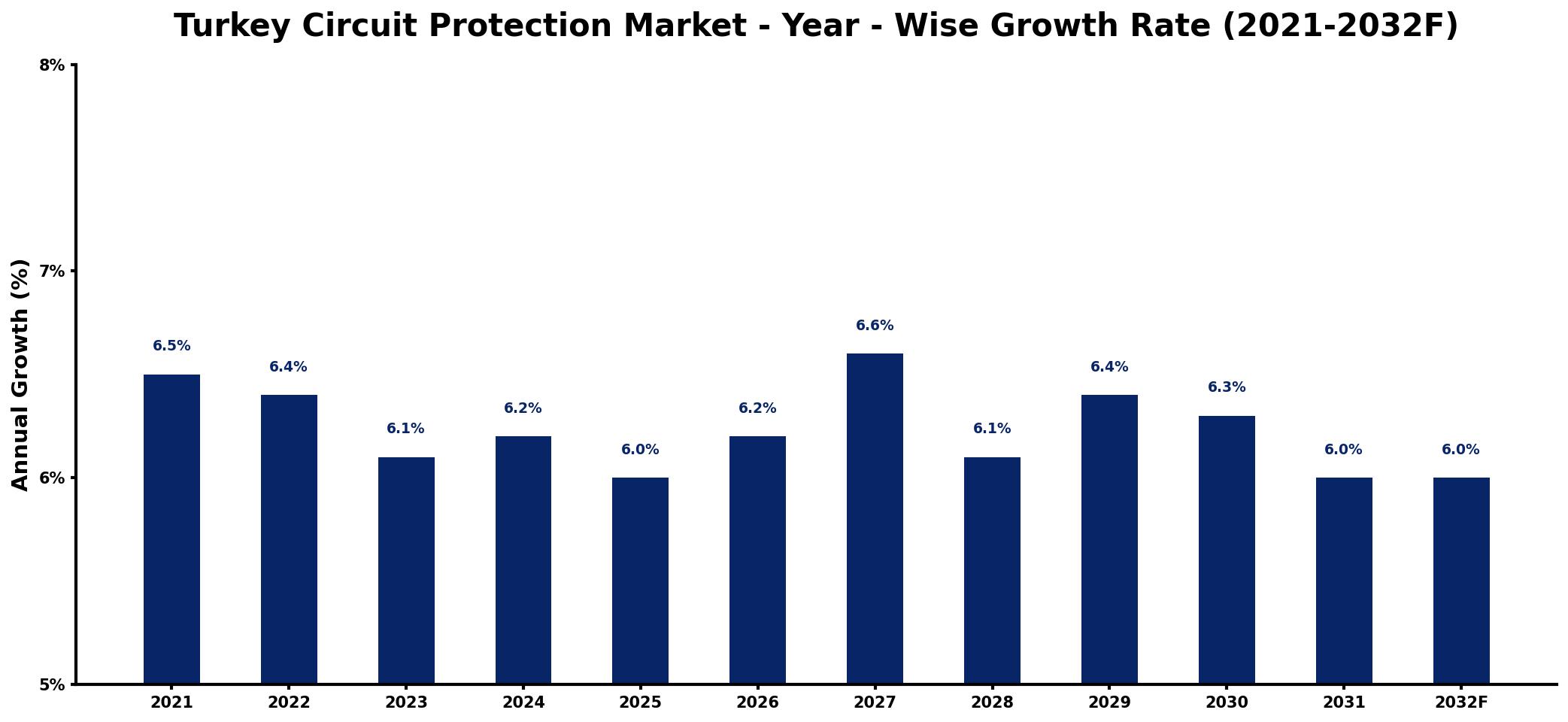
The table below presents the year‑wise growth rates along with the key drivers influencing the market
| Year | Growth Rate | Major Drivers |
| 2021 | 6.5% | Rising demand for renewable energy |
| 2022 | 6.4% | Increased investments in infrastructure |
| 2023 | 6.1% | Expansion of residential construction projects |
| 2024 | 6.2% | Growth in electric vehicle adoption |
| 2025 | 6.0% | Surge in industrial automation needs |
| 2026 | 6.2% | Growing focus on energy efficiency |
| 2027 | 6.6% | Technological advancements in smart grids |
| 2028 | 6.1% | Increase in telecommunications upgrades |
| 2029 | 6.4% | Boost in manufacturing sector output |
| 2030 | 6.3% | increased domestic production output |
| 2031 | 6.0% | Rising awareness of safety standards |
| 2032 | 6.0% | stronger distribution network expansion |
Note: Market size estimations and growth projections presented in this report are based on 6Wresearch's proprietary forecasting methodology, utilizing the latest available industry data, government publications, and primary research inputs.
Turkey Circuit Protection Market Synopsis
The Turkey Circuit Protection Market is witnessing a dynamic evolution, characterized by robust demand for fuses, circuit breakers, and surge protectors. These devices are crucial for safeguarding electrical systems against overcurrents, voltage spikes, and short circuits, thereby ensuring operational safety and reliability across sectors.
As industries increasingly embrace digitization and automation, the importance of reliable circuit protection has never been more pronounced. Innovations in integrated and smart protection devices are also redefining the market landscape, aligning closely with trends in energy efficiency and sustainability.
Turkey Circuit Protection Market Key Takeaways
- The market is projected to achieve substantial growth, reaching USD 1502 Million by 2032.
- Advancements in semiconductor technologies are paving the way for innovative circuit protection solutions.
- The demand for energy-efficient devices is spurring manufacturers to invest in R&D and product innovation.
- Government regulations on electrical safety standards are shaping market dynamics and driving compliance.
- Infrastructure investments in power distribution networks are crucial for market expansion in Turkey.
Evaluation of Restraints in Turkey Circuit Protection Market
While the Turkey Circuit Protection Market is poised for growth, certain challenges persist. Fluctuations in raw material prices can impact production costs, posing a risk to profitability for manufacturers. Additionally, the rapid pace of technological advancement necessitates ongoing innovation, requiring companies to allocate substantial resources for research and development. Furthermore, competition from alternative protection technologies presents an ongoing challenge, compelling businesses to remain agile and adaptive in their strategies.
Turkey Circuit Protection Market Trends
Emerging trends in the Turkey Circuit Protection Market include the miniaturization of protection devices, which aligns with the broader trend toward compact and energy-efficient electronic appliances. Moreover, the growth of the electric vehicle sector is driving demand for specialized circuit protection solutions tailored for automotive applications. Enhanced focus on renewable energy sources is also stimulating the need for advanced circuit protection systems within these infrastructures, ensuring efficiency and safety.
Turkey Circuit Protection Market Opportunities
The most genuine growth opportunities in the Turkey Circuit Protection Market lie in the burgeoning renewable energy and electric vehicle segments. As Turkey accelerates its transition to sustainable energy, the requirement for sophisticated circuit protection solutions will become increasingly pronounced. Additionally, the shift towards smart grid technologies creates new avenues for innovation, encouraging manufacturers to develop advanced protection devices that cater to these evolving needs.
Government Initiatives in the Turkey Circuit Protection Market
Government policies play a vital role in shaping the Turkey Circuit Protection Market. Regulatory frameworks that promote electrical safety and establish stringent safety standards are integral for market reliability. Furthermore, public investments aimed at enhancing infrastructure and encouraging technological innovation help drive the growth of circuit protection solutions, reinforcing the sector's alignment with national safety and efficiency goals.
Future Insights of the Turkey Circuit Protection Market
Looking ahead to 2026-2032, the Turkey Circuit Protection Market is expected to continue its upward trajectory, influenced by the ongoing integration of smart technologies and industrial automation. As sectors such as telecommunications and renewable energy expand, the demand for advanced circuit protection devices will rise correspondingly. Manufacturers that can innovate while ensuring compliance with evolving regulatory standards will position themselves favorably in this competitive landscape.
Turkey Circuit Protection Market Latest Developments (2025 - 2026)
Recent developments in the Turkey Circuit Protection Market indicate a strong push towards incorporating IoT features in protection devices. This trend is expected to revolutionize how industries approach circuit safety and reliability. Furthermore, there's a notable increase in collaborative efforts between manufacturers and technology firms to enhance product offerings, focusing on smarter, more efficient solutions that cater to contemporary energy needs.
Turkey Circuit Protection Market - Key Attractiveness of the Report
- 10 Years of Market Numbers
- Historical Data Starting from 2022 to 2025
- Base Year: 2025
- Forecast Data until 2032
- Key Performance Indicators Impacting the Market
- Major Upcoming Developments and Projects
Key Highlights of the Report:
- Turkey Circuit Protection Market Outlook
- Market Size of Turkey Circuit Protection Market, 2025
- Forecast of Turkey Circuit Protection Market, 2032
- Historical Data and Forecast of Turkey Circuit Protection Revenues & Volume for the Period 2022-2032F
- Turkey Circuit Protection Market Trend Evolution
- Turkey Circuit Protection Market Drivers and Challenges
- Turkey Circuit Protection Price Trends
- Turkey Circuit Protection Porter's Five Forces
- Turkey Circuit Protection Industry Life Cycle
- Historical Data and Forecast of Turkey Circuit Protection Market Revenues & Volume By Type for the Period 2022-2032F
- Historical Data and Forecast of Turkey Circuit Protection Market Revenues & Volume By Overcurrent Protection for the Period 2022-2032F
- Historical Data and Forecast of Turkey Circuit Protection Market Revenues & Volume By ESD Protection for the Period 2022-2032F
- Historical Data and Forecast of Turkey Circuit Protection Market Revenues & Volume By Overvoltage Protection for the Period 2022-2032F
- Historical Data and Forecast of Turkey Circuit Protection Market Revenues & Volume By Device for the Period 2022-2032F
- Historical Data and Forecast of Turkey Circuit Protection Market Revenues & Volume By Circuit Breakers for the Period 2022-2032F
- Historical Data and Forecast of Turkey Circuit Protection Market Revenues & Volume By Fuses for the Period 2022-2032F
- Historical Data and Forecast of Turkey Circuit Protection Market Revenues & Volume By ESD Protection Devices for the Period 2022-2032F
- Historical Data and Forecast of Turkey Circuit Protection Market Revenues & Volume By Surge Protection Devices for the Period 2022-2032F
- Historical Data and Forecast of Turkey Circuit Protection Market Revenues & Volume By Industry for the Period 2022-2032F
- Historical Data and Forecast of Turkey Circuit Protection Market Revenues & Volume By Construction for the Period 2022-2032F
- Historical Data and Forecast of Turkey Circuit Protection Market Revenues & Volume By Automotive and Transportation for the Period 2022-2032F
- Historical Data and Forecast of Turkey Circuit Protection Market Revenues & Volume By Electronics and Electrical Equipment for the Period 2022-2032F
- Historical Data and Forecast of Turkey Circuit Protection Market Revenues & Volume By Industrial for the Period 2022-2032F
- Historical Data and Forecast of Turkey Circuit Protection Market Revenues & Volume By Energy for the Period 2022-2032F
- Historical Data and Forecast of Turkey Circuit Protection Market Revenues & Volume By Others for the Period 2022-2032F
- Turkey Circuit Protection Import Export Trade Statistics
- Market Opportunity Assessment By Type
- Market Opportunity Assessment By Device
- Market Opportunity Assessment By Industry
- Turkey Circuit Protection Top Companies Market Share
- Turkey Circuit Protection Competitive Benchmarking By Technical and Operational Parameters
- Turkey Circuit Protection Company Profiles
- Turkey Circuit Protection Key Strategic Recommendations






































