Turkey Cloud ERP Market Size & Growth Rate (2026-2032)
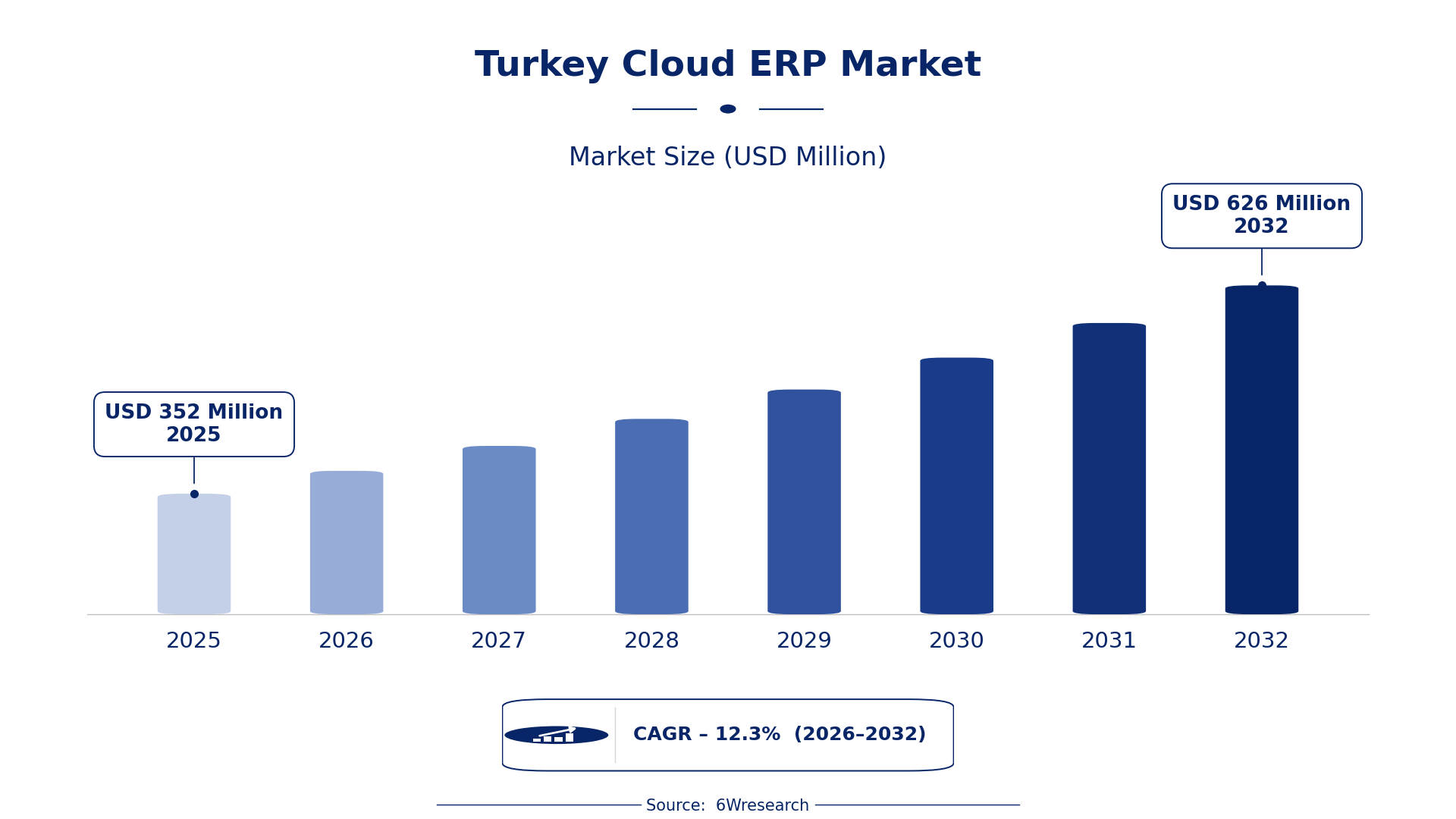
The Turkey Cloud ERP Market was estimated at USD 352 Million in 2025 and is projected to reach USD 626 Million by 2032, growing at a CAGR of 12.3% from 2026 to 2032.
Turkey Cloud ERP Market Synopsis
The Turkey Cloud ERP market has gained substantial momentum, driven by increasing demand for integrated business solutions. Companies across various sectors are eager to streamline their operations, pushing the adoption of cloud-based enterprise resource planning systems.
Looking ahead, the market is set to evolve with enhanced functionalities powered by AI and machine learning. As organizations prioritize digital transformation, there is a clear shift towards more flexible and scalable ERP solutions tailored for specific industries.
Turkey Cloud ERP Market Year-wise Growth Rate and Key Drivers
This graph illustrates the annual growth rates of the Turkey Cloud ERP Market from 2021 to 2032, highlighting a steady upward trajectory and projected expansion over the forecast period.
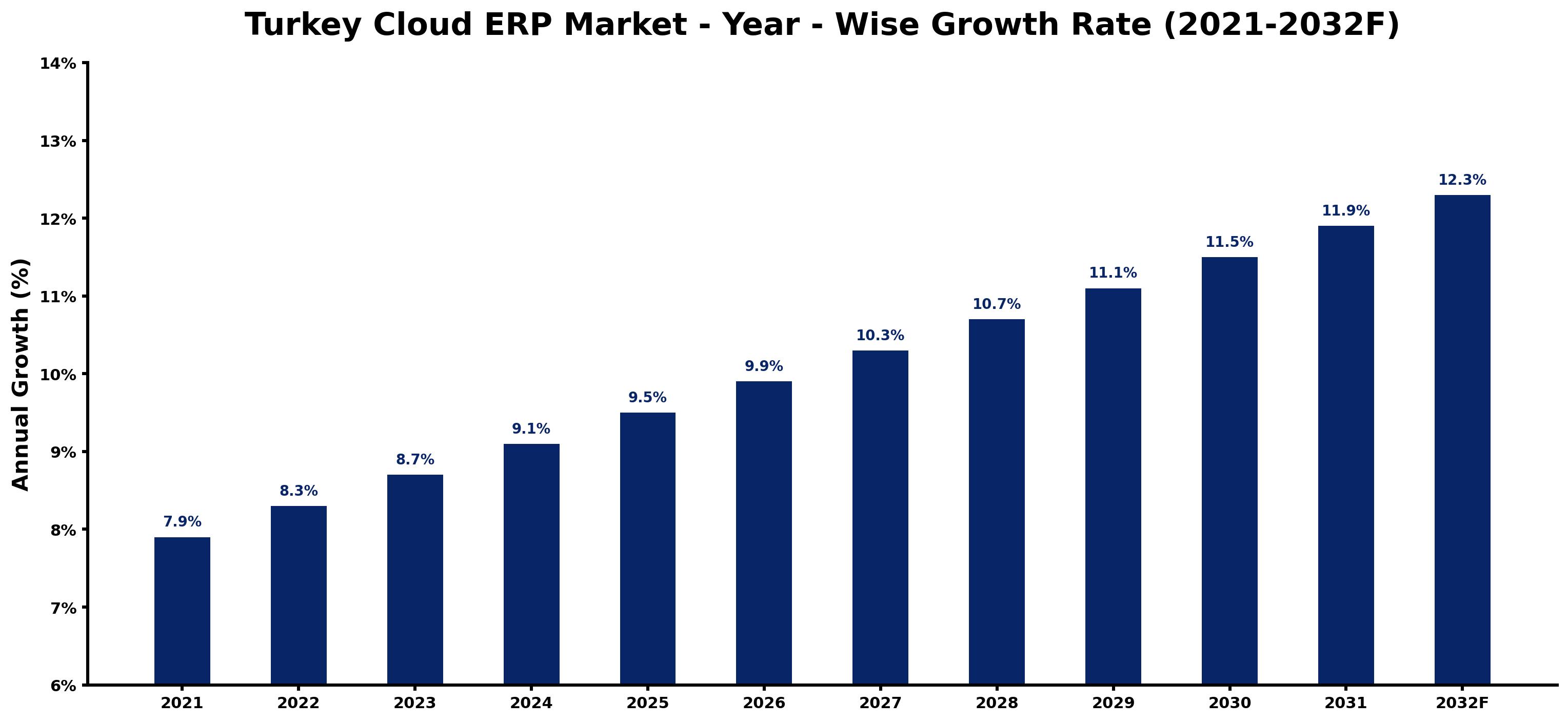
The table below presents the year‑wise growth rates along with the key drivers influencing the market
| Year | Growth Rate | Major Drivers |
| 2021 | 7.9% | Increased local SMEs adopting digital solutions rapidly. |
| 2022 | 8.3% | Government tax breaks for tech-driven businesses. |
| 2023 | 8.7% | Growing interest in e-commerce platforms boosting ERP demand. |
| 2024 | 9.1% | Digital Turkey initiative enhancing cloud technology adoption. |
| 2025 | 9.5% | Local manufacturing sector shifting to automated operations. |
| 2026 | 9.9% | Investment in cybersecurity driving cloud ERP confidence. |
| 2027 | 10.3% | Emerging fintech solutions creating ERP integration opportunities. |
| 2028 | 10.7% | Rising mobile internet penetration increasing cloud service usage. |
| 2029 | 11.1% | Increased government funding for IT sector innovations. |
| 2030 | 11.5% | Shift to data-driven decision-making in enterprises. |
| 2031 | 11.9% | Turkish digital economy strategy emphasizing ERP technologies. |
| 2032 | 12.3% | Increased collaboration between tech startups and enterprises. |
Note: Market size estimations and growth projections presented in this report are based on 6Wresearch's proprietary forecasting methodology, utilizing the latest available industry data, government publications, and primary research inputs.
Turkey Cloud ERP Market Key Takeaways
Below are some of the specific key takeaways from the market, including:
- Cloud ERP solutions are crucial for integrating core business functions like finance and HR.
- The demand for mobile-friendly interfaces is reshaping ERP deployment strategies.
- AI and machine learning advancements are becoming integral to ERP functionalities.
- Industry-specific ERP offerings are gaining traction among businesses in Turkey.
- Regulatory compliance remains a significant factor influencing cloud ERP adoption.
Evaluation of Restraints in Turkey Cloud ERP Market
Despite its growth, the Turkey Cloud ERP market faces notable restraints. High migration costs can deter businesses from transitioning to cloud-based systems, particularly for smaller enterprises with limited budgets. Data privacy and security concerns are paramount as firms navigate regulations on data handling. Additionally, the need for continuous innovation in ERP solutions to meet evolving business needs presents a challenge for vendors striving to keep pace with technological advancements.
Turkey Cloud ERP Market Trends
A few trends are shaping the Turkey Cloud ERP market. The rise of modular ERP systems allows businesses to customize solutions based on their unique requirements. There is a strong push for hybrid cloud environments, enabling organizations to balance on-premise and cloud solutions. on top of that, the increasing emphasis on data analytics within ERP systems is allowing companies to derive insights that enhance decision-making.
Turkey Cloud ERP Market Opportunities
Opportunities abound in the Turkey Cloud ERP market. Companies are looking to invest in cloud infrastructure to support digital transformation initiatives. The growing trend towards automation and data-driven operations provides a fertile ground for ERP vendors to innovate and offer tailored solutions. Additionally, businesses that can successfully address regulatory compliance issues will find a competitive edge in this dynamic market.
Government Initiatives in the Turkey Cloud ERP Market
Government policy is actively shaping the Turkey Cloud ERP market, with various initiatives aimed at promoting technological innovation. The focus is on enhancing digital infrastructure and ensuring compliance with data protection regulations, which are critical for businesses adopting cloud solutions.
- A recently completed initiative involved launching a national digital infrastructure upgrade program to enhance broadband access across urban and rural areas.
- Currently underway is a regulatory framework designed to standardize cloud service provider practices, ensuring data privacy and security compliance.
- A planned public-private partnership aims to boost cloud technology adoption in SMEs by 2028, focusing on education and resource sharing.
- In 2025, a program was introduced to incentivize businesses transitioning from legacy systems to cloud-based ERP solutions.
- The government is also developing an initiative to establish a national cloud computing strategy, expected to be finalized by 2026.
Future Insights of the Turkey Cloud ERP Market
From 2026 to 2032, the Turkey Cloud ERP market is likely to continue its upward trajectory, fueled by ongoing digital transformation efforts across various industries. The integration of advanced technologies such as AI, machine learning, and data analytics will redefine how businesses utilize ERP systems. Companies that prioritize flexibility and customization will thrive as they respond to shifting market demands. The focus on regulatory compliance will remain critical, driving further investment in secure cloud solutions.
Turkey Cloud ERP Market Latest Developments
Over the past 12-14 months, the Turkey Cloud ERP market has seen a flurry of activity, reflecting both innovation and adaptation. Companies are increasingly focusing on enhancing their cloud capabilities to stay competitive and meet the evolving needs of their customers.
- A major technology vendor launched a new cloud ERP solution in early 2025, incorporating AI-driven analytics to enhance user experience.
- Ongoing partnerships between cloud providers and local SMEs have been established to improve accessibility and support for ERP implementation.
- A rollout of a comprehensive training program for ERP users began in mid-2025, aimed at enhancing workforce capabilities.
- A planned upgrade to existing cloud infrastructures is expected to commence in the second half of 2026, focusing on scalability and security enhancements.
- New industry-specific ERP modules are currently being developed, with a launch anticipated in late 2025 to cater to niche markets.
Turkey Cloud ERP Market - Key Attractiveness of the Report
- 10 Years of Market Numbers
- Historical Data Starting from 2022 to 2025
- Base Year: 2025
- Forecast Data until 2032
- Key Performance Indicators Impacting the Market
- Major Upcoming Developments and Projects
Key Highlights of the Report:
- Turkey Cloud ERP Market Outlook
- Market Size of Turkey Cloud ERP Market, 2025
- Forecast of Turkey Cloud ERP Market, 2032
- Historical Data and Forecast of Turkey Cloud ERP Revenues & Volume for the Period 2022-2032F
- Turkey Cloud ERP Market Trend Evolution
- Turkey Cloud ERP Market Drivers and Challenges
- Turkey Cloud ERP Price Trends
- Turkey Cloud ERP Porter's Five Forces
- Turkey Cloud ERP Industry Life Cycle
- Historical Data and Forecast of Turkey Cloud ERP Market Revenues & Volume By Component for the Period 2022-2032F
- Historical Data and Forecast of Turkey Cloud ERP Market Revenues & Volume By Solution for the Period 2022-2032F
- Historical Data and Forecast of Turkey Cloud ERP Market Revenues & Volume By Services for the Period 2022-2032F
- Historical Data and Forecast of Turkey Cloud ERP Market Revenues & Volume By Vertical for the Period 2022-2032F
- Historical Data and Forecast of Turkey Cloud ERP Market Revenues & Volume By BFSI for the Period 2022-2032F
- Historical Data and Forecast of Turkey Cloud ERP Market Revenues & Volume By Manufacturing for the Period 2022-2032F
- Historical Data and Forecast of Turkey Cloud ERP Market Revenues & Volume By IT and Telecom for the Period 2022-2032F
- Historical Data and Forecast of Turkey Cloud ERP Market Revenues & Volume By Business Function for the Period 2022-2032F
- Historical Data and Forecast of Turkey Cloud ERP Market Revenues & Volume By Accounting and Finance for the Period 2022-2032F
- Historical Data and Forecast of Turkey Cloud ERP Market Revenues & Volume By Sales and Marketing for the Period 2022-2032F
- Historical Data and Forecast of Turkey Cloud ERP Market Revenues & Volume By Inventory and Order Management for the Period 2022-2032F
- Historical Data and Forecast of Turkey Cloud ERP Market Revenues & Volume By Organization Size for the Period 2022-2032F
- Historical Data and Forecast of Turkey Cloud ERP Market Revenues & Volume By SMEs for the Period 2022-2032F
- Historical Data and Forecast of Turkey Cloud ERP Market Revenues & Volume By Large Enterprises for the Period 2022-2032F
- Turkey Cloud ERP Import Export Trade Statistics
- Market Opportunity Assessment By Component
- Market Opportunity Assessment By Vertical
- Market Opportunity Assessment By Business Function
- Market Opportunity Assessment By Organization Size
- Turkey Cloud ERP Top Companies Market Share
- Turkey Cloud ERP Competitive Benchmarking By Technical and Operational Parameters
- Turkey Cloud ERP Company Profiles
- Turkey Cloud ERP Key Strategic Recommendations






































