Turkey Container Security Market Size & Growth Rate (2026-2032)
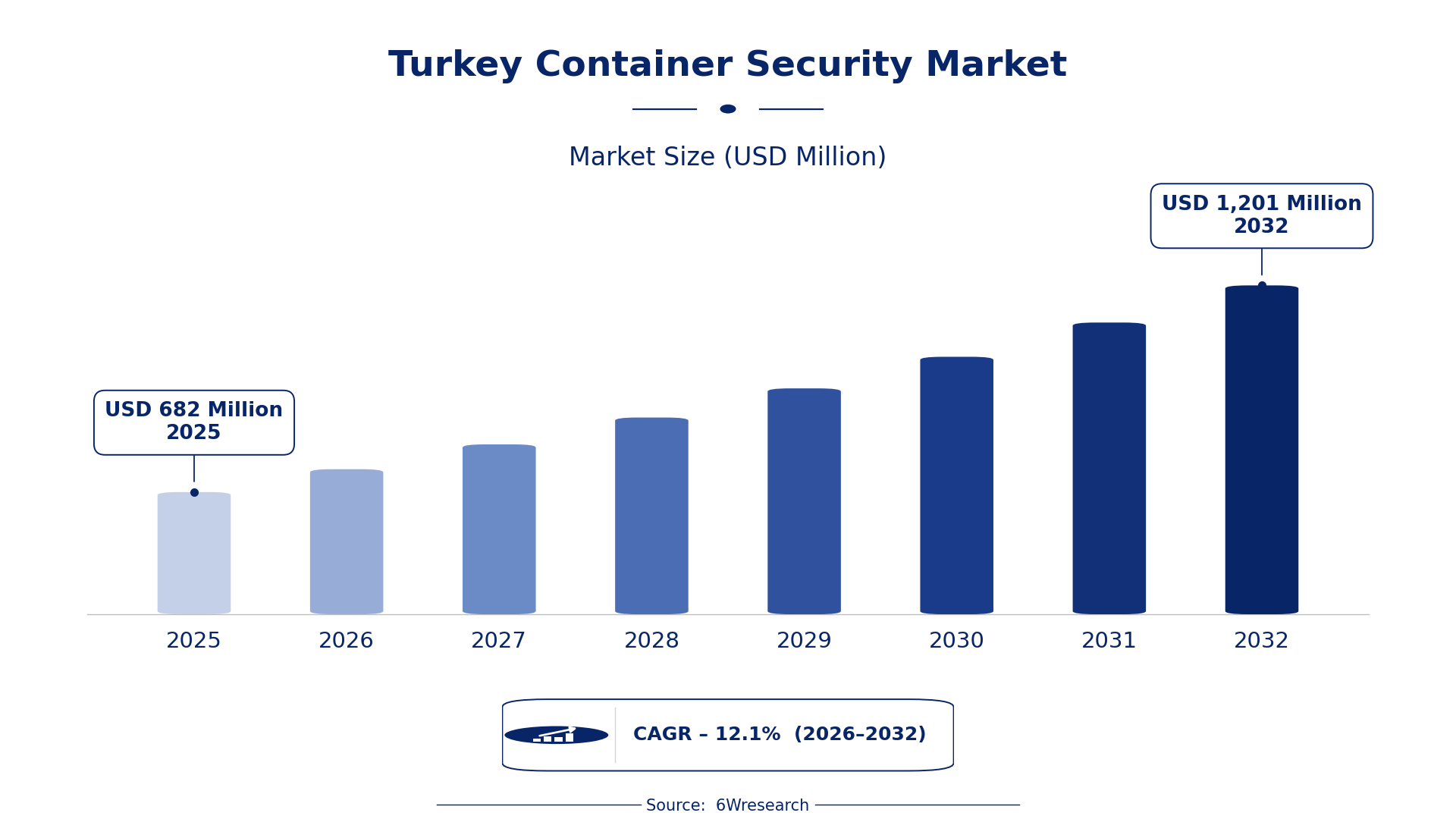
The Turkey Container Security Market was estimated at USD 682 Million in 2025 and is projected to reach USD 1201 Million by 2032, growing at a CAGR of 12.1% from 2026 to 2032.
Turkey Container Security Market Synopsis
Turkey's push towards digital transformation in various industries has led to a growing reliance on containerized applications. This shift is demanding advanced security measures to protect sensitive data and ensure compliance with emerging regulations.
As organizations increasingly adopt DevSecOps practices, integrating security into their development processes becomes crucial. The rising complexity of cyber threats in cloud environments further emphasizes the need for comprehensive container security solutions, tailored specifically for Turkish organizations.
Turkey Container Security Market Year-wise Growth Rate and Key Drivers
This graph illustrates the annual growth rates of the Turkey Container Security Market from 2021 to 2032, highlighting a steady upward trajectory and projected expansion over the forecast period.
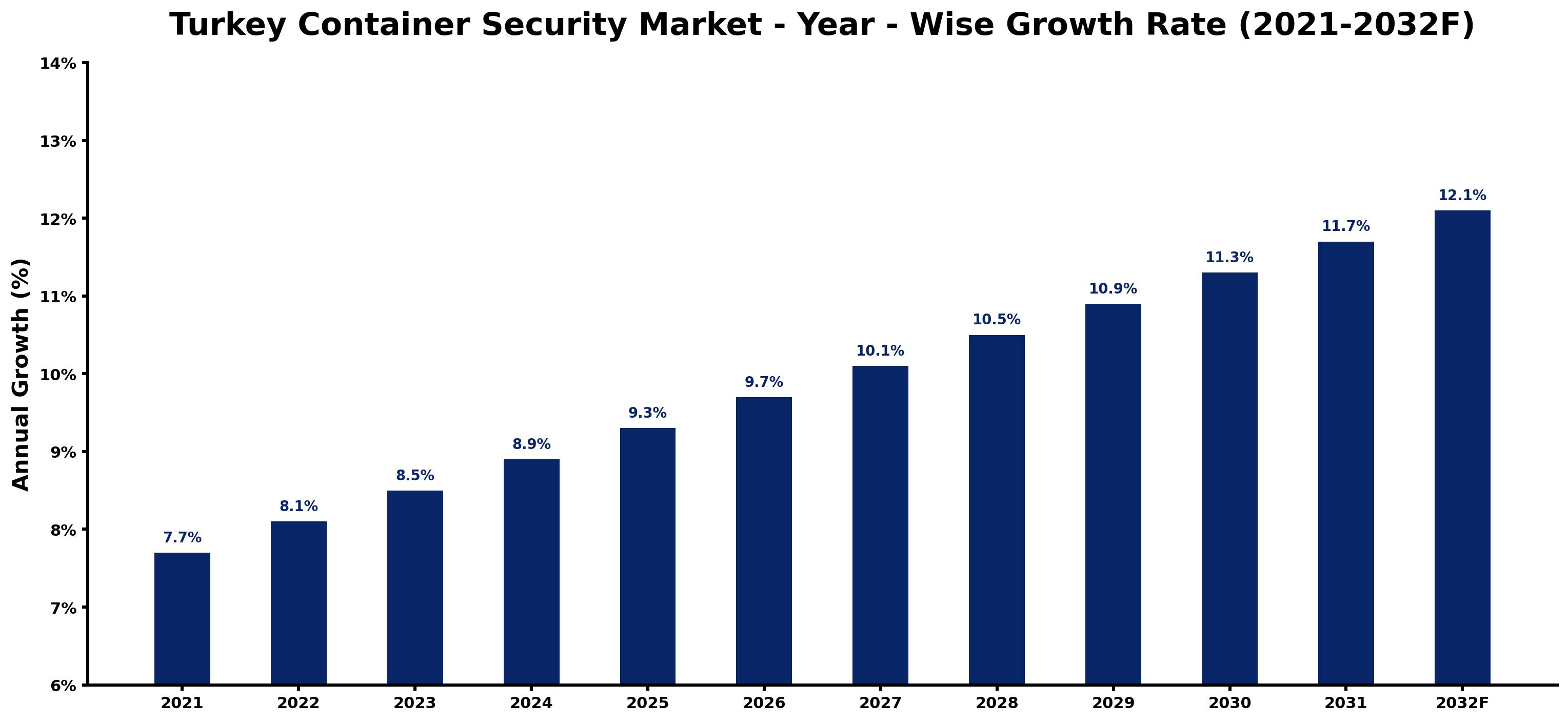
The table below presents the year‑wise growth rates along with the key drivers influencing the market
| Year | Growth Rate | Major Drivers |
| 2021 | 7.7% | Increased regulations by Turkish Customs on container security. |
| 2022 | 8.1% | Rising import volumes boosting demand for secure containers. |
| 2023 | 8.5% | Implementation of new cybersecurity standards for shipping containers. |
| 2024 | 8.9% | Government investment in cargo tracking technology advancements. |
| 2025 | 9.3% | Surge in international trade necessitating enhanced container security. |
| 2026 | 9.7% | Growth of the logistics sector driving security solution adoption. |
| 2027 | 10.1% | Stricter environmental regulations promoting secure container technologies. |
| 2028 | 10.5% | Emergence of local startups offering innovative security solutions. |
| 2029 | 10.9% | Increase in global piracy incidents pushing container security demand. |
| 2030 | 11.3% | National security initiatives prioritizing trade and container safety. |
| 2031 | 11.7% | Adoption of IoT technologies enhancing real-time container monitoring. |
| 2032 | 12.1% | Partnerships with international firms improving security standards. |
Note: Market size estimations and growth projections presented in this report are based on 6Wresearch's proprietary forecasting methodology, utilizing the latest available industry data, government publications, and primary research inputs.
Turkey Container Security Market Key Takeaways
Below are some of the specific key takeaways from the market, including:
- The demand for advanced vulnerability management solutions is surging as Turkish businesses navigate complex cloud environments.
- AI and machine learning innovations are driving the development of smarter security solutions that enhance threat detection capabilities.
- Regulatory frameworks are being implemented to ensure data security, creating a conducive environment for market growth.
- Adoption rates of integrated security solutions are increasing as organizations prioritize end-to-end security in their development workflows.
- Investments in research and development are leading to the emergence of new technologies tailored to container security needs.
Evaluation of Restraints in Turkey Container Security Market
Despite its promising outlook, the Turkey container security market faces significant restraints. Companies often grapple with the complexities of managing vulnerabilities across container images and runtime environments. Compliance with various container security standards can be challenging, particularly as regulations evolve. on top of that, integrating security controls within CI/CD pipelines remains a hurdle for many organizations. The persistent threat of malware and data breaches in hybrid and multi-cloud deployments only complicates these challenges, leading to slower adoption rates than the market potentially warrants.
Turkey Container Security Market Trends
Emerging trends point towards a pronounced shift in security paradigms for containerized applications. Notably, the integration of AI and machine learning into security frameworks enhances predictive analytics, enabling businesses to stay ahead of potential threats. on top of that, the trend toward DevSecOps is gaining traction, encouraging organizations to embed security at the earliest stages of development. As cybersecurity threats evolve, Turkish companies are increasingly seeking proactive solutions to anticipate and mitigate risks.
Turkey Container Security Market Opportunities
A wealth of opportunities exists within the Turkey container security market, particularly in sectors embracing digital transformation. Companies focused on developing next-generation security solutions leveraging AI and machine learning stand to gain significant traction. on top of that, as regulations around data protection tighten, firms specializing in compliance monitoring will find a receptive market. There's also a notable chance to foster partnerships across industries to enhance security awareness and drive comprehensive adoption of container security solutions.
Government Initiatives in the Turkey Container Security Market
Government policies are actively shaping the Turkey container security market, reflecting a commitment to enhancing cybersecurity across sectors. With a focus on regulatory standards for data security and privacy, public sector initiatives aim to foster a secure digital environment, crucial for both local and international businesses.
- A national cybersecurity framework introduced in 2024 emphasizes the need for robust data protection measures across all sectors, including container security.
- Currently underway is a public-sector initiative to promote cybersecurity awareness and training programs targeting businesses, focusing on the integration of security in DevSecOps practices.
- A planned collaboration between government agencies and tech companies seeks to enhance R&D efforts for advanced container security solutions by 2026.
- Regulatory guidelines on data privacy introduced in 2025 require organizations to implement stringent security measures, affecting how containerized applications are managed.
- Recently completed audits of governmental IT infrastructure have highlighted vulnerabilities, prompting immediate action to strengthen container security measures.
Future Insights of the Turkey Container Security Market
Looking ahead to 2026-2032, the Turkey container security market is expected to expand significantly as organizations continue their digital transformation journeys. The increasing focus on cybersecurity, driven by regulatory mandates and the escalating threat landscape, will fuel demand for comprehensive security solutions. Investment in innovative technologies and a commitment to integrating security into development practices will play critical roles in shaping market dynamics in the coming years.
Turkey Container Security Market Latest Developments
Over the past 12-14 months, activity in the Turkey container security market has intensified, with organizations recognizing the necessity of robust security measures in response to growing cyber threats. Investments in advanced technologies are paving the way for innovative solutions that address the unique challenges of containerized applications.
- A major technology vendor launched a new container security platform in Q1 2025, designed to enhance vulnerability management and compliance monitoring for cloud environments.
- An ongoing collaboration between cybersecurity firms and local universities aims to develop cutting-edge solutions, with the initiative expected to yield results by late 2025.
- A regional operator is currently upgrading its security infrastructure, focusing on integrating AI-driven threat detection capabilities to better protect containerized applications.
- A planned workshop series scheduled for early 2026 aims to educate IT professionals on best practices for securing containerized environments.
- A recent public-private partnership initiated in mid-2025 targets improvements in national cybersecurity frameworks, emphasizing container security standards.
Turkey Container Security Market - Key Attractiveness of the Report
- 10 Years of Market Numbers
- Historical Data Starting from 2022 to 2025
- Base Year: 2025
- Forecast Data until 2032
- Key Performance Indicators Impacting the Market
- Major Upcoming Developments and Projects
Key Highlights of the Report:
- Turkey Container Security Market Outlook
- Market Size of Turkey Container Security Market, 2025
- Forecast of Turkey Container Security Market, 2032
- Historical Data and Forecast of Turkey Container Security Revenues & Volume for the Period 2022-2032F
- Turkey Container Security Market Trend Evolution
- Turkey Container Security Market Drivers and Challenges
- Turkey Container Security Price Trends
- Turkey Container Security Porter's Five Forces
- Turkey Container Security Industry Life Cycle
- Historical Data and Forecast of Turkey Container Security Market Revenues & Volume By Component for the Period 2022-2032F
- Historical Data and Forecast of Turkey Container Security Market Revenues & Volume By Container Security Products for the Period 2022-2032F
- Historical Data and Forecast of Turkey Container Security Market Revenues & Volume By Services (Professional, Managed) for the Period 2022-2032F
- Historical Data and Forecast of Turkey Container Security Market Revenues & Volume By Deployment Type for the Period 2022-2032F
- Historical Data and Forecast of Turkey Container Security Market Revenues & Volume By Cloud for the Period 2022-2032F
- Historical Data and Forecast of Turkey Container Security Market Revenues & Volume By On-premises for the Period 2022-2032F
- Historical Data and Forecast of Turkey Container Security Market Revenues & Volume By Vertical for the Period 2022-2032F
- Historical Data and Forecast of Turkey Container Security Market Revenues & Volume By BFSI for the Period 2022-2032F
- Historical Data and Forecast of Turkey Container Security Market Revenues & Volume By Retail for the Period 2022-2032F
- Historical Data and Forecast of Turkey Container Security Market Revenues & Volume By Government for the Period 2022-2032F
- Historical Data and Forecast of Turkey Container Security Market Revenues & Volume By Healthcare for the Period 2022-2032F
- Turkey Container Security Import Export Trade Statistics
- Market Opportunity Assessment By Component
- Market Opportunity Assessment By Deployment Type
- Market Opportunity Assessment By Vertical
- Turkey Container Security Top Companies Market Share
- Turkey Container Security Competitive Benchmarking By Technical and Operational Parameters
- Turkey Container Security Company Profiles
- Turkey Container Security Key Strategic Recommendations






































