Turkey Curtains and Window Blinds Market Size, Share & Growth Rate
The Turkey Curtains and Window Blinds Market was estimated at USD 1286 Million in 2025 and is projected to reach USD 2156 Million by 2032, growing at a CAGR of 7.7% from 2026 to 2032. This growth trajectory is primarily fueled by increasing urbanization, which is motivating consumers to invest in stylish and functional window treatments. As disposable incomes rise, so does the demand for high-quality, aesthetically pleasing products that enhance home interiors.
Turkey Curtains and Window Blinds Market Year-wise Growth Rate and Key Drivers
This graph highlights how the Turkey Curtains and Window Blinds Market has steadily grown over the years, supported by major growth factors.
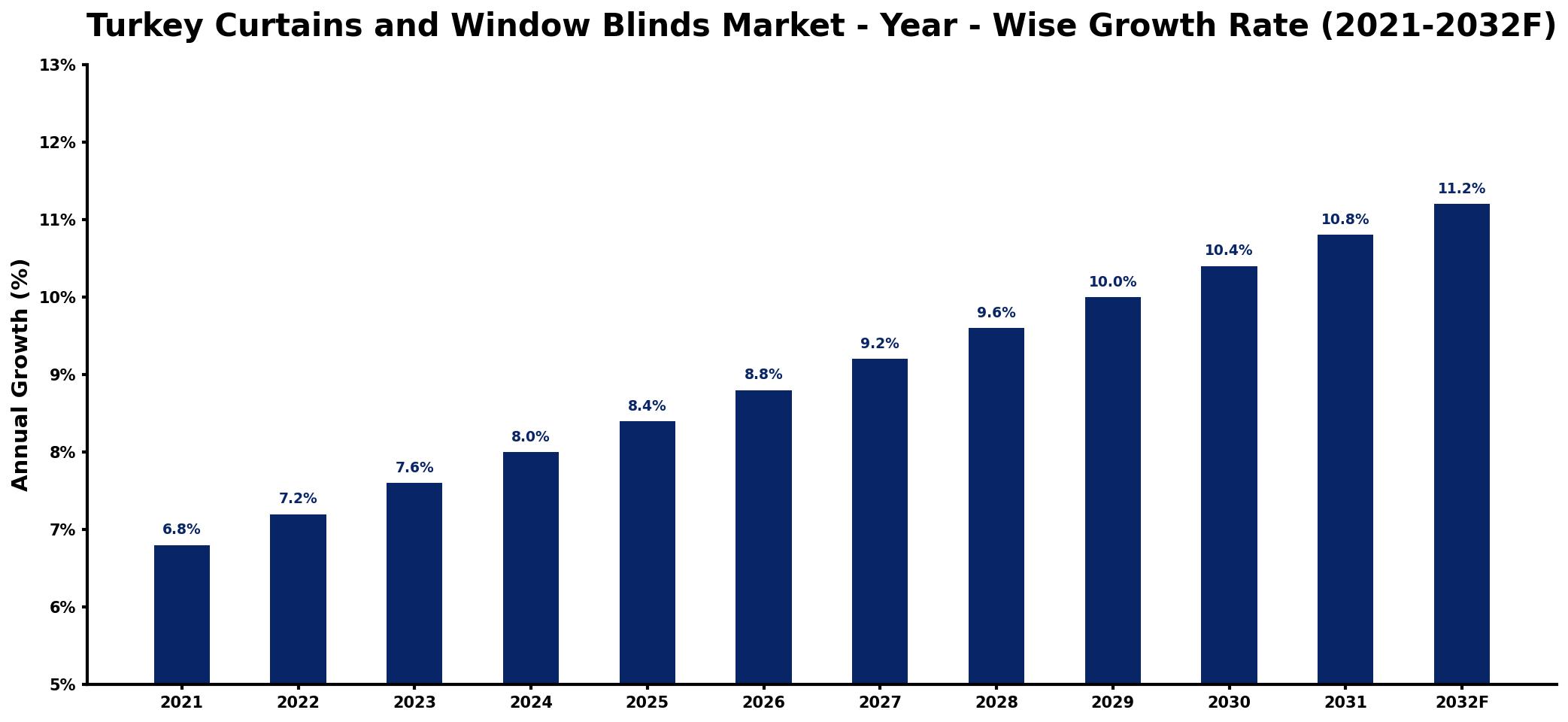
The table below presents the year‑wise growth rates along with the key drivers influencing the market
| Year | Growth Rate | Major Drivers |
| 2021 | 6.8% | Rising demand for home aesthetics |
| 2022 | 7.2% | Increased urban residential developments |
| 2023 | 7.6% | Growth in interior design trends |
| 2024 | 8.0% | Expansion of e-commerce platforms |
| 2025 | 8.4% | Surge in renovation activities |
| 2026 | 8.8% | Higher disposable income levels |
| 2027 | 9.2% | Boom in real estate investments |
| 2028 | 9.6% | Adoption of smart home technologies |
| 2029 | 10.0% | Focus on energy efficiency solutions |
| 2030 | 10.4% | strengthening international trade flows |
| 2031 | 10.8% | Increase in customization preferences |
| 2032 | 11.2% | Rising awareness of aesthetic value |
Note: Market size estimations and growth projections presented in this report are based on 6Wresearch's proprietary forecasting methodology, utilizing the latest available industry data, government publications, and primary research inputs.
Turkey Curtains and Window Blinds Market Synopsis
In recent years, the Turkey Curtains and Window Blinds Market has seen a notable shift towards eco-friendly materials. Consumers are increasingly opting for window treatments made from natural fibers, reflecting a growing awareness of sustainability and environmental impacts. This trend indicates a significant opportunity for companies focused on innovative, sustainable products.
The market landscape is also evolving with the rise of smart home technology, leading to increased demand for automated window solutions. These modern products not only enhance the convenience for users but also offer energy-saving features that appeal to environmentally conscious consumers. This convergence of technology and design is paving the way for new growth opportunities.
Turkey Curtains and Window Blinds Market Key Takeaways
- The market is experiencing steady growth driven by urbanization and increased disposable income.
- There is a significant shift towards eco-friendly products and materials among consumers.
- Technological advancements such as automation are becoming prevalent in window treatment solutions.
- Online retail channels are expanding market reach, offering consumers convenience and variety.
- Customization options are increasingly important to meet diverse consumer preferences.
Evaluation of Restraints in Turkey Curtains and Window Blinds Market
Despite the positive outlook, the Turkey Curtains and Window Blinds Market faces challenges that could hinder its growth. Intense competition from both domestic and international players is making it increasingly difficult for companies to maintain market share. Additionally, fluctuating raw material prices pose a risk to production costs, which can ultimately affect pricing strategies and profit margins. Furthermore, economic instability and currency fluctuations may impact consumer purchasing behavior, posing a challenge for sustained demand.
Turkey Curtains and Window Blinds Market Trends
Current trends indicate a strong consumer inclination towards sustainable and technologically advanced products. There is an evident demand for window treatments made from natural materials, as well as those featuring energy-efficient designs that contribute to improved home insulation. Moreover, the integration of smart technology, including remote-controlled and automated systems, is attracting tech-savvy consumers who prioritize convenience and functionality in their home decor choices.
Turkey Curtains and Window Blinds Market Opportunities
The Turkey Curtains and Window Blinds Market presents several investment opportunities, particularly for those looking to capitalize on the growing focus on home decor and enhancement. With rising disposable incomes, there is a robust demand for high-quality, stylish window treatments. Investing in manufacturers who prioritize sustainable materials and offer customization options can yield significant returns, as these align with current consumer trends. Additionally, leveraging e-commerce platforms can provide companies with greater market access and exposure to a wider audience.
Government Initiatives in the Turkey Curtains and Window Blinds Market
The Turkish government has instituted several policies to bolster local production in the curtains and window blinds market. These initiatives include financial incentives for domestic manufacturers and import tariffs on foreign products to protect the local industry. Moreover, there are programs in place aimed at promoting innovation and technology adoption, which are essential for improving competitiveness and fostering sustainability in the sector.
Future Insights of the Turkey Curtains and Window Blinds Market
Looking ahead, the Turkey Curtains and Window Blinds Market is expected to continue its moderate yet consistent growth from 2026 to 2032. The emphasis on stylish and functional window treatments, combined with technological advancements and eco-friendly materials, will play a crucial role in shaping market dynamics. As urbanization persists and disposable incomes rise, the market is likely to see further investments and innovations aimed at enhancing consumer experience and satisfaction.
Turkey Curtains and Window Blinds Market Latest Developments (2025 - 2026)
Recent developments in the Turkey Curtains and Window Blinds Market highlight an increased focus on smart technology integration and sustainable product offerings. Innovations in automation for window treatments are becoming more common, catering to the growing consumer demand for convenience. Additionally, manufacturers are investing in eco-friendly materials to align with evolving consumer preferences and environmental sustainability efforts.
Turkey Curtains and Window Blinds Market - Key Attractiveness of the Report
- 10 Years of Market Numbers
- Historical Data Starting from 2022 to 2025
- Base Year: 2025
- Forecast Data until 2032
- Key Performance Indicators Impacting the Market
- Major Upcoming Developments and Projects
Key Highlights of the Report:
- Turkey Curtains and Window Blinds Market Outlook
- Market Size of Turkey Curtains and Window Blinds Market, 2025
- Forecast of Turkey Curtains and Window Blinds Market, 2032
- Historical Data and Forecast of Turkey Curtains and Window Blinds Revenues & Volume for the Period 2022-2032F
- Turkey Curtains and Window Blinds Market Trend Evolution
- Turkey Curtains and Window Blinds Market Drivers and Challenges
- Turkey Curtains and Window Blinds Price Trends
- Turkey Curtains and Window Blinds Porter's Five Forces
- Turkey Curtains and Window Blinds Industry Life Cycle
- Historical Data and Forecast of Turkey Curtains and Window Blinds Market Revenues & Volume By Materials for the Period 2022-2032F
- Historical Data and Forecast of Turkey Curtains and Window Blinds Market Revenues & Volume By Curtains (Cotton, Linen, Polyester) for the Period 2022-2032F
- Historical Data and Forecast of Turkey Curtains and Window Blinds Market Revenues & Volume By Window Blinds (Cotton, Linen, Wood, PVC, Metal) for the Period 2022-2032F
- Historical Data and Forecast of Turkey Curtains and Window Blinds Market Revenues & Volume By Product for the Period 2022-2032F
- Historical Data and Forecast of Turkey Curtains and Window Blinds Market Revenues & Volume By Curtains (Box pleat curtains, Pinch pleat curtains & drapery, Goblet pleat curtains & drapery, Eyelet curtains & drapery) for the Period 2022-2032F
- Historical Data and Forecast of Turkey Curtains and Window Blinds Market Revenues & Volume By Window Blinds (Window Shades,, Window Screens, Connected) for the Period 2022-2032F
- Historical Data and Forecast of Turkey Curtains and Window Blinds Market Revenues & Volume By Distribution Channel for the Period 2022-2032F
- Historical Data and Forecast of Turkey Curtains and Window Blinds Market Revenues & Volume By B2B for the Period 2022-2032F
- Historical Data and Forecast of Turkey Curtains and Window Blinds Market Revenues & Volume By B2C for the Period 2022-2032F
- Historical Data and Forecast of Turkey Curtains and Window Blinds Market Revenues & Volume By E-commerce for the Period 2022-2032F
- Historical Data and Forecast of Turkey Curtains and Window Blinds Market Revenues & Volume By Price Range for the Period 2022-2032F
- Historical Data and Forecast of Turkey Curtains and Window Blinds Market Revenues & Volume By High for the Period 2022-2032F
- Historical Data and Forecast of Turkey Curtains and Window Blinds Market Revenues & Volume By Medium for the Period 2022-2032F
- Historical Data and Forecast of Turkey Curtains and Window Blinds Market Revenues & Volume By Low for the Period 2022-2032F
- Turkey Curtains and Window Blinds Import Export Trade Statistics
- Market Opportunity Assessment By Materials
- Market Opportunity Assessment By Product
- Market Opportunity Assessment By Distribution Channel
- Market Opportunity Assessment By Price Range
- Turkey Curtains and Window Blinds Top Companies Market Share
- Turkey Curtains and Window Blinds Competitive Benchmarking By Technical and Operational Parameters
- Turkey Curtains and Window Blinds Company Profiles
- Turkey Curtains and Window Blinds Key Strategic Recommendations






































