Turkey Cutting Equipment Market Size, Share & Growth Rate
The Turkey Cutting Equipment Market was estimated at USD 402 Million in 2025 and is projected to reach USD 554 Million by 2032, growing at a CAGR of 4.7% from 2026 to 2032. This growth trajectory is primarily fueled by the increasing demand for precision cutting solutions across key industrial sectors, particularly automotive, aerospace, and manufacturing. Technological innovations in cutting methods, alongside significant investments in automation, are also enhancing productivity and operational efficiency in these industries.
Turkey Cutting Equipment Market Year-wise Growth Rate and Key Drivers
This graph highlights how the Turkey Cutting Equipment Market has steadily grown over the years, supported by major growth factors.
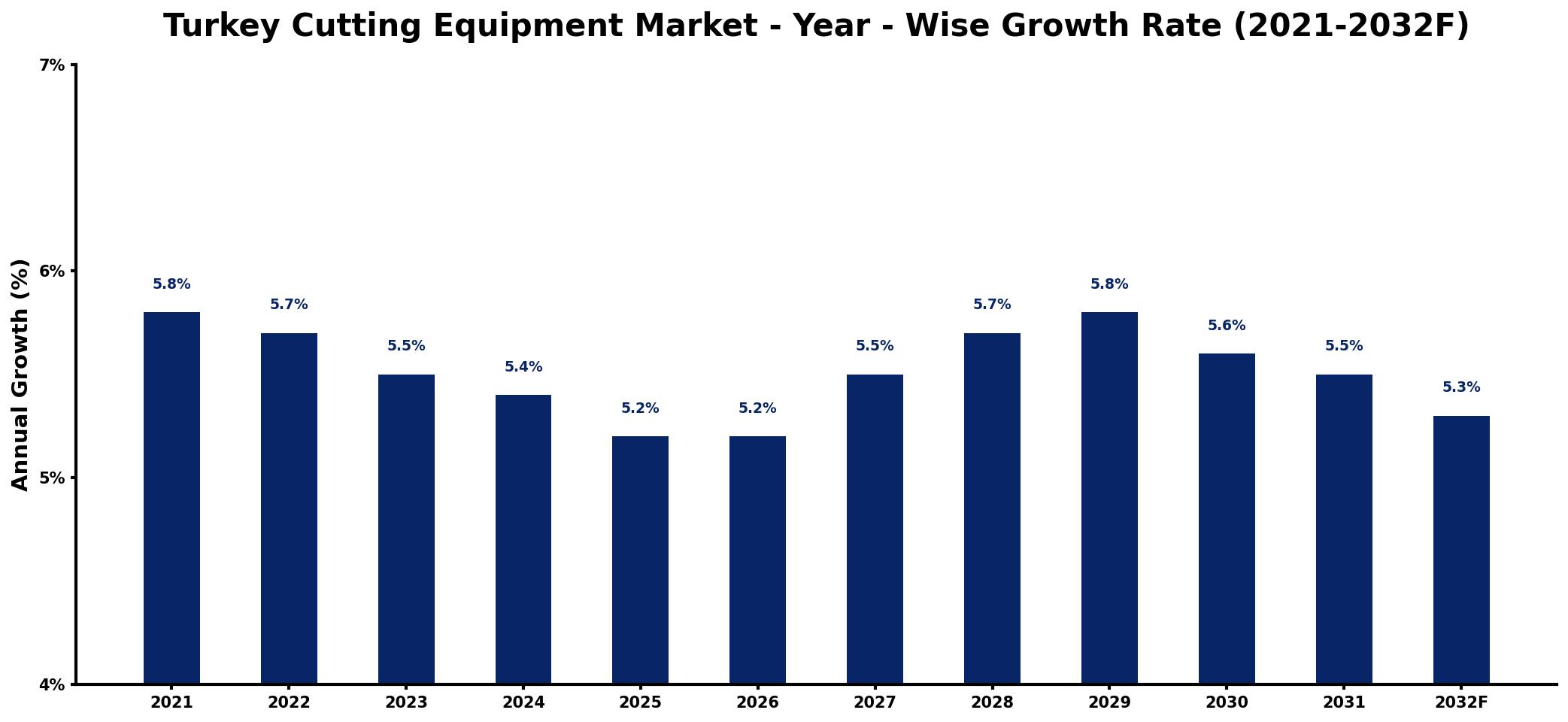
The table below presents the year‑wise growth rates along with the key drivers influencing the market
| Year | Growth Rate | Major Drivers |
| 2021 | 5.8% | Rising demand from food processing |
| 2022 | 5.7% | Increased investments in manufacturing |
| 2023 | 5.5% | Growth in retail sector expansion |
| 2024 | 5.4% | Surge in e-commerce logistics needs |
| 2025 | 5.2% | Expansion of automated solutions market |
| 2026 | 5.2% | Emergence of sustainable practices trend |
| 2027 | 5.5% | Demand from healthcare sector increase |
| 2028 | 5.7% | Technological advancements in production |
| 2029 | 5.8% | strengthening underlying market demand |
| 2030 | 5.6% | Increased focus on operational efficiency |
| 2031 | 5.5% | rising export shipment volumes |
| 2032 | 5.3% | Rising popularity of convenience foods |
Note: Market size estimations and growth projections presented in this report are based on 6Wresearch's proprietary forecasting methodology, utilizing the latest available industry data, government publications, and primary research inputs.
Turkey Cutting Equipment Market Synopsis
The Turkey Cutting Equipment Market is undergoing a transformation driven by advancements in precision cutting technologies. Current trends indicate a robust shift towards automation and digitalization within the manufacturing landscape, marking a significant evolution in operational capabilities. This shift is fostering greater efficiency, particularly in metal fabrication, automotive manufacturing, and construction.
As Turkish industries strive for excellence, the cutting equipment sector is positioned at the forefront, providing essential tools and systems that facilitate meticulous cutting and processing. With regulatory frameworks emphasizing workplace safety and performance, the market is not only growing in size but is also becoming increasingly sophisticated, addressing the complex requirements of modern manufacturing.
Turkey Cutting Equipment Market Key Takeaways
- The market is propelled by innovations in laser cutting, waterjet cutting, and plasma cutting technologies.
- Government policies are enhancing industrial efficiency and promoting the adoption of advanced manufacturing techniques.
- Increasing automation and robotics adoption is reshaping operational workflows in key sectors.
- Precision cutting capabilities are becoming vital in addressing the complexities of modern manufacturing.
- Growing emphasis on workplace safety is influencing equipment selection and deployment strategies.
Evaluation of Restraints in Turkey Cutting Equipment Market
While the Turkey Cutting Equipment Market shows promising growth potential, certain restraints are hindering its progress. A significant challenge lies in keeping pace with rapid technological advancements, which necessitate continuous investments in new cutting tools and systems. Furthermore, the need for precision cutting in increasingly complex geometries adds pressure on manufacturers to consistently enhance their operational capabilities. The balancing act of reducing material waste while improving productivity remains a critical focus area for stakeholders across the automotive, aerospace, and construction sectors.
Turkey Cutting Equipment Market Trends
The market is witnessing a surge in the adoption of digital technologies, with manufacturers leveraging data analytics and IoT to optimize cutting processes. Additionally, there is a noticeable trend towards environmentally friendly cutting solutions, as companies aim to meet sustainability objectives and reduce their ecological footprint. As competitive pressures mount, manufacturers are increasingly turning to collaborative robotics, or cobots, to augment their workforce and enhance efficiency.
Turkey Cutting Equipment Market Opportunities
Genuine growth opportunities are emerging in the realm of customized cutting solutions, catering to niche applications across various industries. The demand for high-precision tools designed to handle complex materials is set to rise, offering manufacturers the chance to innovate and capture market share. Furthermore, the ongoing push for automation presents significant investment potential, as companies look to integrate cutting-edge technologies that streamline operations and drive productivity gains.
Government Initiatives in the Turkey Cutting Equipment Market
The Turkish government is actively fostering an environment conducive to industrial innovation through policies that enhance manufacturing efficiency. Initiatives aimed at promoting technology adoption and ensuring equipment safety are central to governmental strategies. Regulations that focus on workplace safety standards, equipment performance benchmarks, and environmental considerations play a pivotal role in shaping the deployment of cutting equipment solutions across the sector.
Future Insights of the Turkey Cutting Equipment Market
Looking ahead to 2026-2032, the Turkey Cutting Equipment Market is poised for substantial evolution. Continued investment in advanced manufacturing technologies and an emphasis on digitalization will be critical in driving the market forward. As industries adapt to the demands of modern production, the role of cutting equipment will become increasingly significant, with a focus on precision, efficiency, and sustainability at the forefront of this growth trajectory.
Turkey Cutting Equipment Market Latest Developments (2025 - 2026)
Recent developments in the Turkey Cutting Equipment Market indicate a strong focus on integrating smart technologies into cutting solutions. This includes the adoption of AI-driven analytics to enhance operational efficiency and reduce downtime. Concurrently, manufacturers are exploring partnerships with technology firms to develop cutting-edge solutions that meet evolving industry standards. The overarching trend remains geared towards the enhancement of productivity, sustainability, and safety in manufacturing processes.
Turkey Cutting Equipment Market - Key Attractiveness of the Report
- 10 Years of Market Numbers
- Historical Data Starting from 2022 to 2025
- Base Year: 2025
- Forecast Data until 2032
- Key Performance Indicators Impacting the Market
- Major Upcoming Developments and Projects
Key Highlights of the Report:
- Turkey Cutting Equipment Market Outlook
- Market Size of Turkey Cutting Equipment Market, 2025
- Forecast of Turkey Cutting Equipment Market, 2032
- Historical Data and Forecast of Turkey Cutting Equipment Revenues & Volume for the Period 2022-2032F
- Turkey Cutting Equipment Market Trend Evolution
- Turkey Cutting Equipment Market Drivers and Challenges
- Turkey Cutting Equipment Price Trends
- Turkey Cutting Equipment Porter's Five Forces
- Turkey Cutting Equipment Industry Life Cycle
- Historical Data and Forecast of Turkey Cutting Equipment Market Revenues & Volume By Equipment Type for the Period 2022-2032F
- Historical Data and Forecast of Turkey Cutting Equipment Market Revenues & Volume By Manual for the Period 2022-2032F
- Historical Data and Forecast of Turkey Cutting Equipment Market Revenues & Volume By Mechanized for the Period 2022-2032F
- Historical Data and Forecast of Turkey Cutting Equipment Market Revenues & Volume By Cutting Technology for the Period 2022-2032F
- Historical Data and Forecast of Turkey Cutting Equipment Market Revenues & Volume By Plasma cutting for the Period 2022-2032F
- Historical Data and Forecast of Turkey Cutting Equipment Market Revenues & Volume By Oxy-fuel cutting for the Period 2022-2032F
- Historical Data and Forecast of Turkey Cutting Equipment Market Revenues & Volume By Laser cutting for the Period 2022-2032F
- Historical Data and Forecast of Turkey Cutting Equipment Market Revenues & Volume By Waterjet cutting for the Period 2022-2032F
- Historical Data and Forecast of Turkey Cutting Equipment Market Revenues & Volume By Carbon arc cutting for the Period 2022-2032F
- Historical Data and Forecast of Turkey Cutting Equipment Market Revenues & Volume By End Use Industry for the Period 2022-2032F
- Historical Data and Forecast of Turkey Cutting Equipment Market Revenues & Volume By Construction for the Period 2022-2032F
- Historical Data and Forecast of Turkey Cutting Equipment Market Revenues & Volume By Heavy metal fabrication for the Period 2022-2032F
- Historical Data and Forecast of Turkey Cutting Equipment Market Revenues & Volume By Shipbuilding & offshore for the Period 2022-2032F
- Historical Data and Forecast of Turkey Cutting Equipment Market Revenues & Volume By Automotive for the Period 2022-2032F
- Historical Data and Forecast of Turkey Cutting Equipment Market Revenues & Volume By Others for the Period 2022-2032F
- Historical Data and Forecast of Turkey Cutting Equipment Market Revenues & Volume By Type for the Period 2022-2032F
- Historical Data and Forecast of Turkey Cutting Equipment Market Revenues & Volume By Equipment for the Period 2022-2032F
- Historical Data and Forecast of Turkey Cutting Equipment Market Revenues & Volume By Consumables/Accessories for the Period 2022-2032F
- Turkey Cutting Equipment Import Export Trade Statistics
- Market Opportunity Assessment By Equipment Type
- Market Opportunity Assessment By Cutting Technology
- Market Opportunity Assessment By End Use Industry
- Market Opportunity Assessment By Type
- Turkey Cutting Equipment Top Companies Market Share
- Turkey Cutting Equipment Competitive Benchmarking By Technical and Operational Parameters
- Turkey Cutting Equipment Company Profiles
- Turkey Cutting Equipment Key Strategic Recommendations






































