Turkey Data Center Colocation Market Size & Growth Rate (2026-2032)
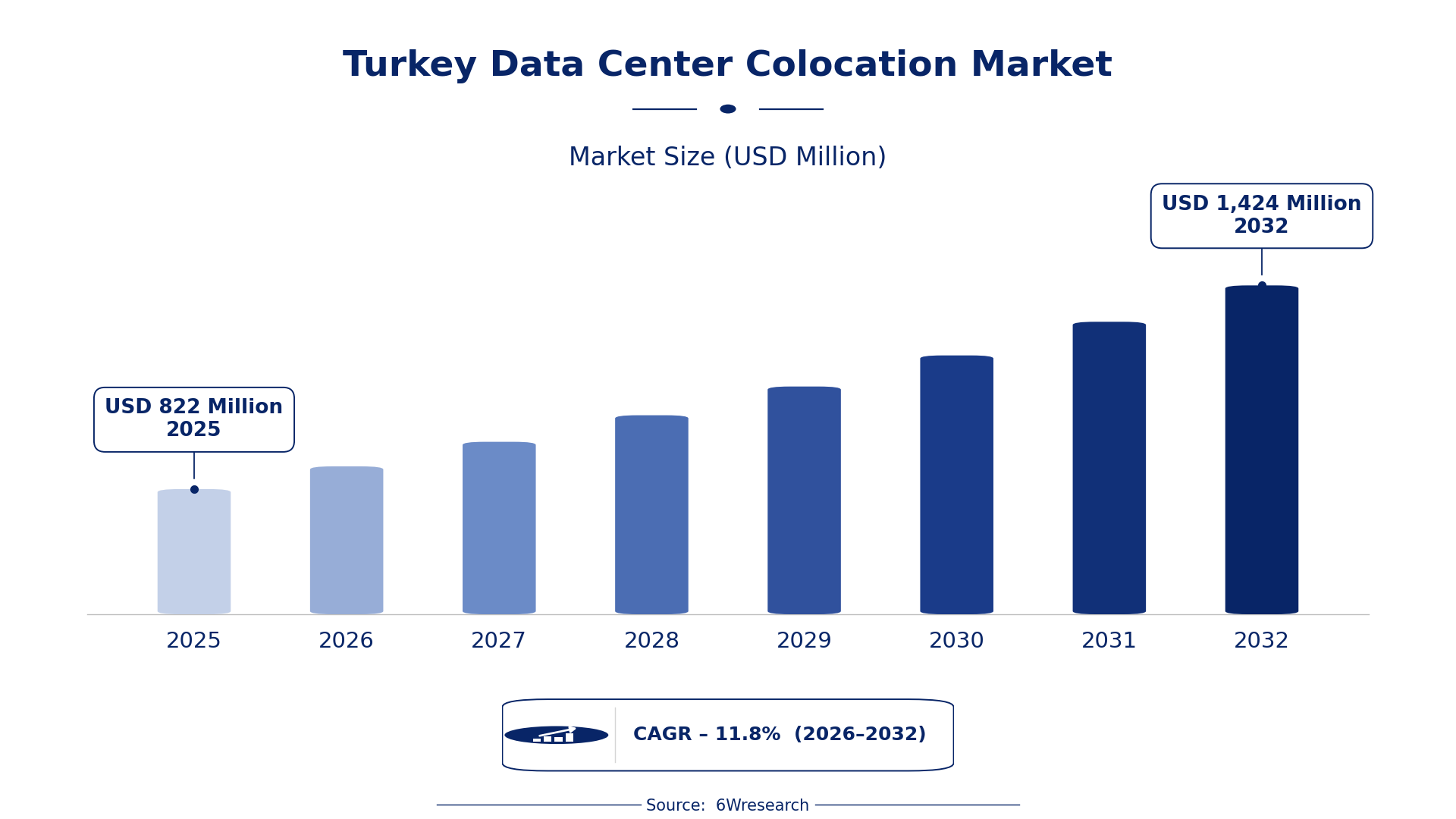
The Turkey Data Center Colocation Market was estimated at USD 822 Million in 2025 and is projected to reach USD 1424 Million by 2032, growing at a CAGR of 11.8% from 2026 to 2032.
Turkey Data Center Colocation Market Synopsis
The Turkey Data Center Colocation Market is witnessing a surge as enterprises increasingly outsource their IT infrastructure. This shift is driven by a pressing need for scalability and cost efficiency, prompting businesses to seek reliable colocation services that offer both security and flexibility.
Recent advancements in data center technologies, such as tiered designs and enhanced connectivity options, are further accelerating growth. As Turkish businesses embrace digital transformation, the demand for colocation services is expected to remain strong, particularly in sectors that prioritize data security and disaster recovery.
Turkey Data Center Colocation Market Year-wise Growth Rate and Key Drivers
This graph illustrates the annual growth rates of the Turkey Data Center Colocation Market from 2021 to 2032, highlighting a steady upward trajectory and projected expansion over the forecast period.
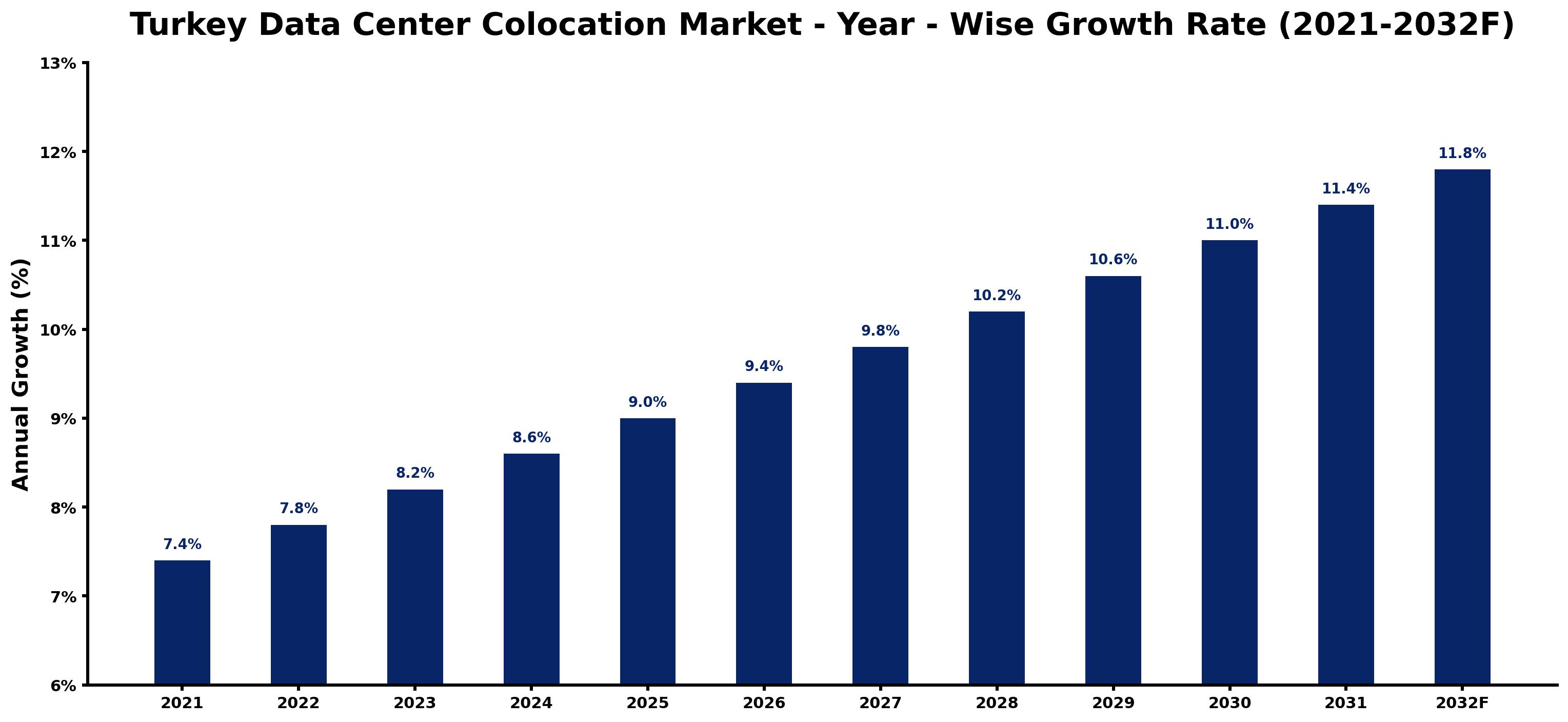
The table below presents the year‑wise growth rates along with the key drivers influencing the market
| Year | Growth Rate | Major Drivers |
| 2021 | 7.4% | Increased internet penetration fostering cloud service demand. |
| 2022 | 7.8% | Government support for tech startups boosting colocation services. |
| 2023 | 8.2% | Growing mobile application usage driving data center expansion. |
| 2024 | 8.6% | Regulatory compliance mandates increasing data protection services. |
| 2025 | 9.0% | Surge in local gaming industry requiring high-capacity data. |
| 2026 | 9.4% | Emergence of 5G technology enhancing data processing needs. |
| 2027 | 9.8% | Increase in remote work driving demand for reliable hosting. |
| 2028 | 10.2% | Rise in telehealth services creating need for secure storage. |
| 2029 | 10.6% | Local cybersecurity regulations prompting need for colocation spaces. |
| 2030 | 11.0% | Urbanization trends requiring more localized data solutions. |
| 2031 | 11.4% | Green technology initiatives promoting energy-efficient data centers. |
| 2032 | 11.8% | Growth in IoT applications needing scalable data solutions. |
Note: Market size estimations and growth projections presented in this report are based on 6Wresearch's proprietary forecasting methodology, utilizing the latest available industry data, government publications, and primary research inputs.
Turkey Data Center Colocation Market Key Takeaways
Below are some of the specific key takeaways from the market, including:
- The market is driven by the need for secure and scalable IT infrastructure solutions.
- Government regulations promoting data residency are creating more opportunities for colocation providers.
- Hybrid IT environments are becoming increasingly popular among enterprises, driving demand for colocation services.
- Recent innovations in data center technology are enhancing service reliability and performance.
- Managed services are on the rise, indicating a shift in how businesses approach their IT needs.
Evaluation of Restraints in Turkey Data Center Colocation Market
Despite promising growth, the Turkey Data Center Colocation Market faces several constraints. One significant issue is the scalability of existing facility infrastructure, which can hinder the ability of providers to accommodate increasing demand. Compliance with service level agreements (SLAs) regarding uptime and reliability remains a pressing challenge. Additionally, the lack of diverse network connectivity options can limit service offerings, making it difficult for businesses to find solutions that meet their specific needs. The industry must also address concerns regarding security and compliance to instill greater confidence among potential clients.
Turkey Data Center Colocation Market Trends
Several trends are shaping the Turkey Data Center Colocation Market. The transition to hybrid IT environments is particularly noteworthy, as organizations seek to combine on-premises and cloud solutions for optimal performance. Additionally, the push for enhanced disaster recovery strategies has led many enterprises to prioritize colocation services that ensure data security and business continuity. The rise of managed services is also changing the landscape, as companies prefer outsourcing specific IT functions to specialized providers, allowing them to focus on core business activities.
Turkey Data Center Colocation Market Opportunities
The market is ripe with growth opportunities, particularly as Turkish businesses undergo digital transformation. Investment in cloud adoption will continue to drive demand for colocation services, especially from sectors such as finance, healthcare, and telecommunications. Companies looking to enhance their operational flexibility and reduce capital expenditures are increasingly turning to colocation as a strategic solution. on top of that, the growing emphasis on compliance with data protection regulations is expected to create additional opportunities for providers who can demonstrate robust security measures and service reliability.
Government Initiatives in the Turkey Data Center Colocation Market
Government policy is playing a crucial role in shaping the Turkey Data Center Colocation Market. With initiatives aimed at enhancing IT infrastructure and encouraging data management outsourcing, public policy is fostering a favorable environment for colocation services. As regulatory frameworks evolve, they are focusing on standards that promote security and resilience within the industry.
- A regulatory framework introduced in 2025 mandating compliance with data residency laws has strengthened the market.
- Currently underway is a national digital infrastructure upgrade program focused on improving data center connectivity across the country.
- A planned public-private initiative aims to enhance service reliability by expanding access to high-speed internet by 2028.
- Government grants for tech startups are encouraging innovation in the data center sector, helping new players enter the market.
- Ongoing discussions on data protection regulations are expected to lead to stricter compliance measures in the coming years.
Future Insights of the Turkey Data Center Colocation Market
Looking ahead to 2026-2032, the Turkey Data Center Colocation Market is set to evolve significantly. The increasing reliance on cloud services and digital transformation will drive further adoption of colocation solutions. Providers that can adapt to changing technological needs and regulatory requirements will position themselves for success. on top of that, as businesses continue to prioritize cybersecurity and data integrity, those offering advanced security features will find themselves at an advantage. The market will likely see more collaborations between tech companies and colocation providers, enhancing service delivery and innovation.
Turkey Data Center Colocation Market Latest Developments
Recent activity in the Turkey Data Center Colocation Market has been vibrant, reflecting a trend toward enhanced service offerings and technological advancements. As companies strive to remain competitive, many are investing heavily in upgrading their infrastructure and expanding their service capabilities.
- A major technology vendor announced the rollout of a new energy-efficient data center design, expected to begin in Q3 2025.
- In early 2025, a leading regional operator completed the expansion of its colocation facilities, increasing capacity to meet rising demand.
- An initiative to implement advanced cooling technologies is currently underway, aimed at improving energy efficiency by mid-2026.
- A partnership between a colocation provider and a cloud services company was recently formed to offer integrated solutions, enhancing service flexibility.
- Plans for a new data center facility, set to break ground in late 2025, are underway to accommodate the growing needs of local enterprises.
Turkey Data Center Colocation Market - Key Attractiveness of the Report
- 10 Years of Market Numbers
- Historical Data Starting from 2022 to 2025
- Base Year: 2025
- Forecast Data until 2032
- Key Performance Indicators Impacting the Market
- Major Upcoming Developments and Projects
Key Highlights of the Report:
- Turkey Data Center Colocation Market Outlook
- Market Size of Turkey Data Center Colocation Market, 2025
- Forecast of Turkey Data Center Colocation Market, 2032
- Historical Data and Forecast of Turkey Data Center Colocation Revenues & Volume for the Period 2022-2032F
- Turkey Data Center Colocation Market Trend Evolution
- Turkey Data Center Colocation Market Drivers and Challenges
- Turkey Data Center Colocation Price Trends
- Turkey Data Center Colocation Porter's Five Forces
- Turkey Data Center Colocation Industry Life Cycle
- Historical Data and Forecast of Turkey Data Center Colocation Market Revenues & Volume By Type for the Period 2022-2032F
- Historical Data and Forecast of Turkey Data Center Colocation Market Revenues & Volume By Retail colocation for the Period 2022-2032F
- Historical Data and Forecast of Turkey Data Center Colocation Market Revenues & Volume By Wholesale colocation for the Period 2022-2032F
- Historical Data and Forecast of Turkey Data Center Colocation Market Revenues & Volume By End-User for the Period 2022-2032F
- Historical Data and Forecast of Turkey Data Center Colocation Market Revenues & Volume By Small and Medium-Sized Enterprises (SMEs) for the Period 2022-2032F
- Historical Data and Forecast of Turkey Data Center Colocation Market Revenues & Volume By Large Enterprises for the Period 2022-2032F
- Historical Data and Forecast of Turkey Data Center Colocation Market Revenues & Volume By Industry for the Period 2022-2032F
- Historical Data and Forecast of Turkey Data Center Colocation Market Revenues & Volume By Banking, Financial Services, and Insurance (BFSI) for the Period 2022-2032F
- Historical Data and Forecast of Turkey Data Center Colocation Market Revenues & Volume By IT and telecom for the Period 2022-2032F
- Historical Data and Forecast of Turkey Data Center Colocation Market Revenues & Volume By Government and defense for the Period 2022-2032F
- Historical Data and Forecast of Turkey Data Center Colocation Market Revenues & Volume By Healthcare for the Period 2022-2032F
- Historical Data and Forecast of Turkey Data Center Colocation Market Revenues & Volume By Research and academics for the Period 2022-2032F
- Historical Data and Forecast of Turkey Data Center Colocation Market Revenues & Volume By Retail for the Period 2022-2032F
- Historical Data and Forecast of Turkey Data Center Colocation Market Revenues & Volume By Energy for the Period 2022-2032F
- Historical Data and Forecast of Turkey Data Center Colocation Market Revenues & Volume By Manufacturing for the Period 2022-2032F
- Turkey Data Center Colocation Import Export Trade Statistics
- Market Opportunity Assessment By Type
- Market Opportunity Assessment By End-User
- Market Opportunity Assessment By Industry
- Turkey Data Center Colocation Top Companies Market Share
- Turkey Data Center Colocation Competitive Benchmarking By Technical and Operational Parameters
- Turkey Data Center Colocation Company Profiles
- Turkey Data Center Colocation Key Strategic Recommendations






































