Turkey Data Center Market Growth Rate
According to 6Wresearch internal databases and industry insights, Turkey Data Center Market is projected to grow at a steady compound annual growth rate (CAGR) of 5.5% during the forecast period 2026–2032.
Turkey Data Center Market Year-wise Growth Rate and Key Drivers (2022-2032)
This graph illustrates the annual growth rates of the Turkey Data Center Market from 2022 to 2032, highlighting a steady upward trajectory and projected market expansion over the forecast period.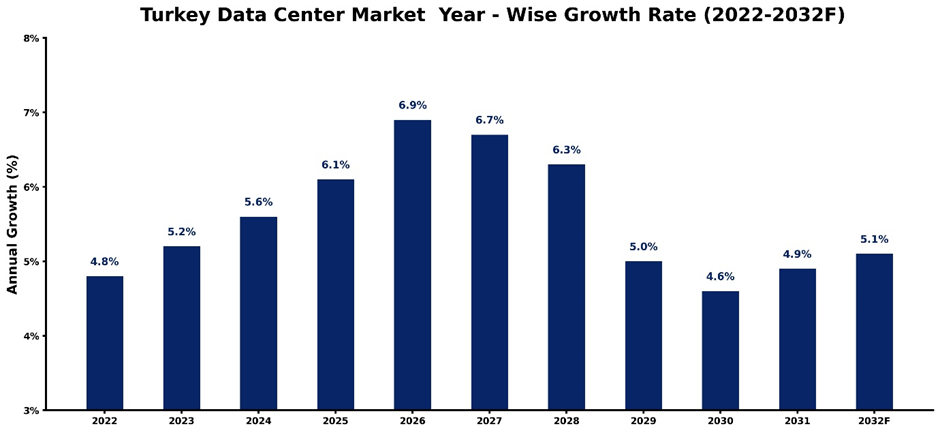 The following table summarizes the historical and forecasted growth rates of Turkey Data Center Market, along with the rationale behind each year’s performance.
| Year | Estimated Annual Growth (%) | Market Rationale |
| 2022 | 4.8% | Post-pandemic digital transformation increased cloud adoption, enterprise IT spending, and online service demand. |
| 2023 | 5.2% | Growth supported by rising cloud workloads, e-commerce expansion, telecom traffic, and enterprise digitalization. |
| 2024 | 5.6% | Increasing colocation demand, hybrid cloud adoption, and investment in Tier III facilities accelerated market expansion. |
| 2025 | 6.1% | AI workloads, data localization needs, and growing demand from BFSI, telecom, and government sectors increased infrastructure requirements. |
| 2026 | 6.9% | Hyperscale cloud expansion, AI computing requirements, and increased data center investments drive stronger growth. |
| 2027 | 6.7% | Edge computing adoption, IoT growth, and increasing enterprise cloud migration support continued expansion. |
| 2028 | 6.3% | Cloud migration continues, but growth moderates due to higher construction, energy, and operational costs. |
| 2029 | 5% | Market begins to mature; demand remains strong from telecom operators, enterprises, and digital service providers. |
| 2030 | 4.6% | Data center modernization, renewable energy adoption, and efficiency improvements support steady growth. |
| 2031 | 4.9% | Demand for secure local data storage, AI-ready infrastructure, and cybersecurity solutions sustains market growth. |
| 2032 | 5.1% | Long-term digital economy expansion, cloud adoption, AI applications, and increasing data consumption maintain positive growth. |
Topics Covered in Turkey Data Center Market Report
The Turkey Data Center Market Report thoroughly covers the market by component and vertical. The market report provides an unbiased and detailed analysis of the ongoing market trends, opportunities, and market drivers. This would help stakeholders devise and align their market strategies according to the current and future market dynamics.
Turkey Data Center Market Highlights
| Report Name | Turkey Data Center Market |
| Forecast period | 2026-2032 |
| CAGR | 5.5% |
| Growing Sector | IT & Telecom |
Turkey Data Center Market Synopsis
Turkey Data Center Market is estimated to witness significant growth due to increasing digital transformation, rising cloud adoption, and the country’s strategic position between Europe, Asia, and the Middle East. Turkey has emerged as an important regional data center hub, supported by expanding internet penetration, enterprise cloud migration, fintech growth, e-commerce expansion, and increasing demand for localized data storage. Data center development is accelerated in recent years, by investments from telecom operators, colocation providers, and international technology companies.
Evaluation of Growth Drivers in Turkey Data Center Market (2026–2032)
Below are the major drivers influencing market dynamics:
| Drivers | Primary Segment Affected | Why It Matters (Evidence) |
| Rapid Cloud Adoption & Enterprise Digital Transformation | Cloud, Colocation, Hyperscale | Turkish enterprises are migrating workloads to cloud platforms to improve scalability and business agility. |
| Increasing Colocation Demand & Local Data Storage Requirements | Colocation & Enterprise Data Centers | Local data center expanded due to growing demand for secure domestic data hosting. |
| AI, Big Data & High-Performance Computing Growth | Hyperscale / AI Data Centers | Increasing AI applications and automation require high-density computing infrastructure. |
| Strategic Geographic Location Between Europe & Asia | Hyperscale & Connectivity Infrastructure | Turkey’s location creates digital bridge, attracting international infrastructure investments. |
| 5G Expansion & Rising Internet Usage | Edge & Cloud Infrastructure | Demand for edge data center deployments enhanced due to increasing mobile data consumption. |
The Turkey Data Center market is set to witness progress at a CAGR of 5.5% during 2026–2032. The major reasons for the market growth rapid cloud adoption, AI workloads, and colocation expansion. Due to rising enterprise digitization, fintech growth, and increasing internet usage, Turkey’s data center capacity is projected to rise from 500 MW in 2025 to over 900 MW by 2032. Also, Turkey remains an attractive regional data center hub, due to its strategic position connecting Europe, Asia, and the Middle East and more than 80 million internet users.
Evaluation of Restraints in Turkey Data Center Market
Below are the major restraints influencing market dynamics:
| Restraints | Primary Segment Affected | What This Means (Evidence) |
| Rising Energy Costs & Power Availability Concerns | Hyperscale & Large Data Centers | Data centers require significant electricity consumption, which will impact operational expenses and investment decisions. |
| Currency Fluctuation & Imported Equipment Costs | All Segments | Costs for imported servers and infrastructure components surged due to depreciation of the Turkish Lira. |
| High Infrastructure Investment Requirements | Hyperscale & Colocation | Large-scale facilities require significant CAPEX for land, cooling infrastructure, and connectivity. |
| Regulatory Compliance & Data Sovereignty Requirements | Cloud & International Operators | Operational complexity may surge due to changing regulations around data storage, cybersecurity, and localization. |
| Limited Renewable Energy Integration | Sustainable Data Centers | Increasing sustainability expectations create pressure to integrate renewable energy solutions. |
Turkey Data Center Market Challenges
The Turkey Data Center market is tackling with challenges such as geographic concentration, with over 70% of facilities located around Istanbul and major urban hubs, thus creating dependency risks. Rising electricity costs, energy availability concerns, and increasing AI workloads requiring 30–50 kW high-density racks pressure infrastructure development. Costs surged for imported servers and cooling equipment, while regulatory compliance adds complexity, due to volatile currency. Additionally, Turkey’s data protection framework requires operators to invest in digital threats and compliance systems.
Turkey Data Center Market Trends
Major trends influencing the Turkey data center market include the following:
- Developing AI-Ready Data Center Infrastructure: The growing use of AI and machine learning applications is leading to rise in demand for GPU-enabled infrastructure and high-density racks.
- Growth of Edge Data Center: Distributed edge data center deployments outside of major metros are being fueled by IoT, fintech, smart city initiatives, and low latency digital apps.
- Adoption of Green Data Center: Growing focus on integrating renewable energy and sustainable facility designs to help minimize operational costs and meet ESG goals.
- Development of a Regional Connectivity Hub: Turkey’s position is attracting investment in submarine cable networks, internet exchanges, and regional connectivity infrastructure.
Investment Opportunities in Turkey Data Center Market
Growth-oriented investment opportunities in the Turkey data center industry include the following:
- Growth of the Edge Computing Network: Distributed edge investments can help to bolster Turkey’s growing digital ecosystem which will feature fintech, e-commerce, and IoT applications.
- Data Centers Powered by Renewable Energy: There are opportunities to reduce operating costs and improve sustainability performance through solar, wind, and hybrid energy solutions.
- International Connectivity Infrastructure: Investments in the submarine cables and fiber networks have will strengthen Turkey’s role as a digital gateway between continents.
- AI and High-Performance Computing Facilities: The requirement for AI training creates opportunities for specialized high-density data centers with advanced cooling capabilities.Top of Form
Top Leading Players in Turkey Data Center Market
A detailed compilation of major companies active in the Turkey data center market is presented below:
1. Turkcell
| Company Name | Turkcell |
|---|---|
| Established Year | 1994 |
| Headquarters | Istanbul, Turkey |
| Official Website | Click Here |
Turkcell is a major Turkish telecommunications and digital infrastructure provider, operating data center facilities and offering cloud computing, hosting, and enterprise digital services.
2. Türk Telekom
| Company Name | Türk Telekom |
|---|---|
| Established Year | 1995 |
| Headquarters | Ankara, Turkey |
| Official Website | Click Here |
Türk Telekom is a leading telecommunications and digital infrastructure provider in Turkey, offering data center, cloud, managed hosting, cybersecurity, and enterprise connectivity services.
3. Equinix
| Company Name | Equinix |
|---|---|
| Established Year | 1998 |
| Headquarters | Redwood City, California, USA |
| Official Website | Click Here |
Equinix is a global digital infrastructure and colocation provider offering secure data center, interconnection, and cloud-connectivity services for enterprises and network providers.
4. Vodafone Turkey
| Company Name | Vodafone Turkey |
|---|---|
| Established Year | 2005 |
| Headquarters | Istanbul, Turkey |
| Official Website | Click Here |
Vodafone Turkey is a major telecommunications operator providing enterprise connectivity, cloud, hosting, and digital infrastructure services to businesses across Turkey.
5. Telehouse Istanbul (İsnet)
| Company Name | Telehouse Istanbul (İsnet) |
|---|---|
| Established Year | 1999 |
| Headquarters | Istanbul, Turkey |
| Official Website | Click Here |
Telehouse Istanbul, operated by İsnet, provides carrier-neutral colocation and data center services, supporting enterprises with secure infrastructure, connectivity, and reliable hosting capabilities.
Top of FormGovernment Initiatives Introduced in the Turkey Data Center Market
According to the Turkish government data, the market is supported by several initiatives which is aimed at strengthening the data center ecosystem, focusing on digital transformation and data localization. Programs promoting cloud adoption and technology infrastructure development are boosting Turkey Data Center Market revenue by increasing demand for domestic data storage. Turkey’s e-Government Gateway initiative encourages digital service adoption and drives data management needs. Furthermore, investments in fiber connectivity and renewable energy integration, will support data center expansion.
Future Insights of the Turkey Data Center Market
The market is expected to witness consistent progress by 2032, backed by cloud adoption, AI workloads, and digital transformation. Surging requirement from fintech, e-commerce, telecom, and enterprise sectors will accelerate infrastructure investments. Data center capacity expected to expand from around 500 MW in 2025 to over 900 MW by 2032, results in expansion of the Turkey Data Center Market size. Turkey’s strategic location, with 80+ million internet users, will strengthen its role as a regional digital connectivity hub.
Market Segmentation Analysis
This report presents a detailed analysis of the market segments along with their leading categories:
By Component - Electrical Infrastructure Led the Market and Networking Infrastructure Set for Rapid Growth
According to Ravi Bhandari, Senior Research Analyst, 6Wresearch, by component, in 2025, the Electrical Infrastructure segment led the Turkey Data Center Market with 40% market share, driven by high power requirements and increasing rack densities. Meanwhile, by 2032, the Networking Infrastructure segment is expected to witness the fastest growth with a CAGR of around 7%, supported by rising cloud adoption and increasing demand for high-speed connectivity.
By Vertical - IT & Telecom Dominated the Market and Banking, Financial Services & Insurance (BFSI) Set for Rapid Expansion
By vertical, due to large-scale network infrastructure requirements and telecom expansion, the IT & Telecom led the Turkey Data Center Market with 40% market share in 2025. However, owing to fintech expansion and increasing demand for compliant data storage, the Banking, Financial Services & Insurance (BFSI) is expected to witness the fastest growth with a CAGR of around 7% during 2026-2032.
Note: Market size estimations and growth projections presented in this report are based on 6Wresearch's proprietary forecasting methodology, utilizing the latest available industry data, government publications, and primary research inputs.
Key Attractiveness of the Report:
- 10 Years of Market Numbers
- Historical Data Starting from 2022 to 2025
- Base Year: 2025
- Forecast Data until 2032
- Key Performance Indicators Impacting the Market
- Major Upcoming Developments and Projects
Key Highlights of the Report:
- Turkey Data Center Market Outlook
- Market Size of Turkey Data Center Market, 2025
- Forecast of Turkey Data Center Market, 2032
- Historical Data and Forecast of Turkey Data Center Revenues & Volume for the Period 2022-2032
- Turkey Data Center Market Trend Evolution
- Turkey Data Center Market Drivers and Challenges
- Turkey Data Center Price Trends
- Turkey Data Center Porter's Five Forces
- Turkey Data Center Industry Life Cycle
- Historical Data and Forecast of Turkey Data Center Market Revenues & Volume By Component for the Period 2022-2032
- Historical Data and Forecast of Turkey Data Center Market Revenues & Volume By Electrical for the Period 2022-2032
- Historical Data and Forecast of Turkey Data Center Market Revenues & Volume By Mechanical for the Period 2022-2032
- Historical Data and Forecast of Turkey Data Center Market Revenues & Volume By Networking for the Period 2022-2032
- Historical Data and Forecast of Turkey Data Center Market Revenues & Volume By Racks for the Period 2022-2032
- Historical Data and Forecast of Turkey Data Center Market Revenues & Volume By Security Systems for the Period 2022-2032
- Historical Data and Forecast of Turkey Data Center Market Revenues & Volume By Fire Systems for the Period 2022-2032
- Historical Data and Forecast of Turkey Data Center Market Revenues & Volume By Vertical for the Period 2022-2032
- Historical Data and Forecast of Turkey Data Center Market Revenues & Volume By Banking Financial Services & Insurance (BFSI) for the Period 2022-2032
- Historical Data and Forecast of Turkey Data Center Market Revenues & Volume By Government for the Period 2022-2032
- Historical Data and Forecast of Turkey Data Center Market Revenues & Volume By IT & Telecom for the Period 2022-2032
- Historical Data and Forecast of Turkey Data Center Market Revenues & Volume By Media for the Period 2022-2032
- Historical Data and Forecast of Turkey Data Center Market Revenues & Volume By Retail for the Period 2022-2032
- Historical Data and Forecast of Turkey Data Center Market Revenues & Volume By Manufacturing for the Period 2022-2032
- Historical Data and Forecast of Turkey Data Center Market Revenues & Volume By Others for the Period 2022-2032
- Turkey Data Center Import Export Trade Statistics
- Market Opportunity Assessment By Component
- Market Opportunity Assessment By Vertical
- Turkey Data Center Top Companies Market Share
- Turkey Data Center Competitive Benchmarking By Technical and Operational Parameters
- Turkey Data Center Company Profiles
- Turkey Data Center Key Strategic Recommendations
Market Scope and Segmentation
The report provides a detailed analysis of the following market segments:
By Component
- Electrical
- Mechanical
- Networking
- Racks
- Security Systems
- Fire Systems
By Vertical
- Banking Financial Services & Insurance (BFSI)
- Government
- IT & Telecom
- Media
- Retail
- Manufacturing
- Others






































