Turkey Data Governance Market Size & Growth Rate (2026-2032)
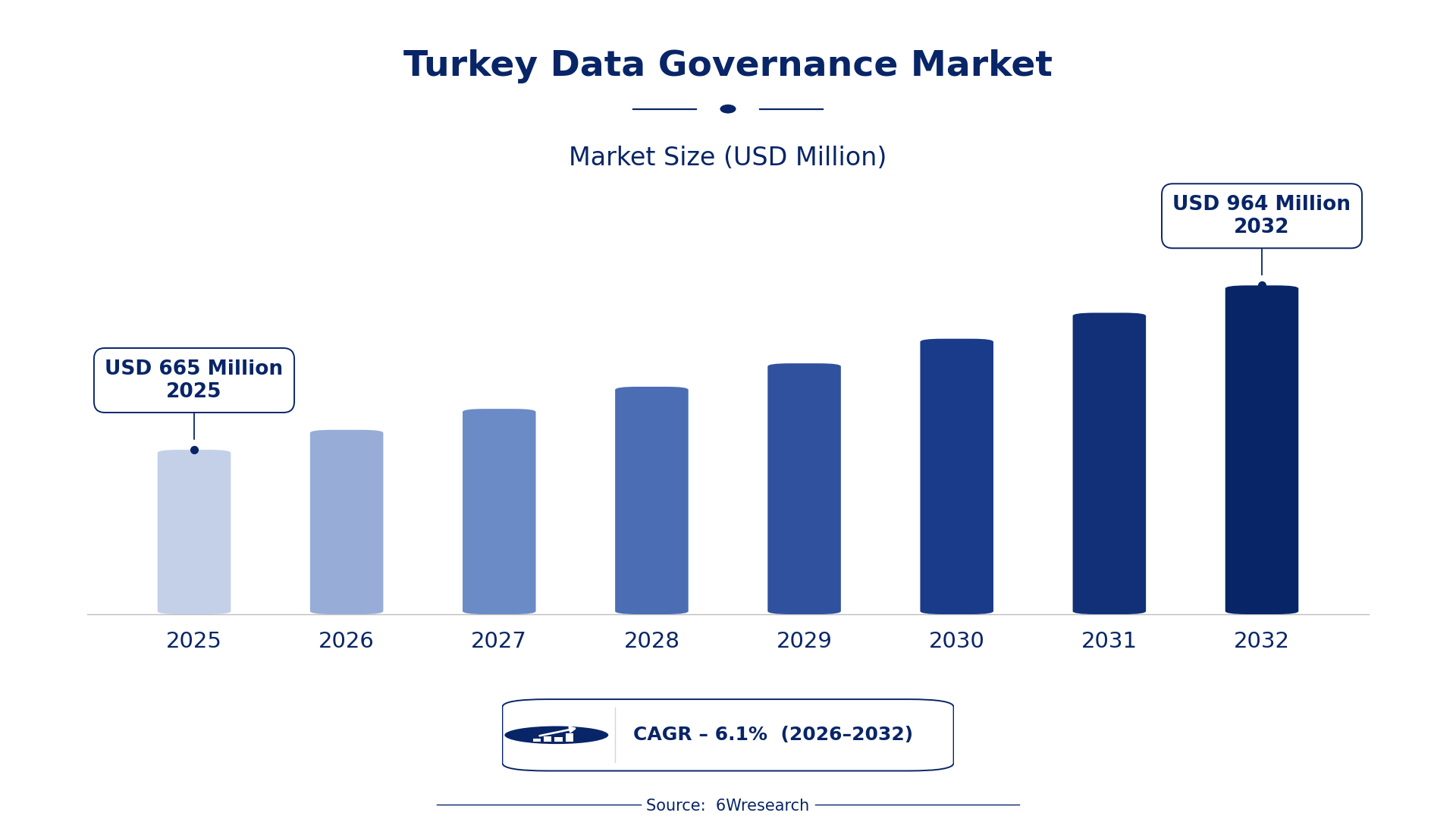
The Turkey Data Governance Market was estimated at USD 665 Million in 2025 and is projected to reach USD 964 Million by 2032, growing at a CAGR of 6.1% from 2026 to 2032.
Turkey Data Governance Market Synopsis
As organizations in Turkey increasingly recognize the critical importance of data governance, the market is witnessing a notable acceleration. This momentum is fueled by a growing demand for frameworks that ensure data integrity and compliance across various sectors, particularly as digital transformation initiatives gain traction.
However, the journey ahead is not without its hurdles. Businesses are grappling with the complexities of implementing effective data governance frameworks, navigating regulatory compliance, and ensuring data quality management, which are essential for sustainable growth in Turkey's competitive landscape.
Turkey Data Governance Market Year-wise Growth Rate and Key Drivers
This graph illustrates the annual growth rates of the Turkey Data Governance Market from 2021 to 2032, highlighting a steady upward trajectory and projected expansion over the forecast period.
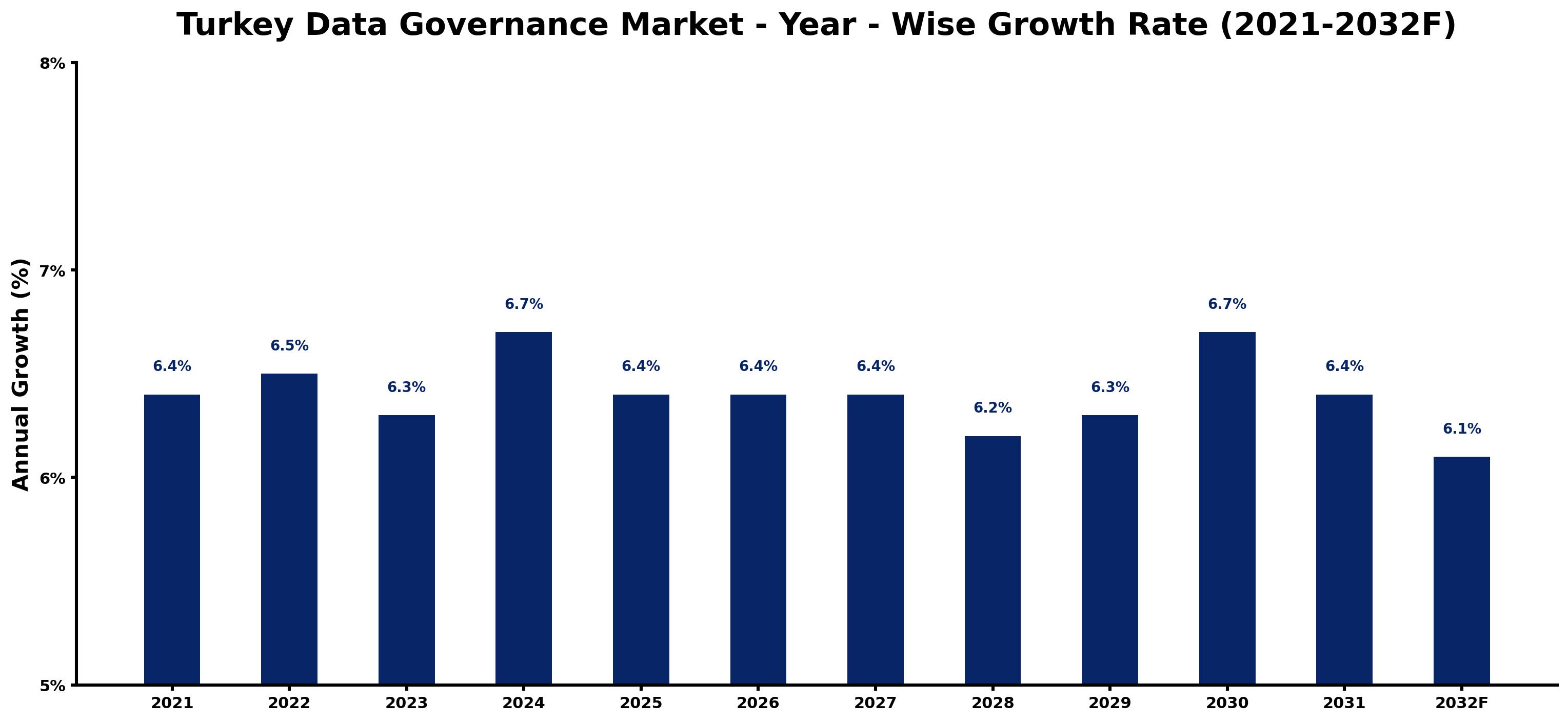
The table below presents the year‑wise growth rates along with the key drivers influencing the market
| Year | Growth Rate | Major Drivers |
| 2021 | 6.4% | Implementation of personal data protection law by KVKK |
| 2022 | 6.5% | Increased public sector focus on digital transformation initiatives |
| 2023 | 6.3% | Growing adoption of cloud services among Turkish enterprises |
| 2024 | 6.7% | Highlighting cybersecurity regulations from BTK for data safety |
| 2025 | 6.4% | Emergence of local fintech driving data governance needs |
| 2026 | 6.4% | Government incentives for data-driven innovation technologies |
| 2027 | 6.4% | Rise in demand for data privacy compliance certifications |
| 2028 | 6.2% | Turkish firms investing in AI for data management solutions |
| 2029 | 6.3% | Boost in e-commerce data analytics for consumer insights |
| 2030 | 6.7% | New regulations on data sharing from Turkish health authority |
| 2031 | 6.4% | Increasing investments in cybersecurity technologies across sectors |
| 2032 | 6.1% | Focus on big data analytics in retail for personalization |
Note: Market size estimations and growth projections presented in this report are based on 6Wresearch's proprietary forecasting methodology, utilizing the latest available industry data, government publications, and primary research inputs.
Turkey Data Governance Market Key Takeaways
Below are some of the specific key takeaways from the market, including:
- The market is driven by the need for structured data policies and compliance with regulations.
- AI-driven data governance platforms are emerging as transformative solutions for enterprises.
- Investment in data quality management and transparency is critical for organizational success.
- Regulatory frameworks are evolving, pushing organizations to adopt robust governance strategies.
- The focus on data democratization is reshaping how organizations manage and utilize data.
Evaluation of Restraints in Turkey Data Governance Market
Organizations in Turkey face several constraints that limit the full realization of data governance potential. One major issue is the clarity and distribution of data stewardship roles and responsibilities, which can lead to inefficiencies and compliance risks. The evolving regulatory environment, particularly concerning data privacy laws, adds another layer of complexity, as organizations must constantly adapt to new requirements. on top of that, establishing comprehensive governance frameworks that encompass policies and standards remains a challenge, hindering effective data management across various IT systems.
Turkey Data Governance Market Trends
The Turkey Data Governance Market is currently shaped by several key trends that reflect the evolving priorities of organizations. A significant trend is the shift towards AI-driven solutions that facilitate automated compliance monitoring, enhancing operational efficiency. Additionally, organizations are increasingly prioritizing data quality management to ensure the reliability and accuracy of data assets. The concept of data democratization is also gaining traction, encouraging a culture of data-driven decision-making across all levels of enterprises.
Turkey Data Governance Market Opportunities
Opportunities for growth in the Turkey Data Governance Market are abundant, particularly for organizations willing to invest in innovative data governance frameworks. The rising emphasis on regulatory compliance presents a chance for service providers to develop tailored solutions that cater to specific industry needs. on top of that, as businesses embark on digital transformation journeys, there is an increasing demand for integrated data governance platforms that can facilitate streamlined operations and enhance data-driven insights.
Government Initiatives in the Turkey Data Governance Market
Government policies play a crucial role in shaping the Turkey Data Governance Market, with a focus on enhancing data management and regulatory compliance across sectors. Recent initiatives demonstrate a commitment to improving data privacy and security, directly influencing how organizations approach governance. As Turkey's digital economy continues to expand, these policy efforts are vital for fostering a transparent and accountable data ecosystem.
- A recently launched initiative aimed at enhancing public sector data management practices has set new standards for transparency and accountability.
- Currently underway is the development of a national regulatory framework for data privacy, expected to strengthen compliance mechanisms across various industries.
- A planned public-private partnership initiative is projected to enhance data infrastructure capabilities by 2028, promoting better data governance practices.
- Ongoing efforts to refine compliance auditing processes are reinforcing the necessity of governance frameworks for corporate responsibility.
Future Insights of the Turkey Data Governance Market
Looking ahead to 2026-2032, the Turkey Data Governance Market is set to experience transformative growth, driven by an increasing recognition of data as a strategic asset. Organizations will likely prioritize investments in advanced data governance frameworks, as regulatory pressures mount and the demand for data-driven decision-making intensifies. As digital transformation accelerates, the integration of AI and machine learning into governance practices will become imperative, allowing enterprises to optimize their data management processes.
Turkey Data Governance Market Latest Developments
In the past year, the Turkey Data Governance Market has witnessed significant activity, highlighting the sector's dynamic nature. Organizations are increasingly adopting comprehensive data governance solutions, driven by a heightened focus on compliance and data quality. This trend indicates a shift towards more strategic approaches to data management across various industries.
- A leading technology vendor launched a new data governance platform in early 2025, aimed at improving compliance monitoring for enterprises.
- An initiative that began in late 2025 focuses on enhancing metadata management capabilities for public sector organizations, currently underway.
- A collaborative project between industry stakeholders and regulatory bodies was announced in Q1 2026 to address data privacy concerns more effectively.
- A rollout expected to begin in mid-2026 aims to integrate AI capabilities into existing data governance frameworks across multiple sectors.
Turkey Data Governance Market - Key Attractiveness of the Report
- 10 Years of Market Numbers
- Historical Data Starting from 2022 to 2025
- Base Year: 2025
- Forecast Data until 2032
- Key Performance Indicators Impacting the Market
- Major Upcoming Developments and Projects
AI-driven platforms are becoming essential tools for organizations, enabling automated compliance monitoring and enhancing data quality management processes, which are vital in today’s digital economy.
Key Highlights of the Report:
- Turkey Data Governance Market Outlook
- Market Size of Turkey Data Governance Market, 2025
- Forecast of Turkey Data Governance Market, 2032
- Historical Data and Forecast of Turkey Data Governance Revenues & Volume for the Period 2022-2032F
- Turkey Data Governance Market Trend Evolution
- Turkey Data Governance Market Drivers and Challenges
- Turkey Data Governance Price Trends
- Turkey Data Governance Porter's Five Forces
- Turkey Data Governance Industry Life Cycle
- Historical Data and Forecast of Turkey Data Governance Market Revenues & Volume By Application for the Period 2022-2032F
- Historical Data and Forecast of Turkey Data Governance Market Revenues & Volume By Incident management for the Period 2022-2032F
- Historical Data and Forecast of Turkey Data Governance Market Revenues & Volume By Process management for the Period 2022-2032F
- Historical Data and Forecast of Turkey Data Governance Market Revenues & Volume By Compliance management for the Period 2022-2032F
- Historical Data and Forecast of Turkey Data Governance Market Revenues & Volume By Risk management for the Period 2022-2032F
- Historical Data and Forecast of Turkey Data Governance Market Revenues & Volume By Audit management for the Period 2022-2032F
- Historical Data and Forecast of Turkey Data Governance Market Revenues & Volume By Data quality and security management for the Period 2022-2032F
- Historical Data and Forecast of Turkey Data Governance Market Revenues & Volume By Others for the Period 2022-2032F
- Historical Data and Forecast of Turkey Data Governance Market Revenues & Volume By Vertical for the Period 2022-2032F
- Historical Data and Forecast of Turkey Data Governance Market Revenues & Volume By BFSI for the Period 2022-2032F
- Historical Data and Forecast of Turkey Data Governance Market Revenues & Volume By Retail and Consumer Goods for the Period 2022-2032F
- Historical Data and Forecast of Turkey Data Governance Market Revenues & Volume By Telecom and IT for the Period 2022-2032F
- Historical Data and Forecast of Turkey Data Governance Market Revenues & Volume By Government for the Period 2022-2032F
- Historical Data and Forecast of Turkey Data Governance Market Revenues & Volume By Healthcare for the Period 2022-2032F
- Historical Data and Forecast of Turkey Data Governance Market Revenues & Volume By Manufacturing for the Period 2022-2032F
- Historical Data and Forecast of Turkey Data Governance Market Revenues & Volume By Energy and Utilities for the Period 2022-2032F
- Historical Data and Forecast of Turkey Data Governance Market Revenues & Volume By Transportation and Logistics for the Period 2022-2032F
- Historical Data and Forecast of Turkey Data Governance Market Revenues & Volume By Component for the Period 2022-2032F
- Historical Data and Forecast of Turkey Data Governance Market Revenues & Volume By Solutions for the Period 2022-2032F
- Historical Data and Forecast of Turkey Data Governance Market Revenues & Volume By Services for the Period 2022-2032F
- Historical Data and Forecast of Turkey Data Governance Market Revenues & Volume By Deployment Model for the Period 2022-2032F
- Historical Data and Forecast of Turkey Data Governance Market Revenues & Volume By On-premises for the Period 2022-2032F
- Historical Data and Forecast of Turkey Data Governance Market Revenues & Volume By Cloud for the Period 2022-2032F
- Historical Data and Forecast of Turkey Data Governance Market Revenues & Volume By Organisation Size for the Period 2022-2032F
- Historical Data and Forecast of Turkey Data Governance Market Revenues & Volume By Small and Medium-Sized Enterprises (SMEs) for the Period 2022-2032F
- Historical Data and Forecast of Turkey Data Governance Market Revenues & Volume By Large enterprises for the Period 2022-2032F
- Turkey Data Governance Import Export Trade Statistics
- Market Opportunity Assessment By Application
- Market Opportunity Assessment By Vertical
- Market Opportunity Assessment By Component
- Market Opportunity Assessment By Deployment Model
- Market Opportunity Assessment By Organisation Size
- Turkey Data Governance Top Companies Market Share
- Turkey Data Governance Competitive Benchmarking By Technical and Operational Parameters
- Turkey Data Governance Company Profiles
- Turkey Data Governance Key Strategic Recommendations






































