Turkey Data Protection Market Size & Growth Rate (2026-2032)
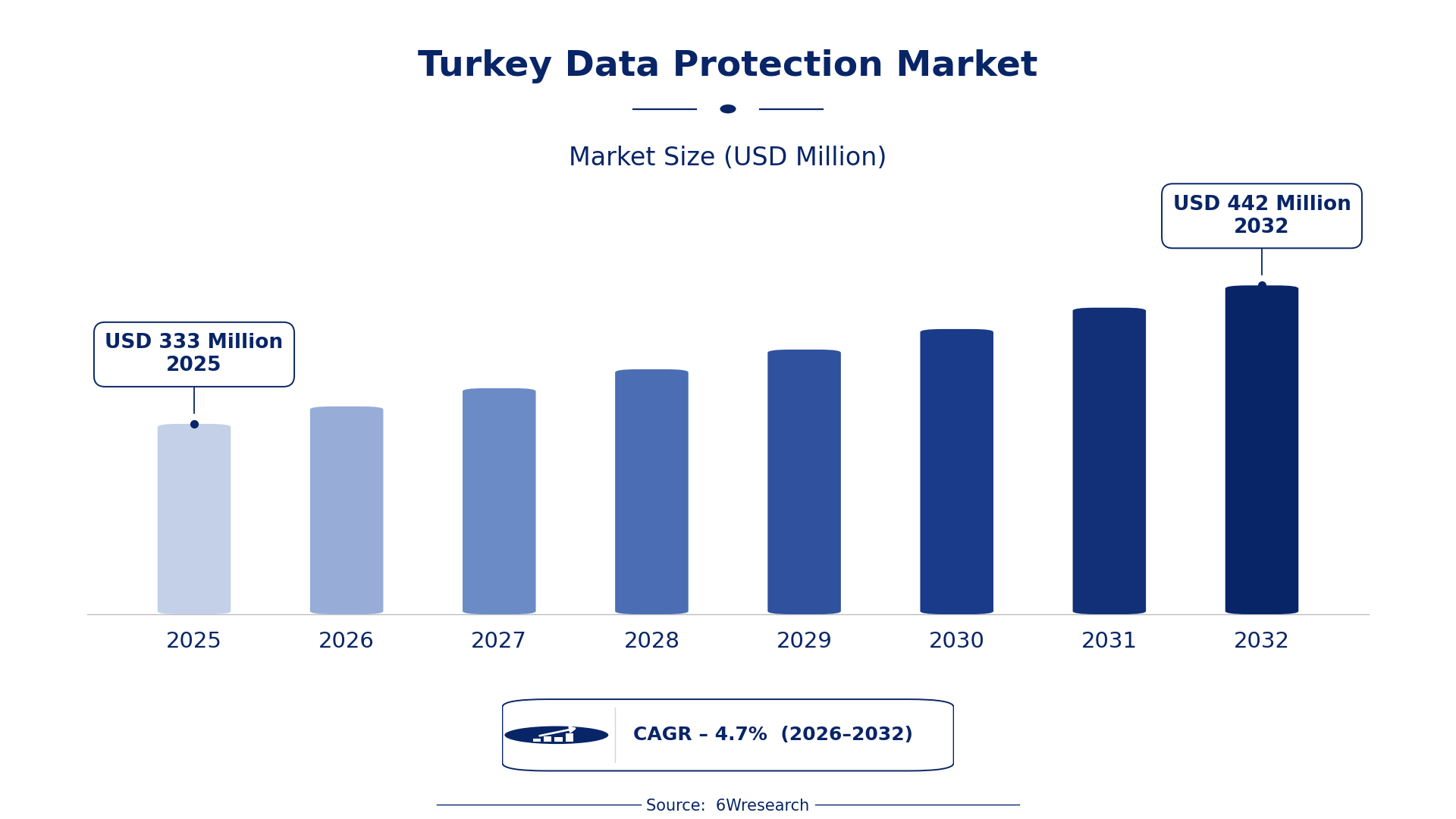
The Turkey Data Protection Market was estimated at USD 333 Million in 2025 and is projected to reach USD 442 Million by 2032, growing at a CAGR of 4.7% from 2026 to 2032.
Turkey Data Protection Market Synopsis
As organizations in Turkey increasingly prioritize data protection, the adoption of advanced solutions is becoming imperative. This demand is fueled by both the need to comply with stringent regulations and the rising awareness among businesses and individuals regarding data privacy.
The influence of the Personal Data Protection Law (KVKK), aligned with GDPR standards, is reshaping operational practices. Companies are compelled to implement robust data security frameworks that not only safeguard sensitive information but also enhance customer trust.
Turkey Data Protection Market Year-wise Growth Rate and Key Drivers
This graph illustrates the annual growth rates of the Turkey Data Protection Market from 2021 to 2032, highlighting a steady upward trajectory and projected expansion over the forecast period.
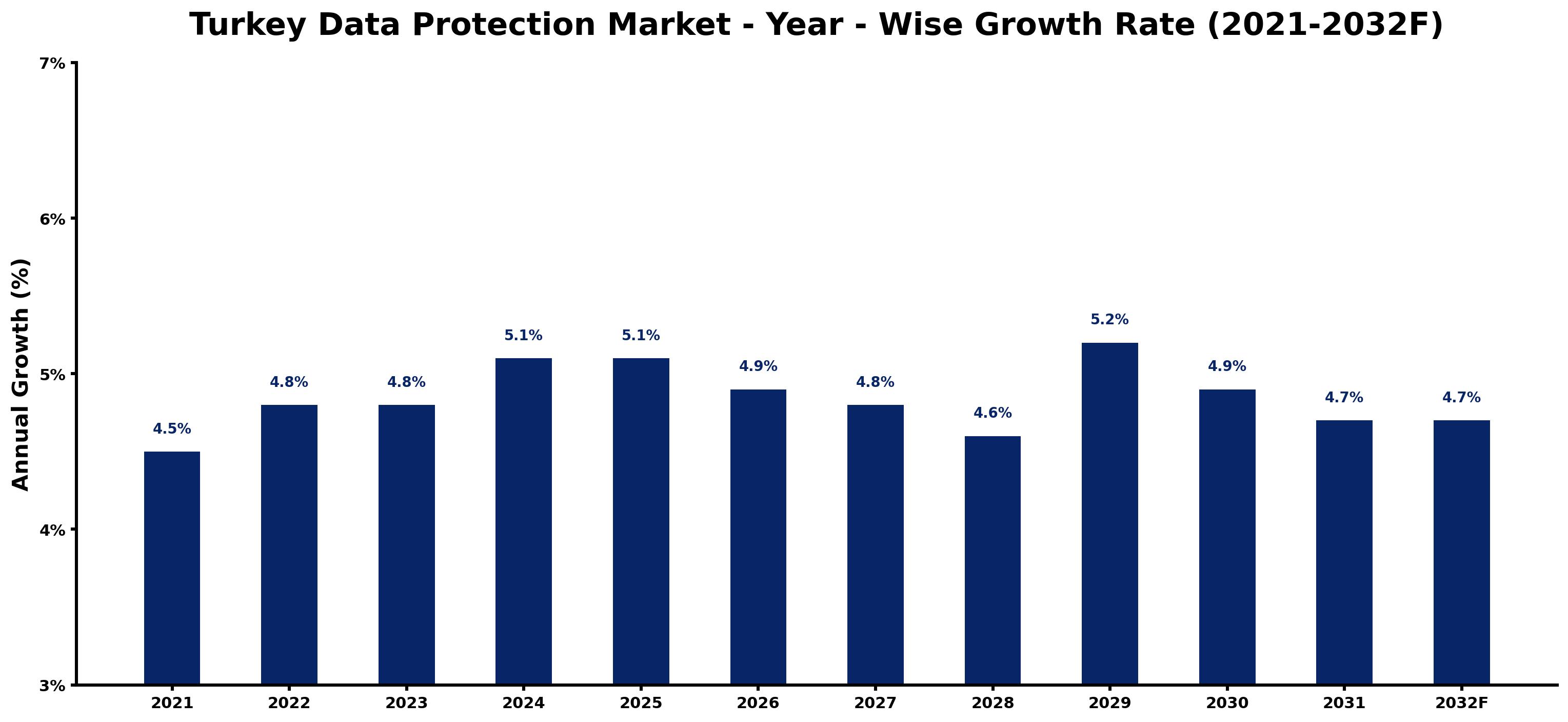
The table below presents the year‑wise growth rates along with the key drivers influencing the market
| Year | Growth Rate | Major Drivers |
| 2021 | 4.5% | Implementation of KVKK bolstering data protection regulations |
| 2022 | 4.8% | Growing concerns over data breaches in Turkish enterprises |
| 2023 | 4.8% | Increase in digital transformation investments by local businesses |
| 2024 | 5.1% | Enhanced regulation enforcement by Personal Data Protection Authority |
| 2025 | 5.1% | Awareness campaigns on data privacy by government agencies |
| 2026 | 4.9% | Corporate governance reforms pushing data protection initiatives |
| 2027 | 4.8% | Rise in cyber threats necessitating stronger data safeguards |
| 2028 | 4.6% | Local businesses adopting stringent data compliance measures |
| 2029 | 5.2% | Collaborations between firms and cybersecurity vendors increasing |
| 2030 | 4.9% | Consumer awareness on data rights driving protection efforts |
| 2031 | 4.7% | Increased penalties for data breaches motivating compliance |
| 2032 | 4.7% | Emergence of data protection training programs for employees |
Note: Market size estimations and growth projections presented in this report are based on 6Wresearch's proprietary forecasting methodology, utilizing the latest available industry data, government publications, and primary research inputs.
Turkey Data Protection Market Key Takeaways
Below are some of the specific key takeaways from the market, including:
- Data protection investments are growing as businesses strive to meet regulatory compliance.
- Encryption and access control technologies are at the forefront of organizational strategies.
- Cloud adoption is increasing, posing new challenges in balancing security and accessibility.
- The Turkish government actively supports organizations in enhancing their data protection measures.
- Awareness campaigns about data privacy are gaining traction among consumers and businesses alike.
Evaluation of Restraints in Turkey Data Protection Market
Despite the upward trajectory, the Turkey Data Protection Market faces several obstacles. Organizations are grappling with continuously evolving cybersecurity threats, which require constant adaptation of strategies. Compliance with legal frameworks adds pressure, as companies must keep abreast of changing regulations. The challenge lies in maintaining operational efficiency while ensuring that data security does not hinder user accessibility, particularly in an era of rapid digital transformation. This tension can stifle innovation and investment in data protection technologies.
Turkey Data Protection Market Trends
Several trends are shaping the Turkey Data Protection Market. The rise of remote work has led to increased vulnerability to cyber threats, prompting organizations to enhance their security frameworks. There's a growing focus on integrating artificial intelligence into data protection solutions, allowing for more proactive threat detection. on top of that, consumer awareness about data privacy is leading companies to adopt transparent practices, which helps build trust. Businesses are also investing in compliance training programs to ensure that employees understand their roles in safeguarding data.
Turkey Data Protection Market Opportunities
Investment opportunities abound for vendors offering innovative data protection solutions. Companies are particularly interested in services that can streamline compliance processes while enhancing security. Solutions that leverage AI and machine learning are appealing, as they can provide sophisticated threat analysis and response mechanisms. Additionally, partnerships with governmental bodies to ensure alignment with regulations could lead to significant market advantages. With organizations prioritizing customer trust, opportunities for consultancy services that guide businesses through compliance challenges are growing.
Government Initiatives in the Turkey Data Protection Market
The Turkish government's proactive stance on data protection is shaping the market significantly. Through regulations such as the Personal Data Protection Law (KVKK), the government has established a framework that mandates strict compliance, fostering a culture of accountability among organizations. Support mechanisms, including guidelines and audits, are aimed at enhancing the overall security posture across various sectors.
- A regulatory framework introduced in 2025 mandates that companies implement comprehensive data protection measures to comply with KVKK.
- Current initiatives focus on conducting audits to ensure organizations are adhering to data protection regulations, with findings published annually.
- A national digital infrastructure upgrade programme launched in early 2025 is aimed at enhancing cybersecurity capabilities across the public sector.
- Upcoming guidelines expected to be released by mid-2026 will provide a roadmap for integrating new technologies into existing data protection strategies.
- Support initiatives for small and medium-sized enterprises to improve their data protection measures have recently been implemented.
Future Insights of the Turkey Data Protection Market
Looking ahead to 2026-2032, the Turkey Data Protection Market is likely to experience robust growth driven by the continued prioritization of data security. As organizations increasingly recognize the ramifications of data breaches, investments in sophisticated protection mechanisms will gain traction. The alignment with international standards such as GDPR will further solidify the focus on compliance. Technological advancements will continue to shape the market, enabling innovative solutions that address emerging cybersecurity threats while fostering trust between companies and consumers.
Turkey Data Protection Market Latest Developments
The past year has seen considerable activity in the Turkey Data Protection Market, reflecting the urgency for organizations to enhance their data security measures. This dynamic environment is characterized by technological advancements, regulatory updates, and increased public awareness. Companies are adapting to these changes as they strive to remain compliant while also protecting sensitive information.
- A major technology vendor launched a cutting-edge data encryption service in Q3 2025 aimed at enhancing data security for businesses.
- Current collaborations between cybersecurity firms and educational institutions are underway to develop comprehensive training programs for data protection compliance.
- An initiative that began in late 2025 focuses on raising public awareness about data privacy rights and responsibilities among consumers.
- A new regulatory compliance tool is set to be rolled out in early 2026, assisting organizations in navigating the KVKK requirements.
- Research partnerships established in 2025 aim to explore innovative approaches to data loss prevention technologies.
Turkey Data Protection Market - Key Attractiveness of the Report
- 10 Years of Market Numbers
- Historical Data Starting from 2022 to 2025
- Base Year: 2025
- Forecast Data until 2032
- Key Performance Indicators Impacting the Market
- Major Upcoming Developments and Projects
Key Highlights of the Report:
- Turkey Data Protection Market Outlook
- Market Size of Turkey Data Protection Market, 2025
- Forecast of Turkey Data Protection Market, 2032
- Historical Data and Forecast of Turkey Data Protection Revenues & Volume for the Period 2022-2032F
- Turkey Data Protection Market Trend Evolution
- Turkey Data Protection Market Drivers and Challenges
- Turkey Data Protection Price Trends
- Turkey Data Protection Porter's Five Forces
- Turkey Data Protection Industry Life Cycle
- Historical Data and Forecast of Turkey Data Protection Market Revenues & Volume By Component for the Period 2022-2032F
- Historical Data and Forecast of Turkey Data Protection Market Revenues & Volume By Solutions for the Period 2022-2032F
- Historical Data and Forecast of Turkey Data Protection Market Revenues & Volume By Services (Professional Services and Managed Services) for the Period 2022-2032F
- Historical Data and Forecast of Turkey Data Protection Market Revenues & Volume By Deployment Mode for the Period 2022-2032F
- Historical Data and Forecast of Turkey Data Protection Market Revenues & Volume By On-premises for the Period 2022-2032F
- Historical Data and Forecast of Turkey Data Protection Market Revenues & Volume By Cloud for the Period 2022-2032F
- Historical Data and Forecast of Turkey Data Protection Market Revenues & Volume By Industry Vertical for the Period 2022-2032F
- Historical Data and Forecast of Turkey Data Protection Market Revenues & Volume By Government and defense for the Period 2022-2032F
- Historical Data and Forecast of Turkey Data Protection Market Revenues & Volume By Banking, Financial Services, and Insurance (BFSI) for the Period 2022-2032F
- Historical Data and Forecast of Turkey Data Protection Market Revenues & Volume By Healthcare for the Period 2022-2032F
- Historical Data and Forecast of Turkey Data Protection Market Revenues & Volume By IT and telecom for the Period 2022-2032F
- Historical Data and Forecast of Turkey Data Protection Market Revenues & Volume By Consumer goods and retail for the Period 2022-2032F
- Historical Data and Forecast of Turkey Data Protection Market Revenues & Volume By Education for the Period 2022-2032F
- Historical Data and Forecast of Turkey Data Protection Market Revenues & Volume By Media and entertainment for the Period 2022-2032F
- Historical Data and Forecast of Turkey Data Protection Market Revenues & Volume By Organization Size Large Enterprises for the Period 2022-2032F
- Historical Data and Forecast of Turkey Data Protection Market Revenues & Volume By SMEs for the Period 2022-2032F
- Historical Data and Forecast of Turkey Data Protection Market Revenues & Volume By Large Enterprises for the Period 2022-2032F
- Turkey Data Protection Import Export Trade Statistics
- Market Opportunity Assessment By Component
- Market Opportunity Assessment By Deployment Mode
- Market Opportunity Assessment By Industry Vertical
- Market Opportunity Assessment By Organization Size Large Enterprises
- Turkey Data Protection Top Companies Market Share
- Turkey Data Protection Competitive Benchmarking By Technical and Operational Parameters
- Turkey Data Protection Company Profiles
- Turkey Data Protection Key Strategic Recommendations






































