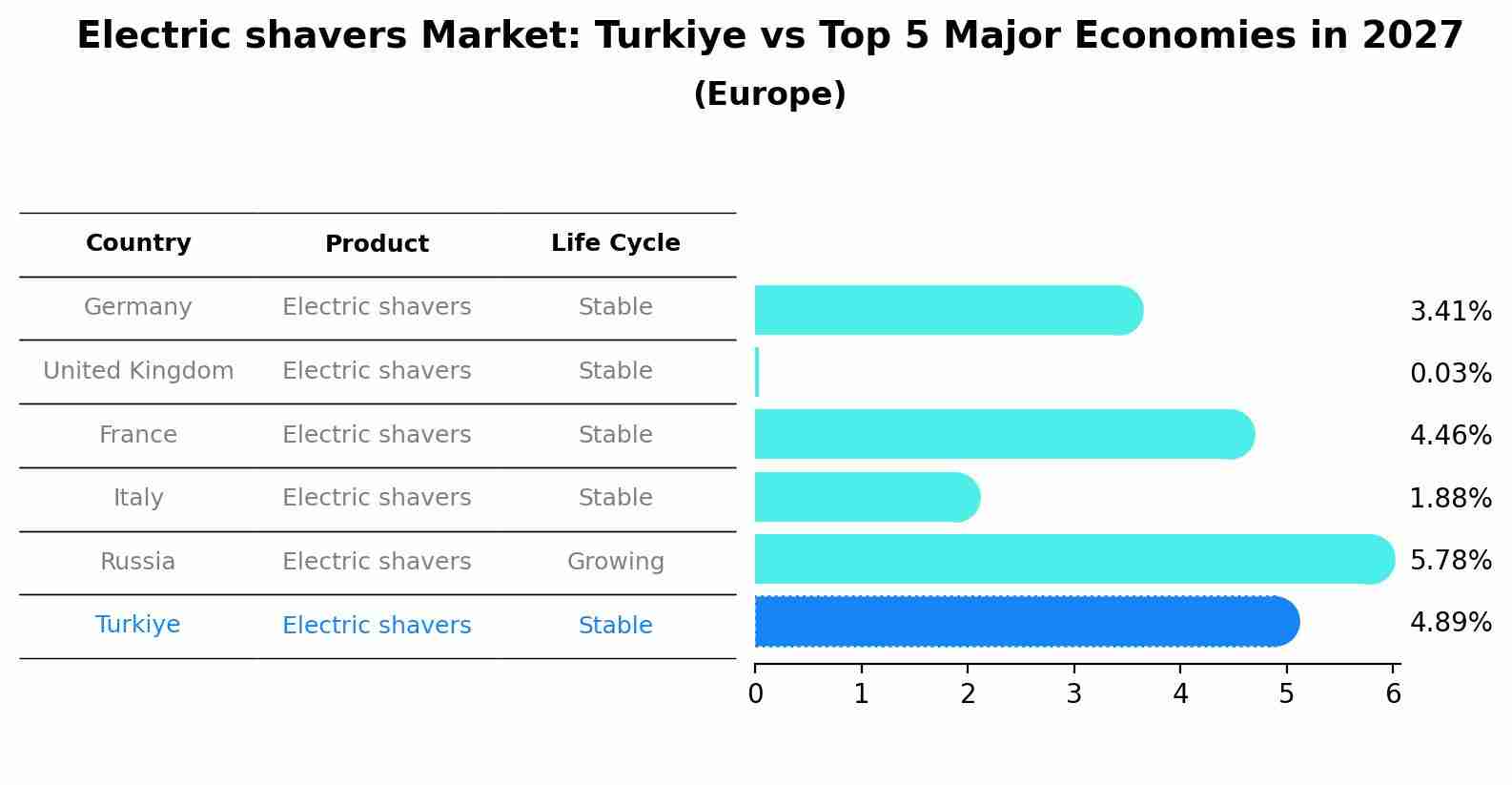
Electric shavers Market: Turkiye vs Top 5 Major Economies in 2027 (Europe)
Turkiye's Electric shavers market is anticipated to experience a stable growth rate of 4.89% by 2027, reflecting trends observed in the largest economy Germany, followed by United Kingdom, France, Italy and Russia.
Turkey Electric shavers Market Overview
The Turkey electric shavers market is characterized by a growing demand for convenient grooming solutions among consumers. The market is witnessing increased adoption of electric shavers due to their ease of use, efficient performance, and technological advancements such as wet/dry functionality and precision trimming features. Major players in the market are focusing on product innovation, ergonomic designs, and marketing strategies to attract a wider consumer base. The market is also influenced by factors such as rising disposable income, changing lifestyle trends, and a growing emphasis on personal grooming. With a competitive landscape comprising both domestic and international brands, the Turkey electric shavers market is expected to continue its growth trajectory, driven by product diversification and increasing consumer awareness of grooming products.
Turkey Electric shavers Market Trends
The Turkey Electric shavers market is witnessing several key trends currently. One prominent trend is the increasing demand for advanced features in electric shavers such as precision cutting technology, longer battery life, and waterproof designs for wet and dry shaving. Consumers are also showing a preference for multifunctional shavers that can trim, shave, and style facial hair efficiently. Another significant trend is the rising popularity of eco-friendly and sustainable electric shavers that prioritize energy efficiency and use of recyclable materials. Additionally, the market is experiencing a shift towards online purchases as e-commerce platforms offer convenience and a wide range of product options. Overall, the Turkey Electric shavers market is evolving to meet the changing preferences and needs of consumers with innovative products and convenient shopping experiences.
Turkey Electric shavers Market Challenges
In the Turkey Electric shavers market, some of the key challenges faced include intense competition from both domestic and international brands, leading to price wars and pressure on profit margins. Additionally, consumer preferences and purchasing behaviors are constantly evolving, making it crucial for companies to stay ahead in terms of innovation and product development. Economic uncertainties and fluctuations in currency exchange rates can also impact the market, affecting pricing strategies and overall sales performance. Moreover, the presence of counterfeit products in the market poses a challenge in terms of brand reputation and consumer trust. To succeed in the Turkey Electric shavers market, companies need to focus on differentiation, quality, and effective marketing strategies to stand out amidst the competition and meet the changing demands of consumers.
Turkey Electric shavers Market Investment Opportunities
The Turkey electric shavers market presents promising investment opportunities due to the increasing consumer preference for grooming products, rising disposable incomes, and growing awareness about personal grooming. Key areas for investment include innovative product development to cater to specific consumer needs, expansion of distribution channels to reach a wider audience, and leveraging digital marketing strategies to enhance brand visibility. Additionally, investing in research and development to create advanced technology features, such as longer battery life or precision cutting blades, can differentiate products in the market. Collaborating with influencers or celebrities for marketing campaigns can also help in building brand credibility and driving sales. Overall, the Turkey electric shavers market offers potential for growth and profitability for investors willing to capitalize on the evolving trends in personal grooming.
Turkey Electric shavers Market Government Policy
The Turkish government has implemented various policies related to the electric shavers market to ensure consumer safety and fair competition. These policies include regulations on product quality and safety standards to protect consumers from potential hazards, as well as import restrictions to promote domestic production and support local manufacturers. Additionally, the government has introduced initiatives to encourage innovation and technological advancements in the electric shavers industry, such as providing funding and incentives for research and development projects. Overall, the government`s policies aim to create a competitive and sustainable market environment for electric shavers in Turkey, balancing consumer protection with industry growth and innovation.
Turkey Electric shavers Market Future Outlook
The Turkey electric shavers market is poised for steady growth in the upcoming years due to increasing awareness about personal grooming among both men and women. The market is expected to be driven by technological advancements such as the introduction of electric shavers with multiple functions and features, as well as the growing preference for convenience and efficiency in grooming routines. Additionally, the rising disposable income levels and changing lifestyle patterns in Turkey are likely to further boost the demand for electric shavers. Manufacturers are also focusing on enhancing product design, performance, and affordability to cater to a diverse consumer base. Overall, the Turkey electric shavers market is anticipated to witness a positive trajectory with opportunities for innovation and expansion in the foreseeable future.
Key Highlights of the Report:
- Turkey Electric shavers Market Outlook
- Market Size of Turkey Electric shavers Market, 2021
- Forecast of Turkey Electric shavers Market, 2027
- Historical Data and Forecast of Turkey Electric shavers Revenues & Volume for the Period 2018 - 2027
- Turkey Electric shavers Market Trend Evolution
- Turkey Electric shavers Market Drivers and Challenges
- Turkey Electric shavers Price Trends
- Turkey Electric shavers Porter's Five Forces
- Turkey Electric shavers Industry Life Cycle
- Historical Data and Forecast of Turkey Electric shavers Market Revenues & Volume By Product for the Period 2018 - 2027
- Historical Data and Forecast of Turkey Electric shavers Market Revenues & Volume By Oil Shaver for the Period 2018 - 2027
- Historical Data and Forecast of Turkey Electric shavers Market Revenues & Volume By Wet/Dry Shaver for the Period 2018 - 2027
- Historical Data and Forecast of Turkey Electric shavers Market Revenues & Volume By Clippers for the Period 2018 - 2027
- Historical Data and Forecast of Turkey Electric shavers Market Revenues & Volume By A Rotary Shaver for the Period 2018 - 2027
- Historical Data and Forecast of Turkey Electric shavers Market Revenues & Volume By Accessories for the Period 2018 - 2027
- Historical Data and Forecast of Turkey Electric shavers Market Revenues & Volume By End-user for the Period 2018 - 2027
- Historical Data and Forecast of Turkey Electric shavers Market Revenues & Volume By Male for the Period 2018 - 2027
- Historical Data and Forecast of Turkey Electric shavers Market Revenues & Volume By Female for the Period 2018 - 2027
- Historical Data and Forecast of Turkey Electric shavers Market Revenues & Volume By Distribution Channel for the Period 2018 - 2027
- Historical Data and Forecast of Turkey Electric shavers Market Revenues & Volume By Health & Beauty Stores for the Period 2018 - 2027
- Historical Data and Forecast of Turkey Electric shavers Market Revenues & Volume By General Merchandising/Mass Stores for the Period 2018 - 2027
- Historical Data and Forecast of Turkey Electric shavers Market Revenues & Volume By Supermarkets & Hypermarkets for the Period 2018 - 2027
- Historical Data and Forecast of Turkey Electric shavers Market Revenues & Volume By Others for the Period 2018 - 2027
- Historical Data and Forecast of Turkey Electric shavers Market Revenues & Volume By Type for the Period 2018 - 2027
- Historical Data and Forecast of Turkey Electric shavers Market Revenues & Volume By Rechargeable Shaver for the Period 2018 - 2027
- Historical Data and Forecast of Turkey Electric shavers Market Revenues & Volume By Battery Type Shaver for the Period 2018 - 2027
- Turkey Electric shavers Import Export Trade Statistics
- Market Opportunity Assessment By Product
- Market Opportunity Assessment By End-user
- Market Opportunity Assessment By Distribution Channel
- Market Opportunity Assessment By Type
- Turkey Electric shavers Top Companies Market Share
- Turkey Electric shavers Competitive Benchmarking By Technical and Operational Parameters
- Turkey Electric shavers Company Profiles
- Turkey Electric shavers Key Strategic Recommendations






































