Turkey Fans and Ventilators Market Summary
The turkey fans and ventilators market was estimated at USD 464 Million in 2025 and is projected to reach USD 622 Million by 2032, growing at a CAGR of 5.0% from 2026 to 2032.
Turkey Fans and Ventilators Market Year-wise Growth Rate and Key Drivers
This graph highlights how the Turkey Fans and Ventilators Market has steadily grown over the past five years, supported by major growth factors.
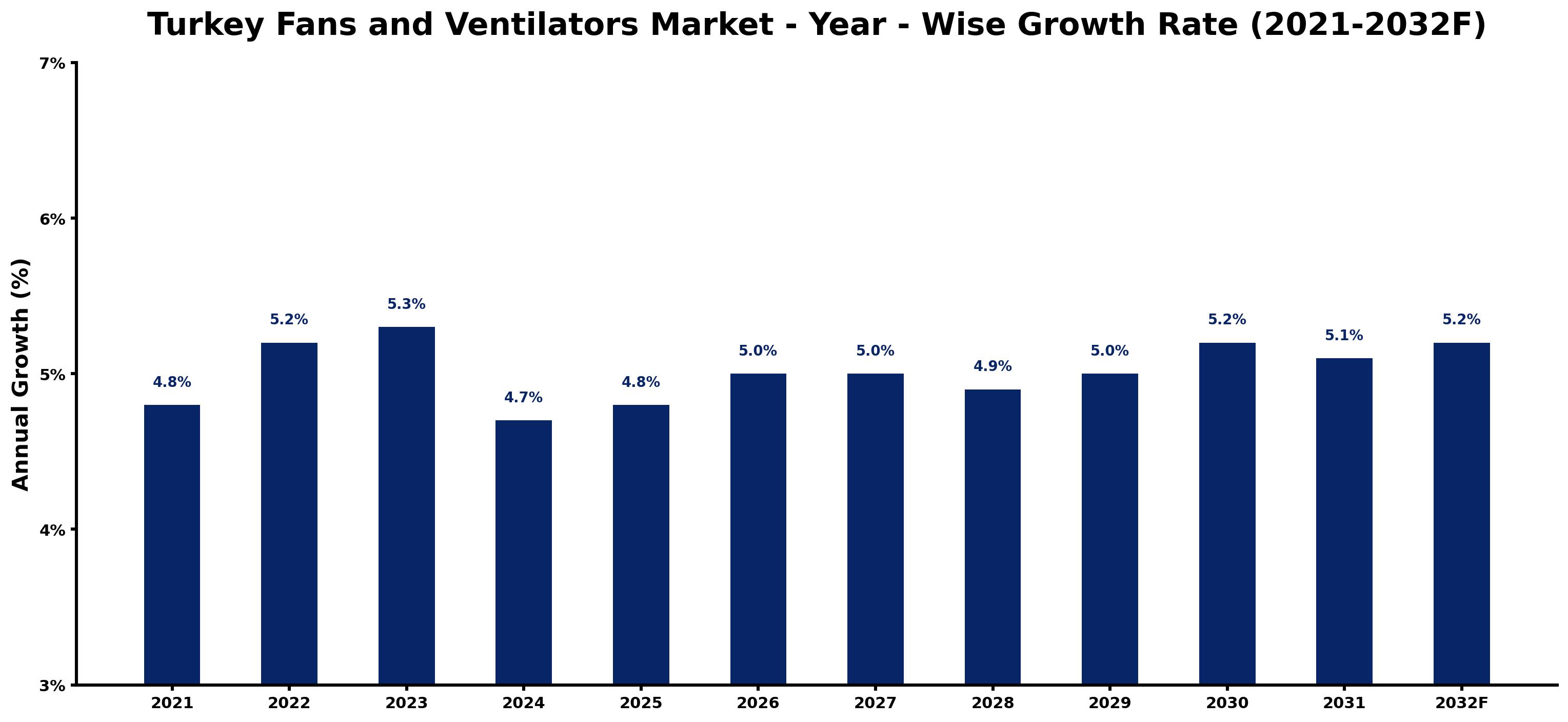
The table below presents the year wise growth rates along with the key drivers influencing the market
| Year | Growth Rate | Major Drivers |
| 2021 | 4.8% | Post-lockdown retail projects are revitalizing consumer interest in indoor comfort solutions. |
| 2022 | 5.2% | Hot summer months drive increased sales, particularly in urban areas of Turkey. |
| 2023 | 5.3% | Local manufacturers pivot towards energy-efficient models, appealing to environmentally conscious consumers. |
| 2024 | 4.7% | Emerging trends in smart home technology encourage integration of advanced fan systems. |
| 2025 | 4.8% | Consumer awareness campaigns highlight the health benefits of proper ventilation and air circulation. |
| 2026 | 5.0% | Tourism rebound fuels demand for hospitality sector upgrades in air quality solutions. |
| 2027 | 5.0% | Continuous power supply challenges inspire innovations in battery-operated ventilation systems. |
| 2028 | 4.9% | Urbanization trends lead to higher demand for compact, efficient cooling devices in apartments. |
| 2029 | 5.0% | Architectural trends favor open spaces, increasing reliance on effective fan systems for airflow. |
| 2030 | 5.2% | Sustainability movements prompt manufacturers to explore biodegradable materials in fan production. |
| 2031 | 5.1% | Technological partnerships emerge, focusing on AI-driven climate control solutions for homes. |
| 2032 | 5.2% | Market expansion efforts target rural areas, emphasizing affordable ventilation options for farmers. |
Note - Market size estimations and growth projections presented in this report are based on 6Wresearch's advanced forecasting approach, validated with industry datasets as of June 2026.
Turkey Fans and Ventilators Market Synopsis
The Turkey Fans and Ventilators Market is projected to reach 5.0% and witness significant growth during the forecast period (2026-2032). The market is driven by the escalating demand for enhanced indoor air quality and the need for efficient air circulation solutions across various sectors, including residential, commercial, and industrial buildings. In recent years, fans and ventilators have become essential components for comfort and health, contributing to their increasing adoption rates.
Turkey Fans and Ventilators Market Growth Drivers
Several factors are propelling the growth of the Turkey Fans and Ventilators Market. Key drivers include:
- The expansion of the HVAC industry, which emphasizes the need for reliable ventilation systems to ensure optimal air quality and temperature regulation.
- Technological advancements in ventilation systems, leading to the development of more energy-efficient and quieter fans and ventilators that meet both consumer and regulatory demands.
- An increasing focus on sustainability and energy conservation in both new construction and retrofit projects, boosting the adoption of high-efficiency ventilation systems.
- The rise in construction activities in urban areas, where efficient air circulation is vital for indoor environmental quality in buildings.
- The growing awareness of health and well-being, leading to a heightened demand for products that improve indoor air quality and overall comfort.
Turkey Fans and Ventilators Market Trends and Opportunities
The Turkey Fans and Ventilators Market is positioned for several notable trends and opportunities that can shape its trajectory in the coming years:
- The integration of smart technologies in fan and ventilator systems is expected to gain momentum, enabling users to control air quality and energy consumption through mobile applications.
- Market participants are likely to invest in research and development to enhance the performance and efficiency of these systems, particularly in response to evolving regulatory standards.
- There is a significant opportunity for eco-friendly designs, appealing to environmentally-conscious consumers looking for sustainable options for air movement and ventilation.
- The need for specialized ventilation systems in industries such as manufacturing and healthcare continues to grow, necessitating the development of tailored solutions that meet specific operational requirements.
- The trend toward urbanization and subsequent demand for energy-efficient residential complexes will further drive market growth as builders seek compliant ventilation solutions.
Turkey Fans and Ventilators Market Challenges and Restraints
Despite the positive outlook for the Turkey Fans and Ventilators Market, several challenges pose barriers to growth:
- Compliance with stringent building codes and environmental regulations can be challenging, particularly for manufacturers seeking to innovate within these frameworks.
- Noise reduction requirements are increasingly critical, requiring advanced design solutions to meet the expectations of consumers and regulatory bodies alike.
- Optimizing fan performance in diverse industrial and HVAC applications necessitates ongoing technical advancements and the development of more adaptable products.
- The harsh operating conditions in certain sectors demand high reliability and durability, which can complicate product development and increase costs.
- Rapid technological changes may outpace some traditional manufacturers, necessitating investment in technology upgrades to remain competitive.
Turkey Fans and Ventilators Market Government Investment and Initiatives
The Turkish government plays an integral role in supporting the fans and ventilators market through various initiatives and policies aimed at promoting energy efficiency and improved air quality. Key aspects of government investment include:
- Incentives for the development and integration of high-efficiency ventilation systems that contribute to reduced energy consumption across residential, commercial, and industrial sectors.
- Funding for research and development initiatives aimed at enhancing existing technologies and creating innovative solutions that address current market challenges.
- Collaborative efforts with industry stakeholders to streamline regulatory processes that ensure product quality and safety, thereby fostering consumer confidence in the market.
- Public campaigns aimed at raising awareness regarding indoor air quality issues and promoting the adoption of advanced ventilation solutions.
- Strategic planning of urban development projects that prioritize sustainability and efficient HVAC systems to improve the overall quality of life in urban environments.
Turkey Fans and Ventilators Market Latest Developments (May 2025 - June 2026)
Recent developments in the Turkey Fans and Ventilators Market highlight a dynamic and evolving landscape. Between May 2025 and June 2026, there have been notable trends, including:
- Increased focus on sustainable product designs, with manufacturers unveiling innovative solutions that incorporate recyclable materials and energy-efficient technologies.
- Emerging partnerships between technology firms and manufacturers to integrate smart controls and IoT capabilities into ventilation systems, enhancing user engagement and system efficiency.
- Regulatory updates aimed at reinforcing indoor air quality standards, which have spurred a wave of product innovations to comply with new guidelines.
- Heightened investment in energy-efficient HVAC systems within the construction sector, driven by government incentives and rising energy costs, emphasizing the need for reliable ventilation solutions.
- A surge in public interest surrounding health and well-being, leading to increased demand for products designed to improve indoor air circulation and reduce airborne pollutants.
Turkey Fans and Ventilators Market - Key Attractiveness of the Report
- 10 Years of Market Numbers
- Historical Data Starting from 2022 to 2025
- Base Year: 2025
- Forecast Data until 2032
- Key Performance Indicators Impacting the Market
- Major Upcoming Developments and Projects
Key Highlights of the Report:
- Turkey Fans and Ventilators Market Outlook
- Market Size of Turkey Fans and Ventilators Market, 2025
- Forecast of Turkey Fans and Ventilators Market, 2032
- Historical Data and Forecast of Turkey Fans and Ventilators Revenues & Volume for the Period 2022-2032F
- Turkey Fans and Ventilators Market Trend Evolution
- Turkey Fans and Ventilators Market Drivers and Challenges
- Turkey Fans and Ventilators Price Trends
- Turkey Fans and Ventilators Porter's Five Forces
- Turkey Fans and Ventilators Industry Life Cycle
- Historical Data and Forecast of Turkey Fans and Ventilators Market Revenues & Volume By Material for the Period 2022-2032F
- Historical Data and Forecast of Turkey Fans and Ventilators Market Revenues & Volume By Metal for the Period 2022-2032F
- Historical Data and Forecast of Turkey Fans and Ventilators Market Revenues & Volume By Composite for the Period 2022-2032F
- Historical Data and Forecast of Turkey Fans and Ventilators Market Revenues & Volume By Rubber for the Period 2022-2032F
- Historical Data and Forecast of Turkey Fans and Ventilators Market Revenues & Volume By Plastic for the Period 2022-2032F
- Historical Data and Forecast of Turkey Fans and Ventilators Market Revenues & Volume By Application for the Period 2022-2032F
- Historical Data and Forecast of Turkey Fans and Ventilators Market Revenues & Volume By Interior for the Period 2022-2032F
- Historical Data and Forecast of Turkey Fans and Ventilators Market Revenues & Volume By Exterior for the Period 2022-2032F
- Historical Data and Forecast of Turkey Fans and Ventilators Market Revenues & Volume By Structural for the Period 2022-2032F
- Historical Data and Forecast of Turkey Fans and Ventilators Market Revenues & Volume By Powertrain for the Period 2022-2032F
- Historical Data and Forecast of Turkey Fans and Ventilators Market Revenues & Volume By Vehicle Types for the Period 2022-2032F
- Historical Data and Forecast of Turkey Fans and Ventilators Market Revenues & Volume By Passenger Vehicles for the Period 2022-2032F
- Historical Data and Forecast of Turkey Fans and Ventilators Market Revenues & Volume By Light Commercial Vehicles for the Period 2022-2032F
- Historical Data and Forecast of Turkey Fans and Ventilators Market Revenues & Volume By Heavy Commercial Vehicles for the Period 2022-2032F
- Turkey Fans and Ventilators Import Export Trade Statistics
- Market Opportunity Assessment By Material
- Market Opportunity Assessment By Application
- Market Opportunity Assessment By Vehicle Types
- Turkey Fans and Ventilators Top Companies Market Share
- Turkey Fans and Ventilators Competitive Benchmarking By Technical and Operational Parameters
- Turkey Fans and Ventilators Company Profiles
- Turkey Fans and Ventilators Key Strategic Recommendations






































